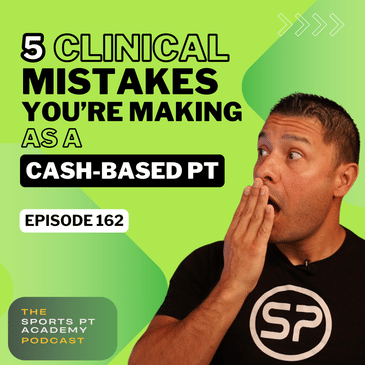
Are you looking to improve your clinical approach with cash-pay patients? Before you add more tools in your clinical toolbox, start by refining these five mistakes you're making currently.
In this episode, Dr. Chris shares five simple things you should improve to quickly improve clinical outcomes, enhance the patient experience, and grow your cash PT business. If you want to streamline your cash practice, this episode is perfect for you. Enjoy episode 162 on the Sports PT Academy podcast on YouTube, Spotify, and Apple Podcasts!
_____________________________________
Are you a physical therapist or physiotherapist looking for tips, tools, and strategies to work with more athletes, become a sports specialist or get a job in a sports setting...so you can finally enjoy the career that you've always dreamed of? If so, you're in the right place...this podcast is for you. Your host is Dr. Chris Garcia, a physical therapist, business owner, entrepreneur, nationally recognized public speaker, and residency-trained sports specialist.
Dr. Chris Garcia, PT, DPT, SCS, CSCS, USAW has worked in professional sports and traveled around the world working with elite athletes throughout his career, and he's learned a lot of lessons along the way. He created this podcast to share his experiences and give you everything you need to know to help YOU become a successful clinician. Dr. Chris Garcia talks about everything from sports rehab and injury prevention to developing athletic performance and the path to getting your dream job...even if it is in professional sports.
If you want to become a successful clinician so you can finally enjoy the career you've always dreamed of, visit www.DrChrisGarcia.com.
LINKS:
www.Instagram.com/ChrisGarciaDPT
www.Facebook.com/ChrisGarciaDPT
***DISCLAIMER: This content is for educational & informational use only and & does not constitute medical advice. The content is not intended to be a substitute for professional advice or medical recommendations, diagnosis, or treatment. Please consult with a qualified medical professional for proper evaluation & treatment, or beginning any exercises or activity in this content. Chris Garcia Academy, Inc. and The Sports PT Academy Podcast are not responsible for any harm caused by the use of this content.***
[00:00:05] [SPEAKER_00]: Are you a motivated healthcare or fitness professional?
[00:00:08] [SPEAKER_00]: Are you looking to work with more athletes, become a sports specialist, or even get a
[00:00:11] [SPEAKER_00]: job in a sports setting so you can finally enjoy the career that you've always dreamed
[00:00:15] [SPEAKER_00]: of?
[00:00:15] [SPEAKER_00]: If so, you're in the right place.
[00:00:17] [SPEAKER_00]: My name is Chris Garcia, physical therapist, business owner, entrepreneur and residency
[00:00:21] [SPEAKER_00]: training sports specialist.
[00:00:23] [SPEAKER_00]: I've been fortunate to work in professional sports and travel around the world working
[00:00:26] [SPEAKER_00]: with elite athletes throughout my career and I've learned a lot of lessons along the
[00:00:30] [SPEAKER_00]: way.
[00:00:30] [SPEAKER_00]: I created this podcast to share my experiences and give you everything you need to know
[00:00:34] [SPEAKER_00]: to help you become a sports expert.
[00:00:37] [SPEAKER_00]: Welcome to the Sports PT Academy.
[00:00:42] [SPEAKER_00]: Are you a cash-based physical therapist and you think you're on the right track?
[00:00:46] [SPEAKER_00]: But I'm here to tell you your five clinical mistakes that you're making as a cash-based
[00:00:51] [SPEAKER_00]: physical therapist.
[00:00:52] [SPEAKER_00]: And in this episode, I'm going to share why these are so important inside your clinical
[00:00:58] [SPEAKER_00]: practice.
[00:01:00] [SPEAKER_00]: Hi everyone, welcome back to the podcast.
[00:01:02] [SPEAKER_00]: Welcome all new listeners and welcome back to those who have heard my content in the
[00:01:05] [SPEAKER_00]: past.
[00:01:06] [SPEAKER_00]: Before I go into this podcast, what is new?
[00:01:09] [SPEAKER_00]: What is exciting?
[00:01:10] [SPEAKER_00]: What is better?
[00:01:11] [SPEAKER_00]: I have a couple things, a couple notes I wanted to share with you.
[00:01:15] [SPEAKER_00]: Life is better.
[00:01:16] [SPEAKER_00]: Someone asked how is my back?
[00:01:17] [SPEAKER_00]: They've been asking about this.
[00:01:18] [SPEAKER_00]: I would say it's about 73.76% better.
[00:01:24] [SPEAKER_00]: I still can't pull heavy from the ground, but I'm still getting in my five days which
[00:01:29] [SPEAKER_00]: has been fantastic.
[00:01:30] [SPEAKER_00]: And someone asked what was the root?
[00:01:32] [SPEAKER_00]: What was the flare up?
[00:01:35] [SPEAKER_00]: I think there was a combination of things.
[00:01:37] [SPEAKER_00]: I think after the CrossFit Open in February and March, I think I just went into training
[00:01:41] [SPEAKER_00]: six, seven days a week right into Murph training and I just kind of set off a
[00:01:47] [SPEAKER_00]: cascade of things.
[00:01:47] [SPEAKER_00]: It was just too much.
[00:01:48] [SPEAKER_00]: The volume was too much.
[00:01:49] [SPEAKER_00]: So here I am back to five days.
[00:01:52] [SPEAKER_00]: So my back is feeling better.
[00:01:55] [SPEAKER_00]: 76.27%.
[00:01:56] [SPEAKER_00]: Life is good.
[00:01:58] [SPEAKER_00]: Family is great.
[00:01:59] [SPEAKER_00]: The latest with my kids is Jacob.
[00:02:03] [SPEAKER_00]: For those of you who don't know, maybe I mentioned the last podcast, but we are
[00:02:06] [SPEAKER_00]: going on a Disney cruise in the next, I think, month or two.
[00:02:10] [SPEAKER_00]: And one of the things that we're trying to get accomplished is my son Jacob.
[00:02:13] [SPEAKER_00]: We're trying to get him to the point where he is fully potty trained so that way he
[00:02:18] [SPEAKER_00]: can enjoy this kids club.
[00:02:19] [SPEAKER_00]: For those who don't know, Disney cruises have this kids club where they are just
[00:02:24] [SPEAKER_00]: like, it's basically like a mini Disneyland.
[00:02:26] [SPEAKER_00]: So excited for that.
[00:02:27] [SPEAKER_00]: Other than that, I'm done with my two week cut.
[00:02:31] [SPEAKER_00]: Officially done.
[00:02:32] [SPEAKER_00]: I ended up losing nine pounds and I kept it up.
[00:02:36] [SPEAKER_00]: I'm up, I think, 2.2 pounds.
[00:02:37] [SPEAKER_00]: So I'm still down seven pounds.
[00:02:39] [SPEAKER_00]: It's been great.
[00:02:41] [SPEAKER_00]: And I'm excited.
[00:02:42] [SPEAKER_00]: We have people registering for the cash PT clinical elevation course.
[00:02:47] [SPEAKER_00]: For those who don't know, it's my eight week mentorship course on how to improve
[00:02:52] [SPEAKER_00]: your practice, clinical outcomes and ultimately grow your business if you're a cash based
[00:02:56] [SPEAKER_00]: physical therapist.
[00:02:57] [SPEAKER_00]: So anyways, those are the updates.
[00:02:59] [SPEAKER_00]: Let's go on to this podcast.
[00:03:01] [SPEAKER_00]: Why am I talking about the five clinical mistakes?
[00:03:04] [SPEAKER_00]: So there's a portion of this I've had some really good discussions with local
[00:03:09] [SPEAKER_00]: providers and people who are kind of stuck inside where they're at.
[00:03:13] [SPEAKER_00]: And one of the conversations was triggered was the word cringy.
[00:03:18] [SPEAKER_00]: Someone I mentor told me, you know, Chris, I had a cringy evaluation,
[00:03:23] [SPEAKER_00]: a cringy sales call, a cringy session.
[00:03:27] [SPEAKER_00]: I think we've all faced that in some form or fashion.
[00:03:29] [SPEAKER_00]: You might not use that word, but you know that you felt internally like, gosh,
[00:03:34] [SPEAKER_00]: that didn't go the way I wanted.
[00:03:35] [SPEAKER_00]: And after kind of having that discussion of what is cringy, I wanted to bring up a
[00:03:41] [SPEAKER_00]: couple things that you are doing that are probably cringe worthy and you might
[00:03:47] [SPEAKER_00]: not see it. But from an outsider perspective, somebody who's done this
[00:03:50] [SPEAKER_00]: already for now 10 years and built a three location cash based company,
[00:03:56] [SPEAKER_00]: I can see what's cringy.
[00:03:58] [SPEAKER_00]: And from an outsider perspective, either you can fix it, maybe you don't
[00:04:01] [SPEAKER_00]: see it yet, but you can fix some of these things so that you feel better
[00:04:04] [SPEAKER_00]: about your craft, you feel better about your outcomes, you feel better about
[00:04:07] [SPEAKER_00]: your business development and you don't go home thinking, gosh, that was
[00:04:10] [SPEAKER_00]: horrible. I could have done a little bit better and I think you can expedite
[00:04:13] [SPEAKER_00]: that. So I'm going to share these five clinical mistakes that really are
[00:04:16] [SPEAKER_00]: cringe worthy that maybe in an insurance based care this would have
[00:04:20] [SPEAKER_00]: worked and now in cash it's just a little different.
[00:04:24] [SPEAKER_00]: So here are the five things.
[00:04:28] [SPEAKER_00]: One thing that you're making the biggest mistake on is your targeting
[00:04:34] [SPEAKER_00]: the words pain free. Pain free is very relative and I've brought this up on
[00:04:41] [SPEAKER_00]: numerous episodes that, you know, do people actually feel that they're
[00:04:45] [SPEAKER_00]: going to be pain free in life?
[00:04:46] [SPEAKER_00]: And I think that's really hard for people to really stomach like even
[00:04:50] [SPEAKER_00]: yourself or anybody that you treat.
[00:04:52] [SPEAKER_00]: They don't want to be pain free because pain is a normal part of life,
[00:04:57] [SPEAKER_00]: right? You have to make some pains.
[00:04:59] [SPEAKER_00]: I have some back pain right now, but it doesn't interfere with my life
[00:05:02] [SPEAKER_00]: enough to seek out care.
[00:05:05] [SPEAKER_00]: And ultimately that's where people want to thrive.
[00:05:07] [SPEAKER_00]: They want to have this balance of they're okay with a little bit of aches
[00:05:10] [SPEAKER_00]: and pains, but they're not fully pain free because that pain free is
[00:05:14] [SPEAKER_00]: so hard to achieve and it's momentary, right?
[00:05:16] [SPEAKER_00]: So you can get somebody at 100 percent, but the minute they go back
[00:05:19] [SPEAKER_00]: and they would go for a run and now their calf is strained again or
[00:05:23] [SPEAKER_00]: they go for a deadlift and their back is a little tight,
[00:05:26] [SPEAKER_00]: but it's not painful.
[00:05:27] [SPEAKER_00]: It's just a little tight.
[00:05:29] [SPEAKER_00]: And so one of the things when you target pain free,
[00:05:31] [SPEAKER_00]: you're setting yourself up for failure.
[00:05:33] [SPEAKER_00]: And the reason is for that because people don't expect that.
[00:05:36] [SPEAKER_00]: But you as a clinician, because you've been taught and trained by P.T.
[00:05:39] [SPEAKER_00]: school and traditional insurance based model is you have to get them
[00:05:42] [SPEAKER_00]: to pain free. They have to be zero out of ten or significant
[00:05:45] [SPEAKER_00]: outcomes or significant improvements.
[00:05:47] [SPEAKER_00]: And so because we've been trained that way,
[00:05:50] [SPEAKER_00]: we now are trying to achieve that in a cash based setting.
[00:05:53] [SPEAKER_00]: And you're like, well, why does that matter?
[00:05:55] [SPEAKER_00]: Well, the people in a cash based setting don't necessarily need
[00:05:57] [SPEAKER_00]: to be pain free.
[00:05:58] [SPEAKER_00]: They just want the quality of life that they've always wanted.
[00:06:00] [SPEAKER_00]: And that quality of life is it might be an ache, it might be a pain,
[00:06:04] [SPEAKER_00]: but it doesn't interfere with their life.
[00:06:05] [SPEAKER_00]: So all they want to do is enjoy life with less aches and pains,
[00:06:10] [SPEAKER_00]: but they don't necessarily need pain free.
[00:06:12] [SPEAKER_00]: So if you're shoving pain free down their throat,
[00:06:15] [SPEAKER_00]: you're offering something that they don't want.
[00:06:17] [SPEAKER_00]: And that's where the confusion lies.
[00:06:19] [SPEAKER_00]: The consumer just wants an active, healthy lifestyle.
[00:06:23] [SPEAKER_00]: And you're over here trying to offer pain free services.
[00:06:27] [SPEAKER_00]: There's very different things here.
[00:06:28] [SPEAKER_00]: And so that nuance of pain free,
[00:06:32] [SPEAKER_00]: you need to remove that from your vocabulary,
[00:06:34] [SPEAKER_00]: remove it from your website, remove it from your marketing.
[00:06:37] [SPEAKER_00]: Do anything that you're doing.
[00:06:38] [SPEAKER_00]: Don't talk about it, the initial valuation,
[00:06:40] [SPEAKER_00]: because it's setting yourself for failure, because here's why.
[00:06:43] [SPEAKER_00]: Let's assume you're six sessions in and that patient is
[00:06:47] [SPEAKER_00]: 70 percent better. That's pretty good.
[00:06:49] [SPEAKER_00]: 70 percent over six visits. Fantastic.
[00:06:51] [SPEAKER_00]: And you're like, well, are you pain free?
[00:06:53] [SPEAKER_00]: Are you pain free? And now in their head, they're like,
[00:06:55] [SPEAKER_00]: well, I'm not pain free.
[00:06:56] [SPEAKER_00]: Maybe you're not doing that good of a job.
[00:06:58] [SPEAKER_00]: And when in reality, what you should be asking is,
[00:07:01] [SPEAKER_00]: are you happy with your progress?
[00:07:02] [SPEAKER_00]: Are you in the direction?
[00:07:03] [SPEAKER_00]: Are you doing more that you want?
[00:07:05] [SPEAKER_00]: Are you living that half active lifestyle?
[00:07:07] [SPEAKER_00]: And they're probably going to say, yes, I'm actually like right back to it.
[00:07:10] [SPEAKER_00]: So then they're hitting certain markers that are successful for them.
[00:07:13] [SPEAKER_00]: But what you're doing is you're asking a different route.
[00:07:15] [SPEAKER_00]: Are you pain free? No.
[00:07:17] [SPEAKER_00]: Now they're not focusing on their function in life.
[00:07:20] [SPEAKER_00]: They're now focusing on, well, gosh, I'm still in pain.
[00:07:22] [SPEAKER_00]: It puts their mindset in a different space.
[00:07:24] [SPEAKER_00]: And so insurance, you had to do that because you had to show that you were,
[00:07:29] [SPEAKER_00]: you know, you were the person who can remove their pain.
[00:07:32] [SPEAKER_00]: You can remove all these impairments and that led to pain free.
[00:07:36] [SPEAKER_00]: And that was just for ADLs.
[00:07:37] [SPEAKER_00]: But people who are in cash based physical therapy, they're not here for ADLs.
[00:07:40] [SPEAKER_00]: They're here for higher level things.
[00:07:42] [SPEAKER_00]: And so pain free was good to ADLs, but no longer moving forward.
[00:07:47] [SPEAKER_00]: So that's one thing that is cringy.
[00:07:49] [SPEAKER_00]: It's cringe worthy.
[00:07:50] [SPEAKER_00]: And that's very, you can always tell you're in your first three to five years
[00:07:55] [SPEAKER_00]: if you're still using those as a cash based physical therapist,
[00:07:58] [SPEAKER_00]: because you haven't figured that out yet.
[00:08:00] [SPEAKER_00]: Now, if you're in your first second year, you're ahead of the game.
[00:08:02] [SPEAKER_00]: Now, after you're hearing this content, now you can now, you know,
[00:08:04] [SPEAKER_00]: just implement it quickly and it'll help.
[00:08:07] [SPEAKER_00]: It's going to be tough for you because it's the first thing you think about
[00:08:09] [SPEAKER_00]: like, oh, we get your pain free guys, you're pain free
[00:08:11] [SPEAKER_00]: and you're setting yourself for failure.
[00:08:13] [SPEAKER_00]: So remove that from your vocabulary.
[00:08:16] [SPEAKER_00]: Number two, you are impairment focused.
[00:08:19] [SPEAKER_00]: And what I mean by this is you're always looking for the thing that's tight,
[00:08:25] [SPEAKER_00]: that's loose, that's weak, that's strong, that's three out of five.
[00:08:28] [SPEAKER_00]: That's four out of five.
[00:08:30] [SPEAKER_00]: And they're very, very impairment focused.
[00:08:32] [SPEAKER_00]: And as I mentioned, the cash pay patient is all about outcomes and about function.
[00:08:37] [SPEAKER_00]: And this person just wants the active, the healthy lifestyle that they want.
[00:08:41] [SPEAKER_00]: And you're over here trying to sell pain free and impairments
[00:08:45] [SPEAKER_00]: and tight hamstrings.
[00:08:46] [SPEAKER_00]: We have to figure out how does pain free, tight hamstrings,
[00:08:49] [SPEAKER_00]: weak hips, weak shoulders translate to an active healthy lifestyle?
[00:08:53] [SPEAKER_00]: That's where the dilemma is going.
[00:08:55] [SPEAKER_00]: Now you have somebody who is offering impairments and the other one's
[00:08:58] [SPEAKER_00]: looking for active lifestyle that that message doesn't match.
[00:09:02] [SPEAKER_00]: And so you have the PT focusing on one thing and the patient
[00:09:06] [SPEAKER_00]: wanting another thing.
[00:09:07] [SPEAKER_00]: Now the expectations don't line up.
[00:09:09] [SPEAKER_00]: So I think impairments are important to help direct your care internally,
[00:09:15] [SPEAKER_00]: but it doesn't direct their plan.
[00:09:18] [SPEAKER_00]: And that's a very different concept.
[00:09:21] [SPEAKER_00]: In an insurance based model, you've always used impairments as your plan.
[00:09:25] [SPEAKER_00]: We're going to get you hamstrings 90 degrees in the next six weeks.
[00:09:29] [SPEAKER_00]: We're going to get you ab strength five out of five in the next eight weeks.
[00:09:33] [SPEAKER_00]: So your impairments were your portions of your goals and your plans.
[00:09:36] [SPEAKER_00]: Now, when you have cash based setting, these people aren't looking
[00:09:41] [SPEAKER_00]: for impairments to solve their problems.
[00:09:42] [SPEAKER_00]: They're just looking for a solution to their problem.
[00:09:45] [SPEAKER_00]: So your plan has to be focused on function and percentages and where
[00:09:48] [SPEAKER_00]: they're going to be in their gym.
[00:09:50] [SPEAKER_00]: So now the impairments are good internally, but they're not good externally.
[00:09:54] [SPEAKER_00]: So if you're going to approach impairments, that's fantastic for
[00:09:58] [SPEAKER_00]: your own notes and documentation, your own internal progress, but don't
[00:10:01] [SPEAKER_00]: translate that to what the consumer, what the patient wants.
[00:10:04] [SPEAKER_00]: That's not what they're looking for.
[00:10:06] [SPEAKER_00]: They're looking for, well, am I back to the gym five days a week?
[00:10:09] [SPEAKER_00]: Am I able to squat?
[00:10:10] [SPEAKER_00]: Am I able to deadlift?
[00:10:11] [SPEAKER_00]: Those are two different things.
[00:10:13] [SPEAKER_00]: So don't try and offer impairments as a solution to their plan.
[00:10:18] [SPEAKER_00]: Differentiate those things.
[00:10:19] [SPEAKER_00]: So number one, uh, don't focus on pain free.
[00:10:21] [SPEAKER_00]: Number two, don't be impairment focused with the consumer, with the patient.
[00:10:25] [SPEAKER_00]: That's not what they care about.
[00:10:27] [SPEAKER_00]: Uh, number three, um, you're trying to compress an hour.
[00:10:33] [SPEAKER_00]: You're trying to now that you, you maybe insurance based, you had
[00:10:36] [SPEAKER_00]: maybe 15 minutes or 30 minutes of one-on-one care and now you have an hour.
[00:10:40] [SPEAKER_00]: And so you think, well, gosh, I've never had an hour.
[00:10:42] [SPEAKER_00]: So you try and fill that hour with all this treatment and rehab exercises.
[00:10:47] [SPEAKER_00]: And you're like, uh, you know, you shorten your subjective and
[00:10:50] [SPEAKER_00]: you shorten your plan and you shorten everything that you're going to do.
[00:10:53] [SPEAKER_00]: And you try and get 55 minutes or 50 minutes of rehab and exercise.
[00:10:58] [SPEAKER_00]: Cause you think that's what the patient wants.
[00:10:59] [SPEAKER_00]: You've never had that before.
[00:11:01] [SPEAKER_00]: Here's the problem.
[00:11:02] [SPEAKER_00]: That's what you've always wanted.
[00:11:04] [SPEAKER_00]: That's not what the patient has wanted.
[00:11:06] [SPEAKER_00]: This PT who's here now trying to deliver 50 minutes of care.
[00:11:10] [SPEAKER_00]: They're just selfish.
[00:11:10] [SPEAKER_00]: And what they're trying to do is they've never had that opportunity
[00:11:14] [SPEAKER_00]: in insurance based care.
[00:11:15] [SPEAKER_00]: So now they have cash.
[00:11:16] [SPEAKER_00]: Now they're like, oh my gosh, now I have more time to do hands on treatment
[00:11:20] [SPEAKER_00]: and more in a rehab exercises.
[00:11:22] [SPEAKER_00]: And by that time you've overloaded the patient.
[00:11:24] [SPEAKER_00]: Their body's all beat up.
[00:11:26] [SPEAKER_00]: You've done so much manual work.
[00:11:28] [SPEAKER_00]: You've over adjusted them and now you're doing 57 exercises.
[00:11:31] [SPEAKER_00]: They're beat up.
[00:11:32] [SPEAKER_00]: They're frustrated.
[00:11:32] [SPEAKER_00]: They're tired.
[00:11:33] [SPEAKER_00]: And no one actually listened to anything that they were actually wanting.
[00:11:37] [SPEAKER_00]: You were just trying to fulfill your goal of being that sports, you know,
[00:11:42] [SPEAKER_00]: cash based person and you,
[00:11:43] [SPEAKER_00]: you were doing all the cool exercises and speed and making them sweat when in
[00:11:47] [SPEAKER_00]: reality, maybe that person didn't want that.
[00:11:49] [SPEAKER_00]: Maybe that's a specialty of yours, but ultimately you didn't listen to them.
[00:11:53] [SPEAKER_00]: The most important pieces of an entire cash based setting is the,
[00:11:58] [SPEAKER_00]: the subjective and the plan.
[00:11:59] [SPEAKER_00]: And you have to have five to 10 minutes minimum on the subjective to one
[00:12:03] [SPEAKER_00]: know how they're doing as a human before you go into, you know, all the treatment.
[00:12:08] [SPEAKER_00]: And on the backend is the plan of care and setting up what's the next week
[00:12:11] [SPEAKER_00]: look like, whether the next two weeks look like.
[00:12:13] [SPEAKER_00]: And so when you compress, you know,
[00:12:15] [SPEAKER_00]: when you do treatment and rehab all the way out and you do it fills up
[00:12:18] [SPEAKER_00]: most of the time of the session,
[00:12:19] [SPEAKER_00]: that person wasn't heard and they didn't get the thing that they wanted,
[00:12:23] [SPEAKER_00]: which was a plan and execution of all this.
[00:12:25] [SPEAKER_00]: You gave them a great hour,
[00:12:26] [SPEAKER_00]: but they still don't know what to expect down the line.
[00:12:29] [SPEAKER_00]: So that's natural in a cash based setting early on because you're like,
[00:12:32] [SPEAKER_00]: I've never had this and you're now in a kid in a candy store and you get to all
[00:12:36] [SPEAKER_00]: this time and you fail to realize you would not meet the demands of what the
[00:12:39] [SPEAKER_00]: patient wanted.
[00:12:40] [SPEAKER_00]: And you were so used to because what the insurance company told you was you
[00:12:43] [SPEAKER_00]: had a short amount of time. Now you have this freedom to do it,
[00:12:46] [SPEAKER_00]: but that maybe that's not what the patient wants.
[00:12:48] [SPEAKER_00]: That's not always what they want.
[00:12:50] [SPEAKER_00]: And that's probably 80% of your caseload.
[00:12:52] [SPEAKER_00]: And so if you're overloading people and you're trying to fill in with more
[00:12:55] [SPEAKER_00]: exercise, that's not what you're trying to achieve.
[00:12:57] [SPEAKER_00]: Leave more time for the subjective and the plan of care. So number one,
[00:13:01] [SPEAKER_00]: no more targeting pain-free. Don't be impairment focused. And number three,
[00:13:06] [SPEAKER_00]: don't try and fill an hour of treatment and rehab exercises. Number four,
[00:13:11] [SPEAKER_00]: stop trying to help everyone.
[00:13:13] [SPEAKER_00]: You know,
[00:13:13] [SPEAKER_00]: I had a great conversation with someone on my mentorship groups yesterday and
[00:13:18] [SPEAKER_00]: you know,
[00:13:18] [SPEAKER_00]: they said it's sad that we can't help when we talk about orthopedic care
[00:13:22] [SPEAKER_00]: and all the quality of care is dropping on all these things.
[00:13:24] [SPEAKER_00]: Insurance base is no longer in bursting at a certain rate.
[00:13:27] [SPEAKER_00]: There's going to be all these patients who will be able to get the
[00:13:30] [SPEAKER_00]: quality of care that you want. And the reality is you can't help everyone.
[00:13:33] [SPEAKER_00]: The reason why you got in cash and cash physical therapy is because you wanted
[00:13:37] [SPEAKER_00]: to have that one-on-one time.
[00:13:38] [SPEAKER_00]: You wanted to specialize and not be the general Walmart approach and treat
[00:13:42] [SPEAKER_00]: everyone.
[00:13:43] [SPEAKER_00]: And because you enjoy creating outcomes for people who want it,
[00:13:45] [SPEAKER_00]: the highly motivated, the highly active,
[00:13:47] [SPEAKER_00]: there are people who want a better quality of life and you just can't
[00:13:50] [SPEAKER_00]: help everyone.
[00:13:50] [SPEAKER_00]: And so you're scared to think about that, right?
[00:13:54] [SPEAKER_00]: Because you got into healthcare because you wanted to help more people.
[00:13:56] [SPEAKER_00]: And the reality is,
[00:13:58] [SPEAKER_00]: is that the only way you help people are the ones who want to be helped by
[00:14:02] [SPEAKER_00]: you using your specialized care.
[00:14:04] [SPEAKER_00]: So get rid of the concept that you help everyone. You know, it's very,
[00:14:07] [SPEAKER_00]: very tough. It's not possible. Now you can help multiple age ranges,
[00:14:11] [SPEAKER_00]: but you might have to specialize in certain groups or certain body parts or
[00:14:14] [SPEAKER_00]: certain approaches, or maybe you're a McKenzie approach,
[00:14:17] [SPEAKER_00]: you're a Maitland or a manual therapist,
[00:14:19] [SPEAKER_00]: you're only rehab or whatever it is,
[00:14:21] [SPEAKER_00]: or maybe you do personal training inside your sessions.
[00:14:23] [SPEAKER_00]: Those are very specialized, but not everybody wants those things.
[00:14:26] [SPEAKER_00]: And that's okay. But you just have to get very,
[00:14:28] [SPEAKER_00]: very close and hone in on what makes you special. So number one,
[00:14:33] [SPEAKER_00]: no targeting pain free. Number two, don't be impairment focused.
[00:14:36] [SPEAKER_00]: Number three, don't try and compress a full hour of rehab and treatment.
[00:14:41] [SPEAKER_00]: You cannot help everyone figure out what makes you special and stick to that.
[00:14:45] [SPEAKER_00]: And number five is you are probably not outlining clearly what the plan
[00:14:54] [SPEAKER_00]: expectations are.
[00:14:56] [SPEAKER_00]: And the easy way to say that is you're not communicating properly and it's very
[00:15:00] [SPEAKER_00]: cringy to watch people. They fill an hour, they shorten down the subjective.
[00:15:05] [SPEAKER_00]: They're like, yay, I already know what I'm going to do with it for your,
[00:15:07] [SPEAKER_00]: your low back. You go through the whole process, give them all the exercises.
[00:15:10] [SPEAKER_00]: They're ready to go. And you really don't have a plan. You're like,
[00:15:13] [SPEAKER_00]: okay, perfect. Let's see you next week. And let's like,
[00:15:15] [SPEAKER_00]: see how you feel next week. Okay. That sounds great, Mary.
[00:15:18] [SPEAKER_00]: And that patient didn't want that any of that. They,
[00:15:22] [SPEAKER_00]: what they wanted was somebody to just listen to them.
[00:15:24] [SPEAKER_00]: They wanted to understand how long this is going to take at what marker will
[00:15:28] [SPEAKER_00]: they be a hundred percent? When can they start running? When can they do this?
[00:15:31] [SPEAKER_00]: When will they have the quality of life that they wanted?
[00:15:33] [SPEAKER_00]: And what you wanted was I want to solve your problem fast, but what you,
[00:15:36] [SPEAKER_00]: what you assumed was the back pain was the problem and the problem is
[00:15:41] [SPEAKER_00]: bigger than that. It's they have a problem inside their strength training
[00:15:44] [SPEAKER_00]: regimen. They don't know what to do. They don't know all the form.
[00:15:47] [SPEAKER_00]: And so while you're over here trying to mechanically fix the low back pain,
[00:15:50] [SPEAKER_00]: that's not what they want. What they want is how do I run better?
[00:15:54] [SPEAKER_00]: How do I run more efficiently? I would have a marathon in three months.
[00:15:57] [SPEAKER_00]: Is that possible? I'm scared. You need to be able to empathize with them,
[00:16:00] [SPEAKER_00]: understand what their concerns are so you can speak to that.
[00:16:03] [SPEAKER_00]: That is what you're missing.
[00:16:04] [SPEAKER_00]: And so when you go straight into designing your own planet care,
[00:16:08] [SPEAKER_00]: well you have failed to realize is that that person has a different
[00:16:12] [SPEAKER_00]: planet care that they want and you have to listen to them and help direct
[00:16:14] [SPEAKER_00]: that. And what you're doing is you're going straight to, you know,
[00:16:18] [SPEAKER_00]: straight to the dessert and you're like, I just want to get treating.
[00:16:21] [SPEAKER_00]: I want to get working. And what if that patient doesn't want manual work?
[00:16:24] [SPEAKER_00]: Maybe they don't want rehab exercises. They just purely want a plan.
[00:16:27] [SPEAKER_00]: And that's different as an insurance based provider.
[00:16:29] [SPEAKER_00]: You come in and you're hungry to just treat.
[00:16:32] [SPEAKER_00]: And what you fail to realize is the consumer is looking for something
[00:16:35] [SPEAKER_00]: different and it's not just the treatment.
[00:16:37] [SPEAKER_00]: And so you have to identify that and ask, you know,
[00:16:39] [SPEAKER_00]: what are the main goals? What has worked for you in the past?
[00:16:42] [SPEAKER_00]: What hasn't? What are you looking for specifically?
[00:16:45] [SPEAKER_00]: How soon do you expect these results to get there?
[00:16:47] [SPEAKER_00]: And once you outline these things, you know what their expectations are.
[00:16:49] [SPEAKER_00]: You can speak to that in their plan of care.
[00:16:51] [SPEAKER_00]: And those are the five things that you're doing that are creating clinical
[00:16:55] [SPEAKER_00]: mistakes and they're super cringy.
[00:16:58] [SPEAKER_00]: And as a cash based provider who mentors business owners like yourself,
[00:17:02] [SPEAKER_00]: I can see it from afar.
[00:17:04] [SPEAKER_00]: And if you're really trying to hone in on your clinical skills,
[00:17:07] [SPEAKER_00]: your outcomes,
[00:17:07] [SPEAKER_00]: grow your practice and be that go-to expert inside community,
[00:17:11] [SPEAKER_00]: you got to get rid of these quickly. So if that's, you know,
[00:17:14] [SPEAKER_00]: something you're passionate about and you want more mentorship on,
[00:17:17] [SPEAKER_00]: you know,
[00:17:18] [SPEAKER_00]: I designed my cash PT clinical elevation course specifically for people like you
[00:17:22] [SPEAKER_00]: who are looking for, you know, what do I need to do inside my sessions?
[00:17:24] [SPEAKER_00]: What am I missing inside that I can get the customer in the door.
[00:17:28] [SPEAKER_00]: I'm just, I'm not getting the outcomes I want.
[00:17:30] [SPEAKER_00]: I'm not getting the scenario I want. I can't get create the plans.
[00:17:33] [SPEAKER_00]: I'm going one-off treatment sessions one by one.
[00:17:35] [SPEAKER_00]: I just can't have continuity and that's where you're lost.
[00:17:38] [SPEAKER_00]: And the reality is it has nothing to do with your clinical skills.
[00:17:41] [SPEAKER_00]: It really has to do with your approach and how you structure and your
[00:17:44] [SPEAKER_00]: system inside your clinical practice.
[00:17:46] [SPEAKER_00]: And that's what I'm here to solve.
[00:17:47] [SPEAKER_00]: And so if you are interested in that eight week online mentorship course,
[00:17:51] [SPEAKER_00]: you can go to drchrisgarcia.com forward slash elevation and put yourself in a
[00:17:56] [SPEAKER_00]: position where you're actually going to thrive in your business and you can
[00:17:59] [SPEAKER_00]: have projection and forecast and be successful.
[00:18:02] [SPEAKER_00]: So I'm excited to see you inside the course. If not,
[00:18:05] [SPEAKER_00]: I'll see you guys on the next episode. Take care.
[00:18:07] [SPEAKER_00]: Thanks for tuning into the sports PT Academy podcast.
[00:18:10] [SPEAKER_00]: It means the absolute world to me. If you enjoy my content,
[00:18:13] [SPEAKER_00]: subscribe to the podcast.
[00:18:14] [SPEAKER_00]: So you know exactly when your episodes come out next,
[00:18:17] [SPEAKER_00]: help me help others by giving me a five star review on Apple podcasts.
[00:18:20] [SPEAKER_00]: I personally read all the reviews and I appreciate your support.
[00:18:23] [SPEAKER_00]: This gives me an opportunity to provide healthcare professionals and fitness
[00:18:26] [SPEAKER_00]: professionals just like you with great information to become sports experts.
[00:18:30] [SPEAKER_00]: If you have any questions,
[00:18:31] [SPEAKER_00]: reach out to my team at drchris at drchrisgarcia.com and tell us
[00:18:35] [SPEAKER_00]: exactly what you're looking for. Do you want more?
[00:18:38] [SPEAKER_00]: Head over to my website, drchrisgarcia.com and sign up for my VIP email
[00:18:43] [SPEAKER_00]: list to stay in touch with my latest updates on courses and mentorship
[00:18:46] [SPEAKER_00]: programs. If you know someone who would benefit from my content,
[00:18:49] [SPEAKER_00]: please share this episode with them until next time. Have an incredible day.