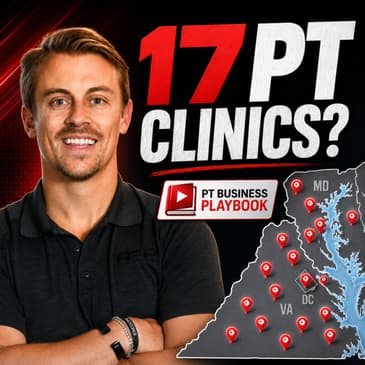
In this episode, Seth Peterson talks with Josh Funk, founder of Rehab 2 Perform, about private practice ownership, business growth, staffing, reimbursement, clinical education, and the future of physical therapy.
Josh shares how his own rehab experience at Ohio State inspired him to build a more active, performance-oriented community rehab model. He explains how early entrepreneurial experiments, side hustles, personal training, coaching, and customer service roles helped prepare him to launch Rehab 2 Perform just three years after PT school.
The conversation covers practical resources for clinicians interested in business, including SBDC, SCORE, local accelerators, and the Goldman Sachs 10,000 Small Businesses program. Josh also discusses what it takes to grow from one clinic to 17, how to understand payer value and internal economy, and why practice owners need to treat staff recruitment with the same strategic attention they give patient acquisition.
Josh also describes how residency programs can serve as attraction magnets, career accelerators, and company-wide education engines. The episode closes with a forward-looking conversation about healthspan, diagnostics, wellness screening, and why physical therapists should become more proactive in risk stratification and prevention-oriented care.
Key Takeaways- Great business ideas often come from bad personal experiences.
- Josh’s own contrast between high-level rehab at Ohio State and community-based care helped spark the Rehab 2 Perform concept.
- Microdose entrepreneurship before you cut the cord.
- Josh emphasizes side hustles, coaching, training, and customer service as low-risk ways to build business skills before opening a practice.
- Free business mentorship exists. Use it.
- SBDC, SCORE, local accelerators, and Goldman Sachs 10,000 Small Businesses helped Josh build business literacy without draining early-stage cash.
- Practice owners must understand reimbursement.
- Josh argues that owners need to understand payer value, administrative burden, MPPR, billing differences, cash services, and the internal economy of the practice.
- Staff acquisition needs a funnel.
- Many practices have a patient marketing funnel, but no talent funnel. Josh sees this as a major missed opportunity.
- Residency can raise the floor across a company.
- A residency program does not only benefit the resident. It creates a pourover effect that can improve the whole clinical ecosystem.
- Build a process-dependent company, not a people-dependent company.
- High achievers may leave. The owner’s job is to operationalize their genius so the organization keeps growing.
- PT needs to move into healthspan and diagnostics.
- Josh believes the public is ready for proactive screening, risk stratification, wellness, and physical capability conversations.
Find Josh and Rehab 2 Perform:
https://rehab2perform.com/
https://www.instagram.com/drjoshfunk/
[00:00:07] All right, Josh Funk, thank you for joining us. This is the AOM Podcast. Seth Peterson, how are you doing over there? Good. You're in Maryland, right? Yeah, the DMV, right outside Washington, D.C. I was born and raised here. I just couldn't get enough of it. I know you're out in a little bit more of a warmer climate, actually one of my favorite places. Hopefully I'll find my way out there soon.
[00:00:34] Yeah, yeah. 105 I think today is the high, but not as bad as Phoenix, so we got that going for us in Tucson. The real question is, are you going to climb Camelback Mountain soon in that heat? Yeah, I used to do that. Now that I'm getting old, the heat tolerance has kind of dropped down a little bit so I can kind of empathize with the patients. You still got what it takes, Seth. I think I can do it. It'll be a dad feat.
[00:01:00] So anyway, one of the reasons we got you on the podcast, I don't think we have a lot of people that are business owners or maybe we do, but we don't touch on the topic of business as much. And so I know that's an area you talk about a lot in private practice world. Maybe a good place, you know, just before we came on, we kind of threw back and forth several ideas. But a good place maybe to start is, okay, you are where you are now. Why did you decide to open your private practice?
[00:01:29] The biggest reason why I opened my private practice and for just perspective here, I've been doing this for a little over 11 years. I opened rehab to perform three years after physical therapy school. But the idea for this came about when I was going through my own rehabilitation journey at Ohio State.
[00:01:46] And for those of you that are familiar with A-B testing, typically in the marketing sense where you're doing some testing and trialing of, you know, let's call it something that's an apple and something that's an orange and you're seeing what works for you. I got a true test of that when I was rehabbing at a power five and now I guess they call it P4 school at Ohio State and it was an unbelievable experience.
[00:02:12] I got better throughout the course of my process, the education, the level of empowerment, the connectivity, the people that I worked with. It was unbelievable. My torn labrum turned from a diagnosis of get you're going to get surgery at the end of the season to why don't you go rehab for the summer? And kind of knock off the remaining five to 10 percent of the deficits that we feel like you had.
[00:02:35] And I came home and I quickly realized that there are true apples to oranges situation when it came to the rehab side. And I went, why is there such a big drop off when it came to community based rehab? Why couldn't I have something like Ohio State at that period of time? Exos was also known as athletes performance or API for anybody who's been around that long. That was an incredibly, you know, it was an incredible place.
[00:03:03] Still is an incredible place. It was something that I had always been drawn to. And I was like, wow, there's high level rehab, high level training. You have this very, very integrated environment for people to go through. I know that it's available, but it's only available out by you. It's only available in Texas. It's only available in Florida. Why isn't it available in Maryland, Virginia? The DMV. Why could I not have access to something like that here?
[00:03:31] And that's really where the idea came about, where I was like, all right, how do I package this unbelievable Division one? Yes, I know that we have access to just about anything and everything at Ohio State. But you also have this going on in other places of the of the country. How do I package that and put together something that's more of a commercialized version? It's available to as many people as possible.
[00:03:53] And that kind of took me through this, you know, whole journey, obviously, through the remainder of my college experience, my three years of PT school at the University of Maryland. I think I was always working in that direction towards eventually opening up rehab to perform at the end of 2014. Yeah, so that's interesting. It sounds like really what kind of motivated you to open it up was to build something that was high quality and you felt like that wasn't available around you. Is that right?
[00:04:20] I would say it's not that maybe high quality wasn't available. It's just that everybody was kind of doing and everything to everyone type of rehab place. And you had this bell curve for your typical rehab clientele. And I could be wrong, correct me if I'm off here, but, you know, your average age for physical therapy is typically like higher 50s, lower 60s. Right. So you're going to have an environment. You're going to have education.
[00:04:46] You're going to have a rehab model that's more catered towards that population base. Now, we could probably all agree that ideally it continues to trend younger and younger. And you have people interacting with a more conservative health care practitioner at earlier and earlier stages in their health care journey.
[00:05:05] And that's where we looked at it and kind of went, hey, how do we provide something that young people are going to enjoy knowing that if they interact with PT sooner, they're less likely to have shots, injections, surgeries. And they're going to be in a situation where they have a positive experience. Right.
[00:05:21] If it was such a grudge purchase for me when I came home, how do I unpack all of the elements of a grudge purchase and make sure that there is something that has a certain amount of connectedness with the younger, more active, potentially higher level consumer or at least somebody who from a psychological standpoint was asking more of their body.
[00:05:42] And that's where I started to get into more of this ecosystem based approach of looking at business, looking at the void that was in the market, pulling inspiration from these different businesses, from different people at that point in time. I mean, I mean, I can talk about everybody from Mike Reinhold, Eric Cressy, Mike Boyle, Charlie Weingroff, all of these different people that I was pulling inspiration from that were talking about some of these, you know, tenants of a more active approach to rehab, a more performance based approach to rehab.
[00:06:12] Something where, you know, when I was at that stage of my rehabilitation journey, why I was so magnetized by the environment at Ohio State and where it was magnets repelling one another when I came home. Yeah, gotcha. And so just from a logistic standpoint, I mean, you're out here three years into PT practice trying to recreate athletes performance, maybe on a micro level, but that's that's a huge goal.
[00:06:40] So how do you logistically just even from a basic standpoint, how do you how did you do that? Yeah, I think two different ways. One, you have to microdose entrepreneurship before you really cut the cord. So I think for me, I've always had elements of entrepreneur, like an entrepreneurial spirit, whether or not it was delivering papers in my neighborhood when I was a young child, doing private lessons at the pool. I eventually my first business I ever started was actually in the lacrosse services space, a company called Lax Factory.
[00:07:10] I ran an almost 100 or 100 camper summer camp when I was going through my college journey. That's when kind of I had that real aha moment that I could probably do well in business. And then that company started actually a month after I graduated from PT school. So I had that side hustle going throughout the course of not just my PT journey, but that three year period after graduation before I started R2P.
[00:07:39] All the while, I was also learning how to do personal training. So I was able to kind of learn the personal training side. I was also doing small group performance coaching in addition to running a lacrosse services company. I think my coaching voice really was able to kind of fully come out through that process. You're learning how to work with a wide variety of different people. I had also had some serving jobs while I was going through PT school. So, again, I think the customer service side was always high on my list.
[00:08:09] But like many things, you aggregate marginal gains in a lot of different areas. You compound financial capital in addition to your intellectual capital and the social capital that you create. And ideally, you know, you cut the cord with some semblance of a plan. It's probably 60 percent there. And then there's always some delusional optimism that kind of carries you through some of those really, really challenging moments.
[00:08:33] But I think, again, like to answer that really, really briefly, it's like you've got to find a side hustle or places to microdose your entrepreneurship, entrepreneurial spirit. Learn potentially while you have some kind of a safety net. And then you also have to kind of reverse engineer what are the pieces that I need to also add to my skill set before I get to that moment, knowing that, hey, I wanted to graduate. I wanted to pay off my school debt. I wanted to buy a townhouse.
[00:09:02] And then I wanted to put myself in a position where I started my business. So what were the kind of things, much like I would reverse engineer a rehab process, that I need to accumulate from a skill set standpoint to make sure that I increase the odds of being successful? Yeah, yeah. And then, you know, like we talk about in clinical practice all the time, mentorship is hugely important.
[00:09:25] I saw that you kind of got involved with, you know, an organization that helped me a lot was the SBDC, Small Business Development Center. I just found that massively helpful. I mean, you have someone that's not in the physical therapy space giving you insight into the business. It was like, well, why do you do it this way? Versus I think where a lot of people get, you know, physical therapy, people that have already started their own practice and you just recreate the same practice that's already out there.
[00:09:55] So that was helpful in that way, I think, for me. Can you talk a little bit about kind of how you maybe got involved with them and other mentors that helped you in the beginning? Absolutely. A quick question for you. How did you find out about that? And then how did you navigate that platform as a whole? Yeah, I don't know. That's maybe a good question. I can't even remember how I heard about them, but I've come to find out that it's really most people don't even know they exist. I mean, it's like a free resource in the community.
[00:10:24] So if anyone listening is thinking about opening up a practice, that's available to you, even not at the beginning, but at any point. So we initially I kind of had the coach there kind of helped me establish the practice and think about how to design and market it. And then later on, we just built a building from the ground up. And then I kind of reconnected with him at that point to try and coordinate a loan for this big building. And that was super helpful.
[00:10:54] I think just the connections that the director had there helped me get a loan really quick. So, yeah, I mean, that's kind of how I used it. What about you? Yeah, no, I'll echo your sentiments. I mean, I can think about both Small Business Development Center and SCORE for anybody who is looking or even thinking about starting their business. I would argue even if you're in the early stages, these would be two great resources. You could type in SBDC in your state and you'll most likely either find some state resources in our area.
[00:11:24] They even had some regional hubs. They had a lot of workshops up at the local community college or a site for just trainings in general. If you can think about like an employment center, sometimes they were hosted there. But it was either free 99 or very, very low cost. And I would just reach out to Diane McFarland at RSBDC. I'd say, hey, Diane, this is the problem. These are the problems that I'm having. What do you think is worth attending?
[00:11:51] Who's worth connecting with at these particular workshops? You know, who might be an attendee that maybe is beneficial to network with? It was very pivotal to me early on. SCORE provided me with a free business mentor, Brandon Mason. I can still think of to this day like he was critical at just like I'm a big question guy. I will ask a million questions because I have no shame in not knowing the answer. And I just want to get to a point where I have some level of clarity that I can move forward. And he was tremendously patient with me.
[00:12:20] And you're talking about usually working with people that have exited their company and have achieved at very, very high levels. Literally serving as a free resource for you. And then on the SBDC side, there were two accelerators. The CEO accelerator and the growth accelerator that I went through. Russell Teeter, who I was even talking to the other day. And this is like nine or 10 years after I went through those programs. I still reach out to him, sometimes say thank you, sometimes pick his brain for connections a little bit more.
[00:12:49] But that program was entirely subsidized by grants through either the state or the local counties. And all I had to do was allocate time. So those are unbelievable places. I think it's no secret that there's a lot of high ticket PT mentorships. I myself do some mentoring. I always push people before they start their practice into those two places.
[00:13:15] Again, because it's no cost or very, very little cost. You can increase your level of overall foundational business literacy, which I think is incredibly important. And again, your cash is a very, very limited early on. I get it. We still are entirely either bank loan funded or personally funded. And I know what it's like to value your cash. And I know what it's also like to value your credit.
[00:13:44] And at the end of the day, you only have so much money to go around. So for anybody who's thinking about it or even in the early stages, I would highly recommend checking out one of those resources. And then the other thing, and I know they've lowered their revenue criteria. And I think it might be $250 at this point. But like once you get close, check out Goldman Sachs, 10,000 small businesses program. That was the next step for me. Again, no cost to the program.
[00:14:10] I think it's subsidized by Goldman, Bloomberg, and also some of the local grants associated with some of the community colleges. And that was an unbelievable program. I got to go to the Cary School of Business. It was either every Friday or sometimes it was two different days during the week. You're doing an on-the-job MBA. That's how I would equate that program because there was a little bit more structure to it. It was less a la carte. And it was more taking you through a defined curriculum.
[00:14:39] I still am connected to some of those people to this day. And I don't think without those programs, all three of them, that I would be where I was today because I did not have the foresight to take on business coursework when I was in PT school. I was just always kind of getting this on-the-job training. And at some point, I needed a little bit more of that formal educational side to give me a better lens into how to be successful long term.
[00:15:10] Yeah, yeah. Hugely, hugely helpful resources. So now, how many clinics are you at right now, Josh? We're opening 16 and 17 next month. So it sounds kind of crazy. I never set out to do that. I think initially it was just like, let's do one thing really, really well and just enjoy coming to work every day. And now it's taken on a whole new form. And I think at this point, we're really, really enjoying being a transformational company in the region that we're in, the DMV.
[00:15:41] Most of our locations are in Maryland. We're doing more and more in Virginia. We would love to get in D.C. at some point in time. But this is, again, this is a place where I was born and raised. I love it here. I'm going to be here hopefully for the rest of my days. And I think we're doing a good job of making an impact and really changing people's expectations with health care, which on the macro is really something that I enjoy a ton. I alluded to earlier, like my early impressions of health care were largely I was thinking grudge purchase. Right.
[00:16:08] You're like, this is a have to experience for people. How do you make it something that is a get to experience so that if they have something minor, they're more likely to interact with it? And that was my way of thinking, OK, we can decrease some of these downstream effects if we make it so enjoyable. And obviously, if you reframe how young people are thinking about it, then you're putting them in a situation where they know no different. Right. And the expectation is the expectation.
[00:16:34] If they go try something else, they're automatically going to come back into or they're going to press that environment to adopt how it does things. So, you know, we want to continue to kind of be a market example or a market setter and continue to adopt business principles that decrease friction, increase enjoyment and obviously give people unbelievable outcomes along the way. Yeah. Yeah. I mean, that's such a kind of huge success. You're 16 and 17.
[00:17:03] You're still expanding. You said next month you're opening two in the same month. Yeah. Which is nuts. Not by design. Not by design by any means. But sometimes that's how it works out. But yeah, I mean, so and it's at the time that I think a lot of what we're hearing about is payment challenges for the profession. Either, you know, I don't know, you know, at least kind of Medicare staying pretty much flat and has been for years. You can talk maybe a little bit about that.
[00:17:31] But then also, how do you as I imagine you're going to have some problems as you continue to grow? Meaning how do you get physical therapists in maybe a market where there's just not as many physical therapists as you'd like? So how do you address those two problems? Those are two great questions. I'm going to do my best to unpack both. On the payment side, I think a big thing that people need to do is, A, first and foremost, educate themselves on how payment works.
[00:18:00] One of the things that I did not do as good of a job early in my career is have a full appreciation for the game that is the level of value that these outside entities are putting on your reimbursement. So fully understanding what they're reimbursing, fully understanding things like MPPR, fully understanding the differences between AMA and CMS with regards to billing.
[00:18:30] Also, putting yourself in a situation where you understand what level of administrative burden each of these different insurance payers are putting on. And understanding also that cash, if you add more of it, there's less and less. And almost no administrative burden, especially when you think about some of the ways that people can have card on file and fill out all intake forms digitally. And I come here telling you that we used to have everything on a clipboard with a pen and a piece of paper and have to fax everything. So we've come a long way in 10 plus years.
[00:19:00] But I think without understanding value that those external entities are putting on your reimbursement and how things are working, you don't potentially put yourself in a situation where you are potentially delivering high value care. You don't always get to dictate what is viewed as high value care. And I think that's something we all just need to understand. Right. High value care is determined in those contractual relationships by somebody outside your company.
[00:19:28] So understanding what high value care looks like for the payers. Right. And there's a lot of overlap amongst them. And then having conversations with your team about how to match expectation with value. Right. And delivering something that's amazing to your customer and doing it, obviously, in the most ethical way possible. Right. So you're not sitting there and it's not strict. You're not telling people to bill the most amount based on different insurance groups.
[00:19:55] You're just having macro understanding, having macro expectations with your staff so that they can play their part in terms of changing your internal economy or at least optimizing your internal economy. If you're not optimizing your internal economy, you're just showing up and you're just billing how you want and placing value on how you want or arguing about what should be the most valuable. You're probably not controlling the control of this. Right. At the end of the day, that's first and foremost what we do.
[00:20:23] From a business standpoint, one of the benefits to growing is we have had more bargaining power or we have more volume as it relates to the outcomes and the amount of data that we have. In those particular situations, instead of having reimbursement decline, we have steadily had reimbursement increase.
[00:20:42] So we've been able to change our internal economy by a becoming just more aware of the value that the insurance payers are placing on certain things, having conversations with our staff, making sure that we are playing that game while also delivering unbelievable high level, high value care. Knowing that outcomes at the end of the day are really what we should prioritize.
[00:21:03] And then on the secondary side, as we continue to grow and move forward, making sure that we have data that is paired with our volume that allows us to have more constructive conversations with the insurance payers.
[00:21:15] So those things alone are allowing us to change our economy from a R2P economy standpoint, adding more cash, getting more into diagnostics, getting more into screening and assessment, getting more into wellness, getting more into potential services that are not covered by insurance, do not fall under a medical necessity lens, but also allow us to deliver things that we feel like are allowing us to practice at the top of our license.
[00:21:42] Those all play into the financial side of things. And that allows us to also be competitive on the secondary side with staffing, right? So it's no secret that if you can't control your internal economy, it's very, very hard to be competitive as it relates to attracting people. Now, I'm not saying that's everything, but there's probably a certain floor that you need to have from a total compensation standpoint. And I say total comp because it's not just salary.
[00:22:11] Yes, salary is important, but your total comp as a whole is something that people obviously should be looking at. And you need to have a certain floor before even having other conversations, right? It's like, all right, well, if your salary and your total comp is in the strike zone, then we're having different conversations surrounding company culture,
[00:22:31] training, models in terms of how long sessions might be, documentation, what the Con Ed budget is, what the upward mobility at that company looks like, what kind of patient population that you're working with. The front side vanity metrics, I think, again, need to be taken care of before you even get into the weeds of what I would say some of the secondary items.
[00:22:58] What are you doing to ensure that you're taking into account your provider's mental, emotional, physical well-being? And then when it comes to attracting professionals to your company, I think the biggest problem that I see a lot of business owners have or actually don't have is they don't have a marketing plan for staff. They've run a funnel for patient acquisition, but they've never run a funnel for staff acquisition.
[00:23:27] So there's no top of funnel strategy. There's no bottom of funnel strategy. There's no conversion strategy. There's no onboarding, retention, structure in place. There's not KPIs. You're not doing things to have active word of mouth on your own team. Let's talk about like a referral bonus. You might not be right. You can't do a referral bonus on this side when it comes to receiving referrals from sources in the community for patients.
[00:23:54] But if your own team is bringing people into the mix and they're good hires, you should be finding a way to monetize that. You know, and I think at the end of the day, if you sit down on a big whiteboard and we do this regularly and you say, what are my top of funnel strategies? What are my bottom of funnel strategies? How am I running our marketing funnel for talent? Like we look at our marketing funnel for prospective patients.
[00:24:19] I think that alone is a huge thing that will allow you to have more clarity because a lot of people find that they're not doing much until we get to the bottom of the funnel. And they are waiting too long and too late. And they're ending up in a situation where the whole process is rushed. If you look at customer acquisition or client acquisition, patient acquisition, whatever we want to call it, you have to have a certain amount of touch points usually before somebody feels comfortable.
[00:24:47] Right. You could probably say somewhere between seven to 11 different impressions before somebody says, I'm going to choose this business. Do I want to potentially accelerate that process and end up in a situation where you didn't get to try before you buy it enough and I didn't get to try before I bought enough? And then we rush this and then you have a relatively hasteful onboarding process, a very, very clunky zero to 90 day onboarding. Mentorships disconnected.
[00:25:16] There wasn't the right fit. And then what's happening? You ramp things up quick. Patients had a potentially interesting experience again because things were too rushed. And then you're dealing with offboarding after a termination or somebody putting in their resignation like that's not ideal at all. We tell people we're always hiring. We want to develop longer relationships. We don't want anybody to feel rushed. We want to know when's ideal for you to potentially join us.
[00:25:45] And then we put ourselves in a situation where we're both able to go through this at a much more comfortable pace. Then we feel like there's a level of certainty where there's a lot of mutual synergy, a lot of mutual belief that this is the right fit for both parties. And we do think that that ends up leading to retention. And at the end of the day, it's not just important to retain people, but it's also important for them to be advocates for your company. And again, if you run that marketing funnel, you think about more top of funnel strategies. You're attracting a bigger net.
[00:26:14] You're developing relationships way before you potentially need somebody. I think you're more likely to put yourself in a situation where you're built for the next decade of business, especially in a situation where people are only talking more and more about a smaller pool of potential candidates. Sounds like you're being strategic about it, Josh. Like, you know, how do you you're probably thinking at, you know, in multiple levels. I think one of the things that that the questions I wanted to ask you, too, was about you have a residency program.
[00:26:43] I mean, do you think that also kind of I mean, I think that would be a huge value in terms of ensuring that there's some consistency and quality as you expand. Do you get a lot of people doing going through that residency? And what have you seen? Yes. Yes, yes. And yes, I should say, I think that this is incredibly going to be it's going to be self-serving. Hey, we run a residency and we're actually expanding our residency.
[00:27:10] So for anybody listening, we have had such a good experience with our sports residency that we want to do it in more places across the company ecosystem. Why have we had a good experience with it? One, it's an incredible attraction magnet. Right. It is attracting people who want to go through a formal curriculum to go to eventually go and receive a board certification. Right. There's a certain amount of scrutiny, scrutiny there.
[00:27:39] There's a certain amount of adherence to standards there. There's a certain level of commitment going through this post EPT, you know, time period in your life that we feel like is only contributing to people, especially on the sports side, being the best possible sports clinician that they can be earlier in your career. We view it as a career accelerant.
[00:28:04] And if you look at a lot of the people that we've had go through the program, a lot of them, they're in pro sports, college sports, or quite honestly, they've worked their way up in our company at much quicker rates than other people. The other benefit from this is if you run something like this in your company, it should not be siloed and it hasn't been siloed.
[00:28:24] So for us, this has been a tremendous pour over where you, Seth, maybe you went through our residency and the other 13 people in the company at that given time were going through the residency, but they all received the benefit because the curriculum itself has value. It is comprehensive. It is looking at a lot of different topics. So if you view that as a pour over and the rest of your staff can benefit from the education that is being provided, maybe it's not set aside for them. It's not being carved out.
[00:28:53] They don't have as much focal time as other people, but they're still having access to materials. They're able to engage with certain things from an asynchronous standpoint. They're able to reach out to the faculty that we have kind of designated within the company ecosystem. It is still something that everybody can benefit from. There is value for people going through the formal track and receiving board certification, but we've also had a decent amount of people kind of self-sourced on their own,
[00:29:20] and they've still received board certification, you know, doing it entirely individually, right? Not under the formal umbrella of the residency, which is only, right, if you think about a rising tide, raising all ships, it's only rising the tide of the entire company. So, you know, we've been fortunate to develop really good relationships elsewhere with other universities, other high schools, other sports-oriented ecosystems. We're looking to expand it on the Anne Arundel County side.
[00:29:50] We have a really, really good private high school there, also some good public schools. We've actually been doing more and more at the Naval Academy, which has been really, really cool for our team as well, in addition to kind of like a semi-pro soccer league that plays at the Naval Academy Stadium during the summer. So we're a good sampling, and that's really where our residency program kind of fits in for anybody that wants a kind of a sampled approach to a lot of different venues. And then a very, very unique situation with an up-and-coming private high school.
[00:30:19] For anybody that's familiar with IMG Academy in Florida, the St. James Performance Academy is quickly headed in that kind of same mold, where you have athletes coming from all over the place. They're coming to this place where, to be quite honest, I think the indoor field in itself is bigger than Ohio State's. These high school kids have access to things that, like, it's hard for me to wrap my head around sometimes when I'm walking in there. They also had the premier lacrosse league there. They had a professional rugby team.
[00:30:45] So, again, this kind of sprinkling of elite high school prep academy, some professional sports. Obviously, we're going to spoke off as well to some of the local high schools and some of the other colleges in the area to kind of round out the experience. But it's something, again, that we've loved the impact that it's had so far. And I'm pretty sure we're either in year five or year six, that we want to continue to make sure that it kind of tracks across our geographical coverage as we grow as a company. Oh, that's huge.
[00:31:14] I love that, how you describe kind of the pour over effect of having someone go through that sort of program. We did a, there's a paper in JOSBT on this concept of local opinion leaders, which is something that actually came from the physician literature and just noticing that if there is someone in the practice that was, often there is this, you'll kind of, we'll all kind of have these experiences where there's someone in the practice that kind of other people look to. And that person kind of reaching out and teaching the other clinicians.
[00:31:43] So they all, after a while, the other clinicians kind of start adopting and picking up little things. So, yeah, I mean, I love it. It's just like what you've talked about, that one individual can have a huge pour over impact on the other clinicians and how they practice, which has got to be huge. Yes, definitely. The, the, the, the positive butterfly effect of having more people go through it, some that stay with us.
[00:32:08] And, and obviously continuing to not just look at the training that we have on the residency side, but, you know, it's also pretty unique. We have, you know, we have 46 in services that run throughout the course of the year. We have structure every first Monday is something. Every second Monday is something. Every third Monday.
[00:32:25] And again, I probably use the ecosystem word in itself more than anybody, but I think the more that you think multimodal with regards to, you know, the, the educational offerings within your company ecosystem, the more likely you are to hit a couple of different things that work well for people. Right? Some people read well. Some people experience screenshots well and want short blurbs. Some people want video. Some people are going to do really well with journal articles. Some people are going to do really good with small groups.
[00:32:53] Some people are going to do really good with one-to-one. And I think for us, we're just trying to put this kind of, everybody talks about a testing battery for return to sport. Well, we want a couple of, we want the best educational battery, right? So at the end of the day, we can say that people who have been with us for a certain amount of time have received enough of this, not just breadth, but depth, especially in the sports and orthopedic realm, to ensure again, that we're, you know, we're fulfilling one of those kind of central tenets of R2P, which is delivering. Amazing outcomes.
[00:33:23] Yeah. Plus, I think, you know, like you mentioned athlete's performance, and I'm sure one of the reasons you even knew about it is because it's seen as a place where you could go and you can learn a lot and you can get these good experiences. I just run into business owners. I think that it's like they're holding on to these clinicians, like, you know, with their claws sunk into them. And if they try and leave, they get all angry and, you know, have contractual arrangements that maybe aren't the best.
[00:33:51] And so then it leaves like a sour taste in their mouth. Whereas if you support that person and they end up reaching a point in their career where they head off, I'm sure it turns into like, you know, they're going to just spread the word about rehab to perform and send other people your way. People are going to want that. And we're going to see that as, oh, this person went through R2P. R2P, I'm going to get there.
[00:34:12] I think not just that, but also like, you know, hopefully some of the people that have left us and gotten some of these jobs, the employer that they go to use it and goes, all right, I know what I'm getting when I get an R2P employee, right? So I think for us, like recognizing we have everybody, you know, we have a lot of people for a season and you build a company for that. Like if you're not building your company for people to leave, you have a people dependent company. And I used to have that, right?
[00:34:42] You need to have a process dependent company. You need to have a company that the floor is really high. The guardrails are really narrow. It allows people to operate in their best genius. But at the same time, you can't have too much variance, right? Because at the end of the day, if that person leaves and you have to fill that spot with somebody else, you want to have a relatively similar experience. And we have young people join us all the time and they end up in other places. And sometimes it's really, really, really hard.
[00:35:10] But all you can do at the end of the day is be happy for people, especially if they've gone out of their way to give you what I would consider a respectful and considerate level of time before they leave you. It's a separate conversation reserved for people to put two weeks in, but we're not going to dive into that right now. But I think at the end of the day, I do not find myself upset with people when they've especially even communicated, hey, R2P is not for me in the long run.
[00:35:39] I am perfectly okay with that. Come in here, work, be a great teammate, make an impact while you're here and leave us in a better spot than when we had you. And if we build you up and we don't operationalize the things that you do really, really well so that everybody else can benefit from your time with us, that is on us as a company. So you're A plus person that left.
[00:36:04] If you didn't operationalize their genius so that everybody in the company that came after them didn't get some kind of pour over or trickle down effect, that's on you as the business owner. That's not that person's problem. It's your problem as a business owner because you're not operationalizing the genius within your company. And I think that's one thing that we've done a really, really – like we've had some unbelievable people in our company, absolutely unbelievable people that are elsewhere.
[00:36:30] And I can still say like they left the company in an unbelievable place because there was some mutual working to kind of distribute their thought leadership amongst the entire team, right? So that when they left, we didn't lose their genius. They left these hints, these clues, these ways of doing things, this language, et cetera, behind. And that's how your company kind of continues to take incremental steps forward. And how do I say this as respectful as possible?
[00:36:57] But like people can leave and we might take a small dip for a little while. But at the same time, we just keep moving. You know what I mean? And you're able to do that again when you find ways to operationalize your high achievers. Like you have high achievers. You might not have them forever. It's perfectly fine if they leave you. It's on you to make sure that that person leaves a lasting legacy in your company. And you come up with ways to make sure that that happens as a business owner. Yeah, yeah.
[00:37:28] Love it. Josh, towards the end, I kind of like to pivot to the future. So what is there a problem when you look into the future for where you're going, but also just the profession in general? What do you see that you think maybe clinicians, practice owners need to start thinking about and preparing for? I'm going to go ahead and say it, but I do think we need to get into health span and diagnostics more. I think we need to get more into the wellness screening.
[00:37:57] I think we talked about it a ton. I think that the population is ready for it. I think people are talking about longevity and health span more than ever. And I don't know who would be better positioned than PTs. I know that we have a tremendous problem with the word injury prevention. But I think the more that we get into risk stratification and the more that we're communicating risk factors to people that could be controllable, I don't think that we're doing anything that is negative to the person.
[00:38:27] Like them going through a process, learning about their body, learning where risk is present, allowing them to do things with the information that they never had before interacting with you is only going to be a net positive. Or you could argue that there was nothing gained, but there's certainly going to be nothing negative. You're certainly not communicating anything other than here's the body of literature out here. Here are the risk factors that you currently have and how you could potentially approach them. And yes, could things still happen? Absolutely.
[00:38:56] Just like anything in the world. But you have all of these screenings and physicals and other things that other professions do on a regular basis. And it's time for us to really make sure that we're out there and not just positioning ourself as a reactive, call us when you need us. But hey, you have a growing young person. Are you doing certain things as they're playing their year-round sports schedule to keep them healthy? Here's what is going on with them. Here's how their body is accommodating.
[00:39:25] Here's where they're at in their height velocity. Okay, I have an adult who's 40, 50. What kind of things do I want to look at to make sure that we don't just live a long life, but we live a physically capable life, right? What kind of risk factors are present there? There was just something the other day on fall risk and fall risk potentially being something that you can get on kind of like warning signals in your 40s or 50s. So how do we potentially have those conversations earlier and earlier and earlier with people?
[00:39:53] There's things we can do with peripartum. I think where this all comes from too is like I can go to my fleet feet and somebody can throw me on a treadmill and I value like some kind of a running analysis there, but I don't value any kind of other analysis that unpacks not just the way that I move visually, but also some objective metrics. And I do think the consumer is looking for it.
[00:40:19] Like it is a time where this stuff is being talked about more and more and more. And I think at one point, maybe when we talked about this, say five, 10 years ago, I don't think that the population was ready for it. But now I think there's fully an addressable market where people are ready to receive these things. And it's time we clearly get out there and communicate, you know, how we can potentially help people. Yeah, I love it. That's a great one. That could be its own podcast. Maybe at a later date.
[00:40:50] Part two, I'm open. Josh Funk, thank you for your time. Appreciate everything you're doing. Seth, awesome, man. I know you were very patient with me and getting this set up. I appreciate your time and everything that you're doing for the profession. Thanks for listening to Hands On, Hands Off, the official podcast of AOMPT. Subscribe now so you never miss an episode.
[00:41:16] And connect with us at aompt.org or at AOMPT on social. Opinions are those of the guests and not official AOMPT policy. See you next time.