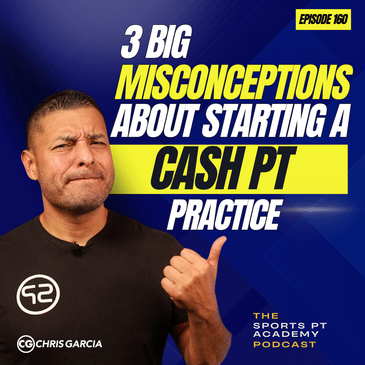
Have you thought about growing a cash-based PT business? Before you waste time or money, Dr. Chris gives insight into the 3 most common misconceptions about starting a cash PT practice.
In this video, Dr. Chris Garcia shares 3 critical things to consider before diving further into your clinical practice. If you want to move forward with your cash-based business on the right path, this episode is perfect for you. Enjoy episode 160 on the Sports PT Academy podcast on YouTube, Spotify, and Apple Podcasts!
________________________________________
Are you a physical therapist or physiotherapist looking for tips, tools, and strategies to work with more athletes, become a sports specialist or get a job in a sports setting...so you can finally enjoy the career that you've always dreamed of? If so, you're in the right place...this podcast is for you. Your host is Dr. Chris Garcia, a physical therapist, business owner, entrepreneur, nationally recognized public speaker, and residency-trained sports specialist.
Dr. Chris Garcia, PT, DPT, SCS, CSCS, USAW has worked in professional sports and traveled around the world working with elite athletes throughout his career, and he's learned a lot of lessons along the way. He created this podcast to share his experiences and give you everything you need to know to help YOU become a successful clinician. Dr. Chris Garcia talks about everything from sports rehab and injury prevention to developing athletic performance and the path to getting your dream job...even if it is in professional sports.
If you want to become a successful clinician so you can finally enjoy the career you've always dreamed of, visit www.DrChrisGarcia.com.
LINKS:
www.Instagram.com/ChrisGarciaDPT
www.Facebook.com/ChrisGarciaDPT
***DISCLAIMER: This content is for educational & informational use only and & does not constitute medical advice. The content is not intended to be a substitute for professional advice or medical recommendations, diagnosis, or treatment. Please consult with a qualified medical professional for proper evaluation & treatment, or beginning any exercises or activity in this content. Chris Garcia Academy, Inc. and The Sports PT Academy Podcast are not responsible for any harm caused by the use of this content.***
[00:00:05] Are you a motivated healthcare or fitness professional? Are you looking to work with more athletes, become a sports specialist, or even get a job in a sports setting so you can finally enjoy the career that you've always dreamed of? If so, you're in the right place. My name is Chris Garcia, physical therapist, business owner, entrepreneur, and residency training sports specialist. I've been fortunate to work in professional sports and travel around the world working with elite athletes throughout my career, and I've learned a lot of lessons along the way. I created this podcast to share my experiences and give you everything you need to know to help you.
[00:00:35] If you become a sports expert, welcome to the Sports PT Academy.
[00:00:42] Chris, should I start a cash-based PT business? Can I do it? Should I do it? If you want to know the three biggest misconceptions of cash-based physical therapy, you need to tune into this episode. Hi, everyone. Welcome back to the podcast. Welcome back all new listeners and welcome back to those who have heard my content in the past.
[00:01:04] Before I go on to today's topic, I wanted to start with what's better, what's new. For those of you watching on YouTube, I have a completely different setup. I'm excited to be inside my personal studio, so you can go ahead and check that out on my YouTube channel.
[00:01:19] But I'm excited to share with you everything inside this course, inside this podcast before I go on. What's better in life? What's happening? I have a couple things written down, but ultimately, my back is still giving me an issue.
[00:01:32] I tried working out this week with a little bit of lighter weight, deadlifting. I just cannot pull from the ground. I have to be very, very careful. And it's a little bit of my SI and low back.
[00:01:45] What else is happening? I have a house party coming in tonight for my team at Sports Performance Physical Therapy, so I'm excited for that.
[00:01:54] What else? Oh, I just finally launched my clinical elevation course for those of you who have been asking. I finally did that, so if you're inside my newsletters or if you're on my website, you can find that as well.
[00:02:06] But otherwise, life is great. Kids are fantastic. I feel good. I'm almost done with the cut. I am down to, I've lost seven pounds in the last, I think, six days or no, eight days.
[00:02:20] And we have one more week of this. For those of you who don't know, I do this in honor of clients who have fought in the UFC, and this is kind of like how they cut down getting close to their actual fight.
[00:02:32] So we started implementing it. I think there's eight of my team members doing this as well, so we're all struggling in misery at the same time.
[00:02:41] So anyways, all right, let's talk about the content and today's podcast.
[00:02:45] Okay, so I've had numerous direct messages on Instagram. I've had friends. I've had people ask, like, should I do cash-based physical therapy?
[00:02:55] I've had new grads. I've had people in PT school thinking, you know, thinking about it.
[00:02:59] And I always get this question. And before I ask, like, if this is good for you, I just want to share the three biggest misconceptions for those.
[00:03:08] And I'll let you answer that inside whatever it is that you're doing and whatever you're forecasting for the future.
[00:03:13] But I get this question often, and I just had it again this week.
[00:03:17] And so instead of sending 57 individual messages, I just want to share it with everyone else out there in the world and things for you to consider if this is the right place for you,
[00:03:28] if this is the right model, and if this is something that you really want to do down the line.
[00:03:32] So as we go into the podcast, I'll share more and more.
[00:03:36] But I think before I give you those tips, I want to tell you, you know, the challenges that people face as they go into a cash-based model.
[00:03:45] For those who might not know my story, I'll kind of give you a little background, a little context.
[00:03:50] I started my company, Cash-Based Physical Therapy, straight...
[00:03:54] I went to PT school.
[00:03:55] I did my residency for a year and a half at The Ohio State University.
[00:04:02] And I went right into treating at Ohio State.
[00:04:05] And then I got a job offer in professional sports with the United States Olympic Committee, where I worked there for three years.
[00:04:10] And then I did some NFL combine training.
[00:04:13] And then I did personal concierge international travel living in Europe for about two years, actually.
[00:04:20] And after that, my wife and I were talking.
[00:04:22] We were like, okay, what's the next step for us?
[00:04:24] And we thought that Cash-Based would be kind of the next fit for me, just based on all the sports experience I had done before.
[00:04:30] And this is 2014.
[00:04:31] So at the time, Instagram wasn't really a thing.
[00:04:35] And I think there was only photos, no videos.
[00:04:37] YouTube was definitely not where it's at today.
[00:04:40] And, you know, there was no podcasting.
[00:04:42] It was just very, very...
[00:04:45] It was very novel.
[00:04:46] And so I did it because I had a clinical skill set that I felt that I could, you know, provide to the community that's different from everybody else.
[00:04:54] And, yeah, so I just did it.
[00:04:56] And I started it.
[00:04:57] And I think that knowing now where today in CashPT is, it's a whole different game.
[00:05:02] And I think that as people think about, you know, doing it, they jump in.
[00:05:08] I want to be able to save you time.
[00:05:10] I want to save you energy.
[00:05:11] I want to streamline your process so you feel good about going into this next thing.
[00:05:15] And I think a lot of people are quick to jump into it.
[00:05:18] And before you waste that time, energy, and money, I think that you really need to take a step back and think about, you know, what's the long game?
[00:05:26] I think people don't really think about that, you know.
[00:05:30] How long is this going to last?
[00:05:31] What's the financial number that I want to make?
[00:05:34] Or is it that you truly just want to make more money per hour, right?
[00:05:37] For some people, that's a big deal, right?
[00:05:39] Like, I don't want to make $65.
[00:05:41] I don't want to make $40.
[00:05:42] I want to make $100.
[00:05:43] I want to make $125.
[00:05:44] Whatever your number is, if it's out of principle, that's probably not the best thing to use your time and energy towards because you can easily find yourself in a trap where you're working, you know, 50 plus hours and only making $20 an hour when you really do the math or even worse, even lower at $10, $15 an hour because of all the energy and effort that you're doing.
[00:06:03] So, you know, that's the challenge that exists that most people don't know what the future holds for them.
[00:06:09] They don't know what the goal is.
[00:06:12] They have no idea of what they're striving for.
[00:06:15] But what they do know is they're willing to hustle and put in the hard work now so that they can have a better future.
[00:06:22] The question is, what's the future look like?
[00:06:24] And how long will you want to do this before you give up?
[00:06:26] Or you think about going a different route?
[00:06:28] Or what does success look like?
[00:06:30] And that's probably the thing that I'll tell most people is if you don't know what success looks like, then you're just, you're going down a path that doesn't even make sense.
[00:06:37] So, find your destination and figure that out.
[00:06:39] All right.
[00:06:40] So, anyway, so that's the problem.
[00:06:41] I see that people go down a path where it's not, it doesn't make sense for them and they're going to have a very, very challenging future.
[00:06:47] So, let's talk about the three biggest misconceptions.
[00:06:51] So, number one, I think that the thing I hear the most is or I see is like anyone can do it, right?
[00:06:58] So, if you have a PT license and you just got out of PT school or you've been doing a side hustle with home health or you're with an insurance-based provider or you work pediatrics or you work a hospital and you now think that anyone can do it, right?
[00:07:13] I have the clinical skill and it's just, I just pack, I buy a treatment table, a bottle of lotion and a towel and I just show up to an event and people magically just come to see me.
[00:07:23] That's, or maybe I'll start an Instagram and a basic website and everyone comes to see me and that's what everybody perceives.
[00:07:29] And that's definitely not the case.
[00:07:30] And I think the person who, anyone can do it is the thought process and that's a misconception.
[00:07:37] The person who can't do this is the one who is very motivated.
[00:07:43] The problem is, is that when people go through these ebbs and flows of motivation, that's where the problem becomes is where you get this high and you get like three to five patients in that week.
[00:07:52] And the following two to three weeks, you kind of dive down, you go back in this wormhole and you're like, ah, maybe cash is not for me or maybe I'm not that good.
[00:07:59] And then you get one or two patients and you ride this rollercoaster and that person relies on motivation to get them through this process.
[00:08:06] But the difference is the person who is successful is not just the one who's motivated, but the one who's dedicated.
[00:08:11] And that person can see the future.
[00:08:13] That person's willing to stay consistent throughout the entire process.
[00:08:16] Their energy levels don't go high and low.
[00:08:19] They're willing to, their stress tolerance is high.
[00:08:22] That person can go through these ebbs and flows of energy and that draining and that hard work and the excitement and also the letdown of what success looks like.
[00:08:34] So if you're really dedicated and you're willing and able to push past stress and you're okay with very little income some weeks and very high income weeks some weeks,
[00:08:46] and you can stay consistent throughout that entire process, then that's for you.
[00:08:50] But if you question yourself, if you have low confidence, if you think that, you know, this is just a hype, right?
[00:08:56] This is just like, like you have some momentum right now.
[00:08:58] You have some downtime.
[00:09:00] You have extra hours.
[00:09:01] You're younger or you're, you're going through some changes right now.
[00:09:05] And you're like, this is the next thing I'm going to do.
[00:09:06] And you, you find yourself attacking different diets and different things and different clinics.
[00:09:10] And, you know, you're always changing jobs.
[00:09:12] Like this is not going to be for you because this is not a temporary thing where you just kind of come in and come out.
[00:09:18] This is something that you dedicate yourself to.
[00:09:20] And so, like I said, if you don't have a destination, then you don't know where you're going.
[00:09:25] And inside that, it's very easy to find yourself just ebbing and flowing because if you don't know where point B is,
[00:09:31] you're at point A, you don't know where point B is, it's very difficult to continue that route because you don't even,
[00:09:36] you can't see what you're working towards.
[00:09:38] And some people just say, well, I want to make more money.
[00:09:40] Well, how much more money?
[00:09:41] What's that number for you, right?
[00:09:43] And we're like, well, I don't know, maybe 40,000.
[00:09:47] I don't know what that is.
[00:09:48] And the thing is, you have to create some targets for yourself.
[00:09:51] And it's like saying, hey, I'm going to lose some weight.
[00:09:53] How much weight?
[00:09:54] Well, I don't know.
[00:09:55] I'm just going to keep losing weight.
[00:09:57] And you'll find yourself quickly.
[00:09:59] You know, it just takes one cold, one vacation, one flu, something to knock you off.
[00:10:04] And you're like, well, that was fun.
[00:10:05] I'm not going to do that anymore.
[00:10:06] And so if you're thinking anyone can do it, that's not the case.
[00:10:10] If you're somebody who requires constant motivation, you failed and it's very tough for you to come out.
[00:10:17] You're highly motivated but not dedicated.
[00:10:19] You don't think of targets or goals and you're just willing to hustle.
[00:10:53] This is not for you.
[00:10:55] You're not going to do it.
[00:10:55] So can anyone do it?
[00:10:57] No, that's definitely not the case.
[00:10:58] It's the person who has all those qualities and those intangibles who's able to do that
[00:11:04] and enjoy that whole process because they know that they're doing something different for
[00:11:08] their community.
[00:11:09] So that's number one.
[00:11:11] Anyone can do it.
[00:11:13] Number two is that it's easy and I'll just work up to a six-figure income in no time.
[00:11:20] This is a definitely kick in the pants.
[00:11:23] For those who have thought, you know, if I just work and I see this many patients, I'll have
[00:11:29] six figures in no time.
[00:11:30] If you see a patient for $100 and you do that math and you figure out how many patients you
[00:11:35] need to see to gain $100,000, you think like, well, six figures is nice because I would have
[00:11:40] made less or equal or more or whatever that is inside the PT business of orthopedics or insurance
[00:11:46] based hospital, whatever it is.
[00:11:48] I think you have to realize that there's much more to the expenses and everything else to it.
[00:11:53] So ultimately to be equal to, you know, have a six-figure income or whatever that is, you're
[00:12:00] probably going to have to be earning somewhere in the ballpark of maybe $250,000 to $400,000
[00:12:04] in order to take home a decent amount that you're expecting.
[00:12:08] So I think that if you think that from a pure number standpoint that six figures is easy
[00:12:13] to achieve, it's all the expenses behind that that will chip away at what you take home.
[00:12:18] And especially if you're trying to, if your destination is to grow into another space or
[00:12:23] whatever it is, you do have to save a lot of that money.
[00:12:25] So for the first two years, you're likely saving a lot of money and all that revenue that you're
[00:12:30] building is probably not going into your lifestyle and everything that you do.
[00:12:34] So to achieve six figures might not be hard from an income standpoint to achieve that,
[00:12:41] but what you take home and what you thrive on and what you live on is going to be a whole
[00:12:45] different story.
[00:12:46] So that gives you some context into, you know, it's easy to make more money.
[00:12:50] Yes, but you're going to have a lot behind that to then fuel as part of the business and
[00:12:55] put into buckets and put into savings to gross to something that could one day be bigger and
[00:13:02] help your community at a larger rate.
[00:13:04] So is it easy to grow to six figures?
[00:13:07] No, there's a lot of blood, sweat and tears, especially in those first two years.
[00:13:10] But the downside is you're saving most of that and you're living off of everything else that
[00:13:15] you're working.
[00:13:15] Maybe you're doing home health, maybe you're doing a hospital job or another side hustle,
[00:13:19] whatever it is that you're doing.
[00:13:20] And, you know, I think the hardest part for a lot of people is that they're not contributing
[00:13:24] to the retirement, they're not contributing to investments, they're not contributing to that.
[00:13:28] You don't have all the back end stability.
[00:13:30] And so when you're making progress in business development, you also are slowing down on the
[00:13:35] back end on what you could be doing 30, 40 years from now.
[00:13:38] And so I think there has to be a fine line and a balance for a lot of people.
[00:13:42] The way I did it was I was all in and I went for it and I was not doing these side hustles.
[00:13:48] I was literally just doing this full time.
[00:13:50] And, you know, I learned these lessons along the way.
[00:13:53] And as I've mentored more cash PT business owners, I've realized there's a big trend.
[00:13:58] And that's why I do these episodes because I get the same questions and I see the same
[00:14:02] challenge.
[00:14:02] I see the same fears, but most importantly, I understand where you guys struggle and what
[00:14:09] your internal fears are that continue to limit like where that next step is, why you struggle
[00:14:14] to go into that next component and whatever that may be.
[00:14:17] So, you know, can anyone do it?
[00:14:20] No, I just described that.
[00:14:21] Is it easy to go six figures?
[00:14:22] It can be the amount of work and everything that you do.
[00:14:25] But ultimately, it's what's the ultimate goal?
[00:14:27] You know, if you're not going to be building something long term, sure, you can use all
[00:14:32] of that money.
[00:14:32] But if you're looking to thrive later down the line, this is a long term investment that
[00:14:38] you really have to think about and, you know, plan for.
[00:14:42] So can anyone do it?
[00:14:44] And is it easy to grow to six figures?
[00:14:47] Not as easy as most people think.
[00:14:49] So the last one is I'll have more time and I'll have to see fewer patients just like I
[00:14:56] did at my old job or my insurance based job or whatever that is.
[00:14:59] So this is another big misconception.
[00:15:02] You know, people think, well, I'll just have more time.
[00:15:04] I'll just treat a couple of people and I'll go to the beach for the day.
[00:15:07] I'll go eat and have lunch with my spouse.
[00:15:10] And they just have this grandiose idea.
[00:15:14] And when you start a cash PT business and you start seeing these things, you're always
[00:15:18] on and that brain is constantly going.
[00:15:21] And so, yes, you will have more time to see the patient.
[00:15:26] You'll have, you know, 30, 45, 60 minutes, 90 minutes, whatever you allow yourself to see
[00:15:29] that patient for.
[00:15:30] But ultimately, you're so involved with the business that you end up and this is just a
[00:15:38] natural progression.
[00:15:39] You end up working maybe 50%, 75%, 100%, 200% more to get patients.
[00:15:47] And what you don't realize is all those hours are included in your total week.
[00:15:52] So when you see 10 patients and you were successful and you're able to see those people and they
[00:15:57] come back.
[00:15:58] Now, it didn't take you those 10 hours to see those patients.
[00:16:01] It took you five to 10 hours of marketing and phone calls and scheduling to get them into
[00:16:07] the clinic.
[00:16:07] And now you did that.
[00:16:08] Now you have to, you know, follow up with emails and programming and all these other things.
[00:16:13] So you've actually probably put in 10 works to see the 10 patients and then you probably
[00:16:17] have another five to 10 hours on the back end to make sure that they're taken care of.
[00:16:22] They're going to come back.
[00:16:23] So you're actually doubling your time.
[00:16:25] So it was no longer 10 hours of treatment.
[00:16:26] It was actually five to 10 hours of sales and marketing to get them in and then five to
[00:16:31] 10 hours of closing them out afterwards.
[00:16:34] So you actually doubled your time to see the same amount of patients.
[00:16:37] And for a lot of people, they're like, well, that doesn't even make sense.
[00:16:39] But this is the misconception that people come in.
[00:16:42] They're like, well, I'll just come in, you know, go in, go out.
[00:16:44] And that's easy because if you were employed by a hospital and insurance-based provider or
[00:16:49] somebody else, you're right.
[00:16:51] You came in and did that job.
[00:16:52] But it was all the back end work that took that customer to come in and then all the
[00:16:56] back end work to keep them coming in.
[00:16:57] And that's the misconception.
[00:16:59] Like, I'll just have more time and I'll have to see less people.
[00:17:01] I'll make more money.
[00:17:02] It's beautiful.
[00:17:03] And reality is you're probably doubling, tripling, quadrupling your work, especially in those
[00:17:07] first few years.
[00:17:07] So if you are considering, you know, developing your cash pay business or you're a startup
[00:17:14] and you're thinking like, well, kind of this is why I got into it.
[00:17:17] I think that if I can give you the biggest advice is that not everyone can do it.
[00:17:24] And if you've made that choice, good for you.
[00:17:26] You're one of the unique rare people to take that leap.
[00:17:30] And it's incredible.
[00:17:31] And you're going to struggle through that process and your stress tolerance will be a
[00:17:36] big factor on how much you grow.
[00:17:39] And, you know, if you've reached that six figure mark, good for you.
[00:17:43] There's no other levels to that.
[00:17:45] Keep stashing that and keep growing the business.
[00:17:47] If you haven't, you're not that far from it.
[00:17:51] You have to work towards that first kind of segment of six figures to give you that
[00:17:55] next milestone.
[00:17:56] They are a milestone.
[00:17:57] So if you're like trying to lose weight, those first five or 10 pounds take a little
[00:18:00] while and you see it finally, you're like, ah, I'm on the right track.
[00:18:03] Now I'm just refining.
[00:18:04] And that's kind of what that next, that first figure mark is.
[00:18:07] And, you know, if you're thinking that you're like, you feel like you're doing more time
[00:18:11] and you're not getting, you're actually putting way more time in and actually seeing much
[00:18:16] fewer patients when you do your hourly rate, you're probably at 10, 20, $30 an hour.
[00:18:20] That is normal.
[00:18:21] And what you'll find is early in your practice, because you're just throwing everything
[00:18:25] at the wall and seeing what sticks.
[00:18:27] And I think that, you know, when you put all of these things together, you know, the,
[00:18:31] the clinical approach and how you structure everything and how you have somebody onboard
[00:18:37] through your business and how you structure everything that you do.
[00:18:41] This is the problem.
[00:18:43] This is a challenge that most people face.
[00:18:45] And, you know, when you've already decided to go into a cash-based business, I think you've
[00:18:51] already overcome these misconceptions, but you still struggle with them.
[00:18:55] You're like, can I do it?
[00:18:57] I thought I once could.
[00:18:58] Is this something that I can do?
[00:19:00] You know, it's easy to get to six figures.
[00:19:01] Now you're in it.
[00:19:02] You're like, well, gosh, I don't have any money.
[00:19:04] I'm making six figures, but I have nothing to show for it.
[00:19:07] That's very normal.
[00:19:08] And I thought I'd have more time with fewer patients.
[00:19:11] And you're probably struggling through that.
[00:19:13] And these are all normal things.
[00:19:15] And I think in that first two years, maybe even for some of you, five to 10 years,
[00:19:18] you've been practicing and for me, I can tell you, those are the biggest three things that
[00:19:23] I would give advice to for anyone thinking about startups.
[00:19:27] You're in your startup phase where you're established and you're struggling.
[00:19:30] And, you know, if I can give you answers to all of these that, you know, this is real.
[00:19:35] The number one thing I would clean up is my clinical approach and my outcomes.
[00:19:40] You know, am I getting the right person into my business?
[00:19:43] Am I getting the right customer?
[00:19:45] And most people haven't thought about that, right?
[00:19:47] They're so obsessed with six figures.
[00:19:49] They're so obsessed with more patients that they forgot to figure out, am I getting the
[00:19:55] outcomes that I need for the patient that needs me?
[00:19:58] And I think that you're willing to take on any patient.
[00:20:01] It's like dating or you're in the dating game.
[00:20:03] I'll take anyone.
[00:20:04] And I think that as you go through this process, it's not about anyone.
[00:20:08] It's really about who you love to serve, figuring that out, and then figuring out what
[00:20:13] their wants and needs are and where they struggle in their fitness and health and where you can
[00:20:17] be a solution.
[00:20:18] Instead of waiting for them to have knee pain or back pain, how can you provide solutions
[00:20:22] to have preventative aspects to it?
[00:20:24] How do you get into treating them and having structure and outline to onboard them so that
[00:20:31] they feel like, oh my gosh, I feel like you've seen me before or I should have been here much
[00:20:36] sooner?
[00:20:36] And that takes a lot of work to figure out what's the outline of your business, but you're
[00:20:42] probably so far in that you're trying to figure out how to even get a customer through the
[00:20:46] door.
[00:20:46] You've never really thought about what about the people that I'm currently serving?
[00:20:50] Is there a way that I can have them spend more time with me?
[00:20:54] Is there anything that I can do from a wellness program design?
[00:20:57] Is there anything else that I can do from a structural standpoint?
[00:21:00] What do I need to clean up in my initial evaluation?
[00:21:02] What do I need to clean up in my follow-up sessions?
[00:21:04] And that's where I spent my years two through six in my business, where I really started to
[00:21:11] realize that clinically, I had started so much on business development that I forgot about
[00:21:17] my clinical skills and my approach.
[00:21:19] And in full transparency, I thought that I had worked in pro sports for a long time.
[00:21:24] I didn't bring it to my local patients sooner because I thought, well, pro athletes want
[00:21:30] to be treated differently than all of my local patients.
[00:21:36] And so I thought it was too high level for them.
[00:21:39] Well, then I was very successful in pro sports and I didn't realize why I wasn't successful
[00:21:45] inside my local community.
[00:21:47] But ultimately, I figured out that all I had to do was apply the same structure and everything
[00:21:51] that I learned in pro sports and brought to my community and I had patients thriving and
[00:21:56] they were actually getting the outcomes that they needed.
[00:21:58] And I realized I knew I could do it.
[00:22:01] I knew I was in it to win it because I was all in.
[00:22:04] I wasn't obsessed with the six figures component.
[00:22:07] I was obsessed with outcomes.
[00:22:08] And I thought I would have more time and fewer patients.
[00:22:11] And I had that same misconception too.
[00:22:13] And I realized over time that that's not the case, but I'm okay with it because that's
[00:22:16] what I signed up for and that's what my risk tolerance and my stress tolerance is okay
[00:22:21] with.
[00:22:22] But I can tell you, if you're struggling with your business, one of the things that you can
[00:22:27] do is look inside your clinical approach and streamline your structure and your operational
[00:22:33] processes.
[00:22:34] Because in business, there's three P's, the people, product, and the process.
[00:22:38] Most people think if I enhance my product, my P, all my clinical skills, that's what's going
[00:22:43] to get me better.
[00:22:43] And that wasn't the case for me.
[00:22:45] I already had a residency.
[00:22:46] I had all these trainings.
[00:22:47] But what I wasn't looking at was, do I understand the person?
[00:22:50] Am I treating the right person?
[00:22:52] The people aspect of those three P's, people.
[00:22:56] Do I understand the customer?
[00:22:57] Am I understanding what they want?
[00:22:59] Do I really have a grasp on them?
[00:23:00] Can I be a specialist in this?
[00:23:02] I was trying to treat everyone and that was where I was going wrong.
[00:23:04] And then I had to streamline my evaluation to help them understand that I get them.
[00:23:08] And I had to figure out what their fears, concerns, their frustrations were to really
[00:23:13] identify those and then address those.
[00:23:15] That's when I made the biggest difference in my practice.
[00:23:17] And then I just started making processes off of these.
[00:23:19] Every intake form that I did, every session I did was very systematic.
[00:23:23] And the problem becomes with a lot of new cash-based PTs is that they wing it, right?
[00:23:29] They want to make it so personalized.
[00:23:31] One-on-one personalized care with a doctor of physical therapy.
[00:23:35] That is where you're going to go wrong.
[00:23:36] That's not the approach you want to take here.
[00:23:38] You want to take a systemized, structured approach so that every session is exactly the same.
[00:23:42] And if it didn't work, then you refine that aspect.
[00:23:44] The first five minutes need to be predictable.
[00:23:46] The middle 30 minutes need to be the same for everyone.
[00:23:49] The back end 15 minutes need to be the same with everyone.
[00:23:52] That same plan of care needs to be driven systematically.
[00:23:54] You have to turn into a McDonald's with personalized one-on-one care.
[00:23:58] That's the crazy part.
[00:23:59] And so you're wearing this fine line of a cash PT practice where clinically,
[00:24:03] that is the foundation of everything that you do because everyone's trying to market.
[00:24:08] Everyone's going to go to community outreach, but it's not about clinical skill development
[00:24:12] in terms of getting more CEUs.
[00:24:13] It's about what's your framework, what's your outline, and can people fall into that
[00:24:17] and feel like, wow, you get me.
[00:24:19] So whether you're a low back pain specialist or a shoulder specialist, you have your clinical
[00:24:23] skills, but is that packaged in a beautiful structure that every session is exactly the same,
[00:24:29] predictable, and every patient goes through that?
[00:24:32] Is it a factory line like McDonald's where it's so seamless yet you still have the unique
[00:24:37] touch?
[00:24:37] And if you're not there, stop focusing on six figures.
[00:24:40] Stop focusing on, you know, that you're not getting the patients that you want.
[00:24:44] You already have people that you can serve.
[00:24:46] Focus on those people and that's what you're going to be your solution.
[00:24:49] So for those who have been interested, I did launch my cash PT clinical elevation course
[00:24:55] and it's exactly this.
[00:24:56] I'm sharing all my skill set, my strategies, my framework, my outline to help you be successful
[00:25:04] in treating cash pay patients.
[00:25:06] Really become the expert inside your town because that's what we really want to do.
[00:25:10] Improve your outcomes and ultimately grow your business.
[00:25:13] And so, you know, I'm doing it this year and I'm not confident that I will do it moving
[00:25:19] forward.
[00:25:19] This is something that a lot of people have asked me for.
[00:25:22] So if you're interested and you've always questioned, you know, what are you doing wrong?
[00:25:25] What can you do structurally?
[00:25:27] Where is it in your business that you can treat cash pay patients just a little differently
[00:25:32] than your insurance base?
[00:25:33] You know something's wrong.
[00:25:34] You just don't know what it is.
[00:25:35] I'm here to help you solve that.
[00:25:36] So if you're interested, feel free to go to the website, drchrisgarcia.com forward slash
[00:25:42] elevation.
[00:25:43] And you can find all the information there.
[00:25:45] So I hope you guys are doing amazing.
[00:25:47] I hope this helps inside your clinical practice and everything that you're doing.
[00:25:51] I absolutely hope that you're crushing it in work, in life, in your fitness, in your relationships,
[00:25:57] because that's what life is all about.
[00:25:59] And business is only a portion of that.
[00:26:01] So I hope that you get a well-rounded approach to everything that you're doing because that's
[00:26:05] where I'm at.
[00:26:06] And I wasn't, I didn't get here taking a different approach.
[00:26:09] I've really just been able to use a lot of this framework to help me scale to three locations
[00:26:14] and, you know, spend time with my family and have an amazing staff of 15 amazing humans who
[00:26:19] believe in that same mission and who uses the exact same framework.
[00:26:22] So find some structure inside your business, but don't use these misconceptions.
[00:26:26] Not everyone can do it.
[00:26:28] It's not easy to grow to six figures and you will definitely not have more time with fewer
[00:26:32] patients who have much more and more and more and more time involved in the business
[00:26:37] and actually have less patients until you figure some of these structural things out
[00:26:41] from a clinical approach.
[00:26:42] So there you have it.
[00:26:44] I'm excited to see you guys on the next episode and I hope you guys take care.
[00:26:49] Thanks for tuning in to the Sports PT Academy podcast.
[00:26:52] It means the absolute world to me.
[00:26:53] If you enjoy my content, subscribe to the podcast so you know exactly when new episodes come out.
[00:26:58] Next, help me help others by giving me a five-star review on Apple Podcasts.
[00:27:02] I personally read all the reviews and I appreciate your support.
[00:27:04] This gives me an opportunity to provide healthcare professionals and fitness professionals just
[00:27:08] like you with great information to become sports experts.
[00:27:12] If you have any questions, reach out to my team at drchris at drchrisgarcia.com and tell
[00:27:17] us exactly what you're looking for.
[00:27:19] Do you want more?
[00:27:20] Head over to my website, drchrisgarcia.com and sign up for my VIP email list to stay in
[00:27:25] touch with my latest updates on courses and mentorship programs.
[00:27:28] If you know someone who would benefit from my content, please share this episode with them.
[00:27:32] Until next time, have an incredible day.