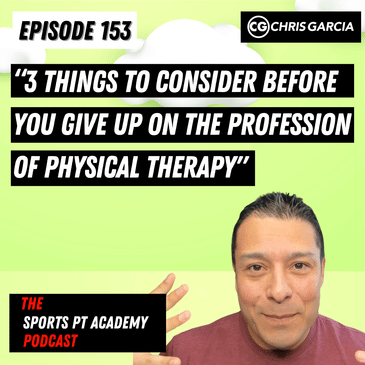
If you've thought about changing your career away from physical therapy due to burnout, productivity standards, or documentation requirements, I share three things that will help you get refocused on the career you once loved. Your passion will be reignited to help do the thing you enjoy most - helping people feel their best.
In this episode, I share three simple things to consider as you navigate frustration with the profession or in your workplace. If you're a sports PT and want to stay motivated in your career path, this episode is perfect for you. Enjoy!
————————————————————————
Are you a physical therapist or physiotherapist looking for tips, tools, and strategies to work with more athletes, become a sports specialist or get a job in a sports setting...so you can finally enjoy the career that you've always dreamed of? If so, you're in the right place...this podcast is for you. Your host is Dr. Chris Garcia, a physical therapist, business owner, entrepreneur, nationally recognized public speaker, and residency-trained sports specialist.
Dr. Chris Garcia, PT, DPT, SCS, CSCS, USAW has worked in professional sports and traveled around the world working with elite athletes throughout his career, and he's learned a lot of lessons along the way. He created this podcast to share his experiences and give you everything you need to know to help YOU become a successful clinician. Dr. Chris Garcia talks about everything from sports rehab and injury prevention to developing athletic performance and the path to getting your dream job...even if it is in professional sports.
If you want to become a successful clinician so you can finally enjoy the career you've always dreamed of, visit www.DrChrisGarcia.com.
LINKS:
www.Instagram.com/ChrisGarciaDPT
www.Facebook.com/ChrisGarciaDPT
***DISCLAIMER: This content is for educational & informational use only and & does not constitute medical advice. The content is not intended to be a substitute for professional advice or medical recommendations, diagnosis, or treatment. Please consult with a qualified medical professional for proper evaluation & treatment, or beginning any exercises or activity in this content. Chris Garcia Academy, Inc. and The Sports PT Academy Podcast are not responsible for any harm caused by the use of this content.***
[00:00:00] Are you a motivated healthcare fitness professional? Are you looking to work with more athletes,
[00:00:09] become a sports specialist, or even get a job in a sports setting so you can finally
[00:00:13] enjoy the career that you've always dreamed of? If so, you're in the right place.
[00:00:17] My name is Chris Garcia, physical therapist, business owner, entrepreneur, and residency
[00:00:21] training sports specialist. I've been fortunate to work in professional sports
[00:00:25] and travel around the world working with elite athletes throughout my career and I've
[00:00:28] learned a lot of lessons along the way. I created this podcast to share my experiences
[00:00:32] and give you everything you need to know to help you become a sports expert.
[00:00:37] Welcome to the Sports PT Academy.
[00:00:39] Hi everyone, welcome back to the podcast. Welcome all new listeners and welcome back
[00:00:47] to those who've heard my content in the past. If you want to know three things to
[00:00:51] consider before you give up on the profession of physical therapy, you need to do it
[00:00:56] into this episode. Before going to the podcast, what is new? What is bigger and
[00:01:00] better? I am coming off a huge high and I'll explain in this podcast on why. A lot of
[00:01:07] good things happening. Coming off the last month, it's been rough. A lot of personal
[00:01:12] life challenges but life is good. Always trying to stay focused on the good,
[00:01:18] on the things that are ahead. My kids are doing amazing. I'm just so proud of
[00:01:24] them. The conversations that they're having, my son Zach is home. He's a very
[00:01:28] logical human being and very rational. For a seven-year-old, it actually surprises me.
[00:01:34] It gets me on some of the things that he says. If you were on my last podcast, one
[00:01:39] of the words he's overusing but using properly in context is satisfying. I don't
[00:01:46] know where he gets his words. It's amazing to see them put it all together.
[00:01:52] My daughter and my son Jacob are doing awesome. Jacob's vocabulary has been off
[00:02:01] the charts and he's a sweet, sweet little boy. Where does he get it from? Probably
[00:02:08] more of his mom than me. I'm more of the logical, very short parent and my
[00:02:17] wife is very understanding and just a pleasant human being to be around. That's
[00:02:24] where he gets it from. Other than that, I'm back in business with training and
[00:02:30] fitness. It's been steady. Back is a little tight. If you guys know about a
[00:02:35] month ago, a month and a half ago, I injured my back and it's talking to me
[00:02:39] again. Just playing with balancing fitness. All right, on to this
[00:02:44] podcast. I'm coming with fire today. If you are a consistent listener, you're
[00:02:52] going to enjoy this one. If you are a new listener, this is going to hit you in
[00:02:57] the face and you might not like me after it. But that's okay because you need
[00:03:03] to hear this. I just had my annual planning meeting with my entire team at
[00:03:09] Sports Performance Physical Therapy in San Diego, California. I brought
[00:03:16] everyone together and we really just focused in on what it is that we want
[00:03:21] to do as a company. What's our mission? What do we enjoy doing? What are we
[00:03:24] not good at? It was amazing to hear everybody's feedback. As I talk and
[00:03:32] listen, it really fired me up on what do we do for the patients and
[00:03:39] athletes that we serve. I'm going to share one of my biggest takeaways and
[00:03:47] how it relates to what you do inside your clinical practice. The thoughts
[00:03:52] that are going in your head, I understand you. I get you. I know
[00:03:56] where you're at. I know your frustrations. I know what's happening
[00:03:58] to the profession. I know what you think about behind or after work. It's
[00:04:08] not just you who thinks about these things. It's not. I know that you're
[00:04:11] frustrated with documentation. I know you're frustrated with productivity
[00:04:15] standards. I know that you are frustrated with how you want to be
[00:04:19] able to treat patients and athletes, but sometimes it gets frustrating when
[00:04:24] either insurance is the problem or that patient can come back or whatever
[00:04:28] logistics or it's your company, it's your team members, it's whatever it is.
[00:04:34] After coming off of this meeting and coming with fire, I want to share
[00:04:38] it with you. I want you to reconsider before you give up on this
[00:04:42] profession. Let me share what's possible and what you can be doing
[00:04:47] because once you get in that brain, I understand what happens. It's
[00:04:51] a self-fulfilling prophecy. I don't enjoy this anymore. Something bad happens at
[00:04:55] work and then you're like, yeah, it's reinforced. I don't love it. For some of
[00:04:59] you who are just new to the profession, you might not have those feelings and
[00:05:02] that's fantastic. I want to keep you away from that. Maybe some of those who
[00:05:06] maybe were practicing a couple years and I don't even want to call it
[00:05:08] burnout because that's not just burnout. It's like, is this the profession for me?
[00:05:12] I know a lot of people ask that question. I've been practicing
[00:05:15] for 15 years now, going on 16 years now and I have more fire than ever
[00:05:23] after 16 years and has it dropped? Not much. There's rough years when you're going through
[00:05:30] different times in your life. You have a kid or you buy a home or you buy your first car
[00:05:35] or you get your first apartment, first town home, whatever it is that you
[00:05:39] all your milestones in life and you struggle professionally to keep up at the same pace.
[00:05:44] It's very tough. You don't have enough energy or time in the day.
[00:05:48] For those who have thought about quitting the profession, like is this for me? Do
[00:05:53] I really enjoy this? I want you to consider three things and I'm going to share those today.
[00:05:59] I'm also in different forums, groups, email lists of physical therapists all around the country.
[00:06:09] I have heard it in the time of this recording, it's January 2024.
[00:06:17] I have heard in the last three months more than ever people asking,
[00:06:26] what if you guys weren't going to do physical therapy? What would you do?
[00:06:31] What else can a physical therapist do besides treat?
[00:06:38] What are we going to do about these productivity standards? Anyone find a way to get reimbursed
[00:06:43] more? Anyone find a way to treat less people with less paperwork? Anyone find a way to get
[00:06:50] more productive with paperwork and not have to take it home or over the weekends?
[00:06:54] These are like, these are normal comments that people have. And the funny thing is you
[00:07:00] probably think them, some people just speak it out loud. And what those questions are headed
[00:07:05] towards is, is this profession for me? Is this sustainable? How can I do this? Do I even want
[00:07:12] to do this? Is it worth it? And so before you give up and you have all those things in your
[00:07:18] head, I'm here to share that one, I think that's very normal. It could be your setting,
[00:07:24] it could be yourself, it can be your environment, your work friends or colleagues who you
[00:07:28] follow, what you're doing, the patients you serve. I mean, there's so many layers to this.
[00:07:32] So I want you to consider three things as you go along this journey. And I want to share it
[00:07:37] because it's everything that I want to coach anybody and mentor anybody that's in my personal
[00:07:44] wheelhouse, my small inner circle. And for those who are inside my academy,
[00:07:50] you'll get this month too. But I think it's very important for you to
[00:07:55] consider these things as you navigate what's your professional career and your path look like.
[00:07:59] So I have some things written down, and I'm going to share them with you. All right. So
[00:08:08] before you go into like, maybe I just need more athletes on my schedule. Maybe I just want to
[00:08:13] see, I don't want to treat more back patients. I want to treat more ankles. I want to do
[00:08:17] more. Before you go down that rabbit hole, let me share what you do at a very high level
[00:08:23] so that way you don't get lost in the weeds. You have patients who are people.
[00:08:31] And these people have problems, just like you. They have normal problems we all do,
[00:08:37] whether that's January. So everyone's thinking about taxes and all these other things. And for
[00:08:42] some people it's money. Some people it's, you know, that they can't perform at the highest
[00:08:46] level. Elite level athletes, maybe it's a mom who is having back pain and doesn't have enough time for
[00:08:55] themselves to be able to have a better quality of life. And they're always paying attention to
[00:08:59] their kids or their family. Maybe it's a high school student who is about to get a college
[00:09:05] scholarship and they can't do these things because they have knee pain and they're going
[00:09:09] to risk their scholarship. Or maybe it's a young professional who has neck pain and
[00:09:15] they work at a computer all day and this is the way they make money. This is their longevity,
[00:09:21] they're just starting their career. Each of these examples are people who have problems
[00:09:27] and these problems are magnified inside their personal life. And maybe that young professional
[00:09:32] with neck pain can't even enjoy the gym because there's been so much pain it knocks them out
[00:09:39] throughout the day and they're not even motivated to go in the evening. Maybe it's
[00:09:42] that busy mom or parent who loves going to the gym because that back pain is interfering with them,
[00:09:48] they choose to not have so much stimulus and maybe they think that's the answer. Maybe I
[00:09:55] shouldn't go to the gym and maybe I should back off a little bit. Maybe that's their community,
[00:09:58] that's their outlet, that's their personal space and that's very important to them. Maybe
[00:10:03] the high schooler now has internal demons and thoughts of what happens if I don't go to
[00:10:08] college or maybe I don't get that scholarship. Maybe my parents are going to not be happy with
[00:10:12] me but they're going to be frustrated with me. These are the thoughts that go on to people's
[00:10:17] heads and you might think Chris, that's a little extreme. No it's not. It's every person that
[00:10:23] you see all the patients and athletes who come into your clinic go onto your table,
[00:10:30] have their story. They have a story. Think about this. Why would they go see you and
[00:10:36] spend an hour to two hours of their life? You're a pretty amazing human being but not that amazing.
[00:10:42] Let's be realistic about this. People don't go to see physical therapists because they're happy.
[00:10:48] They have a problem. Your job is to solve the problem. The question is, are you looking at
[00:10:55] the right problem? You have a solution but are you looking at the right problem? So for instance,
[00:11:02] high schooler with knee pain, call it scholarship. Immediately you do the subjective on the initial
[00:11:08] evaluation. What's your problem today, Samuel? You have knee pain? Let me take a look at it.
[00:11:16] Knee valgus, not good. Oh, anterior shear forces, not good. No wonder why your patella is forced
[00:11:22] now having issues. Oh, bad shoe wear. That's probably it. Many, many reasons why you have
[00:11:29] people on knee pain but you look at the impairment. You look at the movement. Then what's your solution?
[00:11:35] Let me stretch it. Let me mobilize it. Let me put some needles in it. Let me do some
[00:11:42] repeated movements. Everyone has solutions, right? But the real problem could have been
[00:11:49] that this person didn't train for four months. They decided to join the team
[00:11:56] or they were lazy over the summer and they thought they were that good and they didn't train
[00:12:03] and they only ramped up really quickly over a month. So the problem was not necessarily their
[00:12:08] movement, it was their lack of preparation. So the reality is that we're solving a problem
[00:12:15] but the real problem needs to be okay, great. Clearly you have to practice and you have
[00:12:22] to train and you have to compete at a high level over multiple hours a week. I have to figure out
[00:12:28] how to back you off and lower the stimulus so that you can have less aggravation of that tissue
[00:12:33] but still be able to train for the full season. Now while I needle, stretch, strengthen,
[00:12:40] repeated movement, whatever it is, I also need to quality control everything else.
[00:12:46] And my point to that is this person's problem wasn't impairment based. This
[00:12:51] person's problem was a fitness volume intensity who happened to have impairments
[00:12:57] who showed up with knee pain. So the problem you're solving is very impairment based and
[00:13:03] movement based but the real problem is in their health, fitness and overall lifestyle.
[00:13:11] Let's take the mom example or the parent who has back pain and they use this time
[00:13:16] to be allocated towards everything else. If you stop them from exercising because of back
[00:13:21] pain, you're actually going to worsen it. Why? Because they're going to become more
[00:13:24] deconditioned. They're going to lose motivation, gain weight, not be enjoying, enjoy the gym
[00:13:32] and lose their circle, lose their confidence and now they're even more miserable than ever.
[00:13:37] But the physical therapist thinks well you know what, it's because you're a transverse
[00:13:41] abdominis. Oh it's your erectors. Oh it's because you flex all day now you need to
[00:13:46] extend. Oh it's because your your psoas is so tight and you got to pull them in.
[00:13:50] All of those they've existed for months to years. Now you changing them is going to be great
[00:13:57] but what else was contributing to that? Were they holding their kid too much on one side?
[00:14:02] Was it the bad form in the gym? Was it because they went all out and it was January
[00:14:06] 1st and went seven days a week? Your transverse abdominis and your erectors and your psoas
[00:14:11] aren't going to fix that. You still have to quality control. What I'm saying is I just
[00:14:16] think you need to open your eyes to what you do for people before you start getting stuck in this
[00:14:21] impairment movement blah blah blah world where it never ends and the insurance is dictating
[00:14:27] what you need to be able to do. There are patients and athletes out there who have the same
[00:14:32] struggles, same problems in insurance. How about you solve the main problem the real root
[00:14:37] and look above and beyond movement, impairments, all these other things that we're trained to do
[00:14:43] when help them improve their overall health and fitness to accommodate the real root of
[00:14:47] the problem so you can have more bang for your buck and actually have more of an influence in
[00:14:52] their daily activities versus just coming to you twice a week. The root behind all this if
[00:14:58] you haven't heard in 2024 there was a big announcement for a lot of insurances
[00:15:05] and government funding to Medicare, Medicaid, all these other funding sources. There's going to be
[00:15:11] about three to seven percent cut to reimbursement. Now whether you own a PT clinic or not, you work
[00:15:20] in a PT clinic or whatever it is that you do, what that does is it negatively impacts
[00:15:26] how that contributes to the company. Now a business owner and I'm an owner myself,
[00:15:31] I have to think well how does this impact my company? I have a couple options to make
[00:15:35] and you need to know this because if your owners and whoever is in leadership and management should
[00:15:41] be disclosing this to you because it impacts your job and your happiness. Well when three to
[00:15:46] seven percent cuts impact a PT clinic and reimbursement, what that means is there's a
[00:15:52] couple of options to make. You either cut physical therapists and you have less people
[00:15:59] actually treating or you increase the standards to now increase the number of people you have to
[00:16:07] treat. So what that means is people all now if you were treating one person you might have to
[00:16:12] treat two people. If you are treating two people you don't have to be treating four people an
[00:16:17] hour. Now what's that going to do? It's going to impact quality of care. That's the first
[00:16:23] thing you have to understand that if it impacts quality of care you're not going to enjoy
[00:16:29] what you do. The patients you treat aren't going to be able to get the outcomes they wanted
[00:16:33] but there's no way around this if reimbursement keeps dropping you have to see more people.
[00:16:39] That's just the nature of it. So that's why there's a lot of people wondering I don't
[00:16:45] know if I can handle this anymore. I don't know if I can treat 20 to 40 people a day.
[00:16:51] Is that sustainable? That's the conversations people are having. So before you start thinking man
[00:16:57] I don't know if I can do this and I don't know physical therapies for me. It's all about what's
[00:17:02] the label physical therapy to you and the patients you serve. Physical therapy to an
[00:17:06] insurance company is a certain thing. Physical therapy to you is very different. Physical
[00:17:10] therapy to you is improving quality of life having like direct patient care one on one
[00:17:15] having time and while your time with them is going to drop you have to figure out how
[00:17:20] do you maximize that time and I tell you what it's not going to be just in movement.
[00:17:24] It's not going to be just in manual therapy whatever it is you're going to have to figure
[00:17:28] out other ways to impact somebody's quality of life without getting your hands on them
[00:17:32] or getting your eyes on them. That is your superpowers. Your superpowers your eyes and your
[00:17:37] hands what if you don't have access to that all the time and I'm not talking about virtual
[00:17:42] physical therapy. I'm talking about helping people across a lifespan across their fitness
[00:17:47] understanding what they do on a weekly basis understanding what they do on a quarterly basis
[00:17:51] how you can impact the total amount of stress being applied to them. At the highest level you have to
[00:17:56] understand you're helping people with their health with their fitness and their wellness
[00:18:00] you have to understand that you don't help people with movement stop saying that you
[00:18:05] help people with their health what that means is you got to start looking at really it's not
[00:18:10] knee pain because of knee valgus it's knee pain because of or preparation they didn't know what
[00:18:15] they were doing over the summer you got to get them on a program help them understand
[00:18:19] and decrease how much they work out or increase the total amount of stress decrease the total
[00:18:23] amount of stress figure out what you need to do for them in their daily life not in the clinic
[00:18:29] what did they need from a recovery stamp would they be sleeping more what's your nutrition like
[00:18:34] those are going to be more bang for a buck as healthcare providers than a simple exercise for
[00:18:38] knee pain now you can keep fighting this all day and you can stay in the movement and
[00:18:44] movement and pyramid based world you can do that all day but you're going to be
[00:18:49] stuck treating four people to six people to eight people an hour and now you might say well that's
[00:18:54] just the how my clinic works and that's fine that's how businesses have to work but what
[00:18:59] you have to understand is just because they do that doesn't mean you're happy it doesn't
[00:19:04] mean that you're going to enjoy what you do and while you can stick it out I'm telling
[00:19:09] you right now you're going to consider is this the profession for me and before you do that and
[00:19:13] you give up it's not just the business so you work for this is a problem nationwide people will have
[00:19:20] less reimbursements which means you have to see more people or more being more creative and how
[00:19:25] you serve people those are the only way out the only way otherwise you're going to be facing an
[00:19:31] uphill battle for the next few years and you're going to question it and once you come back
[00:19:35] to this podcast my job is to give you a better perspective on what's currently happening and
[00:19:40] what you can do for yourself and anyone on your inner circle if you keep hearing that man this
[00:19:45] profession sucks these patients suck I have to treat more people can you believe that documentation
[00:19:50] productivity yeah that's because of that's the circle you're in I'm telling you right now you
[00:19:55] got to get out of that mindset there are people who want more for this profession like me or
[00:20:01] willing to be creative and work around that what are your options you're going to acquiesce to the
[00:20:05] problem and and complain with everyone else or you're going to make a difference and all you
[00:20:09] can do is you start with yourself first so you have to consider what do you do for people you
[00:20:14] don't do movement you don't do impairment based treatment you don't do manual therapy you help
[00:20:18] people with their health their fitness and their wellness figure out how you can tap into those
[00:20:22] other three resources so you can have a greater impact on them look at those resources health
[00:20:27] how do you improve their health fitness how do you improve their fitness wellness
[00:20:31] wells can they be doing from a recovery standpoint you do attack those three that's where your head
[00:20:35] needs to go that's number one number two is now you have to be able to convey that to the person
[00:20:41] that you help they might be like why can't you for a knee pain yeah but you have to understand
[00:20:46] it's a total amount of stress so now we have to develop a strength conditioning program
[00:20:50] to help you understand how to apply stress across time so this doesn't happen again while I work
[00:20:55] on your movement and everything else now you added value to your service now you can do something
[00:21:00] different for them that no other physical therapist can do when it maybe you just you need to know how
[00:21:05] to figure out how to create a injured prevention program after that of pain why because you don't
[00:21:09] want to see him another eight visits over and you know you can't be able to see him you can't
[00:21:13] see him more than 15 minutes you might have to build in that program develop that for them
[00:21:18] and now they have the outcome they want they just need that program they just need to be able
[00:21:21] to do that now they come to see you monthly you're going to have to work creative to get
[00:21:24] the outcomes that you want with the patients you want the third one is so number one figure out
[00:21:30] what you do for people first at a very high level stop thinking movement stop thinking
[00:21:34] impairments stop thinking manual therapy improve people's health it's number one thing you can do
[00:21:40] second area is how do you work with them and being able to convey that information because
[00:21:43] just because you have the training doesn't mean that you can implement so the second
[00:21:46] part of that is figure out how you can deliver that message you just have to talk to patients
[00:21:50] talk to them about what they're looking for ask the questions ask the questions ask the questions
[00:21:55] if you're not asking about their overall health and what they do for a living and what they do
[00:21:59] for fitness there's no way you can get on to that next level so just because you're good at it
[00:22:03] doesn't mean you're going to be good at delivering it that's where pts struggle how do I convey
[00:22:09] this how do I say this Chris it's mind blowing to me that professionals 10 years into practice
[00:22:15] adults 40 50 plus years old we have a trouble conveying that information the reality is it's
[00:22:21] a simple conversation ask what what do you do on a regular basis for exercise what's your work
[00:22:28] life look like like are you standing are you moving great oh I see you sit and then you
[00:22:33] deadlift I see rather than giving you more flexion based stuff how about we look at your
[00:22:38] mechanics how about looking at ergonomics now let's have you stand up for a little bit more
[00:22:42] how's your sleep let's talk about that oh you only sleep for hours and you have back pain and you
[00:22:46] train five days a week and you have poor posture and you have poor mechanics you guess what your
[00:22:50] flexion extension exercise your man therapy is not going to help the total amount of stress be
[00:22:54] even applying to that back so you have to look at how do you improve their health profile
[00:22:59] next convey that information by asking questions number one figure out what you do for people
[00:23:05] first number two figure out how to deliver it three now that you've figured it out oh I'm the
[00:23:14] health expert number two I now had that conversation now number three is I have the pressure now have
[00:23:19] to deliver on that information now I have to figure out what's the best practice or best
[00:23:23] guidelines for stretching for stretching best practice got practice guidelines for nutrition
[00:23:27] what's the best practice guidelines for sleeping what's the best practice guidelines for strength
[00:23:31] conditioning what's the best practice for injury prevention programs those are better problems to
[00:23:36] have than figuring out how do I manual there how do I do more manual therapy to get better outcomes
[00:23:41] in 15 minutes you will head up a horrible horrible wormhole trying to figure out how to
[00:23:47] get better at manual therapy for the next five years of clinical practice why because your
[00:23:51] impact will be very very small relative to how many minutes and hours you spend with somebody
[00:23:57] across a day a week or a month that time is going to be decreasing rather than get better at
[00:24:02] hammering nails figure out how to create a better foundation of the house you're trying you're so
[00:24:07] focused in on how to create a better outcome in a shorter period of time versus how do I create
[00:24:13] the best outcome in the shortest amount of time by understanding what they do across a week
[00:24:19] across a month with reimbursement dropping number of visits going up quality of life will
[00:24:25] go down unless you understand what you do for people and you get more creative on how to deliver
[00:24:31] that outcome it is what the profession of physical therapy is doing right now and you have to
[00:24:39] so physical therapy will go down that rabbit hole you as a professional need to keep growing
[00:24:43] and ascending more than the profession the profession is not your limit your limitation
[00:24:50] your own brain is the limitation so before you give up on this profession how about you improve
[00:24:55] how you view what you do for people and let everyone else go down that rabbit hole of complaining
[00:25:01] and trying to figure out how to get better at manual therapy in 15 minutes that's where
[00:25:05] everyone else is going you go the other direction because that is where i'm taking anybody that
[00:25:10] I mentor anybody that's in my wheelhouse anybody in my inner circle because that's what we're
[00:25:15] trying to figure out everyone is going to get creative and that's what I share with my inner
[00:25:19] circle so if you're stuck if you are like or you're going that direction you don't want to be
[00:25:26] part of that come over to the dark side I have multiple programs I have multiple mentorship
[00:25:33] opportunities I just need to get you closer to me I need I want you to figure out stop
[00:25:39] listening to the junk stop figuring out how to get better at something that is a declining service
[00:25:46] figure out how to get better and more creative on how you can deliver a different service a
[00:25:50] better outcome and not be capped by somebody else saying that you have to do it a certain way
[00:25:57] if that's of interest to you there's two routes right now if you are a younger clinician
[00:26:03] I would start with my Kickstarter program it's an eight week online mentorship course
[00:26:12] you can find more information drcriscarcia.com forward slash Kickstarter if you are sick and tired
[00:26:18] of things and you're like I just want one on one time I want to be able to navigate these I want
[00:26:24] to have good conversations it's all in my brain and I don't feel comfortable talking to other
[00:26:28] people about it I think that this is only me I am sick and tired of this I'm questioning whether
[00:26:33] I'm burnt out or not you need to join my academy because I know what you're thinking I've coached
[00:26:39] people through I've mentored people through it it's normal it you just got to get creative with
[00:26:42] your environment and no it's not like well I'm a new grad or I've been practicing 20 years I'm
[00:26:47] different no it's not we're all the same human we all process the same information
[00:26:51] if the difference is we all have thoughts right we all have thoughts but the difference between
[00:26:58] people who have negative thoughts or poor thoughts or great thoughts and the ones who are successful
[00:27:03] are the ones who execute on those thoughts so while you can say well I'm going to change the world
[00:27:08] and then two weeks later you're like I still hate my life I still have a professional career I
[00:27:12] hate my job those are all negative thoughts the people who execute the ones who are
[00:27:17] top of the mountain looking down and it has nothing to do with how much prestige and already
[00:27:23] they have it has nothing to do with it it's just a person who could create thoughts into execution
[00:27:27] to action and if you are stuck in your head and you're like I just need I need to work through
[00:27:33] this or I just I have the ideas I just need to know where's the right direction for me I'm
[00:27:39] ready to do it I'm ready to create action in another case my sports PT academy is the
[00:27:44] place for you you can go to drchriscarcia.com forward slash academy and if you're still in
[00:27:51] in the works and still in the middle take any of my courses listen to the podcast follow along
[00:27:56] send me an email I'd love to have a one-on-one with you if you have any questions about anything
[00:28:00] that I do or can do inside your world to make you a better professional send me an email
[00:28:06] drchris at drchriscarcia.com in other case I'm here to help you absolutely crush it
[00:28:13] in your professional personal career so thanks for tuning in I hope you guys are doing absolutely
[00:28:18] amazing and living life to your fullest I will see you guys on the next episode take care.
[00:28:43] you with great information to become sports experts if you have any questions reach out to my team at
[00:28:48] drchris at drchriscarcia.com and tell us exactly what you're looking for do you want more head
[00:28:54] over to my website drchriscarcia.com and sign up for my VIP email list to stay in touch with
[00:29:00] my latest updates on courses and mentorship programs if you know someone who would benefit
[00:29:04] from my content please share this episode with them until next time have an incredible day