
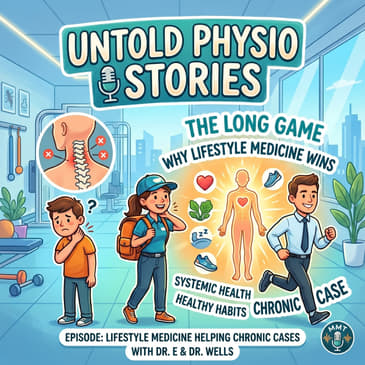
Is your "3-visit fix" failing on chronic cases? Maybe it’s not the tissue—it’s the ecosystem.
In the latest episode of the Untold Physio Stories Podcast, Dr. Wells and I dive into two cases where standard ortho-manual therapy didn't move the needle, but Lifestyle Medicine did.
I share a case of a delivery driver with persistent left-sided neck pain. We tried the resets. We tried cervical retraction. Nothing stuck because she wasn't motivated to do the homework. But when we pivoted to what she actually cared about—walking her dog and cleaning up her diet—everything changed. Fast forward a few months: she’s wearing a weighted vest on the job, hanging from a pull-up bar, and her neck pain is history.
Dr. Wells hits home with a similar story: a high-level executive dealing with a "whack-a-mole" of chronic issues—from tennis elbow to plantar fasciitis. The secret wasn’t a better mobilization; it was addressing systemic stress, alcohol intake, and sleep apnea.
Key takeaways from the episode:
Meet them where they are: If they won't do a reset, will they wear a rucksack?
The Power of Proactivity: Being embedded in a workplace allows for 5–15 minute coaching "nuggets" that have more impact than a 60-minute clinical lecture.
Play the Long Game: Lifestyle changes don't happen in 3–4 visits. Think 6–8 months to truly clean up an ecosystem of sleep, nutrition, and movement.
Stop treating just the joint and start treating the person's life.
Untold Physio Stories is sponsored by
Comprehend PT- Leave Comprehend PT running in the background or record audio when you have time. The AI based SOAP note generator does the rest! No need for accuracy or exact wording! It's a game changer and will give you more time with your patients! Use code MMT50 to save 50% off your first month. Free trial available at sign up!
The Eclectic Approach Network - Check out Dr. E's all new private, non tracking and ad free network for rehab pros! It's free to join, has chat, feed, and all the features of other social networks without the creeping tracking.
Check out EDGE Mobility System's Best Sellers - Something for every PT, OT, DC, MT, ATC or Fitness Minded Individual https://edgemobilitysystem.com
[00:00:00] Welcome back to Untold Physio Stories Podcast. I'm your host, Dr. Erson Religioso III Dr. Sean Wells and I are doing another asynchronous episode. Not sure if you guys can hear my dog in the background. He's panting. It's hot out today, finally, in Buffalo, New York. And I just took him for a 25 minute walk. So that makes him a good boy. Anyway, my current case I'm talking about today is a client I've been working with for several months, just on and off.
[00:00:25] I'm embedded in a workplace. So if we have, you know, anywhere between a five to 15 minute quick conversation, maybe I suggest to her set or I do a little lifestyle coaching. That's all the time we have. But I've seen her for probably three or four times over that many months. About four months ago, she said, hey, Dr. E., I have some left-sided neck pain. What would you suggest I do for this?
[00:00:51] So at the time, I noticed that her head was slightly side bent to the right. She said that in terms of her eyes and her vision prescription, one of her eyes is stronger. So she's always had a slight side bent to the right, maybe about five degrees. We're looking at her range just quickly. She had a loss of cervical retraction and side bending to the left. She was moderately limited and not too painful. To the right, she was functional, non-painful.
[00:01:19] So she had full range. I suggested at the time, hey, why don't you just do a trial of cervical retraction and side bending to the left? Along with the 2020 rules, her role at the corporation is a messenger, meaning that she just goes all around the various sites and she delivers mail and picks up things from the warehouse and potentially delivers small parcels.
[00:01:46] So the next time I saw her was about a month later and she said, you know, my neck's not really any better. And I said, well, have you been doing the resets? And she said, no, you know, I do them sporadically, but not as much as I should. And she does spend a lot of time sitting in her delivery van. So I said, why don't you try to give that a little bit more, you know, give it a little bit more of a try, be a little bit more diligent. That was just a quick conversation in passing.
[00:02:11] The next time she said, hey, you know, my neck is still bothering me and she is just not really motivated enough to do the resets, even though I probably gave it, you know, from my experience. And what the Journal of Anecdotal Evidence tells me that she had a high percentage of getting better if she just kind of was a little bit more active and she varied her positions and she did the resets.
[00:02:37] I gave it like at least an 80% chance that that would have resolved her complaints as they were intermittent to begin with. So I said, well, what are you motivated to do? And she said, well, you know, I've been meaning to just clean up my diet a little bit and exercise a little bit more. And granted, her diet was already pretty clean. She doesn't really eat any junk food, but she had a habit of snacking and eating, you know, before bed.
[00:03:05] So I said, all right, so if you're more motivated to clean up your diet and do physical activity, what kind of activities do you like? She said, well, I like to walk my dog. And I said, well, do you feel like that is enough exercise? She said, no, I do that every day. So I don't think that currently that's not enough exercise, but I do enjoy doing that. And I said, well, you know, I actually walk my dog with a rucksack on and I explained to her what that was.
[00:03:34] And she said, okay, well, maybe I look into that. And so then I don't see her. And that was the only thing I suggested was basically, you know, increasing her physical activity and finding things that she likes to do. I see her then maybe two months later and she looks like she's actually lost a decent amount of weight. And I said, hey, you know, how's your neck doing? She said, my neck is so much better.
[00:04:04] And I said, well, what have you been doing? Did you do those resets? She said, no, I didn't do the resets. But she eliminated all processed foods, all gluten. And she only eats whole foods now. She no longer snacks. She wears a weighted vest, not only when she walks her dog, but she wears it anytime that she's basically not sitting at her desk at work. Anytime she's doing delivery, she started taking the stairs. So she wears it on the job, all over the job.
[00:04:33] And she also bought a hanging bar and she does, you know, several minutes hanging two to three times a day. So, you know, these lifestyle changes are not easy to do. But I think the thing that I love about the proactivity model where we, you know, we go where the people are is we are embedded in corporation.
[00:04:58] When you have access to people, you know, where they are at work and you have these little conversations and you make them more open ended and you use more of a coaching type approach as opposed to, you know, hey, you need to lose weight. You need to increase your physical activity as opposed to, you know, asking them what they like to do. And then, you know, go from there and come up with kind of like an actionable plan. You have much more of an impact.
[00:05:24] And you'll find these things maybe like recurrent neck pain, recurrent back pain. They tend to get better on their own as a result of cleaning up the entire ecosystem from sleep to physical activity to nutrition. So let me know what you think about this case, Dr. Sean Wells. And I'm sure based on, you know, how healthy you are and how much you know about nutrition and physical activity in general that you've probably had similar results. Feel free to share a case. Hey, Dr. Yee. It's Dr. Wells.
[00:05:54] Sounds like a great case. It's amazing how lifestyle factors can play such a big role in not only pain generation, but quality of life. And how much more we as physical therapists and rehab professionals need to start looking at our model of delivery as more than just that point of care for that one injury or that one, you know, that one problem as we like to define it as.
[00:06:21] That's something I know like early on when I started practicing as a as a personal trainer, I could see things a little bit more holistically. And then as I moved into athletic training and then obviously into physical therapy, I felt like the further I went, the further we moved away from kind of holistic care more into just one problem sort of base care.
[00:06:43] And so it's refreshing to see now that more PTs and more providers like yourself were starting to take more of that lifestyle medicine approach. And I think that's something that we have to do. So in my case, I can remember a patient that I had, he was extremely challenging in terms of having many complex chronic pain syndromes.
[00:07:08] So everything from tennis elbow to plantar fasciitis. And it always seemed like it was a whack-a-mole sort of sort of treatment. In other words, one point is plantar fasciitis would be under control. And the next thing you know, he'd say, you know, now I'm starting to develop this really bad tennis elbow. And then we move from that to suddenly, you know, now my back, I just can't get rid of this tailbone pain. What did I do?
[00:07:35] And early on in the programming, I remember doing a thorough dietary assessment and really getting an idea of how much ultra processed foods he was consuming, as well as the amount of alcohol he was consuming on a daily basis as a coping mechanism and really understanding his history. He was a high-level executive at Chase and he had recently retired.
[00:08:05] And that's when he started noticing a lot of these pains popping up. So it's interesting in your case how this young lady had a, you had to find, kind of meet her where she was at in terms of her day-to-day, in terms of getting, you know, finding what was interesting to her, obviously starting her out on a whole new, like, resistance training program or, you know, P90X or, you know, something like that.
[00:08:30] It was, like, probably not up her alley, but finding something she was already doing, you know, like walking the dog or, you know, walking around the office and just modifying that in a way with the dosing as well as enhancing her cleanup of her diet was great. With this particular patient, my former Chase executive, he, you know, I had to find ways to meet his needs
[00:08:52] in that he lived this high-performance, high-tiered lifestyle, and now suddenly he was sort of in retirement mode, right? So I had to realize that there was a lot of factors to address there from getting him sort of out of this systemic stress, fight-or-flight sort of mindset, getting him down to a little bit more of a relaxed state.
[00:09:22] He certainly was not in the mood to meditate, certainly was not barely in the ballpark of finding breathing exercises, like, in his wheelhouse. So sometimes with him it was just starting with simple breath techniques as well as taking breaks from things like the news and his cell phone. So taking tech breaks because frequently news events would come out or stock changes or, you know, earnings report would come out
[00:09:51] and it would just drive him absolutely through the roof in terms of pain. I could almost predict it like when it was a big market shift or something happened that day, news-wise, it would be like, oh, now my, you know, my back is really just flared up. And I could see those associations with his stress level. And so with him starting a full-on meditation program, being with his background, wasn't somewhere where I could start him.
[00:10:20] Going back to his diet, same thing, he loves Italian food. And some of the Italian food obviously can be very, very, very healthy. A lot of the Mediterranean-based foods are great. However, definitely a more ultra-processed type of an Italian diet. So a lot of things like biscottis and sugary baked goods, again, heavy influence on wine, real heavy meat sauces at night and things,
[00:10:49] which would obviously then shift and affect his sleep patterns. And so that was a whole another component of talking about truly what a Mediterranean diet is and just educating him around that because he thought, well, I'm eating Italian food that's Mediterranean. I thought that was healthy, Dr. Sean Wells. And, you know, kind of diving into the details of what a Mediterranean diet looked like was right up his alley because he, again, a detail-specific kind of guy with his executive background.
[00:11:19] He loved getting into the numbers and things. So I could kind of outline to him, like, what a good kind of healthy, very plant-forward type of Mediterranean diet looks like versus kind of what he was eating, which is a lot of refined sugar and heavy fats and a lot of, again, heavy meat-based sauces. So shifting that dietary program really helped him lose a little bit of weight but also improved his sleep
[00:11:46] and most likely helped some of his inflammatory status. So obviously then tying in his sleep, I really, really pushed him to talk to his primary care to look at a sleep study to see if he was having some sleep apnea, and sure enough, he had. And so his primary recommended him get it on a CPAP machine and obviously then at that time, you know, encouraged him to lose weight, which he was in the process of doing.
[00:12:16] But that gentle nudge of helping him get sleep, I also noticed helps his anxiety, which helped his pain response. And then tying that in with his, you know, reduction in following the stock market and working on breathing techniques, all of those helped reduce his anxiety, which improved his threat to movement. And overall, we moved him in the right direction, and he ended up working with one of my associates.
[00:12:43] I ended up moving out of the area where he was at, and one of my associates, Dr. Otto Yasko, he picked up working with him, and he just kept moving that needle further and further. So instead of just working on breathing techniques, he actually worked on, like, getting into meditation pathways instead of just focusing on nutrition, really swapping out alcohol for other sort of behaviors.
[00:13:11] So looking at behavior modification and patternistic ideas of, like, all right, it's 5 o'clock, let's go for the glass of wine. Like, okay, now instead of doing that, let's, like, it's 5 o'clock, let's go for a walk. And swapping out that behavior of sitting and drinking for something more active. So my associate did a great job now. The patient has lost a significant amount of weight. He has maintained a healthy lifestyle.
[00:13:39] He doesn't have these chronic pains that pop up every now and then. And if he does, you know, that pain neuroscience education, that was something else my associate really moved him into, is the notion that when there is pain, it doesn't always mean there's some sort of tissue damage. It may be a signal or maybe you overloaded something or we need to, you know, look at your training volume or something. But overall, it doesn't always mean something's damaged and you're not racing off to get the MRI like he used to do
[00:14:07] or, you know, demanding an initial PT consult for some new injury. So, yeah, it's amazing how the lifestyle factors, they can all tie in together. And more importantly, for each of our cases, I see how you have to meet the patient where they're at. And I know for us, like going through lifestyle courses as well as, you know, teaching lifestyle medicine course, we want to just go right in, you know, for the jugular, right? You want to go for the big home run.
[00:14:35] And sometimes it's a matter of just getting to first base with your patients. And it's a lot of levers to pull. And I know a lot of PTs, particularly in an insurance model, it's not easy. You have to cover all the bases with documentation. You're trying to solve for that problem, right? That plantar fasciitis or that tendons elbow. I'm just trying to focus on that, Sean. I don't have time to focus on all these other things. I think the big takeaway for me is, you know, each interaction you have,
[00:15:01] you can try to address maybe one component of that lifestyle, right? So it's sleep one day, maybe the next day it's a little bit of pain, neuroscience education. And you have that time, particularly in the sessions with like manual therapy or if they are doing a warmup, right? Take that opportunity to not just, you know, chat the patient up about whatever's happening in the news or, you know, talking to them.
[00:15:30] Maybe you're telling them about the intervention you're providing, but you have that opportunity to get that information across to them and also to get the information from them, right? In terms of what their interests are and what their expectations are so that you can then match that education and that lifestyle factor, particular for that individual and where they're at. So overall, great case, Dr. Ian. It's cool to hear about the rucksack too. I love that.
[00:15:57] I have several clients that use those and they've had really good outcomes. And I've done it myself a little bit, but I'm still big into running, surfing and pickleball. So anyhow, love to hear from other PTs and other providers out there. What are you doing in terms of lifestyle? If you like this, subscribe and check out more of our stuff. And we look forward to doing more of these lifestyle medicine podcasts soon. Take care. Hey, Dr. Sean Wells.
[00:16:27] Great job with that case and that executive. I know that type can be very difficult. And I think the thing we both did was basically just take it one step at a time. I think, you know, the pillars of lifestyle medicine and productivity, we call them the elements. We shorten them to five. And I know traditionally all six of them, people think they have to address them all at once. And it becomes rather overwhelming. But when I use it from a coach approach and I just kind of take,
[00:16:54] you know, five to 15 minutes of just coaching and having an open-ended, like, hey, which one of these do you think you could handle at this point? Or, you know, what do you currently think about your diet? And have you ever wanted to make changes? And what type of physical activities do you enjoy? Basically, kind of like what you and I both did. You know, you don't have to do these all at once. Or like you said, you can do it, you can have a quick conversation with them
[00:17:23] when they warm up in a treadmill or when you're doing manual therapy. It doesn't have to be, you know, sitting down and, hey, let's do a lecture on why the Mediterranean diet is more anti-inflammatory than the typical Western diet. So, you know, that was really enlightening in how much you could accomplish. And it's also really a long game. I think those of us who are used to seeing rapid responders in the physical therapy world, you know, we're used to hitting home runs and three to four visits
[00:17:51] and everyone's chronic low back pain or chronic knee pain, whatever, is gone. They return to sport. They return to working out and everything. But lifestyle medicine can make huge changes in these slow or non-responders. But it is a long game. And both the clinician and the patient have to realize that. I think once the patient is open to that, then you as a clinician have to realize that this is not going to be, you know, a three or four session, at least traditional three to four week length of care.
[00:18:19] It's going to be more in the, you know, six to eight months potentially. So as Sean said, if you like this podcast, please rate us five stars wherever you listen to podcasts, especially on Spotify and Apple as that helps our discoverability. And you guys have a great day.