
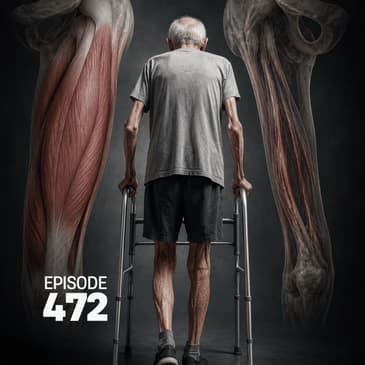
In this episode of the Optimal Body podcast, doctors of physical therapy, Doc Jen and Doctor Dom explore sarcopenia, the age-related loss of muscle mass and strength. They explain that while muscle mass peaks around age 25 and gradually declines, sarcopenia is not inevitable. Lifestyle factors like inactivity and poor nutrition significantly accelerate muscle loss. The hosts highlight resistance training as the most effective intervention, citing a 12-week study where sarcopenia prevalence dropped from 35% to zero. They encourage listeners to start strength training and optimize nutrition, framing sarcopenia as an environment- and activity-related condition rather than an unavoidable consequence of aging.
Needed Discount:
Jen trusted Needed Supplements for fertility, pregnancy, and beyond! Support men and women’s health with vitamins, Omega-3, and more. Used by 6,000+ pros. Use code OPTIMAL for 20% off at checkout!
We Think You'll Love:
For full show notes and resources visit https://jen.health/podcast/472
What You'll Learn:
0:29 Sarcopenia is the age-related loss of muscle mass and strength, increasing risks for falls, diabetes, and other diseases.
1:31 Officially recognized as a disease in 2016, muscle mass peaks around age 25 and declines significantly after age 50.
4:08 Sarcopenia is not inevitable. Sedentary lifestyles and poor nutrition are major contributors, more so than just aging itself.
6:10 The hosts discuss the challenges of maintaining a consistent workout routine while raising young children and feeling exhausted.
7:43 The prevalence of sarcopenia increases significantly with age, rising from 5% in your 60s to over 50% after 80.
9:12 While overall prevalence is similar, women can experience accelerated muscle loss after menopause due to hormonal changes like decreased estrogen.
11:09 Resistance training is the number one evidence-based, non-pharmaceutical treatment for preventing and reversing sarcopenia
12:01 A 12-week study showed a progressive resistance training and nutrition program reduced sarcopenia prevalence from 35% to 0%.
13:29 Strength training reduces muscle breakdown, enhances muscle growth factors, mitigates inflammation, and triggers muscle hypertrophy to build new muscle.
14:22 Improving strength also...
Hosted by Simplecast, an AdsWizz company. See pcm.adswizz.com for information about our collection and use of personal data for advertising.
[00:00:05] Welcome to the The Optimal Body Podcast. I'm Dr. Jen and I'm Dr. Dom and we are doctors of physical therapy bringing you the body tips and physical therapy pearls of wisdom to help you begin to understand your body, relieve your pains and restrictions and answer your questions. Along with expert guests, our goal of the The Optimal Body Podcast is really to help you discover what optimal means within your own body. Let's dive in.
[00:00:28] So today we're diving into sarcopenia, which is a topic we could have talked about on a podcast from a couple weeks ago where we talk about the truth about aging. We kind of decided that since we didn't have it, we wanted to do a full episode on sarcopenia because this is something that is so talked about, especially as we age. What is it? It's the age related loss of our muscle mass specifically. But it's more than that.
[00:00:58] It's not when we lose muscle mass. It's not just like, okay, we have less muscle. That means we're losing our strength. Our risk for falls increases. It also increases our risk of developing other things like type two diabetes, living with disability, hypertension, obesity. So muscle is so important and protective to our health. Having muscle mass is so important to our metabolism, our insulin resistance, everything.
[00:01:25] So that is why we think it's so important. So that is why we think it's important. We do a full episode covering sarcopenia. Yes. Now it was officially recognized as a disease in 2016. Which sounds super late to me. That's what I think too. 10 years ago is just when they defined it, which again, it doesn't mean the disease quote unquote didn't exist. It means they finally classified. A medical code. A medical code based on this loss of muscle mass.
[00:01:54] Right. But here's the timeline. I think, especially as a woman that like everyone needs to know that muscle mass peaks at around age 25, which as a 38 year old, that already sounds so far away. But to be honest, I'm getting stronger. So let's just lay that out. Now, after 50 muscle mass declines at about one to two percent per year, which that sounds like a lot.
[00:02:22] And then muscle strength drops about 1.5 percent per year between the ages of 50 and 60. So it's just like, especially when we hit that middle age, that those 50s, it's like we need to start paying attention to this. I mean, in our 30s already, it's like our peak is 25. But this, especially if you haven't done anything yet, we need to start doing something about it now.
[00:02:46] When it comes to supplementation, there's a lot of noise out there, which is why I've always turned to my registered dietitian friends to actually understand what I need to maximize my bone, tendon and muscle health as I continue to age. I already know what to do in the gym and movement wise, but I need to know nutrient wise what I could better do to help support my body as I age. And I have always turned to Needed when it comes to supplements because I trust their third party testing, the research that they do and the evidence behind their products and especially how they dose.
[00:03:13] They dose at optimal levels, not bare minimum. This is what I relied on trying to conceive pregnancy and postpartum. But now that I'm not nursing, I've been using their vitamin D to support my bone health. I've been using the omega-3s to support my heart and brain health. And I've been using their sleep and relaxation supplement. I absolutely love this. I put it in a little bit of my hot chocolate bone broth at the end of the night.
[00:03:38] And it's something that helps because it has L-theanine, which helps with sleep latency, which means you're not going to take as long to fall asleep, which is key when I have these two littles that don't love to sleep right now. So I cannot recommend Needed Enough. And if you have not checked them out, I highly recommend heading over to thisisneeded.com. Use code OPTIMAL for 20% off your first order. That's T-H-I-S-I-S-N-E-E-D-E-D.com and use code OPTIMAL to get 20% off your first order.
[00:04:08] And I want to point out that this drop in muscle mass, I feel like it's always defined as an age-related drop in muscle mass. So it's like, it makes it seem like age is the only thing. You get older, you lose muscle mass, which we know this is population data. So these are all averages based on like accumulating. If we look at everyone, these are the average amounts. Muscle mass goes down, strength goes down.
[00:04:32] But we all know the people who, like you said, hey, I'm, you know, in my late 30s and I'm getting stronger. I'm literally stronger than I was at 25. Yeah. Stronger. I'm improving my muscle mass. And we all know the person who made some big changes later in life and they're in their 50s or 60s and they start working out and they get jacked. Yeah, 70s. So like we know that like this isn't 100% inevitable. No.
[00:04:57] You know, sarcopenia is driven by, yes, aging, hormonal shifts as we age, which with men that's related more to testosterone. With women, there's a lot more hormones at play. So there can be definitely more impact, especially as women go through menopause, sedentary lifestyle, poor nutrition. All of these things kind of play into this picture. And the one that I want to point out the most is sedentary lifestyle.
[00:05:23] Because based on the definition of sarcopenia, age-related decline, we think that age is the biggest thing. No. Again, we've seen all these examples of people who change the activities they're doing, who make changes to that sedentary lifestyle. I would argue that our physical performance is at 25 with, you know, highest muscle mass. You know, everything's at its peak because when we get past 25, we're starting to get into work. We're starting to grow families.
[00:05:53] We have a lot more responsibilities. Our activity probably drops. Yeah. And to me, if I was a betting man, that probably plays into the picture the most because there's research that shows we can stop and even reverse sarcopenia. Right. By changing our lifestyle behaviors. I think that's encouraging as well, at least for me to hear. Like, even talking with my sister yesterday. And she was saying how, like, at this stage that we are right now with our super littles, it was, like, really exhausting. It's hard to get, like, your workouts in.
[00:06:23] It's hard to feel as motivated and as encouraged to do it when you're getting less sleep. But now she's like, now that my kids are older, like, I feel like I have so much energy to go work out and lift heavier and, like, actually focus on me again. And I was like, okay, it's going to come back. I mean, as you say this, I literally, our littlest guy is going through some struggles at, you know, night right now. We tried moving the boys into the same bedroom. That's a different podcast. That's a whole different podcast.
[00:06:51] But every morning, my wake-up alarm is him, either with his little Ellie, swinging it and hitting me in the head. Or he just, like, pounces on me. He's like, I'm up. Pounces on me like a freaking jackal, just like. And I look up at him and he's, like, laughing and giggling. I know. And I think it's also, like, you do look at someone like Dom who's very fit and you're like, but wait, what do you mean?
[00:07:20] You know, you're not losing muscle. But at the same time, you haven't been doing very many structured workouts. You're barely getting back into lifting again and doing more structured workouts. I'm for sure a yo-yo strength trainer. I do, like, two workouts in a week and then I go a couple weeks and then maybe I'm consistent for three weeks. And, yeah, it's not very consistent. But this is where it's, like, if we're not consistent, this is how it can break down, you know, with developing sarcopenia as we age.
[00:07:49] So, like, between 60 and 69, the prevalence is about 5% to 16% of getting that actual diagnosis. In the 70s, the prevalence rises to about 27%. In the 80s, 36% to 45%. And then by your 80s, it's basically, and 80s and up, it's basically a coin flip whether you're going to be diagnosed with sarcopenia. So, this is so incredibly important if we are not doing anything about it.
[00:08:19] Just that prevalence as it starts to increase from 60 and beyond can be quite alarming. And so, hearing those numbers, it's like you might think, I'm not even close to 60. You know, I'm in my 30s or I'm in my 40s. I'm active. Yes, I have kids, but I manage. And, yeah, that's great. So, right now is the time when you can build up more of your insurance policy. Again, not meaning that when you get to your 60s, you are not still going to be able to strength and resistance train.
[00:08:48] We know plenty of people, your mom at 73 is continuing to strength train and resistance train. But now is when you have a little bit more of that buffer to build up that muscle mass, to gain the health benefits over the next decades of maybe having a little bit more lean muscle mass before we get into the 60s, 70s, 80s where the prevalence really starts to increase.
[00:09:11] And this is like, you know, we have to realize that, yes, there's differences between men and women. However, we do see overall prevalence is similar between the sexes. So, men, it's about 18.7% and women, it's about 18.8%. Now, the trajectory and the consequences can kind of differ based on those hormonal disruptions that women face after menopause.
[00:09:37] So, we have this acceleration of muscle loss because estrogen plays that protective role in the muscle tissue. With that being said, it's not that, you know, okay, you're doomed because you go through menopause. No, we're going to talk about exactly what you can do, even though that is playing such a major role. And older women specifically are, you know, kind of underrepresented in sarcopenia research.
[00:10:04] And so, this is where we also get like that mixed gender populations and really understanding the research and what that means specifically for women. But we don't want to treat this necessarily as like, oh, women have it worse. Like, this is something as a whole population everyone needs to be paying attention to. And it is important beyond sexes. And kind of like we mentioned at the beginning, losses in muscle mass, meaning associated losses in strength also increases our risk of falls.
[00:10:33] Women are already at a higher risk of having fractures, you know, related to falls. So, there's that to pay attention to. On an encouraging note, there was a 2026, so a brand new meta-analysis that confirmed that resistance training specifically improves the hand grip strength, gait speed, knee extension strength, and mobility in older women with sarcopenia.
[00:10:58] So, kind of proof there or evidence there to show that even in older populations who already have sarcopenia, we can still make strength improvements. And I think, you know, what we're going to talk about, what everyone knows, the solution is that strength training really is what the research says. Resistance training is the number one evidence-based non-pharmaceutical treatment for sarcopenia.
[00:11:24] And this is endorsed by the American College of Sports Medicine and International Conference on Fragility and Sarcopenia Research. So, the exercise resistance training done properly, done safely, is the first line that we should be looking at rather than how do I just walk more? How can I add a weighted vest? Or how do I do more low impact or make sure I'm being safe?
[00:11:51] It's like, no, we need to focus less on becoming more fragile and more on becoming more robust so that we become more resilient for our system overall. So, there's one study that if you could hear anything, I would want you to listen to this. There was a 12-week randomized controlled trial. So, it's just a single study, but randomized controlled trial is one of the higher levels of evidence with adults average age of 69.
[00:12:19] So, this is kind of at the stage where people are starting to develop sarcopenia and you're going into your 70s. Some of the people in the study were obviously older than 69. And they did a progressive resistance training with nutritional consultation, the experimental group, for 12 weeks. And the result was the sarcopenia prevalence in the intervention group dropped from 35% to 0%. That's crazy.
[00:12:48] In just a 12-week resistance training and nutrition consultation program. 35% down to 0%. There wasn't a single person in the control group that qualified for a diagnosis of sarcopenia after just these 12 weeks. So, the control group, on the other hand, who did nothing over these 12 weeks actually saw an increase in the percentage of people that were diagnosed with sarcopenia. So, I mean, that's like almost negligence at that point, right?
[00:13:18] To have a control group that does nothing because then we're increasing. You know that they're going to have worse outcomes at this point. Right. And to get down to zero, that's pretty crazy. So, going over some of the physiologic mechanisms to just understand what strength training is actually doing for our body is it helps reduce essentially our muscle breakdown, the protein catabolism. Instead, we're focusing more on anabolism or anabolic processes, which is the building up of our muscle.
[00:13:47] Enhances muscle growth factors, which are just hormone communicators that are going to help with those building processes, mitigates immunosenescence, age-related immune decline, as well as inflammaging, which is, you know, strength training can be protective against inflammation and chronic inflammation as we age, can be related to the breakdown of our tissues. And it also triggers muscle hypertrophy through some of these processes we just talked about with,
[00:14:13] you know, the muscle growth factors, but actually growing new muscle fibers and strengthening the muscle fibers that are there. And some of the biggest things when you're improving your strength overall, we're not just improving our muscle strength, but we're improving our postural balance, which is something that's really important to for our confidence as we're navigating different surfaces
[00:14:37] or we're holding groceries or we're, you know, we want to reduce our risk of falls all that we can. So just by improving our muscle strength, we're already improving our balance. We're improving our gait speed, which is something we measure as we age in physical therapy. We want to know, you know, are you at a risk of increased falls based on how fast you can walk? That is literally something that we're measuring as a disability factor.
[00:15:05] I think one of the most encouraging things as well is that even in the oldest of old, so those in their 80s and 90s, machine-based progressive resistance training has been shown to potentially reverse osteopenia by improving muscle strength and physical performance. Reversing it, even in your 80s and 90s, like there is things that we can do not only to stop or to mitigate or to slow down, but to actually reverse no matter what age you're at.
[00:15:31] So this is another indication that it is never too late to start. And there's this example after example of studies that show these benefits, like an eight-week progressive resistance training program that showed significant improvement in appendicular skeletal muscle mass in older men with sarcopenia. That just means the muscle mass in our arms and legs, which is actually the majority of our skeletal muscle mass, or a six-week squat routine. I thought this one was interesting, that improved hand grip strength and knee extensor strength
[00:16:00] in older women with sarcopenia. I would expect in a squat routine that we would for sure improve our knee extensor strength, but hand grip strength too, like it kind of shows that there's a global effect of doing resistance training. So like we said, age, yes, it can matter. It lets you know where you're at on the timeline, but it doesn't mean like we have all these examples of these randomized control trials and meta-analyses that show regardless of your age,
[00:16:29] there is a plan that can help to stop or reverse the loss of muscle mass. And here's what I need people to hear. When we talk about, okay, what do I do? We need to get away from really gentle. Yes, we want progressive, safe, but we need to stop treating people as if they are already so fragile because that is not what's going to be the goal in actually creating strength impact change.
[00:16:57] Now, and this is where physical therapy as well can be one of the biggest culprits in enhancing this like, oh, just sit down and do some ankle pumps or knee marches at the end of your chair or stand and hold and lift your leg out to the side. Like clamshells, leg kicks. Yes, like all of these really low level activities that aren't actually going to move the needle in what we want to see for actual strength change.
[00:17:25] When we are talking about improving strength, we need to be doing exercises that are challenging us enough that we are getting to the point of muscle failure within, you know, I mean, this could be up to 30 repetitions. So you could still lift relatively light. And as long as you're getting below 30 repetitions and you're getting to failure, muscular failure, not just fatigue, not just like feeling a burning sensation, but literally you cannot,
[00:17:53] you're slowing down the lift. It's really impacting your form. You cannot physically do another rep. That is actually going to move the needle in terms of what we're seeing in strength training. And so, and we need to be doing exercises that also translate to the life that we want to be living. Do you have stairs? We need to be doing step ups. Do you, are you going to be bending down, cleaning, getting things off the floor? We need to be doing deadlifts and squats. Are you going to be reaching overhead?
[00:18:22] We need to be doing overhead presses. All of these movements that we sometimes are afraid of, or let me just punch out in front of me. Let me just do some leg kicks. Like we have to realize that is not enough to move the needle. Yeah. That's not going to stimulate the hypertrophy. It's not going to help us gain muscle mass. And I think some important caveats here, as always, especially when we're dealing with
[00:18:48] populations that, you know, if we're 60 plus, or if you are already somebody who has sarcopenia, who might have a high fall risk, that is, we're doing this under supervision is so, so important because again, training to failure as somebody who might already have low amounts of muscle mass and might already have some postural balance issues. We should be doing this supervised and making sure that in those first sessions, we aren't way overdoing it.
[00:19:17] But, you know, if someone comes to me and they're like, they haven't strength trained ever, or in 20, 30 years, it's going to be really tough for me to like push them to the point where they can't walk out of the gym because again, there's a safety factor here, but that's where a progressive, thoughtful, systematic plan that maybe a physical therapist has worked through with you can be a great place to start. So that by the end of a six week program or 12 week program, you feel confident.
[00:19:48] Going forward and doing it with a personal trainer or doing a home program. Yeah. And I do just want to say as well, you know, if you are a clinician and you are wanting to understand how you could better work with people. Um, I did just take a course called older adult level one, and this was from ice physio. And this really breaks down like rather than taking a client to failure who probably doesn't feel comfortable with that.
[00:20:14] How do you have this chart in the system that kind of can estimate the number of repetitions based on the load that they can handle? So I would highly recommend, you know, there's courses out there where you can understand how to safely and progressively load people without taking them to failure so that they don't feel scared to come to you or do the exercise or, or progress because that is something we want to get compliance as well. Yeah. And of course, like we saw in the research, nutrition is a big component to this as well. Yes.
[00:20:43] And nutritional consultation, whether that comes through seeing a dietitian or nutritionist or starting to focus on things that, you know, might be a little more nutrient dense and carrying the tools that can help with this muscle growth, like more protein, different vitamins and minerals. Um, vitamin D was shown in the research to be a strong driver of, you know, that helped in muscle growth growth, particularly in women who were post-menopausal and just kind of the
[00:21:11] actionable takeaway is like, start slow, start in a way that you're going to be able to understand how your body's reacting to the exercise. It doesn't have to be going out and doing a big workout five times a week, you know, two sessions, three sessions we saw in the research that difference can happen or change can happen in a short of six to 12 week programs. People are completely reversing and getting rid of their sarcopenia. So it doesn't have to be all or nothing right away.
[00:21:41] You know, starting with something is going to be a great place to start. Thanks so much for sticking around for another episode. I think I'm going to change the definition of sarcopenia from age related muscle loss to environment and activity related muscle loss, because that is what I think we see in the research. If we change our activity, we can change the outcomes in our body. Please consider sharing this out there with somebody who you might know is struggling or concerned about this.
[00:22:08] And if you're interested in that lifting for longevity program, that is like Jen said, one of the flagship programs for us now that offers exercise variations for everyone, even up to your 73 year old mother who has severe arthritis herself. Check that out. Use code optimal 20 at checkout to get the bonus $20 discount for being our podcast audience. And of course, we will see you next time on The Optimal Body Podcast.