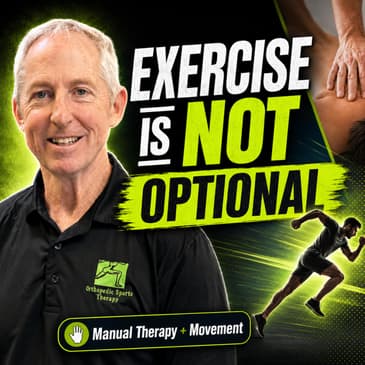
In this episode, Seth speaks with Tim Fearon, a respected leader in orthopedic manual physical therapy, about the role of exercise in manual therapy practice.
Tim reflects on retirement, mentorship, and the clinical evolution that led him to place exercise and patient responsibility at the center of care. He shares how early mentorship shaped his manual therapy skills, but how recurring patient problems forced him to ask a harder question: if symptoms improve but the problem returns, did we really fix anything?
The conversation explores Tim’s shift toward active participation, PNF principles, the Maitland model, reassessment, and exercise as a reasoned clinical intervention rather than a generic home program. Tim also challenges clinicians to stop treating exercise as the less important part of care, stop overdosing patients with too many exercises, and stop outsourcing the very thing that helps patients take ownership of their recovery.
The episode also looks toward the future of physical therapy, including remote therapeutic monitoring, exercise apps, online programs, and why skilled clinicians who can integrate passive care, active care, and patient psychology will continue to matter.
Key Takeaways- Manual therapy alone may not create lasting change.
- Tim describes realizing that he could improve symptoms manually, but patients sometimes returned with the same problem because the underlying functional capacity had not changed.
- Exercise should be reasoned like manual therapy.
- Tim emphasizes using reassessment after active interventions just as clinicians do after passive techniques.
- Patient psychology matters.
- The best exercise is not just biomechanically appropriate. It has to match the person’s behavior, motivation, tolerance, and readiness.
- Do not overdose the home program.
- Tim warns that giving too many exercises can reduce adherence and cause patients to abandon even the most important pieces.
- Exercise should not be treated as lower-value care.
- Handing exercise off too casually can signal to the patient that it is less important than the manual treatment.
- The patient must own part of the outcome.
- Tim repeatedly returns to personal responsibility: patients need to experience that what they do can change their symptoms and function.
- Generic exercise apps will help some people, but not everyone.
- Tim sees value for people in the middle of the bell curve, but warns that more complex patients still need skilled clinical reasoning.
- Skilled PTs integrate passive and active care.
- Tim is not dismissing manual therapy. He argues that passive care and active management work best when they are both delivered with skill and intention.
00:00:03 --> 00:00:04 All right, hit record.
00:00:06 --> 00:00:09 So, all right, Tim Fearon,
00:00:10 --> 00:00:12 you're pretty well known in the manual
00:00:12 --> 00:00:13 therapy community,
00:00:13 --> 00:00:16 but I know you're familiar with Phoenix,
00:00:16 --> 00:00:18 but you're in Ohio today.
00:00:18 --> 00:00:21 So can you tell us about why you're
00:00:21 --> 00:00:23 in Ohio and what you're doing these days?
00:00:24 --> 00:00:24 Yeah,
00:00:24 --> 00:00:27 I'm in Ohio because the woman who brought
00:00:27 --> 00:00:29 me into this world is living here.
00:00:29 --> 00:00:32 And she's certainly in her waning decade
00:00:32 --> 00:00:33 at ninety seven.
00:00:33 --> 00:00:36 And I make as many trips as I
00:00:36 --> 00:00:38 can to make sure that I spend a
00:00:38 --> 00:00:39 little bit of life with her.
00:00:41 --> 00:00:45 And in Phoenix, I retired,
00:00:45 --> 00:00:46 sold my practice.
00:00:47 --> 00:00:49 August thirty first of my last day in
00:00:49 --> 00:00:50 the clinic and retired.
00:00:51 --> 00:00:54 Trying to get used to actually not going
00:00:54 --> 00:00:56 to the clinic every day.
00:00:57 --> 00:00:59 But I haven't really retired.
00:00:59 --> 00:01:02 I see some patients on the side and
00:01:02 --> 00:01:03 I teach a little bit.
00:01:03 --> 00:01:06 And, you know, it's part of me.
00:01:06 --> 00:01:08 So I haven't given that up and just
00:01:08 --> 00:01:10 give up going to the day to day.
00:01:13 --> 00:01:14 Yeah.
00:01:14 --> 00:01:14 Yeah.
00:01:14 --> 00:01:14 I gotta be honest.
00:01:14 --> 00:01:16 I think this is earlier than I expected
00:01:16 --> 00:01:16 you to retire.
00:01:17 --> 00:01:18 So I was,
00:01:19 --> 00:01:21 it's earlier than I expected to retire,
00:01:21 --> 00:01:23 but it's not earlier than my wife wanted
00:01:23 --> 00:01:24 me to retire.
00:01:25 --> 00:01:26 Uh, because, uh,
00:01:26 --> 00:01:28 she's been out for some time and decided
00:01:28 --> 00:01:30 that it wasn't nearly as much fun to
00:01:30 --> 00:01:31 be retired alone.
00:01:32 --> 00:01:33 Uh, so, uh,
00:01:33 --> 00:01:35 I decided I remembered a little bit who
00:01:35 --> 00:01:38 I was before I became a, a,
00:01:39 --> 00:01:41 a therapist that was obsessed with it.
00:01:41 --> 00:01:43 Uh, and I should rediscover that.
00:01:43 --> 00:01:46 So, uh, so that's what I'm doing.
00:01:46 --> 00:01:48 And it was funny.
00:01:48 --> 00:01:50 I'll just, just for the podcast,
00:01:50 --> 00:01:52 I sent you a picture of your mentors,
00:01:53 --> 00:01:53 um,
00:01:54 --> 00:01:56 Tim McGonigal and Michael Moore who are
00:01:57 --> 00:01:59 still seeing patients when I ran into him
00:01:59 --> 00:02:00 at the conference last year.
00:02:00 --> 00:02:02 So that was, that was a crazy moment.
00:02:05 --> 00:02:05 Yeah, well,
00:02:05 --> 00:02:08 they've always been uber focused and they
00:02:08 --> 00:02:10 don't see as many people as they used
00:02:10 --> 00:02:10 to.
00:02:11 --> 00:02:14 And they've totally changed how it is they
00:02:14 --> 00:02:16 see people while the younger people carry
00:02:16 --> 00:02:19 on really the Folsom physical therapy.
00:02:21 --> 00:02:21 But yeah,
00:02:21 --> 00:02:23 those are the first guys who they were
00:02:23 --> 00:02:26 the first mentors who actually
00:02:27 --> 00:02:29 continued to just see patients and could
00:02:29 --> 00:02:32 actually do what they talked about as
00:02:32 --> 00:02:34 opposed to just talking about what they
00:02:34 --> 00:02:35 thought they could do.
00:02:35 --> 00:02:39 So Michael and Tim, great respect.
00:02:39 --> 00:02:41 I'm happy that they're continuing to go.
00:02:41 --> 00:02:42 I thought I would too.
00:02:44 --> 00:02:44 And I did.
00:02:44 --> 00:02:45 I mean,
00:02:45 --> 00:02:48 I'm going to be seventy one in July.
00:02:48 --> 00:02:50 It's coming up.
00:02:51 --> 00:02:51 Now,
00:02:51 --> 00:02:53 and I know they probably influenced you a
00:02:53 --> 00:02:54 little bit for our topic today.
00:02:54 --> 00:02:56 We wanted to talk about exercise.
00:02:56 --> 00:02:58 Uh, they probably had an influence,
00:02:58 --> 00:03:00 but can you talk about maybe,
00:03:00 --> 00:03:02 I know you're passionate about exercise
00:03:02 --> 00:03:04 and integrating that into orthopedic
00:03:04 --> 00:03:05 manual physical therapy.
00:03:05 --> 00:03:08 Can you talk about why?
00:03:09 --> 00:03:12 Uh, the why, uh, is, uh, uh,
00:03:12 --> 00:03:14 let me start with Tim and Michael because
00:03:14 --> 00:03:15 you, you kicked me off there.
00:03:15 --> 00:03:18 Uh, they were my first, uh, uh,
00:03:20 --> 00:03:22 my first push into being actually skillful
00:03:22 --> 00:03:24 at what I was doing with manual therapy,
00:03:24 --> 00:03:26 they were very demanding.
00:03:26 --> 00:03:28 They were Norwegian trained and
00:03:28 --> 00:03:30 anticipated that you were going to do
00:03:30 --> 00:03:32 something, you're going to do it well.
00:03:32 --> 00:03:33 And so I followed that pattern.
00:03:34 --> 00:03:36 And it was all about manual therapy.
00:03:37 --> 00:03:39 And the manual therapy,
00:03:39 --> 00:03:41 then there was an add-on with training.
00:03:41 --> 00:03:44 It was really pretty much only for the
00:03:44 --> 00:03:46 spine, for the trunk, if you will.
00:03:47 --> 00:03:47 And
00:03:49 --> 00:03:50 As I got very,
00:03:50 --> 00:03:51 very good with doing what I was doing
00:03:51 --> 00:03:52 manually,
00:03:52 --> 00:03:54 I realized I was seeing some people for
00:03:54 --> 00:03:55 the same thing that I'd seen them for
00:03:55 --> 00:03:56 before.
00:03:57 --> 00:03:58 And I thought, well,
00:03:58 --> 00:03:59 you didn't really fix anything.
00:03:59 --> 00:04:01 You just ameliorated the symptoms that
00:04:01 --> 00:04:04 were occurring at that time because here
00:04:04 --> 00:04:05 they are at the same problem.
00:04:06 --> 00:04:07 And then somebody who worked with them,
00:04:08 --> 00:04:10 Dennis Morgan, had a...
00:04:11 --> 00:04:13 had a rather extensive training in
00:04:14 --> 00:04:17 neurotherapy and exercise with Maggie
00:04:17 --> 00:04:18 Knott.
00:04:19 --> 00:04:22 And he and I were having this conversation
00:04:22 --> 00:04:25 about, hey, what's the next step?
00:04:25 --> 00:04:27 And he looked me right in the eye
00:04:28 --> 00:04:32 and said, if you just understood PNF,
00:04:33 --> 00:04:36 you would know how to create the
00:04:36 --> 00:04:37 functional gains you're trying to get
00:04:37 --> 00:04:39 while you're doing manual therapy.
00:04:40 --> 00:04:42 So I launched off the deep end to
00:04:42 --> 00:04:44 decide, and really,
00:04:46 --> 00:04:49 if you thought about PNF as the patterns
00:04:49 --> 00:04:50 that we learned in school,
00:04:50 --> 00:04:51 then you missed the boat.
00:04:51 --> 00:04:53 It's really about the principles and
00:04:53 --> 00:04:54 applying it to what we do.
00:04:55 --> 00:04:57 And that totally changed everything I did.
00:04:58 --> 00:05:04 It went to nobody came without having a
00:05:04 --> 00:05:06 personal responsibility for their own
00:05:06 --> 00:05:07 health care problem,
00:05:07 --> 00:05:09 which invariably turned into exercise.
00:05:10 --> 00:05:10 You know,
00:05:10 --> 00:05:13 so that might be maybe the first one
00:05:13 --> 00:05:15 that I paid any attention to was Robin
00:05:15 --> 00:05:15 McKenzie,
00:05:15 --> 00:05:17 because the people were compliant with
00:05:17 --> 00:05:19 their home program because they took the
00:05:19 --> 00:05:21 leg pain and brought it up to the
00:05:21 --> 00:05:22 butt and they took the butt pain and
00:05:22 --> 00:05:24 brought it up to the back and then
00:05:24 --> 00:05:25 they got rid of the back pain.
00:05:25 --> 00:05:25 Of course,
00:05:25 --> 00:05:27 everybody was motivated to do this.
00:05:29 --> 00:05:31 But that was just one isolated event where
00:05:31 --> 00:05:33 it was clear that, hey,
00:05:33 --> 00:05:35 personal responsibility on the part of the
00:05:35 --> 00:05:38 owner of the problem was was key.
00:05:39 --> 00:05:39 So.
00:05:40 --> 00:05:42 That's what launched me in that direction.
00:05:43 --> 00:05:45 Yeah,
00:05:45 --> 00:05:47 that sounds like you just kind of noticed
00:05:47 --> 00:05:50 that was a huge component and maybe you
00:05:50 --> 00:05:52 could be stronger in it in terms of
00:05:53 --> 00:05:55 how to get people towards more functional
00:05:55 --> 00:05:57 recovery that was lasting.
00:05:57 --> 00:05:59 What do you think PTs are doing wrong
00:06:00 --> 00:06:01 when it comes to exercise?
00:06:03 --> 00:06:03 Well, wow,
00:06:04 --> 00:06:07 you opened up the can of worms now.
00:06:07 --> 00:06:09 You'll get another word in here in about
00:06:09 --> 00:06:09 half an hour.
00:06:11 --> 00:06:13 What do I think PTs are doing wrong?
00:06:13 --> 00:06:15 It's not all the PT's fault.
00:06:15 --> 00:06:17 Let's start with that.
00:06:18 --> 00:06:19 I spent most of my career, really,
00:06:20 --> 00:06:22 at least the last over fifty percent of
00:06:22 --> 00:06:24 it, treating other people's failures.
00:06:24 --> 00:06:26 I'm sure there's a whole bunch of people
00:06:26 --> 00:06:27 out there listening to this who think,
00:06:27 --> 00:06:28 hey, that's what I'm doing.
00:06:29 --> 00:06:31 So something's not happening right when
00:06:31 --> 00:06:34 you realize that, geez, you know what?
00:06:34 --> 00:06:35 This wasn't that hard,
00:06:36 --> 00:06:37 but I'm the fourth PT.
00:06:37 --> 00:06:38 Why is that?
00:06:39 --> 00:06:40 And I think in part,
00:06:40 --> 00:06:41 it goes back to,
00:06:43 --> 00:06:45 I'm going to diss on everybody here.
00:06:45 --> 00:06:48 It's the clinician not actually delivering
00:06:48 --> 00:06:50 that which they think or they know or
00:06:50 --> 00:06:53 they're thinking their way through to that
00:06:53 --> 00:06:54 this patient needs.
00:06:55 --> 00:06:55 It's the
00:06:56 --> 00:06:59 educators who gave them no fault of their
00:06:59 --> 00:07:02 own what they had to give them and
00:07:02 --> 00:07:05 because they don't do the active exercise
00:07:05 --> 00:07:07 with patients with people who have
00:07:07 --> 00:07:10 comorbidities they don't do that they
00:07:10 --> 00:07:13 don't own that they don't have the skill
00:07:13 --> 00:07:14 set to pass on to the people in
00:07:14 --> 00:07:17 school and then what they've got to do
00:07:17 --> 00:07:18 is keep up with the literature
00:07:19 --> 00:07:23 and the literature goes on with they put
00:07:23 --> 00:07:25 out what they get and so it's asking
00:07:25 --> 00:07:27 an answerable question so they ask an
00:07:27 --> 00:07:29 answerable question they put out
00:07:29 --> 00:07:31 literature they don't do it they don't do
00:07:31 --> 00:07:35 it i.e the exercise facilitating a patient
00:07:35 --> 00:07:36 to be able to do something
00:07:36 --> 00:07:38 Neither do the people in the academic
00:07:38 --> 00:07:38 roles.
00:07:39 --> 00:07:39 Therefore,
00:07:39 --> 00:07:42 the clinician who walks out of school has
00:07:42 --> 00:07:43 never really learned how to do it.
00:07:44 --> 00:07:45 And here's the terrible thing.
00:07:46 --> 00:07:47 It's rare that they see it modeled by
00:07:48 --> 00:07:49 somebody that they're going to then go
00:07:49 --> 00:07:50 work with and under.
00:07:51 --> 00:07:53 So that's what I think they're doing
00:07:53 --> 00:07:54 wrong.
00:07:54 --> 00:07:56 And then you add in the –
00:07:57 --> 00:07:59 the patient's per man hour pressure that
00:07:59 --> 00:08:01 the young therapist has put underneath,
00:08:02 --> 00:08:05 if they don't prioritize the exercise,
00:08:06 --> 00:08:07 which they don't if they have to
00:08:09 --> 00:08:11 if they have to push through more patients
00:08:11 --> 00:08:12 at a time,
00:08:13 --> 00:08:14 what they do is they hand it off
00:08:14 --> 00:08:18 to somebody who's supposedly the exercise
00:08:18 --> 00:08:18 person in there.
00:08:19 --> 00:08:21 Clearly to the patient, what that says is,
00:08:22 --> 00:08:25 this isn't meritorious of my time,
00:08:25 --> 00:08:27 so I've got an underling here who's gonna
00:08:27 --> 00:08:29 do the lesser important thing.
00:08:30 --> 00:08:32 So I pushed against that completely to
00:08:32 --> 00:08:34 make sure that the patients understood
00:08:34 --> 00:08:35 that, hey,
00:08:35 --> 00:08:37 this is important if you want to have
00:08:37 --> 00:08:38 control,
00:08:38 --> 00:08:40 if you want to be the one who's
00:08:40 --> 00:08:42 in charge of your future healthcare.
00:08:43 --> 00:08:44 So there it is in a nutshell.
00:08:44 --> 00:08:46 I put a little blame around on everybody,
00:08:46 --> 00:08:47 I think.
00:08:47 --> 00:08:49 Okay, Tim,
00:08:49 --> 00:08:51 can I pause you for one sec?
00:08:51 --> 00:08:53 I had a question from the front desk.
00:08:53 --> 00:08:53 Yeah.
00:08:53 --> 00:08:55 I'll just walk over here.
00:08:55 --> 00:08:56 Understood, understood.
00:08:56 --> 00:08:59 Okay, that's good that you can.
00:09:03 --> 00:09:03 All right.
00:09:03 --> 00:09:04 So, yeah, I mean,
00:09:04 --> 00:09:06 I think you kind of you hit,
00:09:07 --> 00:09:07 I think,
00:09:07 --> 00:09:09 with your spiel there on a lot of
00:09:09 --> 00:09:10 the issues that I've kind of noticed.
00:09:11 --> 00:09:13 We have this maybe a couple of years
00:09:13 --> 00:09:13 ago,
00:09:13 --> 00:09:16 we started that intentional exercise
00:09:16 --> 00:09:16 course.
00:09:16 --> 00:09:18 And I think one of the things that
00:09:18 --> 00:09:20 I noticed that we kind of talked about
00:09:20 --> 00:09:20 is.
00:09:21 --> 00:09:23 is even at these like continuing education
00:09:23 --> 00:09:24 courses exercise,
00:09:24 --> 00:09:26 which is just this huge component gets
00:09:26 --> 00:09:27 saved to the last day.
00:09:28 --> 00:09:29 And then I kind of sometimes even in
00:09:29 --> 00:09:30 that last day,
00:09:30 --> 00:09:32 it gets pushed a little bit further and
00:09:32 --> 00:09:34 then you have like two hours to go
00:09:34 --> 00:09:36 over what might be the most important
00:09:36 --> 00:09:38 thing for the patients.
00:09:39 --> 00:09:40 So, I mean,
00:09:40 --> 00:09:43 I kind of know that was why I
00:09:43 --> 00:09:46 felt like that was something that we
00:09:46 --> 00:09:47 needed to do.
00:09:48 --> 00:09:49 How do you think
00:09:50 --> 00:09:52 when you're kind of prescribing an
00:09:52 --> 00:09:54 exercise regimen for a patient?
00:09:54 --> 00:09:56 How do you know when that's the right
00:09:57 --> 00:09:59 exercise approach for that person?
00:10:01 --> 00:10:03 I think what you have to do is,
00:10:04 --> 00:10:06 like we do in any passive care,
00:10:06 --> 00:10:07 the first thing you have to do is
00:10:07 --> 00:10:10 assist the person's psyche, right?
00:10:10 --> 00:10:11 Who they are as a whole.
00:10:11 --> 00:10:11 I mean,
00:10:11 --> 00:10:13 I think it's fifty one percent of what
00:10:13 --> 00:10:13 we do.
00:10:14 --> 00:10:15 If you do the same thing for everybody,
00:10:15 --> 00:10:17 you're going to miss fifty one percent of
00:10:17 --> 00:10:17 them.
00:10:18 --> 00:10:20 uh but i think you have to decide
00:10:20 --> 00:10:23 uh how they're going to behave what
00:10:23 --> 00:10:24 they're going to do one of the worst
00:10:24 --> 00:10:27 things is overdosing exercise what a
00:10:27 --> 00:10:30 patient always wants a hundred percent of
00:10:30 --> 00:10:32 the time what they want is amelioration of
00:10:32 --> 00:10:35 the symptoms that they're experiencing so
00:10:35 --> 00:10:38 if i think i probably started to do
00:10:38 --> 00:10:40 things where i knew that
00:10:40 --> 00:10:43 what I was doing passively felt good,
00:10:43 --> 00:10:45 but I made them participate.
00:10:45 --> 00:10:47 So I make them participate so they're
00:10:47 --> 00:10:49 actually working while we're doing the
00:10:49 --> 00:10:51 same thing that I knew passively I could
00:10:51 --> 00:10:52 change the symptoms,
00:10:52 --> 00:10:53 but I made darn sure it was going
00:10:53 --> 00:10:54 to be active.
00:10:55 --> 00:10:57 And if it was active and they associated
00:10:57 --> 00:11:01 with what they did change their symptoms,
00:11:01 --> 00:11:02 now they're motivated,
00:11:02 --> 00:11:04 just like Robin McKenzie did.
00:11:05 --> 00:11:06 So, really,
00:11:07 --> 00:11:09 I think that maybe the most undersold art
00:11:09 --> 00:11:12 in all of PT, including school,
00:11:13 --> 00:11:16 is the psychology of human behavior,
00:11:16 --> 00:11:16 right?
00:11:17 --> 00:11:19 We don't know anything about it while
00:11:19 --> 00:11:20 we're going to school,
00:11:20 --> 00:11:24 and that psych class is boring because we
00:11:24 --> 00:11:26 just haven't had to manage somebody else's
00:11:26 --> 00:11:27 psyche.
00:11:28 --> 00:11:30 So if you can figure that part out
00:11:30 --> 00:11:32 when you see the patients and then take
00:11:32 --> 00:11:34 them to something that's legitimately
00:11:34 --> 00:11:34 going to be helpful.
00:11:35 --> 00:11:37 And then I'm a big advocate.
00:11:37 --> 00:11:37 I'm a...
00:11:39 --> 00:11:41 I'm a Maitland model thinker in terms of
00:11:41 --> 00:11:43 inductive and deductive reasoning.
00:11:43 --> 00:11:45 And what we do with passive treatment,
00:11:45 --> 00:11:47 you do with active.
00:11:47 --> 00:11:50 And you reassess the patient immediately
00:11:50 --> 00:11:51 afterwards.
00:11:51 --> 00:11:53 So they associate, okay,
00:11:53 --> 00:11:55 we did this exercise A, let's call it.
00:11:56 --> 00:11:59 And my apparent symptoms beforehand were
00:11:59 --> 00:12:02 changed up or down after having done that.
00:12:02 --> 00:12:03 If they're down,
00:12:04 --> 00:12:05 the patient's encouraged about that.
00:12:05 --> 00:12:07 And then they want to listen to you.
00:12:07 --> 00:12:09 if you make them worse everybody knows the
00:12:09 --> 00:12:11 result there then they don't really want
00:12:11 --> 00:12:13 to follow through and that would be a
00:12:13 --> 00:12:16 mistake the worst thing the worst thing i
00:12:16 --> 00:12:18 cut my teeth in the air where every
00:12:18 --> 00:12:20 back patient was handed off the tear-off
00:12:20 --> 00:12:23 slip of williams flexion exercise and if
00:12:23 --> 00:12:26 you were radical radical the posterior
00:12:26 --> 00:12:30 pelvic tilt was actually engaged and i
00:12:30 --> 00:12:30 mean i just
00:12:32 --> 00:12:34 You just can't treat people like
00:12:34 --> 00:12:35 everybody's a widget.
00:12:35 --> 00:12:37 Everybody's got their own little widgets
00:12:37 --> 00:12:38 on top of widgets and you have to
00:12:39 --> 00:12:40 modify accordingly.
00:12:41 --> 00:12:43 But the basics of exercise,
00:12:43 --> 00:12:46 you have some basic principles that if you
00:12:46 --> 00:12:48 can get people in the middle of that
00:12:48 --> 00:12:51 bell-shaped curve for the majority of it,
00:12:51 --> 00:12:51 great.
00:12:51 --> 00:12:53 And then you push the others to the
00:12:53 --> 00:12:54 extremes when you need to.
00:12:56 --> 00:12:59 yeah i mean it sounds like for low
00:12:59 --> 00:13:01 back pain especially you know nobody
00:13:01 --> 00:13:03 responds to the you know not everyone
00:13:03 --> 00:13:05 responds to the same thing i think you
00:13:05 --> 00:13:07 only have to treat people for like two
00:13:07 --> 00:13:10 days to figure that out but but you
00:13:10 --> 00:13:12 were a thinker you just said it uh
00:13:12 --> 00:13:14 to figure it out a lot of people
00:13:14 --> 00:13:16 are just processing you know i call them
00:13:16 --> 00:13:19 clock punchers right and unfortunately uh
00:13:20 --> 00:13:21 You know,
00:13:21 --> 00:13:23 that's the predominance of the people
00:13:24 --> 00:13:26 whose patients I saw later.
00:13:26 --> 00:13:28 So I have to presume when I pay
00:13:28 --> 00:13:31 attention to a class model, you know,
00:13:31 --> 00:13:33 if there's a hundred, well, not a hundred,
00:13:33 --> 00:13:35 if there's thirty people in a class,
00:13:35 --> 00:13:36 you can tell the people who actually do
00:13:37 --> 00:13:39 it and the people who give everybody the
00:13:39 --> 00:13:39 same thing.
00:13:40 --> 00:13:41 And that's,
00:13:41 --> 00:13:42 it's hard to believe we get paid
00:13:42 --> 00:13:43 professional fees,
00:13:43 --> 00:13:48 doctoral fees for a non-thought processed
00:13:48 --> 00:13:50 exercise dosage.
00:13:51 --> 00:13:52 Yeah.
00:13:52 --> 00:13:53 And I think what you said about
00:13:53 --> 00:13:56 integrating exercise into the manual
00:13:56 --> 00:13:58 therapy also kind of reminds me of
00:13:58 --> 00:14:00 something I heard Greg Johnson say,
00:14:00 --> 00:14:02 which is like after every technique,
00:14:02 --> 00:14:03 he would do something,
00:14:03 --> 00:14:05 try to get some sort of active movement
00:14:05 --> 00:14:07 from the patient so that they felt like
00:14:07 --> 00:14:10 it was them that did it and not
00:14:10 --> 00:14:11 him at the end of it.
00:14:12 --> 00:14:13 I think I started that way.
00:14:13 --> 00:14:15 And Greg, of course, has a PNF background,
00:14:15 --> 00:14:17 very heavy, also a Maggie Knott trained.
00:14:19 --> 00:14:20 And then I got to the point where
00:14:20 --> 00:14:21 it was like, no,
00:14:21 --> 00:14:23 the more I can get them to do
00:14:23 --> 00:14:25 and get the same result, the better.
00:14:26 --> 00:14:28 So the inductive and deductive reason
00:14:28 --> 00:14:28 getting me to a...
00:14:29 --> 00:14:33 a trial treatment hypothesis became,
00:14:33 --> 00:14:35 I bet if I can get them to
00:14:35 --> 00:14:39 do this exercise to change that functional
00:14:39 --> 00:14:39 pattern,
00:14:39 --> 00:14:42 that I'll get them to function better,
00:14:42 --> 00:14:43 feel better.
00:14:44 --> 00:14:46 And so the passive things became sort of,
00:14:46 --> 00:14:47 they got pushed to the back,
00:14:48 --> 00:14:49 almost the reverse of what you just
00:14:49 --> 00:14:50 described Greg would do.
00:14:51 --> 00:14:51 At the end,
00:14:51 --> 00:14:54 I'd do something to reward them for having
00:14:54 --> 00:14:56 participated in their own health at the
00:14:56 --> 00:14:57 beginning.
00:14:57 --> 00:14:59 Did you ever have
00:15:01 --> 00:15:03 or how would you i guess of course
00:15:03 --> 00:15:05 you had this pushback from patients how
00:15:05 --> 00:15:07 did you cope with that when you had
00:15:07 --> 00:15:11 it yeah you get pushback uh and the
00:15:11 --> 00:15:14 uh the uh the pushback cat you know
00:15:15 --> 00:15:18 How you speak to your patients is totally
00:15:18 --> 00:15:19 up to you.
00:15:19 --> 00:15:21 But my pushback would be sort of like,
00:15:21 --> 00:15:23 you know, somebody would say, you know,
00:15:23 --> 00:15:24 I don't want to do that.
00:15:24 --> 00:15:24 I said, well,
00:15:24 --> 00:15:26 did you want to change the problem that
00:15:26 --> 00:15:27 you came for?
00:15:27 --> 00:15:29 Because that's why we're doing this.
00:15:29 --> 00:15:31 And if they came back and they were,
00:15:31 --> 00:15:32 you know, I never asked somebody,
00:15:32 --> 00:15:34 how's your home program going?
00:15:34 --> 00:15:34 I said, hey,
00:15:34 --> 00:15:36 show me how you're doing with your home
00:15:36 --> 00:15:36 program.
00:15:37 --> 00:15:39 And when it was clear that they weren't
00:15:39 --> 00:15:39 doing it,
00:15:41 --> 00:15:43 and I started to steer them back to
00:15:43 --> 00:15:43 it,
00:15:44 --> 00:15:47 the pushback category would be
00:15:48 --> 00:15:49 complaining.
00:15:49 --> 00:15:49 I said,
00:15:49 --> 00:15:52 did you want me to invest more concern
00:15:52 --> 00:15:54 into your health care than you're
00:15:54 --> 00:15:54 investing?
00:15:56 --> 00:15:58 And that pretty much got people to pay
00:15:58 --> 00:15:59 attention.
00:15:59 --> 00:16:02 No, yeah, it's not about Tim.
00:16:02 --> 00:16:04 It's not about that guy, the therapist.
00:16:04 --> 00:16:05 It's about me.
00:16:07 --> 00:16:08 Yeah, and you know,
00:16:08 --> 00:16:10 the other thing is the obvious.
00:16:10 --> 00:16:11 Some people,
00:16:11 --> 00:16:13 they'll be very happy if they're doing one
00:16:13 --> 00:16:15 and you have to decide,
00:16:15 --> 00:16:17 is it okay with me if they just
00:16:17 --> 00:16:18 do that one?
00:16:18 --> 00:16:19 Will that resolve?
00:16:19 --> 00:16:20 Let's take Robin McKenzie.
00:16:20 --> 00:16:22 If that resolved and he got them to
00:16:22 --> 00:16:25 the point where they no longer had back
00:16:25 --> 00:16:28 pain, the hard sell then would be that,
00:16:28 --> 00:16:28 hey,
00:16:29 --> 00:16:31 Now what you've got to do is change
00:16:31 --> 00:16:34 the environment that allowed you to create
00:16:34 --> 00:16:35 this, i.e.
00:16:35 --> 00:16:38 your behavior and your physiologic
00:16:38 --> 00:16:41 capacity, to sell them on more exercise,
00:16:41 --> 00:16:41 in other words,
00:16:41 --> 00:16:43 when they weren't symptomatic.
00:16:43 --> 00:16:45 And if you oversell,
00:16:45 --> 00:16:46 if you give somebody who needs three,
00:16:47 --> 00:16:49 if you give them eight, then good luck.
00:16:50 --> 00:16:51 They're not going to even do the first
00:16:51 --> 00:16:51 three.
00:16:53 --> 00:16:54 You know, you oversell.
00:16:55 --> 00:16:56 I don't think you even oversell.
00:16:56 --> 00:16:58 You give more to the people who come
00:16:58 --> 00:16:59 and say, hey, what else can I do?
00:17:00 --> 00:17:02 That's the patient that you give more to.
00:17:02 --> 00:17:04 If you get it to be resolved in
00:17:04 --> 00:17:05 one, wonderful.
00:17:05 --> 00:17:08 If it's two, great.
00:17:08 --> 00:17:09 I think everybody knows that the
00:17:09 --> 00:17:11 literature would indicate three is sort of
00:17:11 --> 00:17:12 the limit.
00:17:12 --> 00:17:13 More than three,
00:17:13 --> 00:17:15 and they screw up two and one as
00:17:15 --> 00:17:18 well as four.
00:17:18 --> 00:17:18 Yeah.
00:17:21 --> 00:17:22 Yeah.
00:17:22 --> 00:17:23 I want to pivot a little bit and
00:17:23 --> 00:17:26 talk about the future of physical therapy
00:17:27 --> 00:17:27 a little.
00:17:27 --> 00:17:30 I think most people enjoy that topic and
00:17:30 --> 00:17:31 it's interesting right now, right?
00:17:31 --> 00:17:33 So we have a big things,
00:17:33 --> 00:17:35 remote therapeutic monitoring with these
00:17:35 --> 00:17:36 home exercise programs.
00:17:36 --> 00:17:37 So people have an app,
00:17:37 --> 00:17:40 they can log in and register that they
00:17:40 --> 00:17:40 did it.
00:17:41 --> 00:17:42 There's primary care PT,
00:17:43 --> 00:17:44 musculoskeletal ultrasound.
00:17:44 --> 00:17:45 Do you,
00:17:45 --> 00:17:47 if when you look at those things in
00:17:47 --> 00:17:49 the future of physical therapy,
00:17:49 --> 00:17:49 is there anything that
00:17:50 --> 00:17:53 maybe you're concerned about or excited
00:17:53 --> 00:17:53 about?
00:17:55 --> 00:17:57 I think the answer is yes to both
00:17:57 --> 00:17:59 of them.
00:18:01 --> 00:18:02 If you look at,
00:18:02 --> 00:18:04 I see the world through bell-shaped,
00:18:04 --> 00:18:06 bell-curved glasses, right?
00:18:06 --> 00:18:07 And so in the middle of it,
00:18:07 --> 00:18:09 the vast majority of people,
00:18:09 --> 00:18:11 if they did what they should do,
00:18:11 --> 00:18:13 first they'd have to know what they should
00:18:13 --> 00:18:13 do.
00:18:13 --> 00:18:14 If they did that,
00:18:14 --> 00:18:15 they honestly don't need us.
00:18:16 --> 00:18:17 If they did it and they do it
00:18:17 --> 00:18:18 consistently.
00:18:19 --> 00:18:23 So those vacuum form, if you will,
00:18:23 --> 00:18:25 exercise programs that they can look
00:18:25 --> 00:18:27 online and plug themselves into the middle
00:18:27 --> 00:18:28 of the bell-shaped curve.
00:18:28 --> 00:18:28 Okay,
00:18:28 --> 00:18:30 that's going to work for those people.
00:18:30 --> 00:18:32 But let's just cut that in thirds and
00:18:32 --> 00:18:33 say that's the middle of the Gaussian
00:18:33 --> 00:18:36 curve and the other two sides are the
00:18:36 --> 00:18:37 other thirds.
00:18:38 --> 00:18:39 Those are the people who need guidance.
00:18:41 --> 00:18:44 And those things are going to, A,
00:18:44 --> 00:18:47 not help that the middle of the bell
00:18:47 --> 00:18:48 is not going to help people on the
00:18:48 --> 00:18:49 curves, right?
00:18:49 --> 00:18:53 And it might actually make some of them
00:18:53 --> 00:18:53 worse.
00:18:54 --> 00:18:56 So they can't do it in an online
00:18:56 --> 00:18:57 fashion.
00:18:57 --> 00:18:59 Having said that, it's going to be sold.
00:18:59 --> 00:19:01 It's already being sold.
00:19:02 --> 00:19:05 So now what happens with the people who
00:19:05 --> 00:19:07 really need help and now feel like they've
00:19:07 --> 00:19:09 experienced physical therapy?
00:19:10 --> 00:19:11 But they haven't, right?
00:19:12 --> 00:19:14 As long as we deliver something that's,
00:19:15 --> 00:19:18 let's say, subprofessional, well,
00:19:18 --> 00:19:19 then we're going to create an increasing
00:19:19 --> 00:19:21 mass of people who just think physical
00:19:21 --> 00:19:22 therapy is worthless.
00:19:23 --> 00:19:24 On the other hand,
00:19:24 --> 00:19:25 the end of my career,
00:19:26 --> 00:19:28 I saw the majority of patients that were
00:19:28 --> 00:19:30 cash pay and they're paying because they
00:19:30 --> 00:19:32 weren't getting good care in the rest of
00:19:32 --> 00:19:33 the medical system.
00:19:33 --> 00:19:35 They were anxious for me to give them
00:19:35 --> 00:19:36 exercise.
00:19:36 --> 00:19:36 Why?
00:19:37 --> 00:19:38 So that they could learn how to do
00:19:38 --> 00:19:39 it and stop paying me,
00:19:40 --> 00:19:41 because they wanted to get better.
00:19:42 --> 00:19:44 And so I think those who really develop
00:19:44 --> 00:19:45 a skill set,
00:19:46 --> 00:19:48 and I'm not dissing manual therapy,
00:19:49 --> 00:19:51 because I think you have to be able
00:19:51 --> 00:19:53 to have that skill set to get people
00:19:53 --> 00:19:56 to be able to do the rehab and
00:19:57 --> 00:19:58 the management things that they need to
00:19:58 --> 00:19:58 do.
00:20:00 --> 00:20:03 So the person who's really genuinely
00:20:03 --> 00:20:06 developed a skill in passive intervention,
00:20:07 --> 00:20:09 then active management and rehab,
00:20:09 --> 00:20:11 those people are going to do just fine.
00:20:12 --> 00:20:13 And those are the people we should be,
00:20:14 --> 00:20:17 they should be speaking directly to the
00:20:17 --> 00:20:21 public because we can make their lives
00:20:21 --> 00:20:22 physically much better.
00:20:24 --> 00:20:26 And yeah, that's where I want to be.
00:20:26 --> 00:20:27 I don't want to be the guy who's
00:20:27 --> 00:20:28 giving out tear out and handing out cheats
00:20:28 --> 00:20:28 too.
00:20:29 --> 00:20:30 Worse yet,
00:20:30 --> 00:20:33 go online and pick out unit number
00:20:33 --> 00:20:35 seventeen B. Right.
00:20:35 --> 00:20:37 And that's why did you go to college,
00:20:37 --> 00:20:39 you know?
00:20:39 --> 00:20:40 Yeah.
00:20:40 --> 00:20:40 Yeah.
00:20:40 --> 00:20:42 Sometimes I think pretty hard about that
00:20:43 --> 00:20:43 stuff.
00:20:44 --> 00:20:46 I think you're maybe a good way to
00:20:46 --> 00:20:46 end.
00:20:47 --> 00:20:47 Obviously,
00:20:47 --> 00:20:48 you've trained a lot of physical
00:20:48 --> 00:20:50 therapists, fellows in particular.
00:20:50 --> 00:20:52 You won the Colton Bourne Teach I Must
00:20:52 --> 00:20:55 Award, I think, in twenty seventeen,
00:20:55 --> 00:20:55 somewhere around there.
00:20:56 --> 00:20:59 Do you want to pass on any words
00:20:59 --> 00:21:04 of encouragement from Ohio out to PTs out
00:21:04 --> 00:21:06 there, maybe earlier in their career?
00:21:08 --> 00:21:09 Yeah, I do.
00:21:09 --> 00:21:10 I think really and truly I mean this.
00:21:10 --> 00:21:13 This is going to sound maybe a little
00:21:13 --> 00:21:14 too Kool-Aid-y, but it's the truth.
00:21:15 --> 00:21:17 I think we're extraordinarily lucky.
00:21:17 --> 00:21:18 We get to go to work.
00:21:19 --> 00:21:21 We have to apply our minds, right?
00:21:21 --> 00:21:23 We have to use our bodies.
00:21:23 --> 00:21:24 We're not sedentary.
00:21:24 --> 00:21:26 We have to engage with the world.
00:21:26 --> 00:21:27 And if you're any good at it,
00:21:28 --> 00:21:30 What you do is you help a life
00:21:30 --> 00:21:32 immediately in front of you and you do
00:21:32 --> 00:21:34 that on a continuum and what happens?
00:21:34 --> 00:21:36 You do that for a career and you
00:21:36 --> 00:21:37 pass that on to their family.
00:21:37 --> 00:21:40 It's really a wonderful profession if it's
00:21:40 --> 00:21:41 done well.
00:21:42 --> 00:21:45 I know a great deal of the people
00:21:45 --> 00:21:46 that I know that are very unhappy
00:21:46 --> 00:21:49 professionally with a similar investment
00:21:49 --> 00:21:52 in education would be doctors and lawyers.
00:21:53 --> 00:21:54 The lawyers,
00:21:54 --> 00:21:56 the ones I know who are the happiest
00:21:56 --> 00:21:58 are those who don't actually practice law.
00:21:58 --> 00:21:59 They just use their law degree in some
00:21:59 --> 00:22:00 fashion or other.
00:22:01 --> 00:22:04 And doctors just don't get enough time.
00:22:04 --> 00:22:04 I mean,
00:22:04 --> 00:22:07 I'm not saying that you're not gratified
00:22:07 --> 00:22:09 if you're a cardiovascular surgeon and you
00:22:09 --> 00:22:12 can do things that other people can't do.
00:22:12 --> 00:22:13 It's a wonderful thing.
00:22:13 --> 00:22:15 But we have that option.
00:22:15 --> 00:22:17 We have that availability,
00:22:17 --> 00:22:20 provided that you take the passion into
00:22:20 --> 00:22:21 the field and
00:22:23 --> 00:22:25 and and pay it forward but you can't
00:22:25 --> 00:22:27 you will not get uh people will not
00:22:27 --> 00:22:29 get that gratification if they go in and
00:22:29 --> 00:22:32 they clock punch going to work to see
00:22:32 --> 00:22:33 looking at the clock when's my last
00:22:33 --> 00:22:36 patient uh and then emrs have made
00:22:36 --> 00:22:39 everybody's life much much worse uh but at
00:22:39 --> 00:22:42 least it doesn't help the patient uh or
00:22:42 --> 00:22:44 the insurance company either because all
00:22:44 --> 00:22:45 the uh
00:22:45 --> 00:22:48 phrases that are just computer punched in
00:22:48 --> 00:22:48 there.
00:22:50 --> 00:22:51 I mean, I get it.
00:22:51 --> 00:22:52 You got to do it,
00:22:52 --> 00:22:54 but get it done.
00:22:54 --> 00:22:55 Don't focus on that.
00:22:55 --> 00:22:56 Focus on your patients.
00:22:56 --> 00:23:00 That's what I would say.
00:23:00 --> 00:23:00 Tim Fearon,
00:23:00 --> 00:23:03 thanks for joining us from afar.
00:23:04 --> 00:23:05 And thanks for continuing to pass the
00:23:05 --> 00:23:06 wisdom on.
00:23:07 --> 00:23:07 Seth,
00:23:07 --> 00:23:09 I'll be happy to rejoin you back in
00:23:09 --> 00:23:10 Arizona.
00:23:10 --> 00:23:12 It is cold and dreary in Ohio in
00:23:12 --> 00:23:13 May.
00:23:15 --> 00:23:18 Alright, that is it.