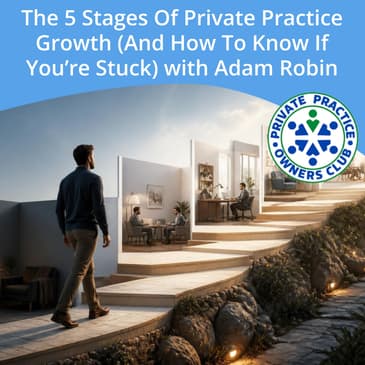
Many physical therapy clinic owners start with a passion for helping patients but end up trapped under a massive clinical caseload. Host Nathan Shields and guest Adam Robin break down the critical path of Private Practice Growth to help you escape the treating therapist trap. If you're working sixty hours a week and missing family milestones, you're likely stuck in the messy middle of operational chaos. They map out the five distinct stages of clinic ownership so you know exactly where to focus your energy next. You'll discover how to organize your front desk, build a strong leadership team, and step into true executive ownership. It's time to stop trading your clinical hours for dollars and start running a business that thrives without you.
Want to talk about how we can help you with your PT business, or have a question you want to ask? Book a call with Nathan - https://calendly.com/ptoclub/discoverycall
Love the show? Subscribe, rate, review, and share! https://ptoclub.com/
[00:00:00] One of the pillars of you actually moving your business into that direction is to surround yourself with people who have either been there or who are on the way, who can kind of show you that vision, who can inspire you to just pivot your thinking just subtly. And it opens up a lot of clarity and direction and quite frankly, can give you like a lot of excitement on how to move things forward for you over the next 6 to 12 months.
[00:00:28] Welcome to the Private Practice Owners Club. Your hosts and coaches, Nathan Shields scaled his practice and exited for millions, while Adam Robin went from working 60 hours a week in one clinic to scaling to multiple clinics while working less than 4 hours per week remotely. This podcast is meant to share with you exactly how they did it and how you can build a business that supports the lifestyle that you truly desire.
[00:00:51] And don't forget to join the Private Practice Owners Club community on Facebook, where we are obsessed with providing even more resources that help owners, just like you, win the game of private practice. Welcome everybody to the Private Practice Owners Club Facebook Live. Doing this every other Thursday, so you can see us again in a couple of weeks.
[00:01:17] And today we're talking about the stages of ownership, which I'm excited about because I talked about this with Blaine. I remember last year on a podcast episode and he had it really dialed in. Sure. It's good to review it again and help people understand where they are and then have some certainty about where to go next, right? And they can say, oh, okay, now I see where I am in the stages.
[00:01:43] If you look at it from a bigger perspective, from a 30,000 foot view, and it gives some certainty and assurance as to what to do next, right? I think if you kind of have that ability to zoom out and see the big picture, it's always helpful, you know, to have perspective. I think understanding that having a general framework of like the stages of business ownership or practice ownership, it can really help you do really three main things.
[00:02:11] Number one, debrief and look back at where did you come from? Like, what did you do to get here? What are the lessons that you learned? What can you continue to reproduce? Number two, understanding where you are, like where you need to focus today. What position are you in? And then number three, understand where you're going. Like, what's the next stage, right? So you can anticipate or prepare for the next challenge. How do you organize your resources, your efforts, your energy such that you can kind of move things in that direction?
[00:02:38] Yeah, I think understanding that can help you stay grounded and where to place your energy more than anything. And one of the things that really helps owners do this is networking with other owners and recognizing where they, that a lot of them in there are in the same boat. And it's also one of the reasons why we're doing our conference in October is to give you those networking opportunities and also talk to you in the stages where you're at to show you what to do next.
[00:03:05] And so one of the reasons why we're doing these Facebook lives on a routine basis is to not only share this information, but also share with you the conference that is coming up, the high performance practice conference to help you build purpose, profit and freedom. It's in San Antonio, it's in San Antonio, October 15th or 17th. You can see all the details at ppoclubevents.com or you can go to ppoclub.com and go to the events tab and you can register there.
[00:03:35] I'll show you really quickly here for those who are watching. This is what you're going to see. The high performance practice, building purpose, profit and freedom, San Antonio, Texas, limiting it to 100 spots, 200, I'm sorry, 200 attendees. And for those people who were at the previous conference and the one before, our inaugural one, ton of value from the speakers that come together, ton of value from the networking and also meeting with the sponsors and vendors that are there on site.
[00:04:06] Great opportunity to get away and really focus on your business, right? That's what I notice as I go to these conferences is an opportunity to reset, refocus, like, okay, looking at bigger pictures, here's where I am. Here are my weak spots. This is where I need to move forward. So, just thought I'd share the high performance practice conference coming up October 15th through 17th. I'll put the link in the comments in the Facebook live, also in the show notes if you're listening to the podcast at a different time.
[00:04:35] Yeah. One of the things that just for me, like last year when I went, we had our conference in Destin, right? It's hard to understand the tangible value that you get from a conference. It's hard to like objectify it.
[00:04:52] But what I've noticed is even from our conference last year and not just that one, but from other ones that I've, that I've gone to, you're really only like one or two, maybe three high level ideas away from like your next level, right? Your next level of growth, right?
[00:05:09] And so a lot of times when you're one of the pillars of you actually moving your business into that direction is to surround yourself with people who have either been there or who are on the way. Who can kind of show you that vision, who can inspire you to just pivot your thinking just subtly. And it opens up a lot of clarity and direction. And quite frankly, can give you like a lot of excitement on like how to move things forward for you over the next six to 12 months.
[00:05:39] And I experienced that personally from our conference when Blaine actually got up on the stage and started talking about finance. He talked about some concepts around moving your money around and it was like, ah, like it opened up this aha moment to help me like, hey, you only need to be doing these, these one or two things. And if you just follow these principles and that allowed me to really tighten up my finances and build a team that can help me with it.
[00:06:03] So yeah, if you're considering it, I think it's a, I think it's a, you know, the answers are within, but you got to tap in if you want to kind of pull them out. Right. Exactly. There's going to be a ton of value there. I have to admit. So you have a framework for where you think about phases. Share with us what your framework is around the different phases of growth and in your clinics, and we'll build off of that and move forward. Okay. Yeah. So, um, very simple.
[00:06:32] I think I like to keep things simple, high level, but I think of it in five primary stages, right? Practice growth or business growth. If you're either in, I don't even know how, how we would, let's say stage one, stage one is to get started. Right. Where it's like, how do I get something off the ground? I have to do some due diligence work. I have to put some together, some, uh, I have to put together a, have an accountant or an EMR, or I got to get a lease signed. If you're going to do something brick and mortar, right. I have to get started.
[00:07:02] I have to do that. Establish an LLC. All that stuff. Legalities. Right. Yeah. So it's get started. Right. Plant your flag. Okay. Number two is stage two is going to be get busy. Right. So it's like, now I've got a building, but it's empty. How do I get people to under, like recognize that I'm here and actually give me money. Right. Yeah. There's a cycle. How do I add it? Yeah.
[00:07:28] There's a cycle that Blaine Stimack, we keep referencing Blaine, Blaine Stimack. He's very smart. If you guys have health rehab solutions, he's got like 40 clinics across the country, but a really simple cycle in those early stages after you open the doors is get patients, see patients, collect the money. Yeah. Like that's all you've got to think about when you open your doors and it's quality of quantity.
[00:07:53] And when I say quantity, not quality, not quality of care, but quantity over the quality of the subsection, subsidiary services that you're doing. I mean, you're going to provide great care and patients are going to come back, but you're not going to have your systems perfected yet. And that's okay. It's going to be messy. You're going to look silly. You're going to look messy. You're going to look silly. There's going to be some hiccups along the way. Yeah. This is not the perfectionist's dream when you first get started, but it's get patient.
[00:08:21] Figure out that cycle, how to get patients, see the patients and collect the money. Well, I think it's really important because in the beginning, you're really day one, your business is slowly dying because you have no income. Right. So like your primary goal is like, how do I get to solvency? How do I get to break even as quickly as possible? Right.
[00:08:46] So a little bit of a different energy and motivation and focus that's required compared to stage three, which is going to be great. Now you're busy. How do I get organized? Right. And this might be a stage where you hire some admin or you bring in another clinician. You start having people in the company and things get more chaotic. Right.
[00:09:09] They get, it becomes more than you can independently manage because you have the limitations of your own human brain and time. Right. Right. So you have to start building systems and efficiencies to start building some leverage. Right. And structure in the organization. Right. But once you do that, your business will start becoming self growing. Right. In some capacities. And it won't only rely on you to actually grow and maintain the business. Right. Right. Right.
[00:09:39] Which will. That's probably where most owners get stuck. Would you say? I would say, yeah. I think that that stage is the most painful stage. Takes a lot of work. Because it's usually, sorry if my screen is freezing. I'm computer's all messed up. Yeah. You're doing fine. But it's usually some of the symptoms within that stage are long hours because you're actually,
[00:10:07] you're still the person getting busy, seeing the patients, treating the patients, marketing the practice, checking them. You're still doing that. And you're actually having to build the business. So you have to kind of be in both stages for a while, which is very painful. It's chaotic. You have to work nights. You have to work weekends. You have to put in 12, 15 hour days for a little while. That is a grind. To push through that, which is the grind. But yeah.
[00:10:35] Once you start getting your time back, you can grow your business, hire more people, start entering into stage four, which is build your team. Right? At that point, you have a self-sustaining, smoother operation. Maybe you have a little bit of an onboarding process. You have an efficient patient acquisition process, good check-in system, good front desk team. You have marketing strategy. Right. You have marketing strategy. You have systems at the front desk.
[00:11:01] You have monthly meetings with your biller, monthly meetings with your accountant. You are clear on what your organizational chart, organization chart looks like. And people are in names that are not your own and in the different spots within the organization chart. Yes. Because initially that organization chart is littered with your own name. Now you put people in those places, right? Yeah. I think it's the, if you can imagine the org chart, there's like CEO at the top and then
[00:11:31] they have these departments. At the top, remember my, my talk from the conference at the top is the board of directors. Board of directors. Board of directors. You and some expert at experts at the top of the board of directors, then the CEO. Yeah. Go ahead. Sorry to interrupt. Yeah. Well, I think before this stage, when you're building the systems, you're kind of, you are the person that does everything except treat the patients. Right. And maybe you don't answer the phone, but you still market, you still recruit, you still are the clinic director. So you're still driving the production.
[00:12:00] You're still the chief finance officer. Like you're doing all the finance stuff, managing the biller. And so really that state, that next stage is really starting to take those hats off where you're assigning, you're actually building out departments and segmenting those efforts outside of you and placing key people into those roles so that they can own departments. And so that you can live more securely in that CEO role. Yeah, totally.
[00:12:29] Which is really where you start to experience freedom. Right. In my opinion. Right. Yeah. And then lastly, you can start becoming a true owner and slash investor, which is stage five, where you can scale up your organization. You can do whatever you want to do, right? Like if you want to open up more locations, you can, if you want to maybe buy the building and not start knocking down walls and build out a bigger practice, you can do that. Or you can get into non-traditional revenue. Maybe if you want to write a book, you know what I mean?
[00:12:59] You write a book or if you wanted to get into teaching or whatever other fun thing you wanted to do with your life, which is stage five, which is- You know what we're seeing? We've noticed this just in the past week and to bring it to light from the conversations you and I have had is that at this stage, people who have built and scaled sometimes find niches within the business ownership that they really enjoy outside of the patient care
[00:13:26] and start pursuing other purposes slash passions. So you talked to someone the other day who started her own billing company because I mean, you don't start your own billing company unless you fall in love with doing the billing or you feel like you're really expert at it, right? And then owner that you talked to has found a secret to reclaiming money through denial analysis. You don't do that.
[00:13:52] It's not until you get to this stage that you can find those other things that you might be doing while still being a business owner, right? And so it's really interesting how we've seen that play out here just in the last week, but it's not until you get to stage five that you can get to that point. Yeah. Even myself, you know, like I think you start to really do because you've been wearing so many hats for so long, but when you have enough time to actually look back and reflect, this
[00:14:22] has been my experience. I don't know if it's been when you actually get back to look back and you say like, how did I get here? Yeah. What were the one, maybe two things that I really excelled at that drove these outcomes that allowed me to build this team or whatever. I mean, like you said, sometimes there's a lot of people in the industry who did really well because they figured out marketing, right? They figured out Facebook ads or how to build a great website or something like that. And so they start a marketing agency, right?
[00:14:51] It's like, I was really, really good at marketing, really, really good at marketing. In my experience, it's like, I was really good at recruiting. I knew how to recruit. And so like, I built my company on recruiting essentially, right? So yeah, I think that's, I see the same, a similar pattern as well. Yeah. So you laid out the framework. There's those five stages, get started, get busy, get organized, build your team and scale, right? And I think most of the people that are listening are going to be somewhere in stages two, three, and four.
[00:15:21] Sure. Those people in the first stage of getting busy, maybe we can just talk to those stages a little bit more in depth. Let's do it. Is that cool? Let's do it. Yeah. So like in stage two, get busy. We talked to, that's when I brought up the cycle of get patients, see patients get paid essentially, right? It's important to let people know that you exist, start to learn how to market, start to learn how you want things done in your business and figure out the systems.
[00:15:50] Like how do I properly intake somebody? How do I properly bill for these patients? How do I properly interact with these insurances and how do I properly interact with my billing company? That's all part of it. And I would say maybe within that stage two of getting busy, I would highlight that's where initially your first hire comes along. And for me, that first hire is that front desk person.
[00:16:18] I have talked to a few owners who they're getting busy and they don't feel like they can, they're really getting anywhere, but it's just them. They are manning the phone. They're busy because they're manning the phones and they might even be verifying insurances and they're treating the patients. And I'm like, man, listen, from a patient's perspective, I don't want to walk into a clinic and see you answer the phone and treat me and go clean the toilets and fill the laundry basket.
[00:16:46] And it's not professional. I don't want to see it. And if not only is it not professional, it's going to limit your growth. If you're focused on answering the phone calls, doing the verifications, all the other things, now you can't focus on the things that are most important, which are get patients, see patients, collect the money. Anything outside of that cycle, you should be handing off to someone else. And I think that lands with the first hire and that being the front desk. Yeah, I agree.
[00:17:14] I like the way that you painted that. I pretty much align with everything you said. If I had to boil it down to what I feel is most critical in that stage, it's really two things in my mind. And this is coming from a place of like pure business. Like I just need to, I want my business to be better. I think number one, it's almost a dangerous suggestion because we typically get stuck here.
[00:17:43] But I think the first thing that you need to really get right is you have to become obsessed with patient satisfaction. Like really, especially if this is your first practice, even if it's a secondary practice, right? It's like, how do I get obsessed with the product and the value that I'm delivering to every single patient at a world-class level? Can I rephrase it and say the patient experience? The patient experience, right? Focus wholly.
[00:18:12] And I think not to cut you off, but I think that talks a little bit about what I was talking about. The patient experience when it's just you doing all the things, that's not a professional patient experience. That's not what they're expecting, right? Yeah. So focusing on the patient experience, huge. Huge, huge. It's, it's, it's, it's, and you're kind of fine tuning it, right? You're kind of like, you have an idea of what that should look like, but you really don't know how to apply it in a business setting yet when there's more moving parts.
[00:18:42] And it's not just the clinical side. Like you, like, like you're looking to, it's like, how do we take that intake call? How fast do we get them scheduled? How do we make sure that we're available during the times that they want to be there? How do we keep them compliant? How do we get buy-in? What is the waiting area look like? Correct. Is that welcoming? Does it smell good? Does it look good? Yeah. Is it nicely designed? Right. Or is it dirty and messy? And yeah. If you could just put yourself in the, in the shoes of a patient, like try to take your
[00:19:11] clinical hat off for a second and be like, okay, if I was a patient, what would I want to see to feel like I would become a huge promoter of this place? Right. And so if you could obsess over that, the thing that will, it will unlock for you is the second really important thing, which is you got to tell the whole world about it. Right. So knock on doors. You should have no chill. You have, you're broke. Go, go freaking tell somebody about this, right?
[00:19:38] Like call, text, DM, call your friends, call your mama, call your grandma, call your grandma, get them in the clinic and tell the entire world about the value that how hard you're working on providing this type of experience. If you just obsess over those two things, I feel like with enough hustle and grit and commitment, you'll probably naturally move into stage two. Right. Yes. Stage three, get organized. Oh, sorry. Stage two. I'm sorry. Three, three, three. Yeah.
[00:20:07] So that's when it goes to get organized. So you've got this influx of patients. Now you need to, and it's chaotic. And yeah, you've hired somebody and you're training them at the same time while you got these patients flowing in. Yeah. There's still chaos involved, but the only antidote for chaos is organization. Right. And yeah, if someone were to come to you and say, yeah, okay, I'm feeling I I'm in the midst of chaos. Where would you focus them first?
[00:20:33] Honestly, feel like I kind of, we've had this conversation with practice owners many times and I can't speak to everyone, but I almost feel like you really start again with the patient experience, right? Like you have to start over. Right. I think if you did stage one or two, right, this stage is less about rebuilding it all. And it's more like just, it's more about just documenting what you're already doing. You know what I mean? Because you're already followed. Right.
[00:21:02] And so that way you can get it out of your head on some type of resource that can be shared with your people and process driven instead of what's in your head. Right. Right. So I would start with how do we answer the phone? How do we call, what do we do when a referral comes in and what's the process from referral or lead coming in to they show up for the initial evaluation? Let's start there. Perfect that. Perfect it. How do we do it?
[00:21:32] Fast, quick, efficient. How do we get them scheduled? How do we schedule out the plan of care? How do we do the follow-ups? I would just start there. How do we respond faster, better in line with our values, et cetera? You're going down the exact line that I was thinking. And I was thinking if I were to give it like what area of the business to focus on is like front desk. Front desk all day. Front desk all day. All day. Start organizing there. If you're in chaos and you're busy, organize the front desk.
[00:22:01] It will make you so much money and will clean up so many things if you start there and focus on it. And to your point, you can think of it as a front desk, but when you think of it from the patient experience timeline, what do they see if they, I mean, look at your website. Is it solid? Is it inviting? Does it highlight it well? Did you spend a decent amount of money to make it look good and efficient and welcoming?
[00:22:28] So sometimes that's the first point of contact for people. And if someone says, I recommend going to XYZ physical therapy or pediatric clinic or whatever, they're going to look you, they're going to Google you. You want that to look good. Right. And then if they call you, what does that voice sound like? Is it warm and inviting? And are they asking the right things or are they going straight to what's your date of birth? Like, no, don't start with that as your first question.
[00:22:57] Why don't you get to know the people that are calling first? So focusing on that patient experience timeline falls right in line with focus on the front desk, that all that interaction that happens there at the front desk can be super beneficial to controlling the chaos. I agree. I think the biggest mistake, I don't want to say the biggest mistake, but a common mistake is whenever that front desk gets chaotic at that stage, like you're going to feel it as
[00:23:25] the owner, your team's going to feel it, your patients are going to feel it. And our typical move is let's just hire another person. Let's hire another front desk person. Right. And so we start bringing on these bodies without clear job descriptions and clear roles and clear ownerships. And so the chaos starts to multiply. Right. So it's like now I've got three front desk people and nobody knows what the heck's going on. And it gets a lot harder.
[00:23:53] It's not unsolvable, but it's a lot harder of a problem to solve at that stage whenever you have no systems built. Yeah. You're jumping stages though. Correct. You're trying to correct. Going from stage three to stage four without the organization. You're starting to build your team without the organization. That's going to totally magnify your weaknesses. Yeah. You come in with a, this is a really, really cool topic, but you're now you're solving multiple problems at one time, right?
[00:24:19] Because you're trying to build your systems and learn leadership without a system, without a playbook. And you're not good at leadership. Leadership and it's just a mess. You know what I mean? So it's a heavy lift, which is probably maybe the worst place to be as an owner, honestly, like in that situation. When you've got a bunch of people looking to you for leadership and you're not organized enough to correct. It's just, uh, you can see the disappointment in their eyes as they're watching you flounder. Correct. Correct.
[00:24:49] Right. Yeah, exactly. Yeah. So getting organized really helps to have, especially before you start building. And your team, especially if we're going to talk about the front desk, if you found for people who are considering, you know, we're getting pretty busy and I'm worried that my front desk might be overwhelmed, or at least they're telling me that they're overwhelmed. Does it still hold true?
[00:25:12] The metric of about 125 visits a week is about the capacity of a full-time front desk person. Is that what you're still seeing? Yeah. If they're going to still hold onto the authorizations and verifications, you know, if they're still holding onto that as part of their job description, that's probably right. I think it's probably useful to find ways to offload that totally first, because you could bump that capacity up to 180 or so, you know, they're just focusing on scheduling, right?
[00:25:40] Scheduling and collecting over the counter and organizing patient experience. Yeah. You can really unlock more capacity in that front desk and keep your admin costs lower by just offloading a fraction of that role. Yeah. But even if you were going to bring on another person, there's nothing necessarily wrong with that, but you clarity is king, you know, like, and we always begin with the end in mind, right? So it's like, if I'm going to bring somebody on, what are they going to do? What is their job description? What are the KPIs?
[00:26:08] And it can't be whatever the other person can't do. It needs to be defined, right? Like this person does this, you own this, you report this, this person does this, you own this, you, and there might be some overlap, but there should be no confusion about who owns what. Yeah. Yeah. Yeah. And as long as you can start building your team with that expectation on the onboarding process, you could probably skip all, a lot of the chaos that you might experience in the long run. Yeah. I like to see the growth on the therapist side.
[00:26:37] Um, the easiest way that was laid out to me again, by Blaine, the man of knowledge guy, this podcast episode is to the goal is to get patients, see patients, right? And you as the initial owner operator are going to fill up your schedule first, get full time. And once you do that, once you get yourself to about an 85 to 90% utilization rate, according to your schedule, that's your green light.
[00:27:03] And assuming that you've got some, that you're getting profitable and, and the billing systems are going through well and money is coming in, you should be making some money at this point. Assuming that's all true and correct. And you haven't bought a lease or bought too much in tenant improvements and equipment to drag you down. Then you can bring on that other provider, move them into a full-time role while you take a part-time treatment role, right?
[00:27:29] The other, the rest of your time is in admin and marketing and generating more standard operating procedures, SOPs, and getting things organized. And you learn how to start offloading patients. I know one provider is, and we've seen this many times, but I was talking to a provider the other day that's pretty stuck because she hasn't learned how to offload her patients to other providers.
[00:27:55] So these patients keep coming to her and they only want to see her. And she hasn't either coached that provider up well enough or infused enough confidence in those patients. They can not only see her, but they can also see the other provider that she has on the team. And so she's finding it hard to fill up that provider's schedule. Yeah. That is part of getting organized. Part of getting organized is learning the handoff process to other providers so you can
[00:28:24] continue to grow and expand. Right. Have you seen some of that yourself? Some difficulties there? Yeah. I mean, it's not like we all, it's not just in PT either. We all go through it. Any company, right? It could be a plumber or like anybody that's the sales driver of the company, right? Like. That's the whole thing behind the E-Myth Revisited. Yeah. That's the whole thing behind the book is like the owner operator gets stuck because they haven't figured out how to get organized and offload their responsibilities.
[00:28:53] This is, could be like, we have five step like stages, but this could even probably be its own stage, right? Like there could be like a state, like these little sub stages in between. Right. But the transformation must occur at some point where you are no longer the therapist, but you are the therapist teacher, right? The coach. You're the therapist coach, right? It's a very common experience that you have in sales organizations, right? It's right. You can no longer be the only person that does sales.
[00:29:22] You have to learn how to teach sales and build a sales team and be the sales manager, right? And that transformation has to come, that has to happen in your brain. You have to decide that what I do is valuable and I'm committed to teaching other clinicians about it and, and spending time and energy and like building something that I can give them
[00:29:47] to help elevate their skills and help them perform at least close to my capacity. Yeah. And that has to, that's a project. That's a big project. I mean, that might take a year to build, right? I think some people think onboarding a provider quick and easy. I just start filling them up with patients and they do their thing. Yeah. That's a good way to get in trouble. And that's not getting organized. And that's not being organized. A proper onboarding process says, this is how we do things at our therapy clinic.
[00:30:17] Here are your tools. Here's some trainings on our EMR. And here are some trainings on how we bill for our services. Here are some of the expectations that we have for our providers in terms of production, but also in getting results with our patients. Here are some of the tools, some of the continuing education courses we plan on sending you to, or here's your, our mentorship schedule. So you can ask questions about how we do things here at our clinic when it comes to different diagnoses.
[00:30:46] Here's some of the equipment that you'll want to learn about. This is how we bill and code appropriately to maximize reimbursement for services ethically. Here are some of the cash pay services and the benefits to the patients and to you. If you are to sell some of these cash pay services, those are all trainings. That's all about being organized. And those should all be part of the, the training, the onboarding, the handoff process for, as you're bringing on other providers. Yeah. So that's beautiful.
[00:31:14] I mean, if anybody is watching this and thinking to themselves, well, if I don't treat patients, what would I do with my time? Do you know what I mean? It's like, there's a lot of stuff to do, right? Right. Because not only are you trying to get out of this stage, but you're trying to prepare yourself for the next stage. And in order to do that, you have to have some foundation. You don't have to write a novel and do five peer review studies to, you know, all that, like, you just got to start with something, right? Start with a checklist and start building it over time.
[00:31:44] Start documenting what you do. And so that way it can become reproducible. I didn't say an important one is this is how we sell a plan of care. Totally. This is what we say. This is how we get patients to stay engaged. This is how we maintain a high arrival rate. This is how we get patients to come at the frequency we want them to come. This is how and why we don't treat one time a week for musculoskeletal injuries. We're going to see them a minimum of these times a week. All that is coaching and that getting organized like that and putting that together.
[00:32:14] Number one is super it's changed dramatically in the ability to do this because of AI and leveraging AI accelerates this process. I can't tell you how many times over. I know it's almost dangerous. I had to organize back in the day with pencil and paper, paper and word documents and stuff like that with binders and whatnot. It doesn't have to happen anymore. Thank you for AI. But once we get organized like this and we've at least gotten it down, it is saved somewhere
[00:32:43] in some resource. Now we can confidently move into stage five or I'm sorry, stage four, which is building the team out. Like it's really easy to start building a team if they have clear defined responsibilities, job descriptions. They know the KPIs that they need to, that they're responsible for. They know how to report to their supervisors. And you can just do a little bit more of copy and paste, copy and paste.
[00:33:12] Like just run the cycle a little. Yeah. It's just copy, paste, change the words, change the title, change the outcome, change the avatar of the person that needs to be in that role and run the, run your system of building people playbook. Right. Go. I would say one thing that I think is, I would love to hear your perspective, but I feel like that stage we're in stage four now build a team. Is that correct? Yeah.
[00:33:38] So the previous stage, stage three, I believe that that stage can get you to over a million dollars a year. Oh, easy. Right. Like if you can get to over maybe even like 1.2, you should be profitable. It could be one of the most productive stage, profitable stages in the company towards the end of that. Towards the end of that. Once you have like a team of three or four providers that all have job descriptions, you're the clinic director, you're still treating maybe 15, 20 hours a week.
[00:34:04] You've got two or three front desk people should be about 1.2, running 20% margins. You should be profitable. And so as you enter into the following stage, stage four, you've got time and money, right? You've got time and money, which is a great, great problem. Like great. You know what I mean? Like it's great. And you've got a team of people. And so now you can start allocating, but you're still holding onto some stuff, right? You're still owning. You are still, you're still, you're still doing the heavy lifting. Yeah.
[00:34:34] The heavy lifting is still yours. So you're not out of the weeds. You're probably still working a lot. You're probably still stressed in a lot of capacities. And so now you get to take some of that money and reinvest it into that kind of middle management layer, which is maybe like clinic director, director of marketing. Maybe you put somebody in charge of marketing and recruiting and you start building that leadership team. A little off, maybe a front office supervisor role. Right. A supervisor trainer role.
[00:35:04] They hire and train people at the front desk. And so it's a little bit more. So you're gonna have to call them up in the organization. Comes with a little bit of a bonus, a little bit of a salary, which is going to eat into your profits a little bit. But what it ultimately will allow you to do is get to that next true freedom where you can maybe go to 3 million or something like that. Right? Yeah. Well, and it's not just all about scale. Like what else could you do when you have a team of leaders and a team itself that are
[00:35:32] running according to the organization that you created and they're doing so successfully, they're able to replicate successful actions. Right. Do you need to exist every day at that clinic? Hopefully not. Hopefully not. Hopefully you're just checking in every so often. I've got friends who live in different states from where their clinics are and they just check
[00:35:57] in on their meetings a couple times a week and they're managing. And I've asked them, I said, why don't you sell or have you considered selling? They're like, why? I don't go into the office and I don't treat. And I am on a few hours a week of management calls. Like, am I going to sell so I can like work five hours less per week?
[00:36:23] Like that's a great opportunity to be like, do I want to have this kind of freedom and lifestyle business now? Or do I want to scale? And if you have plans on scaling, that's a different ball of wax. Yeah. I think it's the next, this is the stage where you really start building your people, right? It's no longer about building the business. It's about building your people and your people build the business. Right. So I was reminded the one responsibility that you have as a leader is to build other leaders. Yeah.
[00:36:52] Like that's your, it's your sole job when you get to this point of building out a team is to start building leaders, look for leaders in the recruiting stages, look for leaders, call people up, invite them up to do more, be more, take on more responsibilities, have conversations with them. Where do you want to go in this organization? But that's the true role of you as a leader is to build and find those leaders within your organization. Yep.
[00:37:19] You really put together a leadership training, right? At this stage, right? You're going to have a leadership training program that you're going to require people to come in and go through. It could be some books that you've read or some valuable resources that have really influenced the way that you think and probably lead out on some of the meetings, train them on how to hold people accountable. Yep. Hold them accountable to the standard operating procedures that you've created. And if we need to change them occasionally, then these people do that.
[00:37:49] You're not the one diving into the SOPs all the time to make sure they're appropriate and that people are getting adequately trained. Yeah, I think just to summarize that whole thing is like building leaders, in my opinion, comes down to really three things. And number one, it's like, give them something to consume. Of course, a book, a YouTube channel, a podcast, give them something to read, give them some people to hang out with that are going in that direction, meet with them and call them into that. Meet with you, the leader.
[00:38:17] You are the leader who's a little bit and call them up personally and challenge their beliefs and coach them up. And then number three is make them do hard things. If you do those three things and just keep that dynamic for each of your people, they'll call up and they'll grow with you. Yeah, you can build great people. Great opportunities. And then from there, scaling is, I can't say it's the easy part. At that point, when it comes to scaling, it's like now you're looking for who?
[00:38:44] Like you're just looking for more and more people, more and more leaders. And it's a constant battle to find the right people that fit your organization, that are value aligned and see a vision for them in your organization. And I know that as you move forward with proper policies and procedures that are well-trained out and you've got nice leadership teams and leadership opportunities for the people within your team, scaling can be kind of easy.
[00:39:11] I hate saying that because it's a hard and it's a different ball of wax altogether, but it's not like the chaos when you started the company and had to get through those first three stages. It's just different. Yeah, I think it is different. If you're trying to grow the company, if you want to scale it out to five locations or 40 locations like Blaine did, you know, I've never done that, but I would assume you have to be profitable.
[00:39:39] So you have to have really, really strong financial systems in place and you have to be able to be able to really understand how money moves through the organization and the cycles of money on a longer, like, what does this mean for next month? What does this mean for next quarter? You have to be able to project those things out a little bit cleaner and become really good at managing your money. You know? Yeah. I talked to an owner a couple of days ago who's looking to open his third clinic and
[00:40:08] he's like, you know, I've got some money. I could cashflow these tenant improvements at this new place. And I said, yeah, maybe I'm not a huge fan of cash flowing your TIs if you can avoid it because you never know. You always want to keep a nice chunk of money in case of some billing hiccup or insurance change or something like that. So I recommended that he go talk to the banker about what is available to him because I don't
[00:40:37] think he has a line of credit and he hasn't gotten a loan for a business loan from the bank before. I said, you just need to go through the experience. You might never get the line of credit. You might never get the business loan for what you're talking about. You just, you can decide not to do that. And that's fine with me.
[00:40:53] I think just as a business owner, you need to have a relationship with a banker and you need to know what that looks like when it means turning in your financials, your T12 financials and your profit and loss statements and your taxes and your personal financial statements. You should learn as a business owner what that sequence looks like and just go through the experience.
[00:41:17] And especially if you're considering scaling in the future, you need to go through some of these steps and just go through the process and go through that experience. Yeah. So I think if you got some great money, this is, you know, good, good pulse on the money, you know what a good high performing leader looks like and you know how to train them up and motivate them and create an alignment around incentives and motivation.
[00:41:40] And then the last thing is for you as the owner, like one of the things that I've seen is finding ways to stay motivated. Like if you're not on fire and excited about something, then you kind of lose motivation. You kind of get boring and the company can feel that. So making sure that if you're going to stay in the company, that you have something exciting that you're working on and that you don't lose that culture that you built. For sure.
[00:42:09] We didn't really bring up culture along the way, but that should be getting set up somewhere between stage two and stage three. Like by the time as you're getting organized and as you're building your team, you really need to start buckling down and hammering out what your values and your purpose and your vision are. That's how you're really going to build an aligned team that wants to fulfill in all the goals that you have and help you achieve them. Right. I agree. Really stay on top of that.
[00:42:39] Yep. Well, we went through the five stages. That's good stuff. Yeah. Much more. We could, we could do an entire podcast on each stage. I'm sure. Yeah. There's so much to learn. It's a big topic. You know what I mean? Like running the business is there's so much to learn. I think the main thing that I've learned along the way is that hard work isn't the answer. Isn't going to help you be good at any of these things.
[00:43:08] Like just because you do this, just because, oh, I built a policy and procedure. There's a whole nother level to it of like, is it a good policy and procedure? Is it drivable? Is it clear? Is it data driven? Are people actually following the process? Is it efficient? Does it align with your overall? Does it even get you the results you want? Right. Like you can, there's layers to that. Hard work is not going to get you there, but becoming a student of the game of business will.
[00:43:35] So, so for those that are listening, come to freaking San Antonio, man. Go to the conference. Go to the conference. Dude, I'm one of those people that was stuck in stage two and three. Yeah. For probably a decade. And I never figured out what it would take to, and I never, during that, decade, I never really experienced much freedom. And that's why I'm so passionate about sharing a lot of these resources on the podcast and the coaching and in the conferences and whatnot.
[00:44:04] It's because there is a better way. You don't have to go through the school of hard knocks the way I did to get to that stage of freedom and stages four and five, you know, it's possible. So I think there's too many people and hopefully not too many people listening that are stuck in those stages that if they focused on what we were talking about today to get, to move to the next stage that they get much further in their practices and experience what they really want to experience. Yeah.
[00:44:34] Tune out all the stuff, tune out all the stuff, get clear on what stage you're in and just lock in, right? Just lock in, take daily action towards that every day, block away all those other things. And if you can just do that with some discipline and consistency for long enough and don't quit, you'll probably grow. That's right. You know? Cool, man. Cool. All right. Good conversation. Thanks, man. We'll see you in two weeks. I shared the registration link in the comments. Go check it out. And we'll see you guys in San Antonio in October. Later, guys.
[00:45:07] Thanks for listening to the Private Practice Owners Club. If you enjoyed this episode, would you mind doing us a huge favor and leaving a review? This helps us get the podcast out to more clinic owners to help them create greater freedom and profits so they can own their future. And visit our website, ppoclub.com, to find more resources and connect with us. Bye. Bye. Bye. Bye. Bye.