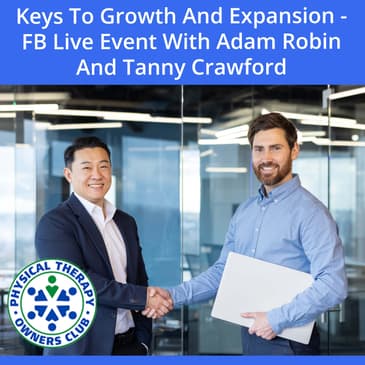
All of our experiences—the highs and the lows—build up to take us to this exact moment. We are on a never-ending journey of growth and expansion. Adam Robin, partner and coach with PT Owners Club, takes the reins on this episode of the Physical Therapy Owners Club and introduces Tanny Crawford – an experienced, new coach on the team. Tanny has been successful in PT ownership and management, and in this episode, he shares what some of the keys to his success have been. What he and Adam share are timeless truths for any business that desires to grow beyond the owners themselves. Tune in to learn about the lessons they took on their journeys to PT ownership.
Want to talk about how we can help you with your PT business, or have a question you want to ask? Book a call with Nathan - https://calendly.com/ptoclub/discoverycall
Love the show? Subscribe, rate, review, and share! https://ptoclub.com/
[00:00:00] The lack of clarity is always the problem. It's never not the problem. The lack of clarity is always the problem. Confusion and inaction are just a lack of clarity. That's right. Confused people don't take action. Confused people don't buy. Confused people don't move forward.
[00:00:23] Welcome! You've entered the Physical Therapy Owners Club podcast, where your host Nathan Shields and other successful PT owners and leaders share their experience and insights on how to build successful PT businesses. They'll share the stories of their paths to success and show you how you can
[00:00:39] also obtain greater freedom and more profits from your business. That's what the PT Owners Club is all about, greater freedom and more profits. There's plenty of room for you as well, so come on in and join the club. Hello everybody! Welcome Physical Therapy Owners Club. I'm your host,
[00:01:01] Adam Robin, and new guest today. So we tried going live once before, and it was like right before Christmas, I think. And we had some technical difficulties, couldn't go live, but he's back. New Physical Therapy Owners Club coach, my friend Tanny Crawford. Tanny, what's
[00:01:16] up man? What's up Adam? Thanks for having me, buddy. Yeah, we made... I don't know what happened last time. Stars weren't aligned. It wouldn't let us on for nothing, so... Yeah. Here, glad to be here.
[00:01:26] Zoom and Facebook, they were having a bad day, and they didn't want to be friends that day, so... But that's all right, we're back today, man. I thought it would be cool to just bring you
[00:01:37] on, talk a little bit about your story, talk a little bit about like your journey and your approach to private practice, and not just private practice but like leadership, because I know like leadership is a big piece of what you do and how you like to do things.
[00:01:51] Because yeah man, your story's pretty cool, and it's unique. It's a little different than most of the people that I've talked to in the past, so tell me about your story, like becoming a PT, where you're from, and how you got started in this game.
[00:02:04] Oh yeah, that's a nice way of saying my story's got a lot of twists and turns and forks in the road, right? So I think everybody's story's got a little bit of that. So I am
[00:02:12] Tanny Crawford. I grew up in Jackson, Mississippi. Oh gosh, a couple generations deep in Mississippi, but went to high school in Jackson, ended up going to a couple different colleges and universities
[00:02:26] before I figured out really what I wanted to do. I thought I was going to go to medical school and then had some path corrections and went into physical therapy, had a summer job one
[00:02:36] summer, good friend of mine that kind of persuaded me and introduced me to the PT world, and so I said, yep, that's what I want to do. Got into PT school way back in 2001,
[00:02:47] went to the University of Mississippi Medical Center there, graduated from class, and I always had this underlying voice or feeling or gut of whatever you want to call it, right? A knack towards,
[00:03:02] I always wanted to open my own clinic, even as a physician if I was going to be a doctor, I was like, you know, I kind of want to run my own clinic. I just didn't have that want
[00:03:08] or need to work for a large corporation. So anyway, fast forward, I took a job out of PT school, worked for a little while, found some partners and local partners, and we started
[00:03:19] a company back in late 2003 called Performance Rehab and over a 12-13 year period, we grew that, so we started off with some assisted living home contracts and outpatient centers and just kind of grew slowly but methodically over 12-13 good years and just unbelievable relationships.
[00:03:47] God really placed a number of people through that decade in our path and we were able to grow the company. We had some great physicians that supported us and through the journey,
[00:03:57] I learned a lot about, this is kind of funny, but something I was just thinking about the other day that I didn't really know much about emotional intelligence or I just, I didn't know.
[00:04:07] I felt like I was gifted now looking back. I know I was kind of gifted in some of those aspects because I can tell if something was wrong with an employee or if a patient really didn't feel
[00:04:21] like they were getting the best treatment. I don't know, there was just something about how I could pick up on it. I didn't know what it was, but I just would act on that and
[00:04:28] I would go talk to them and confront them. We had a good run there, had an exit strategy with a larger PT organization called Dreyer physical therapy that picked us up and acquired us in 2015.
[00:04:41] How many clinics were you at at that time? We had six outpatient clinics and about 20, 21 assisted living contracts. We had about 100 employees, pretty good size organization. Now Dreyer just picked up our outpatient portion of the company. We sold our six clinics and I
[00:04:59] stayed on board with them. One of my partners did as well, stayed on board with them kind of as an area manager managing clinics. We acquired a couple more clinics in the next three years or so.
[00:05:12] We added another 15 or 18 clinics to the mix for Dreyer. I can't remember, they ended up with maybe 150 clinics, 200 clinics. But during that transition from a clinic owner to an area manager for a larger corporation, they had some leadership coaching inside,
[00:05:33] but also along the same lines, there was a friend of mine named Corey Lee. He's a John Maxwell executive coach now, but he kind of spurred my interest. He said, hey, you've been studying
[00:05:44] some leadership with the new company. Once you look at kind of what John Maxwell offers, and so I did. And I got certified in John Maxwell leadership and Adam, man, this light bulb went
[00:05:55] off. That was like, this leadership stuff actually exists out in the world? What is personal development? What is leadership? What is clarity? What are goals? All that stuff. I'm like, clarity. I mean, I thought I could see pretty good, but no, it's anyway,
[00:06:10] went into the John Maxwell piece, got out and finished my stint. My three-year contract with Dreyer had a non-compete. So I moved in with a couple of physicians that opened a new direct primary care cash-based membership medicine model, did some business development
[00:06:25] with them, grew their clinics, and then got picked up. I'm speeding up a little bit here because now we're 2019, speeding up a little bit. But I got picked up by a company here in Nashville. I live in Nashville now that bought a separate company out of bankruptcy.
[00:06:38] They hired me to like a turnaround artist and COVID hit 2020. We kind of turned those clinics around, ended up selling a few COVID hit and really put a damper on that. So I took a chance
[00:06:52] to pivot into real estate here in Nashville and have loved it ever since. And so that brings us up here to pretty much back in November when you guys reached out to me and talked about
[00:07:05] physical therapy owners club and having a good idea of what you wanted and what I needed and it kind of matched up. And so glad to be a part of it. Pretty much brings us right up to still doing
[00:07:17] real estate and doing some coaching just got off a call a few minutes ago. Over the many years of my physical therapy clinic ownership, one of my biggest fears was that
[00:07:28] one of my PTs was suddenly up and quit. I hated being in that position, that position of fear and weakness. That's why back in the day, my business partner, Will Humphries and I decided that we
[00:07:38] were going to change the narrative and always be hiring always on the lookout. Forget it. We weren't waiting for the next provider to quit and then start up the hamster wheel to suddenly replace
[00:07:48] them as soon as possible. We were going to be on the lookout always for the next Rockstar PT. Since that time, I personally witnessed Will Humphries build a bench of willing Rockstar PT candidates for our clinics such that at any time if our providers
[00:08:02] wanted to leave, we had not only a suitable replacement for them, but someone that we were super excited about. He did this not only during some of the most difficult times to find physical
[00:08:10] therapists, but also in some of the most difficult parts of the country to recruit and hire PTs. Now, Will Humphries has developed a program for UPT owners called Rockstar Recruiter to show you exactly how to find the next Rockstar physical therapist for your clinics. Physical therapists
[00:08:25] that don't just fog a mirror and treat patients, but physical therapists that are excited to join your practice and are looking for opportunities to grow and lead in your company. It's exciting to see that what Will had done so masterfully in the past is now providing to
[00:08:38] owners like you across the country to help you be in a position of power versus fear of the next resignation. Bringing on quality physical therapists to view Will's Rockstar Recruiter program will open up opportunities for you in the clinic that you never would have
[00:08:52] imagined. And I've seen it myself. Reach out to him now at will at unlock HBA.com. Will at unlock HVISMBOY.com or call him, text him directly 480-248-5119. Dude, you forgot to mention the best hire you ever made in your career. Do you remember who it
[00:09:23] was? I do. Was it Adam Robin? It was Adam Robin, dude. You hired me. You hired me out of school. It was you and some of your guys with Dreyer hired me. I was the first geek was with Dreyer.
[00:09:34] Well, I didn't know if you wanted me to mention you live or not, but you are. Yes, you were absolutely one. The greatest hire you ever made. That's why I said the phenomenal people. That's right. That's right. That was a plug. So yeah,
[00:09:48] it's been a fun journey and we can branch off into any of that you want to. One thing I really want to touch on real fast is like we had that Slack channel the other day.
[00:09:55] There's been a couple of times where I had to pivot, right? Everybody has to pivot at some point. And so when the maybe my partnership wasn't working and we needed an exit strategy, it's a pivot,
[00:10:06] right? And so when Dreyer picks us up, when contract's done, it's time to pivot. And so pivot in basketball is changing directions with your foot still planted, right? On a foundation. So a pivot for us should also mean it's a change in direction while remaining true to ourself,
[00:10:30] right? Staying connected to the foundation, changing directions while staying connected to the foundation. The core of who you are, the core of what your business is, mission and vision. We talked about that a good bit, but it's phenomenal. And there's something comforting
[00:10:47] knowing that you can change directions, but you still know I know who Taney is. I know how I operate. I know how I want to treat people. I know what my values are.
[00:10:57] I know what my triggers are. So anyway, may not want to go that way, but we did. So I've got a bunch of notes that I wrote down and man, you've had a ton of experience.
[00:11:10] And so I'm kind of making this up on the fly everybody. So bear with me. I've kind of got this broken down into like, so you achieve some success, right? With performance rehab. You had your partners, you were doing that for a while,
[00:11:23] right? So you experienced some success. So like, I'd love to learn a little more about like maybe bullet pointing a few key pieces of like how you did that. But then you had a transition, you pivoted, right? And it seems like during that transition is really when you
[00:11:44] started to find leadership a little bit more about leadership and personal growth. And maybe you were able to kind of reflect back on some of your success and realize that that's maybe
[00:11:51] some of what you were doing, right? So like, let's talk about that. Let's talk about like the first pieces of success. The first, what was it 13 years? Like how'd you do that, man? Like six clinics, 100 employees, like that's a lot. How did you do that?
[00:12:06] I didn't view myself as successful when I was in the middle of all that. In fact, when the partnership started having a few issues, I kind of while I was in the middle of it
[00:12:16] literally viewed it as failure. That's pretty much a preaching moment right there is that sometimes when you're in the middle of something you view as a failure, it's literally an experience that
[00:12:26] builds you up moving forward. I knew I wanted to start my own clinic, but I didn't say in my mind, I did like when I was 20, I don't know 25 years old, I didn't say I want six
[00:12:36] clinics and 93 employees. I was just like, Hey, let's see if we can get a clinic going. If we got a clinic going and then we found another guy like another Adam Robin. And I was like,
[00:12:47] that dude, he could run a clinic by himself. And so then light bulb went off. I'm like, ah, let's do another one because I feel really comfortable. I trust this guy that he's going
[00:12:56] to run this clinic the way I like them the way they should be run. So we did number two. And then about two and a half years later, found another guy and a girl. And then it was just from
[00:13:08] that point it was like, well, we've done it twice and two and a half years later, let's do it again. So we opened a third one and same thing happened. It was literally about we opened our first clinic
[00:13:19] in early 06 and then another one in 08, another one in 10, maybe 11. And then last one or so was 12 and 14. So it was about every year and a half, two years. And it was the people.
[00:13:34] Dude, that's exactly what it looked like down. Yeah, we didn't build the building and then fill it up. We had a person and culture that another person, the piece of the puzzle that fit. And I was
[00:13:45] like, ooh, let's get them plugged in over here because they'll serve the whole community wherever it is if we were in Byron or Brandon or Madison or Clinton or whatever the area was. I was like, this guy, Adam or Russell or Jason, whoever it is, these guys are
[00:14:01] really going to support this community and you don't have to sell that. It's like, it's a product that people need. That person was somebody that people need. So anyway, I have a coaching call today and we were talking briefly about enneagrams. There's another
[00:14:17] personality quiz system called Primal 7. Seven core questions that kind of most everybody asks at least one. And so there was one of them that some people ask this question, is am I successful?
[00:14:29] All right. It's kind of part of some people's again, part of their core. And they tend to ask that question all the time to the world. Am I successful in all their quests and decisions
[00:14:40] and things that they do, they're literally asking the world, am I successful? And so for many people's eyes, I was successful in the clinic. In my own eyes back then,
[00:14:50] I was not. In my own eyes back when my contract ended with Dreyer and they didn't ask me to be on their corporate board as like COO, which Taney's plans may have been. That was to me a failure.
[00:15:03] But the experience that I gained looking back, I'm like, oh man, that was fantastic to have. That was success in itself. So I say that to say, I think I can't answer, of course, I think you're successful. Taney to Robin, I think Robin is successful. I'm Robin at
[00:15:21] calling by his last name sometime, you people. So if y'all are watching. So Mr. Robin, get out and give me 20. I think you are successful. Now, if somebody were to ask you, you're like, well,
[00:15:32] I mean, I've done some good things. We're on the way. It's like we're on the way. We're working on it. Right? So you are the only one that can answer that question. Am I secure?
[00:15:42] Am I safe? Am I wanted my, for instance, my Primal 7 question is am I wanted? You can answer that. But am I going to believe you? Probably not. But I can answer it to myself.
[00:15:54] I'm about the only one in the way to answer that is to flip it into a statement. So instead of am I successful? It's I am successful. Oh, yourself, you are successful. But yes,
[00:16:05] there's more to go with that. So anyway, I wrote down as I heard you talking a few things that resonated with me. Number one, you said one step at a time, right? I said, how'd you do that?
[00:16:19] You said, well, we just got one clinic going. Right? It's like, how do you eat elephant one bite at a time? One step at a time, right? Then you mentioned it was less about your strategy
[00:16:33] and more about finding the right people. Right? So like, I always like to say, and I don't know, somebody told me this one time and it just kind of stuck with me. But first who, then what?
[00:16:45] Right? So Dan Selden wrote a book, Who Not How? Who Not How, buddy? Somebody said first who, then what? I don't know who it was. But it's like, at some point along the journey,
[00:16:57] like once you figured out one clinic, and it was time to kind of go to two, or maybe once you're at two, trying to go into three, you're kind of eclipsing that like,
[00:17:05] you're that evolving owner. At some point it turns into a leadership game. And it's less about strategy. It's not about, it's not your marketing skills. It's not your systems as much.
[00:17:18] It's more about like, how do I get clear on like who we are and what we want to do and find the right people who align with that and then get a massive alignment with my team?
[00:17:28] And that's kind of the rock shit that takes off. And that's when it gets fun. It's so much fun. And we talked before we got on here about attracting. You attract people that want to be around you, right? And so attraction versus chasing. So you are the
[00:17:46] sum of the five people you hang around with most. But like you were talking about earlier, I don't remember exactly how you put it. But at some point, people, they don't hang out with
[00:17:53] you anymore, right? And then there's other people that come into your lives at the moment that they're supposed to. And then your cultural alignment, all of it just works. It gives you so much energy and so much passion. And people can see it and it's contagious.
[00:18:09] Yeah, it's like things switch. And by the way, like this isn't like traditional business advice, if you will. But like there's so much power in this conversation. But like things, like in the
[00:18:24] beginning, when you were at one clinic before you had kind of grown up, right? You were a little kid. I'm assuming you had some sleepless nights, you were stressed out, and you were gripping tight
[00:18:36] to things, and you were trying to control things, and you were trying to like manipulate things and create the strategy. And right. And then it's like it's exhausting. It's so overwhelmingly exhausting and unfun. And a lot of people get stuck there, right?
[00:18:51] But whenever we can get to this place of development where it's like, I just want to like, let's have fun. Let's let go and stop catastrophizing everything. And just have fun and get clear on
[00:19:06] like who I am and who I want to be. And just be that person and start to attract more people around me who want to be similar to me who kind of like have similar values as me.
[00:19:17] And like let go and trust them and stop micromanaging and just kind of like trust that process. That's when things get fun. That's when things get like you get your life back, right? You get to
[00:19:29] like your business grows and your leadership team comes around and they help you grow your clinic and you get to like spend more time with your family. You find that freedom and fulfillment
[00:19:39] that we always try to help clients with. A lot of that has to do with setting up some foundational things in your business. But the hard part is managing what's in between your ears, right? And getting you to think a little bit more clearly about like, hey,
[00:19:53] you don't have to be the boss of everything. Just kind of let things chill for a little bit. So at least that's been my experience. I don't know about you. When you have a dream and then you
[00:20:02] finally get ready to launch that dream, you've got this energy. Yeah, it can get exhausting. It gets exhausting after a couple months or maybe a year of it, of the same old, but you
[00:20:13] can run off this adrenaline rush of your first couple months and six months or whatever of having a new clinic open. Thankfully, I had some partners that were phenomenal at bookkeeping and doting
[00:20:23] the i's, crossing the t's, and I was a lot more of the relationship culture piece was fun. So most of that stress is somehow almost camouflaged for a while when you're just
[00:20:38] kind of running on adrenaline and like, I can't even start like, I'm doing it. I'm doing it. So that was the beginning. And now what 23 and four years later out of school, that's kind of a
[00:20:49] self renewed energy when you included to see other people grow in their businesses, whether it's in the PT world or whatever, a lot of work, it's all the same. But there's just a method to it. Like you said about the clarity, gaining the clarity piece
[00:21:06] and setting goals. And that's just something I didn't know when I was 24, 25, 28, 33. I didn't really say I was a little bit late to the game, but I am glad I'm here. But there's, for instance,
[00:21:18] there's a young guy that's in one of my mastermind groups that's 20, 23, 24 years old. And I just think, and I tell him on the buddy, you are so far ahead of most people that are 24,
[00:21:29] 25 years old, starting to already look for that clarity, having the awareness that you even need clarity and goals and all that and culture. So I would argue that that is the answer. Section three in the vault. It's the answer like the lack of clarity is always the problem.
[00:21:54] It's never not the problem. The lack of clarity is always the problem. Confusion and inaction are just a lack of clarity. That's right. Confused people don't take action. Confused people don't buy. Confused people don't
[00:22:09] move forward, right? So like the art and the rhythm of consistently allowing yourself to gain clarity is the key. Is the key to self-awareness is the key to practice is the key to leadership is the key to like is the key to finding what you really want.
[00:22:25] And you have to keep practicing that clarity. If anybody on here is a hunter, if you take your binoculars out of your bag and you had them for a couple months, your scope on your gun, it's not going to be clear. You got to readjust it. And so
[00:22:36] you have to have a consistent intentional deep work time for yourself. Keep clarity. Same thing with your eyes, your glasses. You can't have the same set of contacts for 15 years. Your eye changes, right? So you have to go back for adjustments and whatever.
[00:22:51] So we have to have our own personal adjustments and consistent ones and intentional ones. That's where a coach comes in, right? I had a little connection call with the potential client today and he's like, listen, it's an investment. You're going to hire a coach.
[00:23:07] It's kind of hard. It's like, uh, kind of hurts a little bit. You got to pay the money. It's not going to break the bank, but it is going to be a financial expense that is more than probably what you want to pay, right? Most of the times.
[00:23:18] And the guy was like, well, could you tell me a little bit about like, what is it about coaching that has been so like astronomically great for you? Like, what was it? Give me an example of something that you implemented in your
[00:23:31] business that was so great. And I sat there and I was like, that's a great question. I said, it really isn't one thing. But what happens is I come to the call and I'm asked,
[00:23:44] what is your focus and priority right now? And I tell the coach and the coach tells me, that's probably not a great thing to focus on right now. Let's replace this thing with this
[00:23:57] thing. And the problem is that the new thing that you need to focus on, you have no idea. You have no knowledge on how to take action on that thing because you've never done it before.
[00:24:07] So you say, hey, coach, I don't know the first step to take regarding X. And then the coach says, no problem. I have an entire blueprint and program for you to implement into your practice
[00:24:17] next week. And I have a network of all these people who have mastered it that I can get you on the phone call with. And it's a series of that over and over and over and over.
[00:24:25] So it's like, it's never one astronomical trick. It's just the process of showing up, shifting my priorities on what is most important and then being provided the resources to quickly implement every month, every month, every month, every month. And then my competition,
[00:24:44] they're running around with a chicken, like a chicken with their head cut off. They're not clear. They're not focused. They're scared about the reimbursement cuts, this and the COVID. And they're chasing their own tail. And I'm sitting there making one massive
[00:25:00] move every single month. And before you know it, you look up and you got six clinics and 100 employees. That's it, right? Like that's been my experience. Yeah. And you were talking about, they don't know how to operate. They may not even have known that X even existed.
[00:25:16] Right? So some of this coaching that I've learned from being coached myself too was it's almost like, you know, when you're at the eye doctor, I use analogies all the time. You're at the eye doctor, you're looking up there and you're like, I don't know if those are
[00:25:29] letter shapes or numbers. And then he dials it in for you. And it's like, oh, A, E, B, R, Q, Z. And then he flips it over and does something else. And you think you know what's up there.
[00:25:41] And then he clears it up for you or ask you the proverbial questions. He adjusts your lenses. But you're like, I didn't even know Z was an option up there. So same thing with coaching, man.
[00:25:53] It's phenomenal. Just the awareness and the clarity that questions can bring to people. And then goals. For instance, I've got a guy I work with here at the real estate office that
[00:26:06] used to be, he would book celebrities on cruises for like, I don't know, colleges, right? So he would have these big names, George W. Buescher, different people. So he booked them as the talent
[00:26:18] for the cruise. And so they would, people would buy this cruise and get on there. And sometimes he said, you know, there's cruises that exist that are like cruises to nowhere. I said, no. He said,
[00:26:28] yep, it leaves the dock, goes out, wanders around for four or five days and then comes back to shore. And I was like, you know, that's a good leadership principle about goals too. Because if you don't really know where you're going, you can't see where you're going,
[00:26:40] you're just going to float around out in the water. You're busy, you're chasing your tail. Oh, you're busy as heck. You're tired at the end of the day too. You have seen all these patients and all this stuff and you're about out of gas.
[00:26:54] It's time to go back to dock. And so anyway, the goal piece is something that's been huge. And just gnawing at those goals, one little percent every week, do one thing closer, just one tiny thing today that takes you a little bit closer to where you're headed.
[00:27:13] And those are just principles that I would never know if I hadn't gotten into coaching and coached myself. I also had a coaching call with a client today and let's just face it, practice owners,
[00:27:25] especially small practice owners, they're busy man. There's a lot of practice owners right now that are in that stage of like maybe you got like a part-time front desk person and you're treating like 30, 35 hours a week trying to work on your business on the weekends.
[00:27:40] That's a hard place to be. So if you're there, welcome to be an entrepreneur. You have to work a little, that's the grind mode. You got to go for it here.
[00:27:50] But the problem that we have is like sometimes whenever we start to kind of open up the door and help them paint a little bit of a vision on what they can focus on,
[00:28:01] you can see the to-do list just go, they start making like 27 to-dos instantly and it becomes overwhelming. It becomes like, oh my God, I'm always having a little bit of anxiety. I am mentally
[00:28:15] creating all this work for myself. And it's like when you're in that stage of business, you can only pick one thing at a time. So getting clear and getting comfortable and getting in the habit of learning like, if I have 27 things on my to-do list,
[00:28:33] I have to be brave enough and bold enough to say no 26 times. No, no, no, no, no, no, no, no, no, no, no, no, no, no, no, no, no, no, no, no, no, no, no, no, no, no, no, no, no, no, no, no, no,
[00:28:40] so that you can say yes to the one right thing right now, right? So that's a good principle. I think it was the book Essentialism. Prioritization is less about saying yes to the
[00:28:51] right thing and it's more about saying no to all the wrong things, right? But like in the beginning, everything's important. Everything's a 10, right? Everything's like the most important thing. So yeah, man, good stuff. So tell me you're working with a few clients right now.
[00:29:09] Yeah, they're all crushing it. What are you seeing in the industry right now with your clients? Are you seeing any common characteristics, common traits, common hurdles that you're helping them overcome? Like what are you seeing with your clients right now? Man, one thing that
[00:29:25] I'm seeing is that they are busy. They're in the clinics. They are learning and they're becoming more aware that they've got that death grip on treatment, right? Like I can't not treat. I'll work 60 hours this week and I'll work on my business outside this 40-hour hammer down
[00:29:43] treatment all because we can't lose that revenue. So that's a very common piece and it's very understandable. I mean just at first glance you would think that's how 100% of people operate. But the other thing is that if you think about developing others, so one of the things that
[00:30:01] I like to do is to try to open people's eyes and minds about developing other people so that they can take up any slack or take up any mistreatments kind of the always-be-hiring thing, right? So
[00:30:16] taking your time to back out just a little bit and then allowing other people being able to delegate well. Give yourself permission for some people out there that's hard to do. Give yourself permission to delegate. Another thing though is I'm finding especially just like I was
[00:30:33] what's really common is they don't really know exactly who they are. They don't know what really their true core values are, right? And so they can't articulate what their communication style is. They can't really articulate what their leadership style is and so
[00:30:50] that's just kind of a common starting point. That awareness is lacking in most everybody. I mean as far as industry it's that treatment piece that 99% of people find it hard to work on the business because they're spending 50, 45, 50 hours a week working in the business and that's two different
[00:31:08] mindsets. It's left side of the brain and right side of the brain. It's 30,000 foot view and it's on the runway view. You can't stand both at the same time so you have to back off, get out and
[00:31:19] so that's one thing that's common is people don't back out work on the business. They just steadily work in it. They're down there on the runway tightening up bolts on the tires and they
[00:31:27] never get out take off and get up and look at it from a 30,000 foot view. Yeah and that's a hard thing to do man. I get it. It's so hard. I recall very, very vividly me being that guy.
[00:31:40] Me being that guy of like no we've got him in our group right now still and it's the hardest challenge is be brave enough to get out of treatment and just try it. Your business will
[00:31:51] survive if you take a four hour block of time and just like take a break and work on the business a little bit. I promise you it'll survive and everybody will actually be really happy
[00:32:01] that you did that. Most people except you at first. Look John Wayne. John Wayne said courage is being scared to death but saddling up anyway. That's right. You know what? That's a good
[00:32:13] point. It's not going to feel good. You're going to be scared. At night you're going to be thinking oh my god I'm going to lose money and I'm going to XYZ right and you're going to be kind of looking
[00:32:22] over the shoulder of your people and that is exactly where the growth happens that discomfort and that's exactly where your team even if you have one or two people on your team
[00:32:34] your team has the opportunity to like actually be themselves and like learn how to work without you. So that's a good point if there's anybody listening which I'm sure will get a few listeners. If you find yourself exhausted and just holding on to treatment and fearful about like
[00:32:51] your whole world coming down if you step out like I just encourage you to be brave and give it a shot and mark off some time on your counter so you can actually work on your
[00:33:01] business because your business needs it. Yeah I think if you can give yourself permission to delegate allow somebody the opportunity to grow and give them the opportunity to mess up it's okay.
[00:33:15] Yeah if you would have done it if you would have done it yourself probably wouldn't have messed up but then you wouldn't have had that four-hour time period to work on your business and study to grow that thing. And they wouldn't have learned. Yeah that's right.
[00:33:27] I think that we have delegation conversations almost every coaching call because here's the thing there are two most important KPIs if you will in your business and it's number one how much time free time do you have on your calendar every week. It's probably the most important KPI.
[00:33:46] Number two is maybe not as objective but how much bandwidth do you have right. So like if you have four hours off every week but you're like paying bills and answering emails and calling the accountant doing payroll and you've got all these things eating up your bandwidth well
[00:34:02] time's great but if you don't have the ability to focus on something that's going to move the needle in your business it's time to delegate right. And so here's the thing you're always going
[00:34:11] to be delegating what you're doing you're always working yourself out of a job right. So it's like you learn it you systemize it you give it away you learn it you systemize it you
[00:34:18] give it away and you keep doing that until you're up at the top of the mountain by yourself right. And what I always tell clients is when you give this thing away that's really really
[00:34:29] scary and you're like that's your baby you've been doing it this whole time you're going to be nervous about that you're going to have some emotions that everybody's a little different might be fear might be paranoia might be a little bit of anxiety right and with some worry
[00:34:44] you're going to want to look over the shoulder and you're going to have this internal urge to jump in and look over the shoulder and try to like make sure it's right the trick to that is like anticipate that anticipate those uncomfortable feelings and
[00:34:58] develop some strategies to hold yourself accountable and say I'm not going to be that boss right I'm not going to be that micromanaging boss and if you could do that over and over and over
[00:35:06] then you actually start to learn and grow and do all the things we're talking about. And again it's really extra scary if you do it by yourself but like we're here to help
[00:35:14] hello not doing this by yourself you've got kids I've got kids we went to the hospital my wife had a baby and then they said all right time to go home I'm like oh crap
[00:35:26] especially on my first one I was like uh what do we do you know I don't worry well a nurse will call you you're going to come see us in a couple of days it'll be fine call us with any questions
[00:35:37] so yeah that's what coaching is all about buddy we're here for you. That's right man if anybody's listening here always feel free to give me a shout if you ever need anything at them at ptoclub.com you can also join the Facebook group physical therapy owners club shoot
[00:35:54] me a direct message if you have any questions any challenges if you need to be connected with anybody in my network you can also email tanny tanny at ptoclub.com shoot him a direct message listen we've
[00:36:07] built a system we've built a strategy that clearly defines and diagnosis exactly where you are at in your business I can tell you the top three challenges that are bottleneck in your
[00:36:20] business right now with a quick phone call and I can give you the blueprint and I can point you in the right direction all I gotta do is reach out and I'm happy to do that for you.
[00:36:28] Tanya you got anything else for the folks? If you're wondering where you are right now in the path to success you're successful whether you're in high school you're in college you started your first clinic you're starting you finished your first year
[00:36:43] you're five years you're a number five clinic you're in your 228th clinic you are successful and of course we can help you get further so thanks Adam thanks for having me buddy. Thanks tanny let's do this again in a couple weeks. Yeah, all right buddy peace out brother.
[00:36:57] See ya bye. Thanks for joining us today in the physical therapy owners club the resource for stability and freedom in your PT practice reach out and join the network today subscribe to our podcast get links to social media and access all of our episodes with show notes
[00:37:16] at ptoclub.com