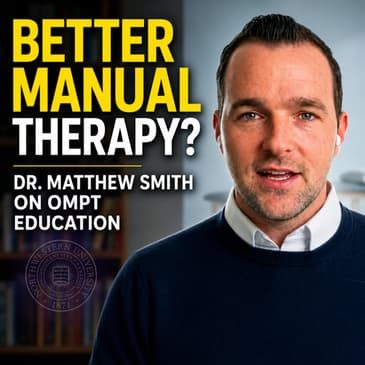
In this episode, host Dr. Skip Gill welcomes Dr. Matthew Smith to discuss his Clinical Science in Manual Therapy Grant-funded study, “Mapping the Continuum: Enhancing Orthopedic Manual Physical Therapy Education Through Instruction and Training.”
Dr. Smith shares how his own OMPT training shaped his interest in clinical reasoning, mentorship, and the way manual therapy is taught across different stages of professional development. He explains why his study looks at the continuum from entry-level DPT education through residency and fellowship, and how instruction changes depending on both the learner and the mentor.
The conversation also explores the value of qualitative research, the complexity of analyzing interview data, early observations from the study, and the importance of near-peer instruction in helping students understand what advanced OMPT training can offer.
For educators, mentors, fellows, residents, and clinicians interested in the future of orthopedic manual physical therapy, this episode offers a thoughtful look at how OMPT principles can be taught more clearly, consistently, and meaningfully across the profession.
Key Takeaways- OMPT is more than technique execution.
- Dr. Smith emphasizes that his own training helped place clinical reasoning at the center of practice.
- The education continuum matters.
- DPT, residency, and fellowship training should not be conflated. Each level has different expectations, depth, and nuance.
- Qualitative research captures what surveys often miss.
- Dr. Smith’s interest is in the “why” and “how” behind clinician behavior, mentorship, and decision-making.
- Fellowship programs may vary in method but align in goals.
- Early observations suggest different programs use different teaching routes while aiming toward similar outcomes.
- Near-peer instruction may be powerful.
- Exposure to residents and fellows can help DPT students better understand advanced training pathways.
- Mentorship drives academic and research growth.
- Dr. Smith reinforces that being a strong clinician does not automatically make someone a strong educator or researcher.
00:00:04 --> 00:00:06 Well, hello, everybody.
00:00:06 --> 00:00:07 I'm Dr.
00:00:07 --> 00:00:09 Skip Gill and one of the trustees for
00:00:09 --> 00:00:12 the Foundation for Orthopedic Manual
00:00:12 --> 00:00:13 Physical Therapy,
00:00:13 --> 00:00:16 which is a supporting organization for
00:00:16 --> 00:00:16 AIOPT.
00:00:17 --> 00:00:19 And I have the pleasure today to introduce
00:00:19 --> 00:00:20 Dr.
00:00:20 --> 00:00:22 Matthew Smith and to discuss his
00:00:22 --> 00:00:25 background and the study for which he
00:00:25 --> 00:00:27 received the Clinical Science in Manual
00:00:27 --> 00:00:30 Therapy Grant Award last year through our
00:00:30 --> 00:00:31 foundation.
00:00:32 --> 00:00:32 Dr.
00:00:32 --> 00:00:34 Matthew Smith is an instructor in the
00:00:34 --> 00:00:37 Department of Physical Therapy and Human
00:00:37 --> 00:00:39 Movement Sciences at Northwestern
00:00:39 --> 00:00:40 universities.
00:00:40 --> 00:00:43 Weinberg School of Medicine and is a
00:00:43 --> 00:00:45 board-certified orthopedic clinical
00:00:45 --> 00:00:47 specialist and a fellow of the American
00:00:47 --> 00:00:49 Academy of Orthopedic Manual Physical
00:00:49 --> 00:00:50 Therapists.
00:00:51 --> 00:00:53 He earned his Doctor of Physical Therapy
00:00:53 --> 00:00:56 from Northwestern University and a Master
00:00:56 --> 00:00:58 of Science in Orthopedic Physical Therapy
00:00:58 --> 00:01:00 from Daemen University and a Doctor of
00:01:00 --> 00:01:03 Science in Physical Therapy from Bellin
00:01:03 --> 00:01:04 College.
00:01:05 --> 00:01:06 At Northwestern,
00:01:06 --> 00:01:08 he leads and contributes to coursework
00:01:08 --> 00:01:10 across the doctor of physical therapy
00:01:10 --> 00:01:11 curriculum,
00:01:11 --> 00:01:13 particularly in musculoskeletal
00:01:13 --> 00:01:13 management,
00:01:14 --> 00:01:15 and has a strong interest in how
00:01:15 --> 00:01:18 clinicians develop clinical reasoning.
00:01:19 --> 00:01:21 In Northwestern's fellowship in advanced
00:01:21 --> 00:01:23 orthopedic physical therapy practice
00:01:23 --> 00:01:25 research and education,
00:01:25 --> 00:01:27 he coordinates the teaching practicum
00:01:27 --> 00:01:28 portion of the fellowship,
00:01:29 --> 00:01:31 including the integration of fellows into
00:01:31 --> 00:01:34 the entry-level musculoskeletal courses.
00:01:35 --> 00:01:35 Dr.
00:01:35 --> 00:01:37 Smith's work focuses on bridging
00:01:37 --> 00:01:39 education, research, and clinical care.
00:01:40 --> 00:01:42 He currently serves as the principal
00:01:42 --> 00:01:44 investigator on a clinical science and
00:01:44 --> 00:01:47 manual therapy grant examining the
00:01:47 --> 00:01:49 continuum of orthopedic manual therapy
00:01:49 --> 00:01:52 education from entry-level training
00:01:52 --> 00:01:55 through residency and fellowship to
00:01:55 --> 00:01:57 improve how manual therapy is taught and
00:01:57 --> 00:01:58 applied throughout this curriculum.
00:02:00 --> 00:02:01 In addition to this work,
00:02:01 --> 00:02:03 as a Searle Fellow and member of the
00:02:03 --> 00:02:05 New Chapter Lab at Northwestern
00:02:05 --> 00:02:06 University,
00:02:07 --> 00:02:09 he focuses on mentorship and leadership,
00:02:09 --> 00:02:12 as well as the use of generative AI
00:02:12 --> 00:02:14 to enhance student learning and feedback
00:02:14 --> 00:02:16 in physical therapy education.
00:02:17 --> 00:02:20 Welcome and glad to have you here with
00:02:20 --> 00:02:21 us today, Matthew.
00:02:21 --> 00:02:22 Yeah, thank you.
00:02:22 --> 00:02:23 Appreciate it for you for having me as
00:02:23 --> 00:02:23 well.
00:02:24 --> 00:02:25 Great.
00:02:25 --> 00:02:27 We'd like to talk today about your ongoing
00:02:27 --> 00:02:30 study titled Mapping the Continuum,
00:02:30 --> 00:02:33 Enhancing Orthopedic Manual Physical
00:02:33 --> 00:02:35 Therapy Education Through Instruction and
00:02:35 --> 00:02:35 Training.
00:02:36 --> 00:02:37 But first,
00:02:37 --> 00:02:38 I wanted to hear a little bit about
00:02:38 --> 00:02:41 your clinical and research pathway that
00:02:41 --> 00:02:44 led you to develop your expertise here.
00:02:44 --> 00:02:46 So what was it that sparked this interest?
00:02:47 --> 00:02:47 Yeah,
00:02:47 --> 00:02:51 I think this interest was sparked kind of
00:02:51 --> 00:02:51 three different ways.
00:02:52 --> 00:02:54 First was my own clinical training.
00:02:54 --> 00:02:57 I really valued what OMPT,
00:02:57 --> 00:03:00 what my training brought me and bringing,
00:03:00 --> 00:03:00 you know,
00:03:00 --> 00:03:02 clinical reasoning to the core as a core
00:03:02 --> 00:03:04 principle for myself and my practice
00:03:05 --> 00:03:07 versus just technique execution, right?
00:03:07 --> 00:03:09 Like going through the whole clinical
00:03:09 --> 00:03:10 reasoning process.
00:03:10 --> 00:03:13 And I don't think we've always done a
00:03:13 --> 00:03:16 great job maybe as a profession of giving
00:03:17 --> 00:03:20 others that access that maybe don't have
00:03:20 --> 00:03:25 the means or the time or the thought
00:03:25 --> 00:03:27 to go and continue that training.
00:03:27 --> 00:03:27 So it really,
00:03:28 --> 00:03:31 I wanted to try and expand the reach
00:03:31 --> 00:03:32 of that OMPT framework.
00:03:33 --> 00:03:34 And I think no better way than with
00:03:34 --> 00:03:37 a DPT and residency training and kind of
00:03:37 --> 00:03:38 marrying some of those.
00:03:39 --> 00:03:43 And also the transfer of those principles
00:03:43 --> 00:03:45 to things outside of orthopedics,
00:03:45 --> 00:03:47 because I know in my clinical time
00:03:47 --> 00:03:49 mentoring students and other
00:03:49 --> 00:03:50 professionals,
00:03:51 --> 00:03:53 I've had people reach back out and say,
00:03:53 --> 00:03:53 you know,
00:03:53 --> 00:03:55 that methodology we used when I was a
00:03:55 --> 00:03:56 student,
00:03:56 --> 00:03:57 which they may or may not have known
00:03:57 --> 00:03:59 at the time was kind of the OMPT
00:03:59 --> 00:04:00 type framework,
00:04:00 --> 00:04:03 has served me well in acute care or,
00:04:03 --> 00:04:05 you know, my CVP, neuro,
00:04:06 --> 00:04:08 all of those different practice fields.
00:04:08 --> 00:04:09 So I just think that it has a
00:04:09 --> 00:04:11 wide applicability and I wanted to make
00:04:11 --> 00:04:13 sure and try to share that.
00:04:13 --> 00:04:14 And then the other thing was the
00:04:14 --> 00:04:15 qualitative aspect,
00:04:15 --> 00:04:16 which I think is
00:04:17 --> 00:04:20 pretty unique to manual therapy type
00:04:20 --> 00:04:21 investigations.
00:04:22 --> 00:04:25 And that is because I just really am
00:04:25 --> 00:04:26 more interested
00:04:27 --> 00:04:29 in the why and the how that people
00:04:29 --> 00:04:34 have versus just a simple binary yes or
00:04:34 --> 00:04:34 no.
00:04:35 --> 00:04:36 And that started more when I was doing
00:04:36 --> 00:04:39 my research at Bellin College,
00:04:40 --> 00:04:41 completing my doctor science there.
00:04:42 --> 00:04:44 And I think I can key into the
00:04:45 --> 00:04:48 one time where qualitative research really
00:04:48 --> 00:04:50 became something that I thought I could be
00:04:51 --> 00:04:51 more passionate about.
00:04:52 --> 00:04:55 And I was interviewing a clinician and
00:04:55 --> 00:04:59 for uh to frame it the survey question
00:04:59 --> 00:05:02 might be did you refer to an outside
00:05:02 --> 00:05:06 provider yes or no however in talking to
00:05:06 --> 00:05:08 that person i found that they were
00:05:08 --> 00:05:10 treating a patient and the patient said
00:05:10 --> 00:05:13 that they had had a previous wonderful
00:05:13 --> 00:05:17 experience with another pt provider that
00:05:17 --> 00:05:19 they credited for a lot of their positive
00:05:19 --> 00:05:22 experience and the treating the current
00:05:22 --> 00:05:24 treating physical therapist
00:05:25 --> 00:05:29 went and found that therapist who luckily
00:05:29 --> 00:05:31 was still in the same network or the
00:05:31 --> 00:05:34 same um you know organization that their
00:05:34 --> 00:05:36 therapist was at but at a different
00:05:36 --> 00:05:38 location and coordinated between the
00:05:38 --> 00:05:41 patient and that therapist for them to
00:05:41 --> 00:05:44 continue their relationship and their care
00:05:44 --> 00:05:46 because the current treating therapist
00:05:46 --> 00:05:50 recognized how important that relationship
00:05:50 --> 00:05:50 was to the patient
00:05:51 --> 00:05:54 so to me that really brought full circle
00:05:54 --> 00:05:59 of that story and that understanding of is
00:05:59 --> 00:06:02 way more powerful than did you re did
00:06:02 --> 00:06:05 you refer to another therapist yes right
00:06:05 --> 00:06:07 so that is really what inspired me to
00:06:07 --> 00:06:10 really get into that discussion with
00:06:10 --> 00:06:12 people versus just a yes or no on
00:06:13 --> 00:06:13 a sheet
00:06:14 --> 00:06:14 Yeah, I agree.
00:06:14 --> 00:06:17 I think we probably gravitate so much
00:06:17 --> 00:06:20 towards quantitative type research that
00:06:20 --> 00:06:22 it's great to have some more qualitative
00:06:22 --> 00:06:24 studies in the mix.
00:06:24 --> 00:06:27 So congratulations on receiving the
00:06:27 --> 00:06:29 Clinical Science and Manual Therapy Grant
00:06:29 --> 00:06:30 Award last year.
00:06:31 --> 00:06:33 And this is a fairly new grant that's
00:06:33 --> 00:06:36 offered by the Paris Family Foundation
00:06:36 --> 00:06:39 through the Foundation for OMPT.
00:06:40 --> 00:06:42 And so I was wondering if you could
00:06:42 --> 00:06:44 just give us a little overview of the
00:06:44 --> 00:06:47 study's aims and the gaps that you are
00:06:47 --> 00:06:47 looking to fill.
00:06:48 --> 00:06:49 Sure, sure.
00:06:49 --> 00:06:51 So myself along with Dr.
00:06:51 --> 00:06:53 Bill Healy and Dr.
00:06:53 --> 00:06:54 Carol Courtney are working together on
00:06:54 --> 00:06:57 this study and overall our research
00:06:57 --> 00:07:00 question was how instruction and
00:07:00 --> 00:07:03 mentorship of OMPT changes depending on
00:07:03 --> 00:07:06 the level of training of both the learner
00:07:06 --> 00:07:07 and the mentor.
00:07:08 --> 00:07:10 So we're really looking to identify
00:07:11 --> 00:07:15 what that continuum is from dpt education
00:07:15 --> 00:07:17 all the way through post-professional
00:07:17 --> 00:07:19 training so looking at some of the
00:07:19 --> 00:07:21 didactic work as well as the clinical
00:07:21 --> 00:07:24 experiences the dpt has and then going all
00:07:24 --> 00:07:26 the way through residency and fellowship
00:07:27 --> 00:07:28 to really find out what are people doing
00:07:29 --> 00:07:32 is there and what is the difference at
00:07:32 --> 00:07:33 each of those levels
00:07:34 --> 00:07:36 And as a fellowship mentor,
00:07:36 --> 00:07:40 how does OMPT influence what you are
00:07:40 --> 00:07:43 instructing to those other levels of DPT
00:07:44 --> 00:07:47 or resident that might not have the OMPT
00:07:47 --> 00:07:49 emphasis that fellowship mentorship has?
00:07:50 --> 00:07:53 And then really the goal is to identify
00:07:53 --> 00:07:55 and come up with some strategies for those
00:07:55 --> 00:07:57 different levels of learning to help
00:07:58 --> 00:08:02 spread OMPT and that thought process
00:08:02 --> 00:08:03 throughout those levels and different
00:08:03 --> 00:08:04 kinds of curriculum.
00:08:04 --> 00:08:05 Because, you know,
00:08:05 --> 00:08:07 you look at some strategic goals of AOMT
00:08:08 --> 00:08:11 and advancing OMPT to a wider audience.
00:08:12 --> 00:08:13 And so I think that that's a great
00:08:13 --> 00:08:15 place to start would be trying to
00:08:15 --> 00:08:17 integrate it a little bit more into those
00:08:17 --> 00:08:20 other levels of orthopedic practice that
00:08:20 --> 00:08:21 are already happening.
00:08:21 --> 00:08:22 Yeah,
00:08:22 --> 00:08:23 and the students really across the
00:08:23 --> 00:08:25 spectrum have to be able to see that
00:08:26 --> 00:08:26 it's different.
00:08:26 --> 00:08:28 What they're getting at residency is
00:08:28 --> 00:08:29 different than entry level.
00:08:29 --> 00:08:30 What they're getting in fellowship is
00:08:31 --> 00:08:32 above and beyond that.
00:08:32 --> 00:08:34 And I think sometimes that can get
00:08:34 --> 00:08:35 conflated together.
00:08:35 --> 00:08:38 So I'm glad to see very specific research
00:08:38 --> 00:08:40 to try and break that out.
00:08:42 --> 00:08:43 Yeah, exactly.
00:08:43 --> 00:08:45 And some of those principles are going to
00:08:45 --> 00:08:47 be the same, right?
00:08:47 --> 00:08:48 What I'm finding a lot, and again,
00:08:48 --> 00:08:50 don't quote me on this because we're still
00:08:50 --> 00:08:51 in, you know,
00:08:51 --> 00:08:53 coming up with or going through all of
00:08:53 --> 00:08:53 the data,
00:08:53 --> 00:08:56 but the overarching principles are going
00:08:56 --> 00:08:57 to be the same,
00:08:57 --> 00:09:00 but the nuance and the detail from which
00:09:00 --> 00:09:02 you expand on those things is going to
00:09:02 --> 00:09:03 change.
00:09:03 --> 00:09:05 So we just hope to shed some light
00:09:05 --> 00:09:08 to give instructors and mentors a place to
00:09:08 --> 00:09:09 start with each of these levels of learner
00:09:10 --> 00:09:11 if they're having trouble figuring out
00:09:12 --> 00:09:14 well how much is too much how much
00:09:14 --> 00:09:17 is not enough those type of questions yeah
00:09:17 --> 00:09:19 absolutely and you've already kind of
00:09:19 --> 00:09:21 mentioned a couple of unique things about
00:09:21 --> 00:09:23 your design certainly the you know the
00:09:23 --> 00:09:26 qualitative piece i think is is great um
00:09:26 --> 00:09:28 anything else maybe that you've built into
00:09:28 --> 00:09:31 the study design or methodology that that
00:09:31 --> 00:09:32 you want to highlight that might be a
00:09:32 --> 00:09:33 little bit unique
00:09:33 --> 00:09:35 yeah i um i mean i can talk
00:09:35 --> 00:09:38 about this study all day um but the
00:09:38 --> 00:09:40 uh i think some unique things that i'm
00:09:40 --> 00:09:42 really excited about are the
00:09:42 --> 00:09:44 representation that we have across the
00:09:44 --> 00:09:47 continuum of dpt's residents and fellows
00:09:47 --> 00:09:49 so for this study particularly we
00:09:49 --> 00:09:52 specifically targeted the fellowship
00:09:52 --> 00:09:55 mentors with the aim of capturing
00:09:56 --> 00:09:58 people involved in fellowship, residency,
00:09:58 --> 00:09:59 and CI.
00:09:59 --> 00:10:01 Just because in discussing with colleagues
00:10:01 --> 00:10:03 and peers,
00:10:03 --> 00:10:05 finding if you are a fellowship mentor,
00:10:06 --> 00:10:08 there is a pretty good likelihood at some
00:10:08 --> 00:10:10 point you were a CI or a residency
00:10:10 --> 00:10:11 mentor.
00:10:13 --> 00:10:14 You're advancing yourself through
00:10:14 --> 00:10:17 mentorship just as you advanced through
00:10:17 --> 00:10:17 training.
00:10:18 --> 00:10:19 So I think we have a really good
00:10:19 --> 00:10:20 representation there.
00:10:20 --> 00:10:22 The other thing that I think is really
00:10:22 --> 00:10:23 fun is the national representation.
00:10:24 --> 00:10:25 I think we're
00:10:27 --> 00:10:29 probably about seventy percent of the
00:10:29 --> 00:10:31 accredited programs in the country are
00:10:31 --> 00:10:34 going to be represented um in this study
00:10:34 --> 00:10:36 so uh part of it we did thirty
00:10:36 --> 00:10:38 one hour interviews so wish me luck on
00:10:38 --> 00:10:39 the uh
00:10:40 --> 00:10:41 data analysis,
00:10:42 --> 00:10:43 but we've got a great team working on
00:10:43 --> 00:10:43 it.
00:10:44 --> 00:10:45 And then lastly,
00:10:45 --> 00:10:46 I think the really unique thing is
00:10:46 --> 00:10:48 bringing in kind of that educational
00:10:48 --> 00:10:52 theory and looking at learning activities
00:10:52 --> 00:10:54 and strategies and tying them in with the
00:10:55 --> 00:10:57 developmental stages of the learner,
00:10:58 --> 00:11:00 which I don't think has been done really
00:11:00 --> 00:11:02 in OMPT specifically.
00:11:03 --> 00:11:04 Yeah, very good.
00:11:05 --> 00:11:07 And just out of curiosity with your kind
00:11:07 --> 00:11:09 of thematic analysis, are you,
00:11:09 --> 00:11:11 are you looking to use kind of software
00:11:11 --> 00:11:13 to help something like in vivo or what,
00:11:14 --> 00:11:15 what, what is it that you're doing?
00:11:15 --> 00:11:16 Cause I know, I mean,
00:11:16 --> 00:11:20 I know it's hundreds of pages of data
00:11:20 --> 00:11:21 when you get down to it because in
00:11:22 --> 00:11:23 qualitative studies,
00:11:23 --> 00:11:24 like words are your data.
00:11:24 --> 00:11:26 So, so what, what are you,
00:11:27 --> 00:11:28 what are you using?
00:11:28 --> 00:11:31 yeah great so um shout out to uh
00:11:31 --> 00:11:33 bill healy one of my co-investigators but
00:11:33 --> 00:11:35 really helping me come up with the
00:11:35 --> 00:11:38 strategy for analysis and coding and
00:11:38 --> 00:11:39 things like that but we're using in vivo
00:11:40 --> 00:11:43 so we're going through we have kind of
00:11:43 --> 00:11:45 the collaborative aspect of it where we
00:11:45 --> 00:11:48 can compare reliability between codes and
00:11:48 --> 00:11:50 all of that stuff my other coders working
00:11:50 --> 00:11:54 with me are fellowship trained individuals
00:11:55 --> 00:11:56 and just to kind of give you a
00:11:56 --> 00:11:57 little perspective i
00:11:59 --> 00:12:01 looked at an interview right after i did
00:12:01 --> 00:12:04 it before any data analysis and i kind
00:12:04 --> 00:12:07 of gave myself a wide-eyed look uh in
00:12:08 --> 00:12:10 at the computer because the the transcript
00:12:10 --> 00:12:13 was thirty five pages long so we uh
00:12:13 --> 00:12:15 so we have a lot of data that
00:12:15 --> 00:12:17 we're looking to hopefully get some really
00:12:18 --> 00:12:19 really cool stuff out of
00:12:20 --> 00:12:20 Yeah, excellent.
00:12:21 --> 00:12:22 And I know it's probably a bit early
00:12:22 --> 00:12:23 to ask,
00:12:23 --> 00:12:26 but maybe do you have any insights or
00:12:26 --> 00:12:28 observations from the study so far?
00:12:29 --> 00:12:32 Like maybe any preliminary results or kind
00:12:33 --> 00:12:35 of interim analysis maybe that you've done
00:12:35 --> 00:12:40 just to start to codify your themes?
00:12:40 --> 00:12:42 Yeah, sure.
00:12:42 --> 00:12:43 I do.
00:12:43 --> 00:12:45 I would say I'm working on,
00:12:45 --> 00:12:46 I have enough that I'm working on an
00:12:46 --> 00:12:47 abstract for AOMT.
00:12:48 --> 00:12:50 for conference now, which is great.
00:12:51 --> 00:12:53 From a big picture perspective,
00:12:54 --> 00:12:57 I think that a super encouraging thing was
00:12:57 --> 00:12:59 looking at the fellowship level and
00:12:59 --> 00:13:02 finding how the instruction is quite
00:13:02 --> 00:13:03 variable.
00:13:03 --> 00:13:04 However,
00:13:04 --> 00:13:07 the goals and what it's looked to
00:13:07 --> 00:13:08 accomplish is very consistent.
00:13:09 --> 00:13:11 So I felt like that was very interesting
00:13:11 --> 00:13:13 to me to be able to see that
00:13:13 --> 00:13:15 everyone's going towards the same goal.
00:13:15 --> 00:13:17 They might just be taking a slightly
00:13:17 --> 00:13:18 different route.
00:13:18 --> 00:13:19 So it was very interesting to see all
00:13:19 --> 00:13:21 those all those different routes.
00:13:22 --> 00:13:26 The other huge thing was real quick.
00:13:26 --> 00:13:28 I mean, because I think that's yeah,
00:13:28 --> 00:13:30 that's an interesting point, because.
00:13:30 --> 00:13:32 we have so many fellowship programs and
00:13:32 --> 00:13:34 they don't all use the same model and
00:13:34 --> 00:13:36 they come maybe some from a little bit
00:13:36 --> 00:13:40 different theoretical backgrounds um so i
00:13:40 --> 00:13:42 guess it's encouraging to see that uh
00:13:42 --> 00:13:45 maybe despite the diversity of our
00:13:45 --> 00:13:48 programs which is actually a a strength of
00:13:48 --> 00:13:51 ayam but that you see them all kind
00:13:51 --> 00:13:54 of converging for the same i guess
00:13:54 --> 00:13:55 ultimate goals
00:13:55 --> 00:13:56 Right.
00:13:56 --> 00:13:59 And I think if any of the participants
00:13:59 --> 00:14:00 in the study are listening,
00:14:01 --> 00:14:04 we have people that use a tree analogy
00:14:04 --> 00:14:07 for their fellowships and residency in
00:14:07 --> 00:14:10 order to show what's being filled in on
00:14:10 --> 00:14:11 the tree.
00:14:11 --> 00:14:11 Well,
00:14:11 --> 00:14:13 then another one is using kind of a
00:14:13 --> 00:14:15 pyramid to that same effect.
00:14:15 --> 00:14:17 So using similar frameworks,
00:14:17 --> 00:14:19 not only activities and techniques,
00:14:20 --> 00:14:23 but overarching frameworks and things like
00:14:23 --> 00:14:24 that, that I think we could,
00:14:25 --> 00:14:26 as an end goal of the study,
00:14:27 --> 00:14:29 bring people together to come up with kind
00:14:29 --> 00:14:32 of a uniform thing of, I don't,
00:14:32 --> 00:14:34 maybe not necessarily care how you do it,
00:14:34 --> 00:14:35 but that these are the things we are
00:14:35 --> 00:14:38 including to get consistency even more so
00:14:38 --> 00:14:39 across the board.
00:14:40 --> 00:14:42 Yeah, great.
00:14:42 --> 00:14:44 The other thing I think that was,
00:14:45 --> 00:14:47 not to blabber on here a little bit,
00:14:47 --> 00:14:48 but the integration,
00:14:48 --> 00:14:50 just because I'm very interested in that
00:14:50 --> 00:14:52 DPT to resident to fellow kind of
00:14:53 --> 00:14:53 continuum.
00:14:54 --> 00:14:56 And I think that the integration of both
00:14:56 --> 00:14:59 the fellows and the residents and DPTs
00:14:59 --> 00:15:00 together
00:15:01 --> 00:15:05 um has been universally praised by most
00:15:05 --> 00:15:07 you know people do it in different ways
00:15:07 --> 00:15:10 um but we i'm seeing a lot of
00:15:10 --> 00:15:13 that near peer instruction and giving a
00:15:13 --> 00:15:16 natural exposure to those advanced levels
00:15:16 --> 00:15:19 of training um residents kind of have an
00:15:19 --> 00:15:21 automatic exposure to fellowship level
00:15:21 --> 00:15:23 training because they're already pursuing
00:15:24 --> 00:15:25 That next step.
00:15:25 --> 00:15:28 So those people will likely know that the
00:15:28 --> 00:15:29 fellowship exists.
00:15:29 --> 00:15:31 But from a DPT perspective,
00:15:32 --> 00:15:34 even from the lived experiences of our
00:15:34 --> 00:15:35 mentors,
00:15:35 --> 00:15:39 being exposed to a fellow or a resident
00:15:39 --> 00:15:43 seemed to be a proactive thing in seeking
00:15:43 --> 00:15:44 out more training.
00:15:46 --> 00:15:48 I always compare it to like I have
00:15:48 --> 00:15:48 a seven year old.
00:15:49 --> 00:15:50 And if I, you know,
00:15:51 --> 00:15:52 we have didactic faculty, right?
00:15:52 --> 00:15:54 I feel like there's a lot of fellowship
00:15:54 --> 00:15:55 trained clinicians that are didactic
00:15:55 --> 00:15:56 faculty,
00:15:56 --> 00:16:00 but maybe comparing it to my
00:16:00 --> 00:16:00 seven-year-old,
00:16:02 --> 00:16:03 he doesn't listen when I say things.
00:16:04 --> 00:16:06 But if the cool coach on the baseball
00:16:06 --> 00:16:08 field that's a little younger and hipper
00:16:08 --> 00:16:10 says something, he's bound to listen.
00:16:11 --> 00:16:13 So I use that analogy to kind of
00:16:13 --> 00:16:13 say like,
00:16:15 --> 00:16:16 As a didactic faculty member,
00:16:16 --> 00:16:19 I very much appreciate the cool,
00:16:19 --> 00:16:22 hip clinicians that have this training
00:16:22 --> 00:16:24 that also continue that thought process
00:16:24 --> 00:16:24 going on.
00:16:25 --> 00:16:26 That's a great point.
00:16:26 --> 00:16:26 Yeah.
00:16:27 --> 00:16:27 Yeah.
00:16:27 --> 00:16:28 I like that analogy.
00:16:30 --> 00:16:31 Yeah, so this is great.
00:16:31 --> 00:16:31 I mean,
00:16:31 --> 00:16:33 this is a great area of research,
00:16:34 --> 00:16:35 just like everything else, right?
00:16:36 --> 00:16:39 The questions are big and you can't solve
00:16:39 --> 00:16:42 them all with just one study.
00:16:43 --> 00:16:44 And so I guess,
00:16:44 --> 00:16:46 could you give me an idea of what
00:16:46 --> 00:16:48 you think might be the next steps in
00:16:48 --> 00:16:50 this area of research?
00:16:50 --> 00:16:52 So maybe things that you're thinking of,
00:16:52 --> 00:16:53 you know,
00:16:53 --> 00:16:55 follow on big questions or either,
00:16:55 --> 00:16:57 or also, I mean, it's team sport.
00:16:57 --> 00:16:58 So, you know,
00:16:58 --> 00:17:00 what are things that other researchers
00:17:00 --> 00:17:03 also need to be looking at, you know,
00:17:03 --> 00:17:05 to help us kind of define this area
00:17:05 --> 00:17:06 a bit better?
00:17:07 --> 00:17:08 Yeah, so for us specifically,
00:17:09 --> 00:17:11 I think a next step would be once
00:17:11 --> 00:17:13 we have this continuum kind of mapped out
00:17:13 --> 00:17:16 and see what activities are where,
00:17:16 --> 00:17:19 going back to the fellowship and residency
00:17:19 --> 00:17:22 and DPT instructors and getting
00:17:23 --> 00:17:25 more specific activities of what they
00:17:25 --> 00:17:27 think can fit where,
00:17:27 --> 00:17:30 because there's great transition zones of
00:17:30 --> 00:17:31 DPT to residency,
00:17:31 --> 00:17:33 from residency to fellowship.
00:17:33 --> 00:17:36 So using their expertise to really
00:17:36 --> 00:17:39 understand where things specifically fit.
00:17:39 --> 00:17:42 We have a lot of great examples of
00:17:42 --> 00:17:44 let's talk about literature review,
00:17:44 --> 00:17:44 for example.
00:17:45 --> 00:17:47 But let's maybe get some standardization
00:17:47 --> 00:17:49 of what are things that we want to
00:17:49 --> 00:17:51 push forward at each level.
00:17:52 --> 00:17:53 That would just be one brief example.
00:17:53 --> 00:17:56 So the formation of some kind of toolkit
00:17:56 --> 00:18:01 or guidebook down the road to help those
00:18:01 --> 00:18:04 DPT and residency level mentors
00:18:04 --> 00:18:07 specifically try to integrate OMPT
00:18:07 --> 00:18:07 practice.
00:18:08 --> 00:18:09 And then I think the other thing I'm
00:18:09 --> 00:18:10 learning is
00:18:11 --> 00:18:14 really getting a broader perspective from
00:18:14 --> 00:18:18 dpt and residency education on what do
00:18:18 --> 00:18:21 they think a opt is or what do
00:18:21 --> 00:18:24 they think you know fellowship training
00:18:24 --> 00:18:26 would add or would not add right why
00:18:26 --> 00:18:29 didn't some people do fellowship and stop
00:18:29 --> 00:18:31 their residency or whatever like that uh
00:18:31 --> 00:18:34 because when we look at um capti for
00:18:34 --> 00:18:39 example or abp trfe or avpts
00:18:40 --> 00:18:43 the definitions of manual therapy are very
00:18:43 --> 00:18:43 broad.
00:18:44 --> 00:18:45 So, you know,
00:18:45 --> 00:18:47 something I'm looking at with another Dr.
00:18:47 --> 00:18:50 Hagan at Midwestern is we're looking at
00:18:51 --> 00:18:53 how is that definition defined amongst all
00:18:53 --> 00:18:56 of these organizations compared to what an
00:18:57 --> 00:18:59 organization like AOMT is defining it as.
00:18:59 --> 00:19:00 So those would just be a couple kind
00:19:00 --> 00:19:04 of general ideas of where I think we
00:19:04 --> 00:19:05 look to be going.
00:19:06 --> 00:19:06 Yeah, absolutely.
00:19:06 --> 00:19:08 I mean, it helps on that agenda,
00:19:08 --> 00:19:10 but also just from our general marketing,
00:19:11 --> 00:19:13 both from AOMP and from the foundation's
00:19:14 --> 00:19:16 perspective, we'd love to have that,
00:19:17 --> 00:19:19 you know, that extra data, so to speak.
00:19:19 --> 00:19:21 Yep.
00:19:21 --> 00:19:21 If it's okay,
00:19:21 --> 00:19:25 I'd like to circle back to the CSMT
00:19:25 --> 00:19:26 grant.
00:19:26 --> 00:19:28 So, you know,
00:19:28 --> 00:19:32 this is a phenomenal example
00:19:33 --> 00:19:37 opportunity for folks that are looking
00:19:37 --> 00:19:42 forward to being able to do a grant
00:19:42 --> 00:19:43 of this magnitude.
00:19:45 --> 00:19:47 For those that are maybe looking at this,
00:19:47 --> 00:19:49 because we'll be in the cycle for this,
00:19:50 --> 00:19:51 well, we're kind of in it already.
00:19:53 --> 00:19:54 And so I was just wondering,
00:19:54 --> 00:19:56 could you give us maybe a little bit
00:19:56 --> 00:19:58 of maybe advice for folks
00:19:59 --> 00:20:02 you know the process or um just share
00:20:02 --> 00:20:04 a few thoughts about you know you going
00:20:04 --> 00:20:06 through the process and what tips can you
00:20:06 --> 00:20:09 give them of course yeah uh i think
00:20:09 --> 00:20:12 my main tip would be listening to feedback
00:20:13 --> 00:20:15 so just from a little framing thing is
00:20:15 --> 00:20:17 you know i submitted this grant or a
00:20:17 --> 00:20:19 similar one not the same thing in the
00:20:20 --> 00:20:23 first round in and it was rejected and
00:20:23 --> 00:20:24 so instead of you know
00:20:26 --> 00:20:27 throwing a pity party and deleting the
00:20:28 --> 00:20:29 file into the trash bin.
00:20:30 --> 00:20:33 I really just saved the reviewers comments
00:20:33 --> 00:20:35 and kind of sat on it and then
00:20:36 --> 00:20:39 revisited it as the next part opened with
00:20:39 --> 00:20:41 those improvements in mind.
00:20:41 --> 00:20:44 And they were probably right.
00:20:44 --> 00:20:46 Like it was now it is a much
00:20:46 --> 00:20:48 better proposal, a much better study.
00:20:48 --> 00:20:50 But that's because I took that advice and
00:20:50 --> 00:20:51 integrated it in.
00:20:52 --> 00:20:54 And I think the other thing is
00:20:55 --> 00:20:58 mentorship for myself so as a relatively
00:20:58 --> 00:21:00 young researcher you know Dr.
00:21:01 --> 00:21:02 Bill Healy and Dr.
00:21:02 --> 00:21:04 Carol Courtney were really instrumental in
00:21:04 --> 00:21:07 taking it to that next step so I
00:21:07 --> 00:21:10 think depending on your expertise or level
00:21:10 --> 00:21:13 of experience making sure that you have
00:21:13 --> 00:21:17 good mentorship available to take your
00:21:17 --> 00:21:19 study to the next level because
00:21:20 --> 00:21:23 Just realizing an email from Matt Smith
00:21:23 --> 00:21:25 versus an email from Dr. Healy or Dr.
00:21:25 --> 00:21:28 Courtney holds a little bit different
00:21:28 --> 00:21:28 weight.
00:21:29 --> 00:21:31 So as a fairly independent person,
00:21:31 --> 00:21:32 that was an area of growth for me
00:21:33 --> 00:21:35 that I think that I've come to appreciate
00:21:36 --> 00:21:38 and I think very much helped bring this
00:21:38 --> 00:21:39 study forward.
00:21:40 --> 00:21:41 Yeah, that's great.
00:21:42 --> 00:21:45 I guess maybe any other last thoughts or
00:21:45 --> 00:21:47 pieces of wisdom you want to share with
00:21:47 --> 00:21:48 our listeners,
00:21:48 --> 00:21:51 but maybe even more broadly about just
00:21:51 --> 00:21:54 building a successful academic or research
00:21:54 --> 00:21:55 career?
00:21:56 --> 00:21:56 Yeah,
00:21:56 --> 00:22:00 I think from the guy doing study on
00:22:00 --> 00:22:01 mentorship and instruction,
00:22:01 --> 00:22:02 this is not going to come as a
00:22:02 --> 00:22:03 shock,
00:22:03 --> 00:22:08 but I would say the importance of getting
00:22:08 --> 00:22:10 good mentorship for yourself.
00:22:10 --> 00:22:15 So I think being a good clinician doesn't
00:22:15 --> 00:22:18 necessarily make you a good educator or a
00:22:18 --> 00:22:19 good researcher.
00:22:20 --> 00:22:21 In my experience,
00:22:21 --> 00:22:23 those are very different skill sets than
00:22:23 --> 00:22:27 just being a good clinician.
00:22:28 --> 00:22:30 So my career advancement really has been
00:22:30 --> 00:22:34 propelled by seeking out those specific
00:22:35 --> 00:22:37 goals and finding mentors that contribute
00:22:37 --> 00:22:39 to them so whether that's bill and carol
00:22:39 --> 00:22:41 like i have mentioned here about this
00:22:41 --> 00:22:44 study particularly i work very closely
00:22:44 --> 00:22:47 with dr amy seitz at northwestern who's
00:22:47 --> 00:22:49 been instrumental in my understanding not
00:22:49 --> 00:22:51 only of orthopedics as a whole but
00:22:51 --> 00:22:54 education and you know tailoring my
00:22:54 --> 00:22:56 research and so i'm eternally grateful for
00:22:56 --> 00:22:59 that and getting involved if you are this
00:22:59 --> 00:23:01 is more of an educational research study
00:23:01 --> 00:23:03 which i think is a big area of
00:23:03 --> 00:23:03 growth
00:23:04 --> 00:23:05 in the profession.
00:23:05 --> 00:23:08 So we have a education lab at
00:23:08 --> 00:23:09 Northwestern.
00:23:09 --> 00:23:11 It's the new chapter lab where the
00:23:11 --> 00:23:14 collaborative hubs advancing physical
00:23:14 --> 00:23:15 therapy, education, research,
00:23:16 --> 00:23:16 the mouthful.
00:23:17 --> 00:23:18 But, you know,
00:23:18 --> 00:23:19 aligning yourself with some of those
00:23:19 --> 00:23:21 things you may not have experience in
00:23:22 --> 00:23:23 because a lot of people have been there.
00:23:23 --> 00:23:24 And in my experience,
00:23:24 --> 00:23:27 everybody is just more than willing to
00:23:27 --> 00:23:30 help if you ask for it and kind
00:23:30 --> 00:23:31 of follow up.
00:23:33 --> 00:23:33 Yeah.
00:23:33 --> 00:23:33 Yeah.
00:23:34 --> 00:23:34 Awesome.
00:23:34 --> 00:23:34 Awesome.
00:23:35 --> 00:23:35 Well, uh,
00:23:35 --> 00:23:37 I guess this kind of finishes us up.
00:23:37 --> 00:23:39 I just, you know, I wanted to say,
00:23:39 --> 00:23:39 um,
00:23:39 --> 00:23:41 thank you for your time today and just,
00:23:41 --> 00:23:42 uh, you know,
00:23:43 --> 00:23:45 all the insights that you've shared.
00:23:45 --> 00:23:48 I think maybe my take home messages from
00:23:48 --> 00:23:50 what you've talked about today is just the
00:23:51 --> 00:23:53 importance of our fellows,
00:23:53 --> 00:23:55 our fellowship trained individuals to get
00:23:55 --> 00:23:57 involved and just
00:23:57 --> 00:24:00 remain involved in both entry level and
00:24:00 --> 00:24:01 residency training.
00:24:01 --> 00:24:02 Obviously, that's the key,
00:24:03 --> 00:24:05 along with early exposure to fellows.
00:24:06 --> 00:24:13 I like your approach and your interest in
00:24:14 --> 00:24:17 being explicit about figuring out the why
00:24:17 --> 00:24:18 behind
00:24:19 --> 00:24:22 why you're treating and what you're
00:24:22 --> 00:24:24 treating and why you're doing that.
00:24:24 --> 00:24:27 And this qualitative approach to get to
00:24:28 --> 00:24:31 some of the nuances of that answer are
00:24:31 --> 00:24:32 wonderful.
00:24:32 --> 00:24:35 So we will be looking forward to hearing
00:24:35 --> 00:24:39 the results of your study and just wish
00:24:39 --> 00:24:41 you great luck in your future endeavors.
00:24:42 --> 00:24:43 Thanks for joining us today.
00:24:44 --> 00:24:45 Yeah, thanks for having me.
00:24:45 --> 00:24:46 I really much appreciate your time.
00:24:46 --> 00:24:48 And anyone, feel free to reach out.
00:24:48 --> 00:24:50 I'm always happy to chat about this or
00:24:50 --> 00:24:51 anything else or collaborate.
00:24:52 --> 00:24:53 So thanks so much for having me.
00:24:53 --> 00:24:55 All right.
00:24:55 --> 00:24:55 Take care.
00:24:55 --> 00:24:56 Bye-bye.