
Ever feel like you’re trying to evaluate a fish out of water? 🐟 As PTs, we’ve all been there—mimicking a swimming stroke in the clinic air, knowing it’s just not the same as the real deal in the pool.
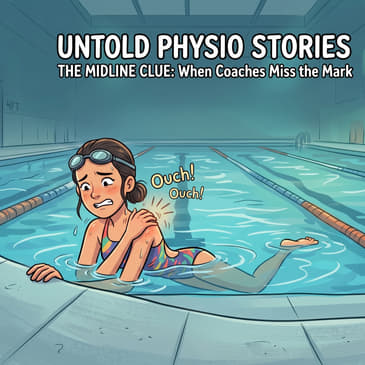
In our latest episode of Untold Physio Stories, Dr. Wells and I dive into a fascinating case of a swimmer whose coach missed a glaring mechanical flaw: crossing the midline. 🚫
We talk about:
The "Outside Eye" Advantage: Why a fresh perspective (ours!) is often the missing piece in an athlete's performance puzzle.
The Impingement Zone: How that extra-long pull—thinking it adds power—actually drives the shoulder straight into a repetitive stress trap. 🛑
Manual Therapy Magic: Using posterior and anterior glides to reset arthrokinematics and get those shoulders moving safely again. 👐
Whether it's a baseball player's "funny" gait or a swimmer's midline crossover, the "functional" stuff happens in the wild. If you can’t get to the pool, you’ve got to know what to look for!
Untold Physio Stories is sponsored by
Comprehend PT- Leave Comprehend PT running in the background or record audio when you have time. The AI based SOAP note generator does the rest! No need for accuracy or exact wording! It's a game changer and will give you more time with your patients! Use code MMT50 to save 50% off your first month. Free trial available at sign up!
The Eclectic Approach Network - Check out Dr. E's all new private, non tracking and ad free network for rehab pros! It's free to join, has chat, feed, and all the features of other social networks without the creeping tracking.
Check out EDGE Mobility System's Best Sellers - Something for every PT, OT, DC, MT, ATC or Fitness Minded Individual https://edgemobilitysystem.com
[00:00:00] Welcome back to Untold Physio Stories Podcast. It's Dr. E and Dr. Wells and I have been off for a bit, but we each have some interesting cases and we're both also super busy. So this time we're doing the asynchronous case presentation format.
[00:00:20] You heard me talk about my daughter in a recent episode and how she's taken up swimming and diving. So because every single one of my kids, at least five out of six, because one is in college now, have taken up competitive swimming. Now all of a sudden instead of working with gymnasts, I find myself working with a lot of competitive swimmers.
[00:00:42] One girl in particular had recurrent left shoulder pain and I found a lot of similar things that I've seen in many shoulder cases that 20 years ago would have said are simple rotator cuff issue and an impingement like complaints.
[00:01:01] But as I've been saying for many years now, we should really get away from the term impingement. I think impingement is a great term for the feeling of it, but it doesn't really describe what's happening. You know, the ball and socket joint. It's not like the humeral head is gliding upward or the humerus is going upward instead of downward when you elevate and the rotator cuff is getting pinched.
[00:01:25] I don't doubt that there's pain, but I don't think the description of dysfunctional arthrokinematics is actually what's happening, especially in lieu of studies showing that when someone has limited external rotation, they do anterior glides and posterior glides and you would expect that the anterior glide would improve external rotation more, but it turns out that the posterior glide does
[00:01:54] similarly invalidating old school arthrokinematic mindsets. So back to the patient, she had limited cervical retraction inside bedding to the left as well as a very weak rotator cuff. When I implemented the cervical retraction side bedding to the left, rotator cuff strength didn't improve, which led me to believe that it wasn't a
[00:02:21] cervicogenic only and that there was a rotator cuff component because if pain and range of motion in the shoulder would have improved with cervical loading only and strength improved, I would have said that it's probably a motor control issue and she most likely does not need to do strengthening. But that is only a picture of a force output for the duration of my active force testing.
[00:02:46] So I gave her cervical retraction inside bedding to the left to be done repeatedly throughout the day. 20-20 rule. She needs to get up as often as possible. At least during the day, she can do it in between periods when she's at school. And at lunch, try not to use the computer too long when she's doing homework. Again, 20-20 rule. And just simple external rotations.
[00:03:13] So after a couple of visits, she was maybe at least 50-75% better. And one of the first things I asked her coach was that, hey, are you sure she's not doing anything kind of, you know, irregular with her stroke? And he said, yeah, you know, let me take a look at her. And he came back to me at the end of the practice and said, no, I don't really see anything that's wrong. And I said, are you sure? And he said, yeah, absolutely. I took a good look at her.
[00:03:42] But I kept on asking the patient, you know, do you think there's anything about your form? And one thing was that she, instead of just simply turning her head to breathe, she would do this really weird kind of cervical protraction and rotation, which I think was negating a lot of the cervical retraction inside of bedding to the left resets. Because every time she took a breath, she was protracting and rotating to the right.
[00:04:12] And we're talking about doing this hundreds and hundreds of times over many, many laps. So I think that was one thing that was negating her improvement. But overall, again, she was better. And she went from doing some practices where she was only doing kicks to being able to swim most strokes, except for the crawl and the breaststroke really seemed to flare it up. So I really thought that, you know, because she was compliant, her strength was improving.
[00:04:40] You know, after three weeks of doing definitely a good rotator cuff strengthening program. I thought there was something more to it. Then she said she went on vacation and just randomly there was a Y in town and she didn't want to get deconditioned. So she just paid for, you know, several day passes for the week and a half that she was there.
[00:05:04] And just again, out of nowhere, a lifeguard, she was the only one who was there, you know, swimming in the lap pool during the day. And this lifeguard said, hey, you know, can I give you some comments on your technique? And it turns out that this lifeguard either was a former competitive swimmer, you know, current competitive swimmer or some sort of coach. She was a young girl. The patient said she was probably in her early 20s.
[00:05:30] But she said that she would follow her, you know, up and down as she was doing these laps. And what she found was other than the cervical protraction and rotation, she said that for her left shoulder, she was actually crossing midline and reaching overhead excessively to midline. So almost doing, you know, what would be considered a really hard impingement sign.
[00:05:58] And she said that when she corrected that, first of all, the patient said that it felt very, very strange. But she was immediately able to actually pull through the water and swim much faster. So it only took her maybe a week of continuous practice for that to feel natural. But she said that not only did her shoulder feel completely better and it didn't hurt at all anymore, but she said that it also improved the efficiency of her swimming.
[00:06:26] So I guess to you listeners and also to Sean, let me know what you think of this case. And very similar to Sean's case is that you really sometimes have to advocate for the athletes because maybe the coach actually told me that he took a good look at her, but also maybe he didn't really at all. Or maybe, you know, even though there are literally apps out there called Coach's Eye,
[00:06:52] not every coach has an actual great Coach's Eye because there's a bell curve and everything from therapists to doctors to coaches to just in general, apply that to any kind of skill. And this coach possibly may have, in terms of his eye, just been at the top of the bell curve instead of to the right. Let me know what you think, Sean. Hey, Erson. That's definitely an interesting case. I think it reminds me a little bit of my case that I had recently with the baseball player
[00:07:18] who was running funny and seemed like the coaches didn't seem to notice, but obviously the parents did. And, you know, he ended up having a distal hamstring strain. Um, it's amazing how sometimes an outside perspective really gives athletes, uh, you know, that, that, that change that they need or that adjustment and technique. Um, it's really hard for us as PTs to evaluate someone's swimming, right?
[00:07:45] You can try to like mimic and say, all right, do your swimming stroke in the air. And it's just not the same. So it's definitely a tricky thing. That's where, uh, some, some regards, I kind of miss the old athletic training days where we would literally go down to the pool and evaluate a swimmer and look at their swimming stroke or have them go through a few functional tests in the water. Uh, but that's not always a luxury in our profession, uh, when we're stuck at a home or office or clinic, right? So, um, interesting that she was crossing midline so much.
[00:08:13] Um, I wonder if she was just trying to get a bigger pole and thinking that by crossing midline, she was enhancing her pole or, um, I know we see that sometime in surfers here in Florida where with paddling, they obviously they can't cross midline too much. They'll hit the board, but they, they do the big swagger. Like you want to enter high with the hand, but you don't want the elbow kicked out too much where you end up in that impingement sign over and over again. You actually kind of want to roll with the board to kind of facilitate that, that elevation
[00:08:42] without getting that kind of impingement sign. But, uh, yeah, I wholeheartedly agree with you two and the bio, um, the arthrokinematics on the shoulder, uh, we can implement manual therapy techniques and, you know, improve, you know, uh, external rotation with posterior glides or, uh, even, you know, improve, uh, flexion with, uh, with, uh, the anterior glides. We've, we've seen, uh, the, the neurophysiological effects there that really are powerful.
[00:09:10] So, um, all in all, I think, uh, it's a really great case and, uh, look forward to hearing more of you. Hey guys, if you like this episode, have any questions or comments for Dr. Wells and myself, reach out to us on social media as always rate untold physio stories, five stars, wherever you listen to podcasts, especially Spotify and Apple, as that helps our discoverability and you guys have a great day.