Ever heard of SAM? No, not the guy from HR—we’re talking about Sustained Acoustic Medicine. 🔊
In this asynchronous deep dive, Dr. Sean Wells () joins me to unpack this "new" wearable, low-intensity continuous ultrasound device that’s making waves (literally) in the rehab world. It’s being touted for everything from knee OA to chronic low back pain, with some literature even suggesting it hits those elusive MCID targets for pain relief.
But here’s the rub:
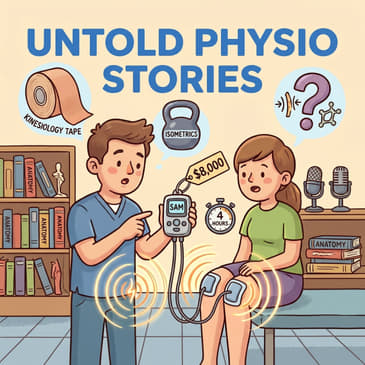
The Price Tag: We’re talking roughly $8,000 for a retail unit. For a clinic owner? Even at a professional discount, you’re looking at a massive ROI hurdle.
The Mechanism: Is it truly mechanotransduction, or is it just the neurophysiological effect of wearing a "prescription-only" device for 4 hours straight?
The Competition: Can isometric loading or even a simple roll of kinesiology tape provide the same neuro-modulation for a fraction of the cost?
Dr. Wells digs into the systematic reviews, while I play the skeptic, questioning if the "magic" is in the machine or the duration of the stimulus.
What do you think? Is SAM a valuable tool for those "failed-everything-else" patients, or is it just an over-engineered subscription model for ultrasound patches? 💸
Listen in to hear our take on:
Low-intensity vs. traditional high-intensity ultrasound.
The "Prescription-Only" placebo boost.
Why duration might trump intensity in pain modulation.
Love the show? Rate us 5 stars on Apple Podcasts and Spotify—it helps more therapists find the truth behind the tech! ⭐⭐⭐⭐⭐
#PhysicalTherapy #RehabTech #ManualTherapy #SAM #EvidenceBasedPractice #ModernManualTherapy #Podcast
Have you used SAM in your clinic yet, or are you sticking to your $20 kettlebells for mechanotransduction? Let’s chat in the comments! 👇
[00:00:00] Welcome back to Untold Physio Stories Podcast. It's Dr. E, your host, and also with Dr. Wells. We're doing another asynchronous podcast, this time on SAM. Take it away, Sean. Hey, Dr. E, it's Dr. Wells. Got a new story for you or maybe a new concept that I'm curious to hear if you've experienced this or heard about it. It's called Sustained Acoustic Medicine, also abbreviated as SAM.
[00:00:29] Apparently, a couple of my patients are really into it right now. They state that it's given them quite a bit of pain relief and it's kind of an amazing new device. Overall, I don't know much about it, but as I've kind of dug into the literature and did some more research and did a deep dive with AI, I found that there is some evidence behind this device.
[00:00:55] So, effectively, what it is, SAM is low-intensity ultrasound. Typically, it looks like it's usually dosed at around 3 megahertz and looks like the intensity is fairly low, like around 1 to 1.3 milliwatt per centimeter squared, I believe.
[00:01:20] So, it's not a high-intensity ultrasound, and that kind of makes sense because the idea here is that you slap these patches on and these patches slowly release this pulsed. Actually, I don't know if it's pulsed. It could be continuous. I'm pretty certain it's continuous, low-intensity ultrasound. And the idea with this is physiologically is that it's supposed to stimulate mechanotransduction, right?
[00:01:48] So, we have this ultrasound frequency. It's supposed to stimulate different cells like RBCs, stimulating maybe even chondrocytes. And with that, you're maybe getting different cellular regulation and DNA changes and things. So, I think the theory, the physiological theory there, but I guess the question is, like, for me and always has been for a lot of providers is, you know, what's the translation and function and things?
[00:02:16] So, interestingly, I found a systematic review and meta-analysis by Winkler et al. 2021, and it outlines some pretty good evidence in support of the use of SAM for many varying conditions. Anything from knee osteoarthritis to neck and shoulder pain to even chronic lower back pain. Some of the studies, like, granted, they look at kind of the typical VAS scale, right?
[00:02:46] All right, so how much did it reduce pain, that sort of thing. And interestingly, like, a lot of it was exceeding MCID. So, you know, at the most, some of them I saw were reducing pain around three to four points. On average, it looked like a lot of them were reducing it 1.5 points, which, again, would exceed MCID for a lot of conditions. But it kind of also begs the question of how much placebo effect is there.
[00:03:12] But when you dig down into the, like, study design on some of these devices, there was actually quite a few that included placebo patches, right? So they just slap a patch on and say you're going to feel it. And even though it's not turned on and activated, the patient still has some benefit, but not as much benefit as when the actual device was activated. So that's pretty robust and pretty exciting.
[00:03:40] Several of the studies also cited functional measures. What I don't like about the systematic review and meta-analysis is that they kind of lumped in, like, functional measures. So they would include, like, range of motion in that, which really isn't a functional measure. It's really a measure of impairment. They would measure WOMAC as a functional measure, which is true.
[00:04:03] WOMAC does include functional metrics, but it also includes stiffness and pain and other factors in there that's not just function. And then strength as well. Again, to me, it's like dynamometry is more impairment level. It is a metric, but it's not functional level. But some of these studies did include those metrics, and they saw significant improvements in those functional outcomes as well. So I think it's an interesting intervention.
[00:04:32] And, like, again, it's always the what, so what, now what. I kind of question how much this device will impact physical therapy and rehab outcomes. And so I did more research, and I thought, all right, I'm going to play the physical therapist owner. You know, I own a clinic, so, like, I'm going to go out and buy some. Well, retail-wise, if I'm just the patient that wants it, first off, it's supposed to be prescription-only.
[00:04:59] Secondly, the other factor is for a retail purchase, it's about $8,000 for one device. And then you have to also purchase the adhesive patches. So that, to me, is a fairly large financial investment. And so as I did some more of that deep dive into the literature and said, all right, like, what about beyond just what the research has,
[00:05:25] let's go into what's the cost for someone, let's say, like insurance. Because, let's just say, most average Americans don't just have $8,000 to throw down for disposable adhesive ultrasound devices. And from what I found is that research, while the FDA does approve the device, the insurance companies currently really aren't reimbursing at very high levels for this device because it's still relatively new.
[00:05:52] And so I think for your average Joe or Jane that's going to an insurance-based clinic, if they get this device, it's going to be kind of one of those value-added services that may not be reimbursed. Now, that could be wrong. You know, maybe there are some providers, and I'd love to hear any PTs out there that are utilizing this and getting good financial remuneration for it through insurance. Let us know, like, what you're doing and what your methods are in the comments. I'd love to hear that.
[00:06:20] But for me, I look at it from a cash standpoint, it could be really beneficial. But at scale, it could also be really pricey. So, like, a clinician's rate, I think it's around probably $4,000. It's about half that retail rate for one device. So, if I was looking at getting it for every single one of the PTs in my practice, you know, that would be four times about $4,000. So, anywhere from $16,000 to $20,000 for initial startup costs. So, while that is cheaper than maybe, say, like the old-fashioned ultrasound machine,
[00:06:50] and the cool thing is that you can slap this on a patient, they walk out the door, and they're getting that continuous ultrasound for four hours. I still don't know if that's quite as cost effective or just sort of like a cool, new, expensive device. But, anyhow, I'd love to hear your thoughts, see if you've run into it. I know, again, it's been popular in some of the settings. I know athletic trainers and some professional organizations have used them.
[00:07:16] And, again, some of my clients here in Florida have started kind of being turned on to them. And I do see an opportunity, especially with patients that are chronic pain. And in this particular Winkler study, they use a lot of patients that have failed traditional physical therapy or traditional therapies in general. So, maybe this is that kind of final string sort of thing that patients can try to help get them some quality of life, maybe get them off narcotics and things.
[00:07:41] But I just can't get my mind around the cost and if it is really, you know, cost effective. Love to hear your thoughts. Comment below if you've been using it. And, Dr. E., I'd really like to hear your opinion. Hey, Sean. Thanks for that review on SAM. I've definitely never heard of it. And as soon as I hear anything with ultrasound, I immediately think placebo-based as the short-term, higher-intensity treatments.
[00:08:09] You know, they work for pain, whether the machine is on or off. I haven't reviewed the research, but I did a search and I found the same articles that you did. I find it interesting that there was one piece of research that showed that the non-placebo version seemed to be more effective. But I'm wondering if it didn't quite replicate the feeling of it. I don't even know if there is a feeling, if it's very low-intensity.
[00:08:39] But I think there's something to the duration of the treatment. Similar to how you and I have been talking about sustained isometrics for tendinopathy loading. And I've noted in several of the cases on a couple of podcasts that the pain relief that you get from several sessions of two-minute holds up to 10 minutes of time under tension a day for isometric holds
[00:09:01] in a lengthened or non-lengthened position seems to help tendinopathy pain within a couple of weeks, which is too fast for a tissue adaptation or any kind of strength or hypertrophy changes. I think if this is typically for a few hours, that there could be some sort of more sustained neurophysiologic effect leading to pain modulation.
[00:09:28] I don't think it is probably as a result of whatever it is they're saying. I mean, everyone always seems to think it's some sort of mechanotransduction. And that is a generic type of mechanism that is decades old at this point, probably. And it's been proven, you know, to be nonspecific or neurophysiologic in almost every case. Just because something works doesn't mean the mechanisms that they propose are valid.
[00:09:55] I'm also wondering if essentially the effects of kinesio tape are the same thing and a lot cheaper, right? Because as you noted, the ROI on this is it's a lot to ask. I mean, not only is it as expensive as a shockwave machine, at least a cheaper radial shockwave machine, not even a focused one, but the results are probably the same.
[00:10:20] And you don't have to buy electrodes that you have to keep on almost like a recurring subscription in a way, which we all hate those in-app subscriptions or recurring monthly subscriptions that we're all inundated with. So, yeah, $8,000 is way too rich for something that is not proven.
[00:10:42] And I'm also wondering, because it's prescription only, does that add to the placebo effect of, wow, this is like a prescription strength device? Strange that that would be prescription if it's so low dosage. I wonder why that would be. It's not like TENS or anything else with electrodes are, you know, prescription only as you can buy off the shelf units now.
[00:11:09] And even my H-Wave device, which is quite expensive, it's still not $8,000. It's not prescription only. You know, I can lease one or sell one outright to a patient. So, yeah, I mean, that's my thoughts.
[00:11:23] You know, anytime someone says, hey, this magical new treatment does this and it increases blood flow and it promotes healing and reduces inflammation, I think my response is always, well, exercise does the same thing and it's free. Right? Or isometrics does the same thing and it's free.
[00:11:42] It's just that people probably are not exercising for the specific time under tension where they stretch once, but they don't repeatedly enrange load throughout the day or they don't do 10 minutes of time under tension for isometrics throughout the day. So is it the duration of the treatment, you know, even it being nonspecific, that does something and not necessarily whatever mechanism they're proposing that only the specific treatment gets? That's my thoughts.
[00:12:11] And also I would think, well, red light therapy also does the same thing and it's also way more accessible and quite a bit cheaper. And you guys, if you are listening and you have any experience with SAM, let us know. And otherwise, always please rate Untold Physio Stories five stars wherever you listen to podcasts, especially Apple and Spotify, as that helps our discoverability. And you guys have a great day.