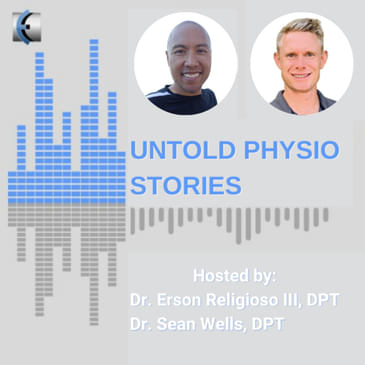
Dr. E is joined by his new co-host and good friend, Dr. Sean Wells, from Nutritional Physical Therapy. They talk about two ankle cases, both injuries. Dr. E discovered an old classic reset helped both cases WB with significantly less pain. Then they discuss this article by Dr. Tom Michaud, DC and how it has impacted their practice and Clinical Decision Making.
Untold Physio Stories is sponsored by
Comprehend PT- Leave Comprehend PT running in the background or record audio when you have time. The AI based SOAP note generator does the rest! No need for accuracy or exact wording! It's a game changer and will give you more time with your patients! Use code MMT50 to save 50% off your first month. Free trial available at sign up!
The Eclectic Approach Network - Check out Dr. E's all new private, non tracking and ad free network for rehab pros! It's free to join, has chat, feed, and all the features of other social networks without the creeping tracking.
Check out EDGE Mobility System's Best Sellers - Something for every PT, OT, DC, MT, ATC or Fitness Minded Individual https://edgemobilitysystem.com
[00:00:00] Welcome back to Untold Physio Stories Podcast. I'm your host, Dr. E with Modern Manual Therapy and Edge Mobility System. And my co-host is Dr. Sean Wells. How's it going today, Sean? It's doing great. How about you, Erson? Great. Getting ready to go on a New Zealand vacation, huh? I am. We're heading to New Zealand next week. Excited. It's going to be a fun trip. Lots of hiking and hopefully some really nice weather and exploring some new things.
[00:00:27] Yeah. Well, because I'm a Christian and a big geek, I thought that Sean was actually going to go to Hobbit Town or something, but it turns out he's going for surfing and the rest of the country. Imagine that. Right. Yeah. For those of us who are big Lord of the Rings fans, and I'm talking about especially the movies more so than the books, even though I do like the books as well. We think that that is the only thing that you get out of New Zealand. Not the waterfalls or the glaciers or the whales.
[00:00:55] No, no, no. Nothing else. I mean, surfing, that was really new to me. So that's cool. I'm looking forward to it. All right. Well, that's not what we're going to talk about today, but I just thought that I'd make some banter. So yeah. Sounds good. I've had some recent cases. One, acute tendinopathy, insidious onset, or what the patient thought. And another one, a semi-subacute, probably calf strain.
[00:01:22] And neither one of those kind of fall into the category that I normally like. Can you guess any particular reason why those are not my favorite types of cases? My guess is they're nagging, and sometimes you don't really respond quickly to a lot of our interventions. So yeah, patients can be impatient. And I know that we also, as providers, can be really impatient too.
[00:01:49] Yeah. I mean, I once had a mentee call me out on something. I said during a mentoring session, we were just talking about atypical patients. I said, yeah, I don't really like it when people don't fit my clinical practice patterns. And he just said, that's because you got to put some work in. And I was like, well, yeah, that's an honest take. I mean, because people fit my clinical practice patterns. They tend to be what McKenzie calls arrangement syndrome, what I call rapid responders.
[00:02:14] Then you do some simple repeated loading strategies, maybe some isometrics and a little manual therapy to spice it up. And you look like a rock star, you know. But with true tendinopathy, they say you got to load them, of course, right? So you got to load them, not necessarily for the muscle strain, but for the tendinopathy, you got to load it to increase strength of the muscle, to take load off that abnormal tendon that is highly sensitized.
[00:02:40] So both of these cases were, they had very difficulty weight bearing. They had a lot, the antalgic AIDS was very similar. Neither one could really had a good heel strike. They kind of landed flat and they didn't like to push off either. One guy, even before, without pushing off, instead for some reason, he had this strange compensatory hip hike. Like he would actually like fire his QL instead of actually pushing off. So I thought that was kind of odd. Okay.
[00:03:11] So both of them had also severely limited dorsiflexion. And I checked lateral tibial glide because that's my first go-to. A long time ago, my old reset used to be plantarflexion and inversion before I started doing lateral tibial glide. And in both cases, their dorsiflexion, one had amazing dorsiflexion and I was kind of surprised. And the other one had very limited dorsiflexion. And both of them, their lateral tibial glide was kind of hit or miss. It didn't really improve their complaints.
[00:03:41] So I just said, you know, I'm going to do my old fallback of repeated plantarflexion and inversion. I mean, I did all the muscle testing and sure for both of them, you know, plantarflexion was very weak and painful and resisted dorsiflexion was okay. Resisted inversion was a little painful on the one with some calf issues. But the plantarflexion and inversion, both of them said they just felt like a great stretch in the anterior kind of tail accrual joint.
[00:04:06] But then they were both amazed that the pain had significantly reduced along with the antalgic gait. When you say plantarflexion and inversion, how were you positioning them for that? So they're in supine and I just take their foot. So I take their forefoot and I'm kind of cupping their heel and I just passively move the forefoot into inversion and plantarflexion. And, you know, I had done this also in the past for maybe plantarfasciopathy because when you kind of twist,
[00:04:35] you can kind of twist the forefoot and also slack the medial arch. And also you can kind of get the great toe into some flexion because when someone's usually missing torsiflexion or they have trouble pushing off, they're missing great toe extensions. You could also give great toe flexion, which often improves and resets great toe extension. So, yeah, both of them were all obviously very happy. I would say they had anywhere between 50 and 75 percent pain reduction.
[00:05:01] And then for the one with a tendinopathy and not the one with a calf strain, because calf strain, I said, well, you probably still have to take some load off of it and try not to use it as much as possible. You know, try to avoid going down ladders because they do like a lot of scaffolding work, a lot of ladder work. But the one with the tendinopathy, he did have like that thickened mid portion Achilles. So I started giving him just really light sustained isometrics. And then I came up. I just posted.
[00:05:31] I don't know if you saw it like that. It was like a Google LLM review of this chiropractor's amazing article. Like I thought I was going to I thought I was going to click upon. Like this guy just sells products just like me. So he writes articles and I just thought I was going to click on like this blog post. Like, you know, this is the stuff that I think you should do and hear my products that help it. Meanwhile, he writes this like amazing literature review. Right. It is fantastic. Yeah. I'm about three quarters of the way through.
[00:05:59] And the way he summarized so much research and like kind of the progression of a time of how this is how we used to think. And now this is like kind of what we're moving towards. I was like, man, this is really well put together. Yeah. And he still like sells his products at the end. But I'm like, man, this guy deserves to have you buy his products. I mean, seriously, because he he's totally justified it. So for those of you guys, I'll post a link to that.
[00:06:21] But just FYI, just real quick, like, you know, he goes over why isometrics may help with with pain modulation, but also the type of isometric he should use. So you could use a sustained isometric, particularly in an extent, like a lengthened position. To kind of restore tendon like fluid dynamics. Yeah. And it needs to be 70% of their max contraction.
[00:06:46] And that's that's kind of like one of the best strategies to to help attend an opathy over the eccentric loading. And I was kind of getting away from eccentric loading anyway. And even because he he said that research was initially promising. And then it kind of shows that, like, it hasn't really been helping as much as we thought, because up like 60% of people still have pain when on an eccentric loading program. And he also said that it's probably because it's just painful. And we're basically telling people to suck it up. Yeah. Yeah.
[00:07:13] I've had several clients who just especially like with tennis elbow not want to continue that protocol because it's just so painful. And so I've moved to isometrics. Basically replicating that you're replicating the thing that hurts. It's like saying, like, well, the thing that hurts is the thing that makes you better. And I just I just want you to be compliant because I say so. And let's fingers crossed. I have moved to isometrics. But I think the thing after reading his article that I've been missing is that 70% of maximal voluntary contraction.
[00:07:43] So using my handheld dynamometer that I have, the active force, I'm actually able to sort of quantify, at least on the non painful side. Now, I know that's not exactly a one to one, but it's better than guessing. And I can kind of get an idea of how much force that needs to be for the patient so they can kind of replicate it. Sure. Sure. Yeah. I just I've been saying, I mean, even though I also have the active force, I've been saying just push, just push what you would consider like 70% of your effort. 70%. Yeah. Right.
[00:08:10] And it would be in a lengthened position, you do like 45 to 60 second isometric holds. So that's one thing. But then he also goes over the pain, you know, like, why? Why are some of them so painful? And it's about, you know, like cortical inhibition. So he's like, in order to improve cortical inhibition, then you can do rhythmic isometrics. And he didn't really get into I have to look at the article that he was referencing, because he said to a metronome.
[00:08:38] So I just imagine doing it to a metronome because I did it for my like kind of the back pain that I figured out was a glute tendinopathy. So not only did I do a couple of like lengthened, like almost submaximal holds, but then when it was hurting, I was just kind of like I put it in a lengthened position. I tried like different twisting. So this is kind of like where I'm adding like my stuff to his recommendations. So I just started lengthening it because I couldn't I couldn't. Side glides are painful. So then I tried lengthening it.
[00:09:06] Then I did like I pretended there's a metronome in my head. I was like, boom, boom, boom, boom, boom. And so it's just like those those rhythmic contractions isometrically, whether lengthened or not lengthened. I tried it like shortened. I tried it lengthened. It turned out lengthened actually made it feel better. It modulated that pain pretty quick because in the eclectic approach and modern manual therapy, I use isometrics. I try like one or two.
[00:09:32] And if I banded it, if it makes repeated loading pain free like it often does, that's great. But I never thought about either a sustained hold. I didn't think about in a lengthened position. And then I certainly didn't think about doing it like rhythmically over a couple of minutes to a metronome. Yeah, no, that's really novel. And I've seen that once before. One of the personal trainers that used to work with me had experience as a ballets and he used to use rhythmic movements, particularly for gluteal issues. And I remember him having someone in a plie type squat and bouncing.
[00:10:01] And I was like, what do we you know, what's the point of that? And he said, well, I'm trying to get her glutes to engage in a rhythmic pattern. And at that time, I was like, you know, OK, I'm working on isometrics. I'm working on eccentric. Well, that time it's probably mostly eccentrics because that was what all the data was pointing to. And here he was ahead of his curve, I guess. So, yeah, really cool. Yeah. So now I'm thinking, you know, if someone has like retraction side bending issues and normally I just kind of do this or manipulate them or something. And like I always go for the ISO first.
[00:10:30] I mean, I recently accidentally discovered myself that a sustained isometric in neutral helped my left low back pain. But now, you know, now I'm trying it in sideline. Now I'm or now I'll try or not sideline in lengthening position or now try lengthening position to a beat. And I think that that's just more ways to help reconceptualize it. But I also wanted to get back to the point where he's talking about when the fluid dynamics are changed in abnormal tendons, that like the sliding of fascicles is somewhat altered.
[00:10:58] And I think, well, maybe that's why slacking seems to work so much, because in both of these cases that I'm talking about, repeated plantar flexion in inversion ended up slacking the calf or slacking the tendon. And maybe we restored some sliding of fluid dynamics. And then that's what you add that with the sustained isometrics and the repeated loading, repeated isometrics. And I think that's really what made a difference. It's really cool. It's only been one case. Sure.
[00:11:24] Anyway, I think I got to run because I have an electrician. But thanks for coming on, Sean. Yeah, absolutely. It's great. Great. I look forward to the next one. Yep. If you guys think this is interesting, have any comments, make sure to reach out on social media. And as always, please rate Untold Physio Stories five stars. Remember you listen to podcasts, especially Spotify and Apple. That helps our discoverability. And you guys have a great day. We'll see you, Sean. Have a great vacation. Take care. Thanks. Bye-bye.