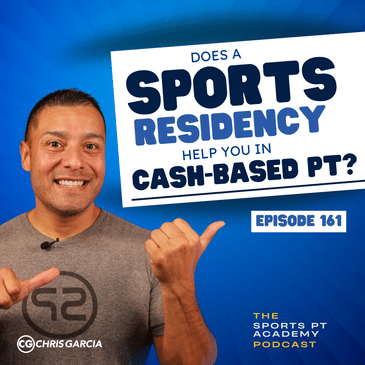
Are you debating whether to complete a sports PT residency or start a cash-based PT practice? Are you stuck thinking if a residency will enhance your treatment or success in cash-pay services?
After completing a sports PT residency, working in professional sports for 10 years, and scaling my cash-based PT practice to 3 locations with over 15 staff, I share the advantages and disadvantages of both scenarios.
If you want to make sure you're on the right path to success in cash PT practice without wasting more time or energy, this episode is perfect for you. Enjoy episode 161 on the Sports PT Academy podcast on YouTube, Spotify, and Apple Podcasts!
_____________________________________
Are you a physical therapist or physiotherapist looking for tips, tools, and strategies to work with more athletes, become a sports specialist or get a job in a sports setting...so you can finally enjoy the career that you've always dreamed of? If so, you're in the right place...this podcast is for you. Your host is Dr. Chris Garcia, a physical therapist, business owner, entrepreneur, nationally recognized public speaker, and residency-trained sports specialist.
Dr. Chris Garcia, PT, DPT, SCS, CSCS, USAW has worked in professional sports and traveled around the world working with elite athletes throughout his career, and he's learned a lot of lessons along the way. He created this podcast to share his experiences and give you everything you need to know to help YOU become a successful clinician. Dr. Chris Garcia talks about everything from sports rehab and injury prevention to developing athletic performance and the path to getting your dream job...even if it is in professional sports.
If you want to become a successful clinician so you can finally enjoy the career you've always dreamed of, visit www.DrChrisGarcia.com.
LINKS:
www.Instagram.com/ChrisGarciaDPT
www.Facebook.com/ChrisGarciaDPT
***DISCLAIMER: This content is for educational & informational use only and & does not constitute medical advice. The content is not intended to be a substitute for professional advice or medical recommendations, diagnosis, or treatment. Please consult with a qualified medical professional for proper evaluation & treatment, or beginning any exercises or activity in this content. Chris Garcia Academy, Inc. and The Sports PT Academy Podcast are not responsible for any harm caused by the use of this content.***
[00:00:05] Are you a motivated healthcare or fitness professional? Are you looking to work with more athletes, become a sports specialist, or even get a job in a sports setting so you can finally enjoy the career that you've always dreamed of? If so, you're in the right place. My name is Chris Garcia, physical therapist, business owner, entrepreneur, and residency training sports specialist. I've been fortunate to work in professional sports and travel around the world working with elite athletes throughout my career, and I've learned a lot of lessons along the way. I created this podcast to share my experiences and give you everything you need to know to help you in the world.
[00:00:35] If you've become a sports expert, welcome to the SportsPT Academy.
[00:00:42] If you've been debating between a sports residency or opening a cash-based physical therapy company and you're stuck thinking, should I do a residency? Do I open my cash-based clinic first? Or does a sports residency even help me in my cash-based setting? If so, you need to tune into this episode.
[00:01:01] Before I go on to the podcast, hi everyone, welcome back to the podcast. Welcome all new listeners and welcome back to those who have heard my content in the past.
[00:01:10] For those of you who know, I love going positive. What's new? What's the latest and greatest in life? There's always good things. My back is finally feeling a little bit better.
[00:01:20] I just finished the second week of my calorie cut. I've lost 9.8 pounds in the last two weeks and it has all been from monitoring my carbs, decreasing my sodium, increasing my water intake, and decreasing my total calories.
[00:01:38] Some of those calories will come back. I'm not excited about that, but I'm excited to get food.
[00:01:44] There was one night that I think I mentioned in my last episode that I actually woke up from hunger.
[00:01:50] For those of you who are wondering why I do it, I enjoy it because some of our clients who fight in the UFC do it and it's a big mental challenge.
[00:01:59] So I enjoyed it and I had, I think, eight team members do it on with me. So that was exciting and I'm glad to be done with that.
[00:02:07] We just hosted three parties at our house. Our family has a lot of parties at our house and they usually involve 15 to 20 people.
[00:02:16] And we had one on Friday with my team, my staff, and then on Sunday with family.
[00:02:23] So it's good to be in that routine again. We're just finishing out the summer, but finishing up all of our parties.
[00:02:28] We have one more, which my son, Zach, is this month. It's his birthday.
[00:02:33] And we'll host one more party this month. But otherwise, life is amazing.
[00:02:37] Back on the fitness train, wife and I are going, we just planned out another date night.
[00:02:40] So I'm excited for you, for us at the end of the month.
[00:02:42] And then we're going to do date days at some point.
[00:02:45] So yeah, on to this podcast.
[00:02:47] So why are we talking about sports residencies and cash-based physical therapy?
[00:02:53] And honestly, it came from an email that somebody inquired.
[00:02:56] They said, Chris, I've been listening to your podcast and I love being a sports physical therapist.
[00:03:02] And I'm considering the next step in my career.
[00:03:05] This person's one year out and they're wondering, is it better for me to go into a sports residency?
[00:03:12] Or they've been thinking about opening a cash-based clinic right out of PT school.
[00:03:15] And both are really good options.
[00:03:17] It really comes down to a lot of factors.
[00:03:19] And I'll share that inside this episode.
[00:03:21] But someone asked recently, should I do a sports residency before opening my cash-based company?
[00:03:28] And for obviously, for the obvious reasons of, will it help my outcomes?
[00:03:32] Will it help me be more successful in business?
[00:03:34] And I think you're going to find some purists out there who are, you know, only sports residency first.
[00:03:39] Or you can 100% do a cash-based company right out of PT school.
[00:03:43] You don't need those things.
[00:03:44] So I'm going to be somewhere in the middle.
[00:03:45] And I'll show you the benefits of both and what you can gain by doing sports residency first.
[00:03:52] Or what you can gain right off with a cash-based company right off the top, right out of PT school.
[00:03:59] So I'll tell my story and I'll give you some scenarios where that might be a better case for you.
[00:04:05] But I did a sports residency right out of PT school.
[00:04:08] I did a 15-month residency at The Ohio State University.
[00:04:12] And one of the best things that I could have done for my professional career.
[00:04:15] And there's tangible things that I took away from that.
[00:04:19] And there's a lot of intangibles.
[00:04:20] And what the question becomes is what's important to you and what's important into your professional career.
[00:04:27] So I did this year and a half residency.
[00:04:29] And I learned a ton.
[00:04:30] And every residency is just a little different.
[00:04:32] So a little background.
[00:04:34] I did acute injury management on the field.
[00:04:37] I think I did 5-10 hours a week during different seasons of the rugby schedule.
[00:04:43] And I taught, I think, 5-10 hours when rugby was slow or they didn't have a lot of competition.
[00:04:50] Then I would fill the hours with teaching.
[00:04:52] So I taught anatomy lab and a couple ortho courses.
[00:04:56] And so I got to teach.
[00:04:57] I got to do grand rounds with surgeons on Friday mornings like at 6 a.m.
[00:05:02] I would listen to all the techniques that were happening.
[00:05:04] What they were doing and what we changed as a group with rehab protocols.
[00:05:09] So that was fantastic.
[00:05:10] So I got to see the cutting edge research with surgeons who are at the top level, best of the best.
[00:05:15] Do a little bit of teaching and then do a little bit of acute injury management.
[00:05:19] And then obviously treat.
[00:05:20] And so there was ebbs and flows of how all those things kind of jive together and were part of the residency.
[00:05:27] And so in that journey, I learned a lot about being a sports PT and really how to manage an athlete from the field.
[00:05:36] And I learned the textbook process of how things should work, right?
[00:05:40] I mean, we were practicing spine boarding on a regular basis.
[00:05:43] We were going through all the journal clubs.
[00:05:45] We were talking to the surgeons about injuries.
[00:05:47] And then the great part is I would take that information and we'd bring it down to the field.
[00:05:52] And collectively, that really enhanced the application of it, right?
[00:05:56] You take a CEU course, but maybe you don't see those types of patients.
[00:06:00] Or you don't know that you don't use tape very often or that methodology very often.
[00:06:04] And you have to wait for the perfect patients to be able to do that.
[00:06:07] And fortunately for me, it was all sports related.
[00:06:10] So I would take it from the classroom, learn it in the classroom, teach it in the classroom, go to ground rounds,
[00:06:15] take in your information, try and apply it on the field.
[00:06:17] And sometimes it'll work.
[00:06:18] Sometimes it wouldn't work.
[00:06:19] And what I really understood was the residency's job was not to give you just the exposure,
[00:06:25] but was really how to process all that information and put the entire map, the entire journey,
[00:06:32] the entire roadmap that an athlete or patient goes through and understand the cycle from injury to the clinic,
[00:06:40] maybe to the surgeon's office, and literally having a patient go through that entire cycle
[00:06:45] and being able to help them at every stage.
[00:06:48] And that helped me tremendously.
[00:06:49] And having mentors were so critical because ultimately what they taught me was what to avoid
[00:06:55] and if I was on the right track.
[00:06:57] And people always confuse mentorship with learning clinical skill development.
[00:07:01] And that wasn't necessarily my priority.
[00:07:03] My priority was, initially I did go in for that, but as I grew into it, I realized my priority was,
[00:07:08] I need help putting it all together.
[00:07:10] That was the absolute struggle for me because I was like, I know how to mobilize.
[00:07:16] I know how to tape.
[00:07:18] I know how to adjust.
[00:07:19] I know how to do these technical skills.
[00:07:21] But what I didn't know how to do was put that all together for this athlete's case in this scenario during this season.
[00:07:28] And then it would just, it'd be a scramble when that patient or that athlete had to compete that week.
[00:07:35] Or, you know, they had to compete in an unrealistic timeline.
[00:07:37] Or, they re-injured themselves and they're in the game.
[00:07:41] What do I do here?
[00:07:42] And so, what I didn't know how to do was put that all together in certain scenarios.
[00:07:47] And what the residency did was give me that confidence to be able to say,
[00:07:51] okay, well, they're injured on the field.
[00:07:53] I know normal timelines, but they have a tournament in four weeks.
[00:07:56] What would I change a little differently?
[00:07:58] When would I be a little more conservative?
[00:07:59] That's where really the exposure came from.
[00:08:02] And a lot of my mentors helped me piece that together.
[00:08:05] So, my entire residency, I was trying to figure out, yes, I'm developing clinical skills.
[00:08:09] Yes, I'm developing clinical skills.
[00:08:10] But when do I use it?
[00:08:11] How do I use it?
[00:08:13] That, to me, was the most powerful.
[00:08:14] So, as I got into the residency, I got a job offer with the Olympic Training Center.
[00:08:19] And I ended up learning those same applications.
[00:08:22] But now, I didn't have a mentor.
[00:08:24] And I went straight to working with pro sports and learning acute injury management, working in a clinic.
[00:08:29] And then now, introducing strength and conditioning and understanding how a year cycle and four years of a cycle are put together.
[00:08:35] So, that was my journey through my residency, right?
[00:08:39] So, does everyone need to do a residency?
[00:08:42] Absolutely not.
[00:08:43] I think that it depends on what your priority was.
[00:08:45] My priority was I wanted to be the best possible sports clinician on the planet.
[00:08:52] And I was obsessed about developing the skill set to be able to handle any case that came at me.
[00:08:58] And I'm a perfectionist.
[00:09:00] I'm an OCD, if you guys haven't heard through my podcast or anything that I do.
[00:09:03] But I love being the best at what I do.
[00:09:06] If I am picking up trash, I want to be the best trash picker-upper.
[00:09:10] If I'm working on mobilizations, I want to do that.
[00:09:12] If I want to work with athletes, I want to do that.
[00:09:14] If I am, I don't care if I'm a barber, I want to be the best barber on the planet.
[00:09:18] And so, for me, I'm addicted to that.
[00:09:19] And so, I thought the residency would give me the best platform.
[00:09:21] But how I got into cash-based physical therapy was a completely different setting.
[00:09:26] And the residency taught me how to put things together and how to learn the knowledge at
[00:09:33] different stages of injury and how to push somebody through that entire cycle.
[00:09:38] And so, as I went into pro sports, I ended up doing concierge physical therapy and being
[00:09:42] able to help an athlete for three straight months and being with them 24-7 and learning how
[00:09:48] to manage them themselves.
[00:09:50] So, without the residency, I don't know if I would have the framework in which I treat.
[00:09:54] I was trained directly by Shirley Sarman in movement systems and movement analysis.
[00:10:00] So, I had that framework.
[00:10:01] I was taught in residency with how to manage athletes throughout the entire process.
[00:10:07] And I learned strength conditioning at the Olympic Training Center, working with their
[00:10:10] strength coaches on how to put all of that, how to put movement and sports residency training
[00:10:16] and acute energy management and all those things and strength conditioning.
[00:10:18] And how to put that all together.
[00:10:20] That set the framework for me then to open my cash-based company.
[00:10:25] So, my cash-based company is based in athletes, based in active people.
[00:10:30] And we do get professional athletes.
[00:10:32] We get high school athletes, whatever that is.
[00:10:33] And my strength is being able to break down their injuries into seasons and then now put
[00:10:41] them through an entire cycle from injury from day one.
[00:10:45] And that's a hard skill if you don't have a lot of practice.
[00:10:48] If you're not an athletic trainer, even though I've done sports residency, being able to take
[00:10:50] a fresh ankle sprain and wrap it, get them back into practice with modifications while
[00:10:56] doing strength and conditioning, while doing pool work and designing programs until they
[00:11:01] heal and meshing that until their time of return to sport.
[00:11:05] Even if it's unrealistic, those are my favorite.
[00:11:08] And so, taking an athlete from an acute injury management back to sport without even getting
[00:11:12] into the chronic phase is a huge deal.
[00:11:15] And that's not easy.
[00:11:16] But that's my passion because that's my training for my residency.
[00:11:20] And everything going into now, if they're out, if they're in season and they overcome that
[00:11:25] injury, being able to develop their strength and conditioning profile so you minimize or
[00:11:29] mitigate the risk of that injury happening again.
[00:11:31] All of those are different skill sets that are acquired from a residency.
[00:11:34] And every residency is different.
[00:11:36] Some focus a lot on didactic.
[00:11:37] Some on a lot of clinical skill development.
[00:11:41] There's manual therapy residencies and manual therapy fellowships.
[00:11:44] There's types for different types of people.
[00:11:46] So, I think the question becomes, if you're going to do a cash-based business, what are
[00:11:54] you going to specialize in?
[00:11:55] Who's going to be your customer?
[00:11:56] Who's going to be the patient?
[00:11:58] And my favorite answer is always like, well, I'm going to treat everyone.
[00:12:01] I can treat everything.
[00:12:03] And the reality is that the reason you go into residency is to specialize, right?
[00:12:08] That's the whole intent.
[00:12:09] How do I become really good at these few things?
[00:12:13] And if you're saying that I'm going to open a cash-based clinic and you're going to be
[00:12:16] good at everything, then why do a residency, right?
[00:12:18] The ultimate goal of residency is so you can help specialize.
[00:12:21] And if you're going to open a cash-based to everyone, is that really a case?
[00:12:25] But, you know, that's for you to decide.
[00:12:28] And I opened my cash-based company because I wanted to treat my local community like pro
[00:12:35] athletes.
[00:12:35] I had the skills.
[00:12:36] I already had developed them in my residency and my Olympic training center and working
[00:12:40] with pro athletes and doing all these things and traveling.
[00:12:42] That skill set, I didn't want that to go to waste.
[00:12:45] I didn't want it to just go back to an ortho mill or an ortho insurance-based company and
[00:12:50] those skills wouldn't be applied.
[00:12:51] So I basically trained all of my life and my career for 10 years to now have that go to
[00:12:56] waste.
[00:12:56] And I didn't want that.
[00:12:57] And I thought that the public would benefit from this process, seamless process from
[00:13:02] acute injury management, strength conditioning, and have them go through an entire cycle,
[00:13:06] basically create them into professional athletes.
[00:13:08] And that was my passion.
[00:13:09] That's why I loved that concept I had never heard of before.
[00:13:13] And it was just something that I thought, I think I can contribute to this planet and
[00:13:16] to this community with something bigger and better than what has been known before.
[00:13:20] And that's why I opened my clinic.
[00:13:22] So to answer the question, right, does a sports residency help prepare you or help you in a
[00:13:30] cash-based clinic?
[00:13:31] When you look at a residency, a residency teaches you clinical reasoning.
[00:13:36] It teaches you the hard skills on, you know, if you have patient A, ACL repair, or you have
[00:13:43] patient B, dislocated shoulder, and both of them need to return to sport in eight weeks,
[00:13:48] how do you manage them differently?
[00:13:50] Or it's an on-the-field injury and they now have a fracture of their tibia.
[00:13:55] What do you do with this person?
[00:13:56] How do you get them out?
[00:13:57] What do you do in 911 process?
[00:13:59] How do you triage them?
[00:14:01] What if somebody faints, has a seizure, concussion?
[00:14:04] How to manage those.
[00:14:05] Those are all fantastic skills and how to reason through all those processes.
[00:14:10] So a sports residency will teach you the hard skills.
[00:14:15] Those are clinical skills to help you in the clinic or on the field.
[00:14:20] Those are really beneficial things.
[00:14:23] Now, then those are hard skills, but then there's also soft skills.
[00:14:27] And soft skills is communication, intangible things with people, your patients that PT
[00:14:35] school or residency doesn't focus on because those things don't dictate whether an insurance
[00:14:41] based company or insurance is going to reimburse you.
[00:14:44] It's all about the outcome, right?
[00:14:45] So did you achieve five degrees of range of motion?
[00:14:47] Did you achieve whatever it is that you're trying to achieve?
[00:14:50] Now, the hard skills are fantastic because that's going to get you some outcomes.
[00:14:54] The intangibles, the soft skills help you build a better relationship.
[00:14:59] They help you get better outcomes faster, but it's harder to prove.
[00:15:03] Now, what it does allow you to do is understand why, how to help somebody in their expectations
[00:15:09] on what that it's going to entail, how long it's going to take to recover, understanding,
[00:15:13] you know, that person communicating properly, showing empathy, sympathy, all the things
[00:15:17] that you love about your doctor, your physician, your surgeon, your therapist, your dentist,
[00:15:23] all those intangibles are the reason why people have better outcomes psychologically.
[00:15:30] And the hard skills are important and so are the soft skills.
[00:15:33] So a residency does train you with the hard clinical skills, which are really important,
[00:15:38] but it doesn't train you on the soft skills.
[00:15:41] And you might be saying, well, of course, that makes sense.
[00:15:43] It's not part of the APTA's, you know, big goal of growing the profession is soft skills.
[00:15:50] That's not it.
[00:15:51] And why is that important?
[00:15:53] On my last podcast, I've shared this and I'm very passionate about this.
[00:15:56] I think people need to understand in business, you have three Ps that you have to understand.
[00:16:02] And that's the product, the people, and the process.
[00:16:05] Whether you are shopping at Target or Walmart or any business, that business is held up by
[00:16:13] those three Ps.
[00:16:14] So if you go to a barber and they have three Ps involved in their business, the product
[00:16:20] is the actual haircut itself.
[00:16:21] Do they line me up just right?
[00:16:23] Is it a good fade?
[00:16:24] Is it perfect for what you need?
[00:16:26] Do they style it just right?
[00:16:28] That's the actual product itself.
[00:16:30] Did they do the job that you're paying for?
[00:16:31] Now, what happens during the experience you're there with them?
[00:16:35] You're sitting down in a chair and they're completely quiet and it's a little awkward
[00:16:39] and you try talking to them and they only answer with one word answers.
[00:16:43] What happens then?
[00:16:44] How do you feel?
[00:16:45] They got the job done, but would you come back?
[00:16:47] And you're like, well, I mean, is it cheap or is it not?
[00:16:51] Okay.
[00:16:52] Now that changes the game.
[00:16:53] Because if you had to pay a premium dollar for a product that was just done, but it wasn't
[00:16:58] a great experience, you're like, I could have got that done at somewhere else, you know,
[00:17:03] at Fantastic Sam's or a local chain that really is a cheaper rate, good product, not that bad
[00:17:10] of an experience, but it's better than paying what I just did.
[00:17:13] And that's how people make decisions.
[00:17:14] You fail to realize that because you're a clinician who's trained in hard skills, going to
[00:17:20] residency to learn more hard skills.
[00:17:22] But you forget that you're a customer as well.
[00:17:25] And the customer you're going to serve is dependent on those three P's.
[00:17:29] They come for the product, but they stay because you understand people and how to manage them
[00:17:36] and how to communicate and the soft skills associated with that.
[00:17:39] So your people skills, your ability to relate and have those soft skills and communicate and
[00:17:46] body language and energy and all these things that you can do for a session is beyond the product.
[00:17:51] Now that won't be trained in that.
[00:17:53] Now, if you're saying, well, Chris, I've always struggled with that.
[00:17:56] A residency is not going to fix that.
[00:17:57] How about you work on that and not worry about the doing, not doing residency and just focus
[00:18:02] on developing yourself so that you can be successful in your cash-based clinic.
[00:18:06] I think that people think cash-based PT is purely clinical skill because that's what
[00:18:09] every outpatient insurance-based ortho mill-like product is that that's what they need.
[00:18:15] Think about every CEU you've ever taken clinical skills.
[00:18:18] And it's like building a house.
[00:18:20] Let me explain that to you.
[00:18:21] If you were going to hire somebody to build a house and you didn't have a general contractor
[00:18:26] to show you what the timeline is, this is how you build a house, and you just hired the
[00:18:31] carpenter, somebody who just does woodwork, or you hired a roofer and you said, hey,
[00:18:37] I want you to build me this house.
[00:18:39] They're like, I'm a roofer.
[00:18:40] I've learned how to roof, but I don't know how to frame.
[00:18:43] So now you got to buy a note.
[00:18:44] That person says, I now have to learn how to frame.
[00:18:46] So they learn some skills and learn how to frame the house.
[00:18:48] They're like, oh, now I got a drywall.
[00:18:49] I got to put some drywall.
[00:18:50] I got to do electrical.
[00:18:51] I don't know how to do it.
[00:18:52] So they take all these courses.
[00:18:53] They learn how to do these things.
[00:18:54] And they learn electrical work.
[00:18:56] And they learn plumbing and all these other things.
[00:18:58] And they're like, you ask, okay, well, how long is it going to take?
[00:19:01] You're like, they're like, oh, I've only learned how to piece this together.
[00:19:04] I've never actually done it as a whole.
[00:19:06] And that's how clinicians are nowadays.
[00:19:08] We learn how to mobilize, how to adjust, how to tape, how to do soft tissue, how to do
[00:19:14] McKenzie exercise.
[00:19:15] These are all tactical skills, hard skills that you've learned how to do electrical and
[00:19:20] plumbing.
[00:19:20] But we haven't figured out is how do you put it all together and have that athlete in season
[00:19:25] with an acute ankle sprain?
[00:19:27] How do you manage them?
[00:19:28] You're like, I don't know because I've only done pieces of this and I've never done it
[00:19:31] in this and I never had to control it all.
[00:19:34] And learning how to put together a house and put together a plan that an athlete can go
[00:19:38] through and seamlessly go through an entire process with you for up to a year.
[00:19:43] That's like building a house.
[00:19:44] You haven't become that general contractor.
[00:19:46] And so if you're looking for more clinical skills to piecemeal things, to learn how to roof,
[00:19:51] to learn how to do a foundation, that's not what you need.
[00:19:53] Not in cash-based PT.
[00:19:55] An insurance-based PT?
[00:19:56] Yes, because the quality is irrespective.
[00:19:59] People don't care about quality care in insurance-based.
[00:20:02] You might say like, well, I have a lot of patients who do.
[00:20:04] Yeah, right.
[00:20:05] If you had a $10 copay, they don't care.
[00:20:08] If you had an $80 copay, now they care.
[00:20:10] But you're so used to clinical skill, clinical skill that you realize that they don't want
[00:20:14] to pay for the same product if the experience hasn't gone up.
[00:20:17] What more do they get from that?
[00:20:18] What's the value that you're going to add to that?
[00:20:21] So residency doesn't help you on that, but it does help you with clinical skill development
[00:20:25] and the hard skills.
[00:20:26] Now, as I mentioned, you have to work on the product, which you've worked on.
[00:20:30] You all work on your entire career.
[00:20:32] You have to also work on the people, which is where you probably struggle the most.
[00:20:36] You're like, how do I work on people?
[00:20:37] What do I do?
[00:20:38] And the last one that I mentioned on my last podcast is the process.
[00:20:43] And how do you get somebody seamlessly?
[00:20:45] Does every evaluation look the same and consistent?
[00:20:48] Or is it tailored to every single person that you get lost and you fumble your words and
[00:20:53] you go over 10 to 20 minutes over a lot of time?
[00:20:55] All these things are factors inside working with people in a catch-based setting.
[00:21:00] And if you don't have a good seamless process, it's very choppy.
[00:21:03] You go from on the table to sitting down to on the table to standing up and that person's
[00:21:07] like flared up and you don't have a seamless process.
[00:21:10] That's going to affect how successful you are in business.
[00:21:15] And if your process is not smooth and aligned, that person will find themselves at another facility.
[00:21:20] And if you've relied on your clinical skills and your process is not good and your communication
[00:21:24] is not good and your experience is not good, what incentivizes that person to not just see
[00:21:29] that same style of clinician in insurance-based care?
[00:21:34] And you have to be able to do all three.
[00:21:36] And so when somebody brought up this question, does a sports residency help me in a cash-based
[00:21:41] setting?
[00:21:43] It does to a T.
[00:21:46] And for instance, in my clinical practice, it has helped me with learning how to manage
[00:21:53] somebody from start to finish all the way through.
[00:21:56] I can manage any patient that comes at me, any athlete, any timeline, anything, any condition,
[00:22:02] and I will find a route for them.
[00:22:04] I might not get them 100% better.
[00:22:06] I might not get them 90% better, but I will instill the confidence and I will show them
[00:22:11] through the experience that I can provide value for them, that I can provide solutions
[00:22:15] for them.
[00:22:15] Why?
[00:22:16] Because I genuinely care and I want to make a difference in their life and I'm going to
[00:22:19] find solutions.
[00:22:20] So if I don't have that clinical skill, I'll get it, but I'll make sure that experience and
[00:22:24] that people skills, that people understanding is what they want and what they expect.
[00:22:28] And my process is going to be absolutely seamless so that there's less of a barrier or friction
[00:22:33] for them to realize that I'm the clinician for them.
[00:22:37] So what does a residency help you with?
[00:22:40] I think a residency helps you with what you're going to do to them, right?
[00:22:47] I'm going to mobilize their back.
[00:22:49] I'm going to cup their QL.
[00:22:53] I'm going to scrape their triceps.
[00:22:55] I'm going to insert the blank.
[00:22:57] What you're going to do to them.
[00:22:59] That's the premise of a residency to prepare you to be able to manage athletes at any given
[00:23:05] time.
[00:23:06] You'll learn more clinical skills, more framing, more electrical work, more plumbing.
[00:23:11] That's what you are going to learn.
[00:23:13] But what you don't learn how to do is become the general contractor and understand timelines
[00:23:17] and how long it's going to build the house.
[00:23:19] And if it rains, what do I do?
[00:23:21] And if it's snowing, what do I do?
[00:23:23] And you learn those scenarios.
[00:23:24] And in cash-based physical therapy, that's an essential skill that you have to develop.
[00:23:29] And as you go into it right now, you might be like, well, I'm in school or I just opened
[00:23:34] my PT practice and you're obsessed about clinical skills.
[00:23:37] How do I get more of them?
[00:23:39] And if you're going to a residency because you want to develop more clinical skills, I
[00:23:43] would say just do more CEUs and then open up your cash-based company.
[00:23:48] Now, if you're saying, well, I've always wanted to a residency because it's a mission of mine.
[00:23:52] I'm very passionate about developing myself personally.
[00:23:55] Then I think there's something to that.
[00:23:58] Is the residency going to set you up for more success in your cash-based business?
[00:24:02] That is a tough, tough question.
[00:24:05] If you specialize in athletes and you know for a fact you're going to be on, you're going
[00:24:09] to be either traveling or you're going to be on the field or you're going to be working
[00:24:12] with athletes in an acute injury setting or you know for a fact you're going to be doing
[00:24:15] strength and conditioning.
[00:24:17] Yes.
[00:24:17] Then that is an essential piece.
[00:24:19] But if you've ever listened to or heard of my PT bell curve, I think that we are really
[00:24:25] good at understanding acute, excuse me, chronic pain, which is four weeks to 16 weeks after
[00:24:30] injury.
[00:24:31] We're not strong on acute injury management, which is zero to four weeks.
[00:24:34] And we're not strong on strength and conditioning, which is 16 weeks and after.
[00:24:38] What the residency will prepare you on is the buns, the strength and conditioning and the
[00:24:41] acute injury management.
[00:24:43] If you go on just doing what you're doing now, you're probably going to get really good
[00:24:47] at four weeks to 16 weeks of care after injury.
[00:24:50] And that's a typical orthopedic setting.
[00:24:52] And if that's what you want and those are the people you're going to specialize in, all
[00:24:55] for it.
[00:24:56] I mean, just attack it.
[00:24:57] I think that you're going to be great.
[00:24:58] But and that's if you're going to dive into that.
[00:25:00] If you're going to be more, you know, broad athlete based and sports based, you want to
[00:25:03] work in a performance center or a CrossFit gym or something like this, I think you have
[00:25:07] to understand all of those properties and how to seamlessly put those together.
[00:25:10] So you have to learn how to be a general contractor and not just a roofer and not just a plumber
[00:25:14] and not just an electrician is kind of being a little bit of everything.
[00:25:17] And does a residency help?
[00:25:19] Sure.
[00:25:20] Is it essential?
[00:25:21] Not for everyone, depending on the patient load or the patient type that you're going
[00:25:24] to do and we're going to specialize in.
[00:25:26] But ultimately, it does teach you out of the three P's.
[00:25:29] It will teach you the product.
[00:25:30] It will not teach you the people and managing expectations and communications and all the
[00:25:34] soft skills.
[00:25:35] And it will not teach you the process.
[00:25:37] But you're going to need all three in business to do that.
[00:25:39] And one of the things that I've done really well and I pride myself on and I'm passionate
[00:25:43] about is the process and the people management.
[00:25:46] My product, my clinical skills, outstanding, amazing.
[00:25:50] You know, after doing residency and doing all these things and working on pro sports for over
[00:25:53] 10 years, I developed a lot of clinical skills.
[00:25:55] But the clinical skills only got me so far.
[00:25:58] And that's when I started looking at, well, there's got to be something in my process,
[00:26:01] something I'm missing.
[00:26:02] And it was understanding people and their expectations, but then also the process.
[00:26:06] And so as I worked more pro athletes, I realized their expectations were different.
[00:26:10] And it was now managing their expectations and managing their people, improving my people
[00:26:15] skills.
[00:26:16] And so that's when I really started taking off and I understand that.
[00:26:19] And then I started thinking, well, I had to get a better process because I had all these
[00:26:23] athletes with me.
[00:26:24] And once I streamlined that and I made it consistent, I was trying to personalize it for every athlete.
[00:26:29] And once I made it a little bit more structured and every athlete got the same process,
[00:26:33] but I still was able to take the time to tailor it to that person.
[00:26:38] My structure or my framework was the same, but every person still got individualized care.
[00:26:42] And so once I locked in the process and the people and I had a solid foundation and product,
[00:26:47] it was a no brainer then for me to open up my own clinic and do all these things.
[00:26:51] And that's why I've been so successful with the ability to scale to three locations over 15
[00:26:55] staff.
[00:26:56] And if you, you'll find yourself somewhere in that gap and wherever your journey is,
[00:27:01] and maybe you're starting or maybe you're in school, or maybe you just started, you're
[00:27:04] out 10 years and you're like, I've been thinking about going back.
[00:27:07] You'll find yourself and you can answer your own questions, but ultimately, does it help?
[00:27:10] Yes.
[00:27:11] For specific patient populations.
[00:27:13] Is it necessary?
[00:27:14] No.
[00:27:15] Find yourself, whatever your story is, and really make that a decision that is, is it going
[00:27:20] to impact your business?
[00:27:21] Is it going to impact all three Ps and which one is your weakness?
[00:27:24] Then do that.
[00:27:24] And so for those who are looking at developing, not just the clinical skills to learn how to
[00:27:29] frame or learn how to do electricity or plumbing, and you're looking at what are the clinical
[00:27:34] skills in cash that are really going to separate me from everyone else?
[00:27:38] What are the people skills that I need really to focus on?
[00:27:41] What are the process?
[00:27:42] That's where I've, I've really thrived and been successful.
[00:27:46] And I'm sharing it now with everybody out there.
[00:27:50] You know, people have asked, you're going to do it next year.
[00:27:52] Can I, I don't, I work during these times and all these other things.
[00:27:54] I'm honestly, I don't know if I'll do it again.
[00:27:56] This could be the last time I'm doing it because so many people have asked, um, Chris, what
[00:28:00] makes it so different?
[00:28:01] Why have you been so successful with the three clinics?
[00:28:03] How have you been able to do that?
[00:28:05] And you know, people will say, well, maybe I'll do the residency like you, Chris, or maybe
[00:28:08] I'll take the same CEOs and that's not it.
[00:28:10] It's learning how to be that general contractor and put it all together.
[00:28:13] And I'm now offering that inside my cash PT clinical elevation course.
[00:28:17] Uh, for those who are listening, uh, the time is going to be in October of 2024, whenever
[00:28:22] you're listening to this, but ultimately give you a chance to be successful in your business
[00:28:26] and all my strategies, my frameworks, my outlines, my scripts to be able to help you be successful.
[00:28:31] Uh, it took me over 10 years in practice to be able to put these together.
[00:28:35] So if you're looking to streamline, uh, your cash, uh, PT business, and you're looking at
[00:28:39] maybe starting it, developing it, or maybe you have staff that you've been able to do
[00:28:43] it, but now they just don't seem to listen to you and you need some support, uh, put
[00:28:47] them on the course.
[00:28:48] I'd love to be part of, uh, your clinics growth.
[00:28:49] I've been able to do it.
[00:28:50] Now I want to be able to help everyone else out there.
[00:28:53] So, uh, if you're interested, I can go to the website, drchrisgarcia.com forward slash
[00:28:58] elevation, uh, and, uh, be able to register.
[00:29:00] I'm only taking about five to 10 people in the course just because I want to keep it intimate
[00:29:05] and make sure that, uh, everyone gets their questions answered and everyone can benefit.
[00:29:08] So if you're interested, go on to, uh, the website.
[00:29:11] Other than that, I hope you guys are doing amazing and I'll see you guys on the next episode.
[00:29:15] Take care.
[00:29:16] Thanks for tuning into the sports PT Academy podcast.
[00:29:19] It means the absolute world to me.
[00:29:21] If you enjoy my content, subscribe to the podcast.
[00:29:23] You know exactly when new episodes come out next, help me help others by giving me a
[00:29:27] five-star review on Apple podcasts.
[00:29:29] I personally read all the reviews and I appreciate your support.
[00:29:32] This gives me an opportunity to provide healthcare professionals and fitness professionals, just
[00:29:36] like you with great information to become sports experts.
[00:29:39] If you have any questions, reach out to my team at drchris at drchrisgarcia.com and tell
[00:29:44] us exactly what you're looking for.
[00:29:46] Do you want more head over to my website, drchrisgarcia.com and sign up for my VIP email list to stay in
[00:29:53] touch with my latest updates on courses and mentorship programs.
[00:29:56] If you know someone who would benefit from my content, please share this episode with them.
[00:30:00] Until next time, have an incredible day.