
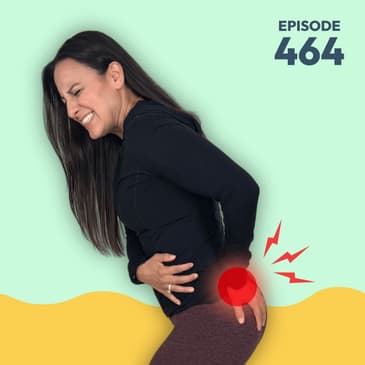
In this episode of the Optimal Body Podcast, Doctor Dom shares her personal experience of sustaining a minor back injury and developing sciatic pain while deadlifting. She and Doc Jen discuss how even fitness professionals aren't immune to pain and injury, emphasizing that stress, poor sleep, and rushing through movements increase the risk of experiencing issues like sciatic pain. They debunk the myth that deadlifts are inherently dangerous and clarify that disc bulges are common even in pain-free individuals, and not always linked to sciatic pain. Doctor Dom outlines her recovery approach, including breathing, relaxation, and gentle progressive movement. The key message: pain, including sciatic pain, isn't always a sign of serious damage, and mindful movement is essential for recovery.
Lifting for Longevity:
Check out our NEW movement longevity course -> Lifting for Longevity! Build your Strength, Mobility, Power, Balance and more regardless of what stage or age you’re at! Podcast listeners get a bonus discount with code OPTIMAL20
We Think You'll Love:
What You'll Learn:
2:02 Doc Jen's Deadlift Injury
4:04 The Importance of Mindset After Injury
7:17 Deadlifts Aren't Inherently Dangerous
10:19 Pain vs. Actual Tissue Damage
10:57 Disc Bulges in Asymptomatic People
14:27 The Benefits of Deadlifting
16:06 Immediate Steps for Acute Back Pain
18:29 Reintroducing Safe Movement Patterns
23:49 The Reality of Long-Term Maintenance
24:42 Common Mistakes After an Injury
For full show notes and resources visit https://jen.health/podcast/464
Hosted by Simplecast, an AdsWizz company. See pcm.adswizz.com for information about our collection and use of personal data for advertising.
[00:00:05] Welcome to the Optimal Body Podcast. I'm Dr. Jen and I'm Dr. Dom and we are doctors of physical therapy bringing you the body tips and physical therapy pearls of wisdom to help you begin to understand your body, relieve your pains and restrictions and answer your questions. Along with expert guests, our goal of the Optimal Body Podcast is really to help you discover what optimal means within your own body. Let's dive in.
[00:00:28] So before we jump into this interview, and you're going to want to listen to this because I think so many people don't think that Doc Jen can get injured. You know, she's the one that teaches us how to move. How could she get an injury? Nobody is immune to these aches and pains or injuries that will inevitably come up while we're going through our normal exercise routine. And that's one reason why we absolutely love the newest course that Jen created in collaboration with her mom called Lifting for Longevity.
[00:00:56] This course focuses on getting back to the foundational strength building, power training and also jump and balance training to really help with the components of our movement that are going to help us move well at any stage of life. We have gotten so much incredible feedback from this course that it has helped people get back into or reintroduce strength training into their routine because of all the incredible modifications that are included in the course.
[00:01:23] So if you're interested in checking it out, go to the link in the show notes. It's just Jen.Health backslash longevity. And as a podcast listener, you can get a bonus $20 off using code optimal 20 at checkout. All right, let's get into the episode.
[00:01:38] So this week's PT Pearl is getting a little personal and you are the subject of discussion today because just yesterday you were doing deadlifts and had a little incident where you felt a zing through your back and some pain down your leg into your booty down your leg. What happened?
[00:02:30] I know. It was a good weight, but it was a good weight, but a heavy weight. And I was moving through just really too quickly, not really focusing on form to what it should be. Plus, I don't want to blame, you know, just the deadlift itself and form because it also goes into I have not been sleeping and getting really good sleep. I've been a little stressed out about things.
[00:03:00] So it's like the underslept, overstressed combination with rushing through, not really focusing. And as I was doing my deadlift, I just felt this kind of zing go from my back into my leg and glute. And I knew in that moment I felt it before. So this isn't a new sensation to me. I've actually felt it not during deadlifts, actually, when I'm bent down to get Luca or doing something else.
[00:03:28] So this wasn't a new experience for me. So when I went into I was like, OK, I think I could do the last set at the same weight and just really focus on slowing it down and what the form was doing. And I had my friend kind of like point some things out for me as well as to what I could focus on because I hadn't said anything at this point. And I did it. I did less reps, but I really focus on form and I could feel my muscles working better. So a lot less tension into my back.
[00:03:58] But after that, I was like, OK, let me do things a little different after this last set. Which this is so important. I think that you're sharing this because it kind of breaks down that. Barrier of people who might watch you move or people who might watch any online fitness based influencer move and just assume they never have pain. They never get hurt when they exercise. They never. Which many people know, yes, we're all human. We have pain.
[00:04:27] We get hurt when we're doing movements and stuff. We do things too quickly. And also you bringing up that this is kind of a recurring thing that you feel something in that area or have felt something in that area before, which we talk about a lot. You know, as certain areas in our body get sensitized to certain movements or pain or desensitized to certain movements or stimuli, we might be more likely to feel this.
[00:04:53] And the most important thing, and I maybe a year ago now had a similar incident where I hadn't been strength training a lot. But was it right after Emily moved or something and you needed a workout partner? Or maybe she was on a trip. Yeah, I don't know. She was gone and you needed a workout partner and I go in and do deadlifts with you. And same thing. I'm going a little too quick. Had a very, mine didn't go down into my legs, but just felt something give in my back.
[00:05:18] And the most important thing, I think, in both of our scenarios was that we finished the last two sets. Did you do the same weight or did you bring it down a little bit? I did. I did less reps. But that's not necessarily something that I would promote to people, especially. For sure. When you like, but I think the most important thing is that we didn't catastrophize our pain. Like, as soon as we felt it, we were like, OK, I know my muscles can still support me.
[00:05:45] My brain is telling me there's this new sensation that has arrived. Right. But instead of just like freaking out, immediately freezing, we were able to say, OK, how can I change what I did before into a different movement pattern? Yeah, I only mentioned that because I think it's counterintuitive to most people. Like, oh, you felt your back give out. Like, mine was, yeah, it did not feel good.
[00:06:08] And I felt my pain, you know, for a while after that session, like a week after that session before I started feeling more confident and comfortable. But our mindset goes to, OK, it wasn't the deadlift. It wasn't just the simple fact that I'm deadlifting. I did something or I didn't do something that contributed to this. And I can make changes where I can still go and try to lift the same weight without fear, really lock in.
[00:06:37] And we both did at least one other set and are like, OK, that felt a lot better even after having that injury incident. You know, and that's why it's like these words that we typically use. My back went out. My, you know, I broke my back. You just said, and that's why it clicked in me and like we catastrophize in our brain. We're telling our brain something is so wrong that my back went out. Like, think about what that sounds like to yourself.
[00:07:07] You know, like if you tell your brain a bear is chasing you, your body is going to go into protective mode. If you tell your brain that your back went out, your back is broken, something snapped, something popped, something, you know, like whatever it may be, we make it worse. We potentially make those symptoms a lot worse than they need to be in that moment. And so I think what we tell ourselves is really important. And it's never just the movement. People so often want to blame the deadlift.
[00:07:37] Deadlifts are bad for you. But everyday movement, we're going to have a deadlift. So if you're not preparing your body for that movement, we're going to have a lot more risk of injury. And I know like some people were commenting on my post about it. I posted about this as well. And we're saying, yes, like I have clients who are like, oh, when I was bending over, changing my bed. So now I'm afraid to bend over or when I'm afraid to change your bed. Right. I'm I'm it was it happened when I bent down to pick up a pencil.
[00:08:06] And it's like if it can happen when I'm not lifting weight and load to where I am lifting significant weight and load and a deadlift. It is not the movement itself. It's our body and prepared, which can happen on a day to day basis, which is something is so crucial that I want to talk about. I think in part that's where I feel comfortable saying, oh, my back went out because I don't connect it with.
[00:08:32] Things moving out of place, you know, so saying that to me isn't necessarily the bear is chasing me. It's more like, again, the phrase like. Maybe more accurately, oh, I felt pain in my back during that deadlift and understanding a lot of it has to do with what you mentioned earlier. You've prepared your body to do that deadlift. You've prepared your body to do that set without pain perfectly. But you mentioned day to day there can be different.
[00:09:01] I didn't sleep as well. I have a lot of other stresses and things on my mind going on with work, going on with whatever. However, how is that impacting my readiness and preparedness to do this set and to focus on the things that I might need to focus on when I am doing this deadlift under a pretty significant load? Right. I mean, and that's where like that load doesn't just mean preparedness of the body, but like my sleep, my stress, my work, my kids.
[00:09:31] Like it does change on a day to day basis. And it's not based on just like the phases of your period or like, you know, like these standardized things that everyone wants to tell you. But it's truly based on your own day to day capacity and being able to monitor that and move appropriately.
[00:09:50] So for me, I should have started at a lighter weight, moved slower with more intention, knowing that I was tired, knowing that I was a little stressed, knowing I was working out a lot earlier in the day than I normally ever do. So my body hasn't really been up and moving a lot that day. So what can I do to make sure I'm better prepared in that moment for that day? And that's, I think, what's so incredibly important, no matter what exercise you're going to do, you know, not just talking about deadlifts.
[00:10:19] The other thing we're kind of dancing around is distinguishing between pain and actual damage or tissue damage. I think every time many people out there think that if they have pain during an exercise, they hurt or sprained or tore or bulged a disc. Especially like disc herniations are a huge one.
[00:10:40] If somebody feels like or has a history of disc herniations or has had an image in the past and has disc herniations and they have one of these instances when they're deadlifting or squatting, they're like, oh, I bulged a disc again or I herniated a disc again. That's why this is happening. And this is where it's like my mind doesn't automatically go to, oh, my gosh, I bulge a disc. I have a disc herniation. I need to run and get an MRI because we have research. So there's one particular research from 2015, actually.
[00:11:10] It's titled The Systematic Literature Review of Imaging Features of Spinal Degeneration in Asymptomatic Population. So these are people who are reporting no pain in their back. And what they found, they looked at over three, like looking at all the studies together, it was over 3000 people. OK, the prevalence of disc degeneration in asymptomatic individuals increased from 37 percent in 20 year olds to 96 percent in 80 year old individuals.
[00:11:38] Again, zero pain disc bulge prevalence increased from 30 percent in 20 year olds to 84 percent of 80 of 80 year olds. And that's like I think the number was like 50 percent of 40 year olds. So it's like half of 40 year olds walking around with no pain are going to have a disc, a disc bulge, a disc herniation. So in my mind, I'm like this herniated disc has probably already been there, right?
[00:12:08] I already have a disc bulge. So now I'm getting extra pressure on my nerve based on all of these other capacities that are happening, based on the all of the environmental factors, plus the form factors and what I did going into this deadlift. So it's not I'm not going to blame the image or the structure or be worried about going out.
[00:12:27] I'm going to say, OK, what can I do in this moment to help calm down symptoms, remind my brain it is safe and be able to move effectively forward? Yeah. And one of the points being, if you are somebody who has something like this happen, run and get an image. Oh, you have a disc bulge. If you're 40, 50 percent chance, it's a coin flip chance that you would have had a disc bulge on your image before you had that injury. Exactly. And so that's the point that we're making.
[00:12:57] Again, images can provide information. Yes. Disc bulges can be present at the onset of an injury and of symptoms. That disc bulge may not go away on image. You may have disc bulges on your image for the rest of your life. The focus should be on the symptoms, symptom management and how we can get back to lifting. Because what I think develops in some people's mind is deadlifts are dangerous. I've hurt myself once multiple times doing deadlifts.
[00:13:26] Deadlifts are dangerous. Like it's not worth the risk, which we would not agree with because daily life requires us to pick things up off the ground. And yeah, you might not be somebody who is looking for opportunities to lift 100 pound boxes or couches off the ground. But throughout life, you might and will likely have instances where it would be nice to feel confident helping somebody move a couch, picking up a chair and moving it. Moving your luggage. Moving your luggage.
[00:13:55] Grabbing your 50 pound, you know, five, six year old or grandson, you know, your mom picking up our 30 pound kids. Like because they're both about 30 pounds. So no, deadlifting itself isn't dangerous. It's one of the most effective exercises for helping build strength throughout our lower body and up into our spine.
[00:14:21] And it has great functional implications on what it will allow our body to be prepared for. Especially as we get older, like for my mom, for example, she's got like her knee osteoarthritis is getting pretty bad. So squats are really, really difficult right now. Right. Putting a lot of tension into that knee joint. But what we can do is we can load her up in deadlifts so she actually feels like her muscles are doing something effective. Because if we don't challenge our system, we're not going to see change.
[00:14:48] And if we're not going to challenge our muscles enough, how are they going to support the joint that's aching? Right. So if I can't do squats with her and or load her up effectively enough to create that change, deadlifts are such a great option. So we just need to stop fearing them, knowing that it's such a functional movement that we need throughout life.
[00:15:07] Now, we also see that when people are sedentary, when they're not moving, when they're not exercising enough, you actually have more risk of developing a disc herniation. Because that historically and especially years ago would be the recommendation. Yeah. Oh, just don't move. Don't do anything. Rest. Don't squat or deadlift. Yeah. Until you're getting older. We need to treat you more fragilely.
[00:15:34] Yeah. We need to avoid heavy lifting. And again, that's just where the deconditioning cycle starts. And your body becomes less and less prepared for these movements in the future. And there are so many research from the onset of low back injury. Complete rest is usually one of the least beneficial things in the research where some version of movement and exercise to begin early rehab is much more effective.
[00:15:59] That's starting to get you out of that pain and get you back into doing deadlifts, squats more confidently. Yeah. And so after I kind of felt that, I completed one more set, like I said. But instead of going on to some accessory exercises or doing a little bit more loaded stuff,
[00:16:16] I went immediately down to the floor, laid on my stomach into like extension or like on my elbows where I could completely relax my legs, my bum, my back, and just breathe into the opposite sensation, the opposite stimulus. So I was giving my body, okay, if flexing and hinging is kind of what like, you know, created the sensation of pain to my brain, I'm going to reverse it. I'm going to give it the opposite stimulus.
[00:16:44] Your body's smart and it starts to connect and say like, oh, flexion, that's where we just hurt our back. We should have, you know, we should maybe be careful in that. It wants to protect you, right? It wants to guard against that. So your body is trying to fight what your mind thinks. And it's literally a McKenzie technique in physical therapy where we reverse, you know, get you feeling better into a particular movement pattern before we start to put you back into flexion.
[00:17:11] So a lot of times with disc herniation type injuries, going into more of an extension type, what you can tell her, even if that's just lying flat on the floor, not even on your elbows. So just breathing there, relaxing the body, like getting the legs to shake out, the booty to shake out, the back to shake out. Because think about it, rather than tensing up and locking up and saying, oh my gosh, now I need to protect myself. What that does is that puts so much more tension on those nerves.
[00:17:41] So all of a sudden, not only did I already put a lot of tension through that nerve and it felt something that's telling my brain, whoo, we need to be careful. But now I'm putting extra tension because I'm tensing up my muscles. So what would be best actually is relaxing those muscles as soon as that happens. So that's why I got down to the floor and did breath in that position for about one to two minutes. And then I went into some really slow supported prone press ups.
[00:18:10] So this is where I have my hands kind of underneath my shoulders. Again, I'm trying to relax through my back and my bum as much as possible and just using my arms and my upper back to kind of guide into some extension. So kind of moving my spine again in that opposite direction that feels okay and safe for my body, knowing that, okay, look, I can move into my spine. I can flex my spine. I'm extending in a different way, but I'm still moving into my spine in a way that feels safe and supported right now.
[00:18:39] Then after that, I went into, okay, let me lay on my back, do some breath work, connect to my pelvic floor and my core. Maybe try some bridges. I did some bridges. I did some alternating bridges because as we walk as well, it's one leg after the other, right? It's an alternating pattern. Single leg bridge. Single leg bridge, opposite arm. So it's kind of like a dead bug where you kind of extend the opposite arm, opposite leg. But instead of being in front of the core, it's back of the core.
[00:19:07] So my glutes and my back and going into more of that pattern, which we have to understand also a bridge or a hip thrust. It's a deadlift movement because I'm breaking at my hips and I'm extending. So if I'm automatically teaching my brain, it's okay and it's safe, but I'm taking it down to a much lower level, right?
[00:19:26] Rather than going back to the deadlift, I'm going to a bridge, a hip thrust, and showing my body I can bend and hinge and extend with control and not feel pain. So kind of getting into those movement strategies afterwards really helped as well as just kind of some, I did some nerve tensioning exercises, kind of getting that nerve to glide through. So there's not too much stuck tension again.
[00:19:54] And then ended with a little bit of cat-cow. So if I can guide my body to, again, bend and extend in a way that feels safe and tolerable. This isn't me like excruciating pain, pushing into pain. This is me moving through a range that feels safe and comfortable. How can I use, can I exhale a little bit more, use my core? And does it feel different? And, you know, kind of seeing the experience, what does a cat-cow feel like only through my upper back mainly? And then what does it feel like only through my lower back mainly?
[00:20:24] And kind of like testing the waters. Let's see what flexion feels like. Let's see what these movement feels like. And when I got up, I could walk without pain. And now, granted, there are still, you know, experiences where I'm hinging over, I'm bending quickly, and I'm like, oh, it's still there. So it's reminding me that I still got work to do right now, which isn't a bad thing. I just experienced this yesterday.
[00:20:47] So now it's like, okay, how am I walking this path of building that foundation again and not wanting to go and rush it back to the max exercise? And this is just such an important progression. And you did a lot there. And I think because you know so much and are in tune with these principles, you know how to do it based on your body's tolerance.
[00:21:09] But the main things you talked about there are, you know, breath to start getting that core engagement back and to start down-regulating the system and the tension. Engaging and activating the core to show that there's some protection around there. And then working into the different ranges. I like how, you know, just getting into a cat-cow where you started with extension with the kind of prone press-ups to explore all those different ranges of motion.
[00:21:35] To start telling your back, like, okay, it is safe, especially when we're unloaded. And just doing that little bit within an hour, you know, less, minutes, minutes from the time of injury probably significantly helped versus getting done with that workout and then just trying to hobble through the day. Or just immediately going high school. You know, I'll take care of this later. Or yeah, ice and resting and just laying down and not doing anything.
[00:22:03] So I think that that's such an important process. I definitely didn't do that when I... You are so much better at rehabbing the things going on in your body than I am. I think in a couple of weeks we're going to talk about an injury I have. And I'm going to have to make some bad admissions as to how poor a patient I am when I know what I should be doing. Yeah. But I think, you know, the main thing is our nervous system wants to protect us. Our brain wants to protect us.
[00:22:32] So how are we going to speak to it in a way that can calm things down and then slowly build things up? And that's where, like, I will be going into our low back and SI plan. And every time this has happened, you guys, I kid you not. And it's probably because I've done it so many times. Like, I do a week of the low back and SI plan in Gen Health and it goes away. Which, I mean, I hope that's the case this time. I don't know. But that's where I'm also like, I get to continue that plan. There's three phases, right? Done the first week.
[00:23:02] I get better. I'm done. So it's like, it's, and someone asked me this the other day too. It's like, well, I really need my hip strength. It really needs to get worked on. How often and how long do I have to do that? And I'm like, for life. Like, we can't just, this isn't something, I mean, how often do you have to brush your teeth? Like, do you just brush your teeth for a couple of weeks and you're like, I'm all good. Good dentist appointment. And you're like, great, I'm there. Yeah. I don't need to do that anymore.
[00:23:31] Like, it doesn't work like that. Right. So even I'm telling this for myself as well. I got to keep building that foundation and working on that as well as the other environmental things. My sleep, my stress. Like, what am I doing to like also control as best as I can those other environmental factors? Those are the toughest realities about exercise and about optimizing your movement health. And we get that question all the time. How often should I do this? How long do I need to do this?
[00:24:00] And the how long question I think can be broken out because some people are meaning, how long do I need to do this before I notice a change? And sometimes people are like, how long do I need to do this before I can stop? Yeah. And that's the challenge is like, there's not really a date where you can just be like, stop, I'm there. My legs are strong enough. Right. Because if we stop doing the thing that got us the strength, then we won't have the stimulus to maintain the strength.
[00:24:27] And so in this type of scenario, I think what does the average person, quote unquote, do wrong? And not really wrong, but like maybe perpetuate and delay the rehab process in those immediate moments. I mean, I think the biggest thing is that we always relate pain to damage and we don't want to do more damage if I keep moving. Right. Pain is a signal.
[00:24:52] It's a warning, which is the most wonderful thing our body does for us so that we are not creating damage. Right. And so it is something that's so special that we have and that we get to honor and listen to. But it doesn't mean that you've automatically created damage and that something is horribly wrong. So we need to stop catastrophizing in our mind and we need to say, OK. And obviously, I want to also point out that there's different levels of this. Like there are people who do something and they hear a big snap.
[00:25:22] They fall to the ground. There are levels to every injury. There are levels to every pain experience. So there's no one way that this is going to work for everyone. Right. This worked for me in this experience. But this is going to happen for a lot of people, even physical therapists. So it's like we're just wanting to give you an insight of, OK, how can I think about this pain when it happens?
[00:25:47] How can I calm my nervous system so I don't add to the sensation and the symptoms of pain? And then what can I do to start moving forward? And I think if you have those three like as your reminders when something does go wrong, you're going to be in a such like such a supported position moving forward when you need to either go into GenHealth or go and see a physical therapist in person to really get the tools to help rebuild the system.
[00:26:15] Thanks so much for joining us for another episode all about how Doc Gen is not bulletproof and she also experiences pain and has very human experiences. I hope you can pull some little tips and tidbits from her experience and process as to what you can do if you experience something like this in the future. And if you've had something like this happen, go check out the low back plan in GenHealth. You can get a full week for free and use code optimal at checkout and you'll get that whole
[00:26:42] first month and be able to do the first phase for just $20. And of course, we'll see you next time on the Optimal Body Podcast. Thank you