
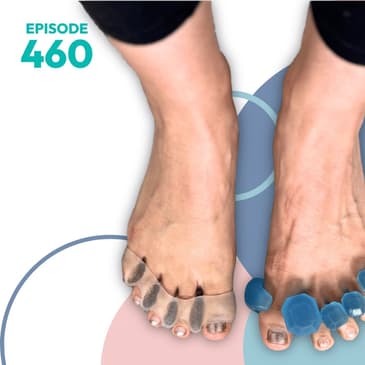
In this episode of the Optimal Body podcast, Doctors of Physical Therapy Doc Jen and Doctor Dom explore the benefits of toe spacers for foot health. They discuss how these simple, affordable devices help counteract toe crowding caused by modern footwear, reducing pain and improving function. Backed by research, toe spacers show benefits for conditions like bunions, plantar fasciitis, Morton's neuroma, and flat feet. They also highlight benefits for balance and neurological conditions. The hosts emphasize that toe spacers work best when combined with targeted foot exercises and proper footwear, offering practical tips for safe and effective use.
Zulu Weighted Vest:
Upgrade your everyday movement with the ZULU Weighted Vest — designed to increase calorie burn, naturally engage your core, and improve posture with every step. Perfect for walks, workouts, and daily errands. Use code OPTIMAL for 20% off at checkout.
Free Foot Health Webinar:
Dealing with pain from bunions or plantar fasciitis? Or just interested in how to optimize your foot health overall? Come sign up for Doc Jen's free foot health webinar!
We Think You'll Love:
For full show notes and resources visit https://jen.health/podcast/460
What You'll Learn:
1:52 The hosts introduce toe spacers, comparing them to pedicure tools and noting their growing popularity among celebrities and athletes.
4:04 A brief history of the original toe spacer concept, introduced in 1914 to address foot conditions caused by toe crowding.
6:58 A 2024 systematic review is cited, showing toe spacers are an effective conservative treatment, especially for hallux valgus (bunions).
8:52 Discussion on how toe spacers can reduce pain, redistribute pressure, and slow the progression of bunions, supported by research.
12:26 Explaining how toe spacers help Morton's neuroma by creating space between the metatarsals, reducing nerve irritation and providing symptom relief.
15:24 How spreading the toes can stretch intrinsic foot muscles, improve blood flow, and redistribute pressure to help heal plantar fasciitis.
18:44 Toe spacers help activate intrinsic foot muscles by providing a gentle stretch, which can improve strength and support for flat feet.
20:52 Discussion on how toe spacers can improve gait in neurological patients, enhance balance, and potentially reduce fall risk as we age.
23:32 The hosts recommend pairing toe spacer use with...
Hosted by Simplecast, an AdsWizz company. See pcm.adswizz.com for information about our collection and use of personal data for advertising.
[00:00:05] Welcome to the Optimal Body Podcast. I'm Dr. Jen and I'm Dr. Dom and we are doctors of physical therapy bringing you the body tips and physical therapy pearls of wisdom to help you begin to understand your body, relieve your pains and restrictions and answer your questions. Along with expert guests, our goal of the Optimal Body Podcast is really to help you discover what optimal means within your own body. Let's dive in.
[00:00:29] I'm so excited to announce that we have a completely free webinar coming up and this is going to really dive into the information about updated research on plantar fasciitis and bunions because there's so much noise out there. What are the tools that are supposed to help me? What am I actually supposed to be paying attention to? Am I supposed to roll my foot? Am I supposed to stretch my foot? Like there's so much noise and you guys, it's not just about the feet. So I really want a resource that I can provide you that goes through the feet of the feet of the body.
[00:00:58] What's through the latest research? What's BS? What's true? What do I really need to be paying attention to? And what is going to matter long term? So I'm doing this completely free because I want a place for you to actually understand the health of your feet. This is our foundation. This is what we walk on and move on. And it matters so much how we are implementing the strength and support of our foot that plays a role up into our entire body. So this matters a lot, especially, especially if you are complaining or get
[00:01:28] you know, foot pain, you know, foot pain, plantar fasciitis, you're getting chronic issues, bunions run in your family. This is what you want to sign up for. It's completely free. We're going to have it linked up in the show notes. Just head over to docgenfit.com backslash foot webinar and you can get in again. This is completely free of space to ask me questions. So I hope that you show up. You come and learn with us because I'm telling you, your feet are going to thank you.
[00:01:52] So today we're going to be talking about this little thing that looks like something a manicurist or someone at a salon would put between your toes when they're giving you a pedicure. I said manicurist, but it's a pedicure. Toe spacers. Which we have been proponents of for so long. I know like people think it's weird if you get sent photos of feet, but I honestly have gotten so many photos of feet throughout the years.
[00:02:22] I don't know if that's something I would admit, babe. You know, just people showing me that they're using their toe spacers or they're even just interlacing socks between their toes because I've talked about that a million times. If you haven't gone out and bought them yet, like just at least put thin socks between your toes because the benefits can be so incredible. So we're going to talk about it. Yeah, it's becoming so common and you hear celebrities and athletes, you mentioned a comedian, you know, had toe spacers in their routine.
[00:02:50] And we just kind of want to on this podcast separate the hype from the evidence. What is it actually saying? What can it do specifically for certain conditions? We're going to talk about bunions, plantar fasciitis, Morton's neuroma, you know, some heavy hitters. And there's pretty compelling evidence when it comes to how toe spacers can benefit people with those conditions. And just so you know, and if you're watching on YouTube, we have our toe spacers on right now.
[00:03:16] Which the ones that and don't judge my feet if you're looking at them because I desperately need a pedicure. Just FYI, Dom. I need a lead and go get it. Hint, hint, hint. And if you notice, I have one toe spacer on and on the other foot, I have a toe sock, which kind of looks weird if you're watching on YouTube. But that's because I started wearing these toe socks because I was wearing wider toe area, wider toe box shoes. But I always felt like my socks were still so restrictive.
[00:03:46] So I converted to toe socks. And my first weeks of wearing toe socks, it was like I would take the sock off at the end of the day. And it felt like I had had a toe spacer in all day. Because you kind of do. You have that separation of the toes. For sure. And we're going to talk more about how you progress into using toe spacers later. And we'll touch on the types that we recommend at the end and the types that we do not recommend.
[00:04:12] You know, because this goes deeper into the comfort and what the effectiveness and the intention of what we're trying to achieve when we're doing them. But just a brief history. So the original toe spacer concept was introduced by Alexander Weill. Weill Weill I'd go with Weill. In 1914 to address foot conditions caused by toe crowding.
[00:04:36] Which especially when shoes were where modern shoes were made back in the day, they were so tapered at the toe. And so I could only imagine the amount of toe crowding. You know, podiatrists at the time were seeing and stuff. And so just being able to say, well, what is the opposite of toe crowding? Okay. I have something that I've been genuinely loving. This is the Zulu weighted vest. And I've been wearing their 16-pound Onyx one with my walks and my bodyweight workouts.
[00:05:04] And it's honestly becoming a staple in my daily routine. And what I love as a movement nerd is how thoughtful the fit is. You get adjustable straps, side straps that actually stay put, plus pockets on the straps for my phone. So no bouncing, no holding anything done, which is super important, especially as I'm pushing a stroller. However, I think the key feature here is a machine washable fresh layer.
[00:05:27] This allows me not to feel so gross and sweaty because they have a removable neoprene outer cover that helps control the sweat and odor for easy everyday wear. Simply toss it in the wash and then hang it to dry. But here's what I really want you to hear. Wearing a weighted vest naturally cues the body into better posture. That added load encourages you to stack that ribcage over your pelvis and subtly engage your core without even having to think about it. It's like a passive posture reminder with every single step that you take.
[00:05:56] And on top of that, the increased calorie burn from walking with added weight has genuinely been supporting my body recomposition journey. More output, same walk. Trust me, I'll take it. If you want to check it out, head to our show notes. Use code OPTIMAL. You'll get additional 20% off at checkout. Yeah. And this is like back when industry was really starting to boom and when probably footwear and all, you know, the clothes that we wear started to really evolve. Mm-hmm.
[00:06:24] And you said back then toes were crowded in shoes. I mean, if you look modern day at what type of footwear people wear, I don't think it's changed much. Not much, especially when you're trying to look a little classy. Yeah, especially the high-end footwear and the fashionable stuff. Yeah. So, how do toe spacers work? It kind of says it in the name. I mean, the goal of a toe spacer is to provide passive space between the toes.
[00:06:48] They were designed to combat this toe crowding that we were starting to see from the footwear, the socks that we wear, to give those toes a little bit of relief. And we actually have some pretty good compelling evidence today to show the effectiveness of toe spacers.
[00:07:06] Now, not alone, typically, but in conjunction with other therapies, like just being able to go out and buy a pretty affordable toe spacer or, again, using a thin sock and interlacing it between your toes. Like, you can't get much more, much cheaper and conservative of an option that actually has been shown to work. So, one of the most comprehensive reviews to date is from December.
[00:07:33] We have a December 2024 systematic review that showed using, that looked at toe spacers as this therapeutic tool. And overall, they found that as a conservative treatment tool, particularly with folks with helix valgus. So, that's where your big toe is starting to go in.
[00:07:53] So, typically, we're seeing this in people who have bunion formation and associated deformities with promising findings in neurology and lower leg muscle function during gait, which, again, is so incredible. If we can look at neurological conditions and how toe spacers are even helping with walking. Yeah. And when we talk about lower leg muscle function, a lot of the muscles in our lower leg are the things that control our arch,
[00:08:19] are the things that control our ankle stability and provide mobility in those areas. So, we're going to talk about that a little later when we talk about flat foot, some other conditions that we looked into specifically. But I think you pointed out a very important thing that toe spacers aren't necessarily a standalone treatment.
[00:08:41] And that's why, after we talk about all of the conditions, we're going to talk about the exercises that we think would best be paired with initial use of toe spacers. Right. It's not like there's no one fix for everything. And I think that is what we always try to, you know, hone in on our podcast. But it is an incredible tool that we actually do recommend because there's a lot of crap out there in ads and advertisement, especially like for the bunion.
[00:09:11] You're going to twist this thing that's going to force and pull your toe over. Don't recommend and probably would not never spend the money for that thing. But a simple toe spacer, I do recommend. So, when we're looking at helix valgus, so those are the bunion formation, right? Where that big toe is going in. What's really happening is that in that midfoot, the bone that connects into that big toe is actually moving out.
[00:09:36] And as a result, your body wants to compensate for itself, right? So, if the bone in our big toe connected is going out, then our big toe is going to move in. And we get that bunion formation on the outside. And that's where we start to see that big toe really crowding over to the other toes.
[00:09:56] So, what toe spacers do in this instance is they're really just helping to reduce pain, redistribute that pressure that's coming into the bottom of the foot, slow the progression of that big toe coming in, and improve really a lot of patient-reported outcomes when it comes to pain and function.
[00:10:20] They cannot structurally correct or reverse a bunion deformity, but they're, again, a tool, a part of a lot of other things that we should be doing when it comes to bunions. Yeah, this is always a point of debate, and I have my own thoughts on the whole, can we correct bunions using conservative treatment? But the research, I mean, it's pretty exciting to see. So, a couple studies we want to bring up talking about bunions.
[00:10:50] There was a randomized clinical trial done by Attleberry in 2018 that looked at 56 women with moderate hallux valgus, so moderate bunions. Over three months, the treatment group received foot joint mobilizations, strengthening exercises, and toe spacer use. The results showed significant improvements in pain scores and AOFAS, which is the American Orthopedic Foot and Ankle Society scores.
[00:11:17] And that tends to just be functional scores and how their foot bothers them or doesn't bother them during their normal daily activities. And when looking into that study as well, we did see that it slowed the progression of the bunion and even stopped the progression for some of it or reversed mild to moderate bunions. So, if you can start to reverse like a mild to moderate bunion before it becomes something severe or before it goes into needing surgery, that's a huge bonus.
[00:11:46] You know, so I think this is, again, something that is so important to point out. There was another 2021 systematic review that looked at a combination of exercise and toe spacers. And it was among the most effective strategies at reducing hallux valgus angle and metatarsal angle. So, again, that when we're looking not only at the big toe going in, but also the toe that connects into that or the bone that connects into that big toe from going out so much.
[00:12:16] So, if we're going to reverse those angles by using strengthening exercises and using toe spacers, like that is a huge combination win that could be so effective. So, again, depending on the degree of the bunion, jury might still be out on how much we can reduce or make it look quote unquote normal again. But compelling evidence that using toe spacers and exercise is one of the most effective strategies at reducing your pain and symptoms and improving your function in your feet.
[00:12:47] Another condition we looked at was Morton's neuroma, which is when we are getting irritation in the nerves that run in the foot. And that tends to happen due to crowding in those metatarsals that Jen is talking about, which the bones that connect into the toes. So, essentially, the toe spacers are going to help attack this at its root cause, which is crowding.
[00:13:09] You know, if we are able to provide space in the toes, that's going to have a downstream or upstream, I guess, effect on the metatarsals and provide a little more passive space in the foot. And that's kind of the mechanism by which we at least would think toe spacers are going to help Morton's neuroma. Now, there is a case report now, not the strongest evidence that we have available, but, you know, something that we have from 2020 that looked at a dynamic ultrasound to visualize this in real time.
[00:13:38] Like what is actually happening? Is this creating the effect that we're trying to go for? So, at baseline, Morton's neuroma sat at just 0.1 centimeter above the metatarsal head. So, I think above those bones on the inside of the foot where you're having the pain. So, typically, you have that pain because when you squeeze around the foot, you'll feel that like right between the second and third toe. That's usually where you have that neuroma forming.
[00:14:04] And so, under simulated loading, so the neuroma dropped below the metatarsal heads, which reproduced the symptoms. So, they loaded that area of the foot, the neuroma dropped, and they're getting that compression under load, right?
[00:14:21] When a silicone toe spacer was inserted between the second and third toes, while maintaining that same pressure, the neuroma was lifted 0.2 centimeters above the metatarsal heads. That provided immediate symptom relief in this case. So, that I think is a really cool visual representation of how it's helping to offload the pressure and the symptoms from that neuroma. Now, again, is this the fix? No.
[00:14:48] But can this play a role in helping to reduce symptom provocation so that you can work, you can stand on your feet, you can do the things that you have to do while you're working on the exercises that are going to have that long-term effect, I think is the key here.
[00:15:05] And while we may not have found many massive meta-analyses or randomized control trials specifically talking about Morton's neuroma, foot health specialists describe Morton's neuroma as one of the conditions most directly responsive to toe spacers, especially compared to wearing narrow shoes with a neuroma-squeezing toe box. So, the experts have found in their clinical practice that Morton's neuroma responds very well. Next, we want to talk about another big one, which is plantar fasciitis.
[00:15:34] So, our plantar fascia is that tight band of tissue essentially running down the arch of our foot from the base of our toes to our heel. What we have to realize is that the muscles that connect all the way up between the toes are found on the inside of the foot. So, if we're wanting to effect change anywhere along that plantar fascia, we have to be addressing those deep intrinsic foot muscles that actually connect to the toes. And so, think about it just like in your hand.
[00:16:04] If I spread my fingers in my hand, it's because of the muscles that come from inside the hand. So, it's the same within the feet. So, if I want to create... Just when you spread your fingers wide, you should be able to feel a stretch through your palm almost. Yeah. And that's a similar concept to what you might be doing in your foot by opening space up in the toes. We're also opening that tissue. We're helping provide a little more stretch to the tissue on the bottom of that foot.
[00:16:31] And what we see, you know, when we can reduce some of that pressure on the inside of the foot by getting that gentle stretch from the toe spacers, we're helping to get blood flow back to that plantar fascia area as well. And so, one study by Ridge et al. demonstrated that by adducting the big toe into the bunion position, it decreased the plantar blood flow.
[00:16:53] So, that means taking that big toe and pushing it in actually decreased that blood flow, which is critical for tissue healing. So, again, we want to create the best space and best environment so that our foot can get back to the proper function that is necessary. So, that's why, you know, looking at this, there's another study from 2023, a case report published by the American Journal.
[00:17:21] A case report found that the recurrent toe spreader use improved both plantar fasciitis and bunion symptoms with redistribution of the plantar pressure in standing being a proposed mechanism. So, again, we're looking at just creating space, a gentle stretch of those toes to help reduce the pressure at the bottom of the foot so that tissues can heal and work, work, activate the way that we want them to.
[00:17:51] And often, we develop plantar fasciitis or, you know, changes in our plantar fascia tissue because we're trying to compensate for something. Because we're trying, our foot is trying to find stability and then it's kind of a cascade where we have those changes in our plantar fascia along with the crowding of the toes and less activation in the intrinsic muscles. So, just by doing this one thing and opening things up, we might be giving more space to our intrinsic foot muscles.
[00:18:19] Those are the muscles that help us actively spread and move our toes. So, then we can do some of the exercises that we're going to talk about after this and also opening up the blood flow to the plantar fascia so that it has a better chance to remodel and heal while we're doing our other therapeutic exercises. So, again, check a great tool for plantar fasciitis.
[00:18:43] Now, when it comes to flat feet, again, remember that the muscles on the inside of the foot connect up to the toes. So, if we're going to give them a gentle stretch of the toes, we know that muscles activate better through an increased length, not when they're just tight and constricted, right? So, if you are not able to move your toes, say you cannot separate them. Like, try it right now. Can you separate your toes? How well do they move? If you don't have that control of your toes, you're losing the control of the strength of the foot.
[00:19:12] So, just being able to get into a passive stretch of those toes is going to give you better connection into how the bottom of their foot and those intrinsic foot muscles can move again. So, this is why when it comes to flat feet, wearing toe spacers can be a great tool to help to spread the toes so that we can start to activate those muscles properly and gain the strength and support for that foot.
[00:19:41] I mean, hopefully this is starting to connect. It's starting to make sense. It's starting to like all work together no matter what you have going on in your foot. This could be supportive. And this is further supported by an EMG study. So, EMG studies, they basically just measure activity in muscles. Again, not the most massive, you know, level of evidence, but it's something that kind of adds to this story.
[00:20:07] That when they, an EMG study was done looking at the tibialis anterior and peroneus longus. These are the muscles in the lower legs that we were talking about earlier. And these two muscles specifically are super important for controlling our arch, for helping to control how the arch rises and falls as we walk. So, they measured the activity in 20 individuals walking with and without toe separators, 20 healthy participants.
[00:20:33] When walking with soft toe separators, the tibialis anterior activity significantly increased. And this kind of gives us a direct relevance to how walking with the toe spacers on can actually increase the activity in the muscle that is responsible for helping support our arch. Now, what I think is really cool beyond all the things that we are commonly told about with our feet and some common, you know, complaints about pain.
[00:21:01] What I think is really cool is looking at some of the studies with neurological conditions and gait improvement, even fall prevention. I think this, again, so say I'm not having any of these foot issues, but we are all older people in training. And we are going to be prone to falls as we age and different systems of our body continue to change.
[00:21:24] And knowing that toe spacers can potentially help with reducing fall risk or getting us more in tune to what our foot is doing is such an underappreciated concept. That I think we need to be looking at. So one of the systematic reviews from 2024 highlighted a body of evidence showing that toe spacers improve gait parameters in neurological patients, including chronic stroke patients.
[00:21:52] And I don't know, like, at least in school, like this was never something we would have kind of talked about in terms of protocol with stroke patients. But to see that this is potentially, hopefully becoming more of a common practice of what avenues can we look at? What tools can we use to assist in gait? And especially those who have neurological conditions or what underwent a stroke, I think is so cool. Yeah. And like you mentioned, as we age, it's common.
[00:22:22] I wouldn't say I don't want to say normal, but common for us to start to be able to feel our feet less. And again, as we age, if we have been having any foot deformities like clawfoot, like bunions, again, any sort of neuropathies or tingling in our feet, you know, those things tend to tend to progress as we age. And as we noted above, especially with the foot deformities like bunions, this can be helpful.
[00:22:47] And it makes a lot of sense to me when we talk about opening up the toes, we're technically widening that base of support. So it makes a lot of sense for me that just from that angle, we would help improve balance. We also talked about implications on how it can help us improve the activity in our foot intrinsic muscles, muscles that are very important for reactive balance. The muscles of our arch, also a muscle that's very important for that floor-based balance.
[00:23:14] So a lot of these things make a lot of sense to me at face value. But then when you just say, hey, putting on toe spacers could potentially help balance and reduce fall risks in people that are having neurologic conditions later in life. Again, great tool to add into the bag. Amazing tool. So now let's talk about some of the foot exercises that we recommend kind of pairing this with. Because again, we've continued to say that this doesn't work alone.
[00:23:41] And these are examples of exercises that's going to be specific to what you have going on. What is, you know, a whole host of what could be needed in a bigger picture. But when we're just looking at, you know, let's look at some baseline exercises we should start to implement within our foot. One of the main ones is just a short foot arch exercise. So this is where we are trying to bring essentially the ball of the foot back into the heel.
[00:24:10] So without clawing of the toes, without gripping of the foot, I'm literally just trying to bring the ball of the foot, press my toes down in an elongated position so that I can engage the bottom of my arch and start to feel that contraction and then lengthen it. Contract it and lengthen it. And that is something that's really hard to connect to at first and takes time and practice. But if you wear your toe spacers, you might be able to improve that intrinsic foot muscles a little bit.
[00:24:38] And if you're listening while we're talking through these exercises, it's always kind of tough to imagine what exactly we're talking about. So we do have video examples that will be popping up on YouTube if you're watching. The next is toe splay or toe spreads. Some people call it toe yoga because there's different variations. And again, when you get a passive stretch, the next thing that we always preach is you want to learn to actively control that movement or that mobility.
[00:25:05] So especially if you're using your toe spacer and you take it out, the very next thing you should do is look down at your feet. And even if you aren't confident that you're going to get any movement or even if you don't get any movement, look at your feet and say spread and try to spread those toes, spread out the big toe and the pinky toe to the side. I'm not great at this. When I do my toe spreads, my pinky toe kind of goes down. My big toe doesn't move a ton.
[00:25:33] I've been working on it for years after decades of cramming my feet into tiny little football cleats and basketball shoes. I'm trying to wake my feet up. And the thing is, we can get frustrated if we can't do it or we can realize, hey, I've got X amount more years of life. I've got 30, 40, 20 more years of life. If I continue to work on this daily, weekly, maybe over the next 5, 10, 20 years, I'll see improvement.
[00:26:01] And then I'll get all those other improvements that come with increasing the activity in my toes and my intrinsic foot muscles. So there's other variations of the toe yoga where you just have your foot on the ground and you try to only lift your big toes while keeping your other four toes calm. Then you can do it the other way where you lift up your four toes, keeping the big toe down. And then you can try to do little waves with your toes, toe waves. And that's kind of the toe yoga concept.
[00:26:32] Yeah. And it's so funny. Like we've even had friends who were like, I've never been able to move my pinky toe. And they started using toe spacers. And then all of a sudden they're like, oh my gosh, my pinky toe moved. Shout out to you all. Yeah. So it's just, it's incredible like the change that we can start to create in our foot when we give it the opportunity in this space to be able to do it. Now, another really common one are toe scrunches or marble pickups.
[00:26:59] My only thing about this one is that when we're walking in gait, we don't want to just be like squeezing and crunching our entire foot. So it's not always the most functional exercise, but it's something that can help strengthen the foot overall. It's going to get your flexors activated. It's going to help, again, use those muscles, wake those muscles up. Like you said, it doesn't directly translate into function great. Right. In a great way.
[00:27:23] But what you can do and a better way to kind of approach it is if you're going to crunch in the towel five times, also think with just like your toes, keeping your heel on the ground, then reverse it. So try to push that towel out with your toes five times. So you're pulling in, pulling out. So just so that we're getting more function and more use of those feet. Next, we have heel raises or calf strengthening.
[00:27:48] Again, this is just talking about that whole posterior chain when it comes to our plantar fascia going up into our Achilles tendon and into the calf. There's a lot of research that shows if you have tight calves, tight Achilles tendons, you are going to, you're at a higher risk of developing tightness through that plantar fascia. So tons of different variations of heel raises.
[00:28:11] The easiest or first place to start is just flat on the ground, raising all the way up onto your toes and back down. Something to look out for is not letting your ankles to go to the outside. You always want to keep your ankles in line with your feet, kind of in line with your second, you know, toe-ish area. A good way to do this is squeezing a ball between your heels so that when you go up, you're really keeping that ankle in line with the movement.
[00:28:40] Yeah, and you should feel the outside of your calf really kind of light up because that's the muscle that connects all the way down to the base of the big toe or the ball at the foot. So you're really going to feel that whole contraction and that actually helps to support the arch as well. So really making sure that you're staying over that big toe is recommended. And then single leg balance. So this could be done in so many different aspects, but try it with wearing toe spacers.
[00:29:06] So actually put your toe spacers on trying to make sure that your toes aren't crunched and that they're actually spread out. They're flat and then starting to work on balance. That could be just single leg balance, just standing on a steady surface. That could be single leg balance and now trying to close your eyes. That could be going onto an unstable surface and trying a single leg arm balance. It's the single leg balance.
[00:29:28] This could be throwing a ball, catching a ball and single, you know, like there's so many ways that we could start to mix up single leg balance. You're doing Bulgarian split squats. You're doing single leg deadlifts, whatever it may be. But try it with your with no shoes, no socks. And even in toe spacers, that could be a good way to start to build in that proprioceptive training. And all these other exercises kind of play into single leg balance when we're doing the short foot.
[00:29:55] You know, that's a way to find stability through that midfoot area, stability through the arch. A progression of the short foot exercise is doing short foot and standing and then doing short foot and trying to stand on a single leg and see how your foot responds. Because when we make our body and our muscles uncomfortable or put them in positions that don't feel super stable, we kind of revert to old patterns.
[00:30:20] So if you go onto a single leg and you notice, well, my toes are lifting all over the place. My arch completely collapses into my flat foot. Again, maybe that's a variation you're not quite ready for or your foot isn't prepared for. So giving yourself extra support, holding onto a wall and trying to go onto that single leg and seeing if that is a more comfortable way for your foot to train in that position.
[00:30:47] And again, like I said, your foot is the first place that we start to react to instability, our foot and our ankle. So noticing what your foot starts to do in those times that you put yourself in a potentially unstable situation is important to pay attention to. And the more you do it, the more you'll notice, wow, I stand on one foot now after a few weeks or a month of doing this.
[00:31:12] And I don't notice nearly as much activity in my feet, nearly as much activity in my toes and in my ankle. That means those muscles are getting a lot more comfortable with that. Now I want to talk a little bit about, OK, so what toe spacers should I get and how long should I be using them? And this is like anything. If you have not spread your toes at all or spent time with your toe spread, you're not going to suddenly wear them all day long. Like that would not you wouldn't suddenly be working out under incredible load if you haven't been squatting at all.
[00:31:41] You know, like let's think about this in a very smart way. So we're still going to approach it very slowly. So I'm going to recommend you're going to start to wear them for like 10 to 15 minutes a day. Just when you're you kick off your shoes at the end of the day and you're, you know, watching a show for a little bit, like put it lay down on your couch and put some toe spacers on. So it's not something that you have to it's something that you gradually build into just 10 minutes a day is already going to start to make a massive difference in what you're feeling with your feet. So start there.
[00:32:11] And then we want to make sure, again, we're not going so aggressive with the type of toe spacers that you're wearing. So ones that I always, always go back to and just feel best for me are the Neboso toe splay. So this one, just the material is so ooey gooey stretchy on your feet and between the toes and it's not too aggressive.
[00:32:37] So this I could, it stays in place no matter where I walk around, whether I'm walking around with shoes or without shoes. So it's just, it's been my go-to for so long. And we actually have a discount code, Code Optimal. And we'll have that linked up as well if you want to check out the toe splay. It's just, it's been my go-to for so long. The other ones that I like as well and might feel more comfortable for some people if you don't like it, you know, wrapping around your toes is from Gate Happens.
[00:33:05] And I believe code docgenfit should work for that. I'll have to check in and make sure that that's still an active code. But this is just like a, it's one that just kind of goes between the toes and it's not going to be on the outside. So again, it's a really comfortable one you could wear with shoes. For me, it doesn't stay in place as well as the one that wraps around my toes. So I just, I just go back to the toes play more often.
[00:33:28] Another thing I like about the one from Gate Happens is, so I have a really big kind of gap in between my big toe and my second toe. And they do have places that you can put an extra little bit of cork or a little plug in that spot so that it gives you a wider gap. They also have that on the pinky side for people that might need that. So it is a little bit more adjustable based on what you might need. I also, as I mentioned at the beginning, love wearing my toe socks.
[00:33:57] I don't find myself wearing toe spacers a ton because, I mean, and I can't tell you the difference. It was like, once I started wearing toe socks versus my regular conventional socks, at the end of the day, I just felt like my toes were being held in a little bit of a stretch all day long. And I would take the sock off and I'll be like, wow. So it's hard to explain, but definitely an option as well.
[00:34:21] And one thing that I also want to point out, so early, early, early on, before I knew much about toe spacers and I was just wanting to get started, I bought some yoga toes. I think that's what it's called. And they are so aggressive. You guys, you don't need huge amount of space between your toes. You just need a gentle space. It shouldn't be so aggressive that you're sore, that you're forcing your toes to separate around something.
[00:34:52] It's minimal and it's a minimal stretch. It's not aggression. So please throw out ones that are like so incredibly aggressive. It's not necessary. You want to be able to comfortably get to the point where you can walk in them and you can even wear like wider toe box shoes, like Vivo Barefoot shoes. And it's no problem, right? Right. It's kind of like we talk about with any stretch. You shouldn't feel like you're fighting against it.
[00:35:19] You shouldn't feel like you need to crank your toes and feet to get them into whatever toe spacers you're using. It should be something comfortable, something you can continue to breathe normally during and relax into. Yeah, it's not something aggressive, especially because the goal isn't to create toe space wider than what your normal foot would actually be. So we're going for a normal kind of toe space.
[00:35:46] The other thing to look out for if you do have peripheral vascular disease or diabetic foot, consult your podiatrist first. So don't just jump in. Oh, this sounds good. I'm going to use it. Like if you have reduced sensation to your feet, this is something that you need to have a conversation with your podiatrist about. Or if you have any fixed deformities or surgical fixations within your toes, again, something to talk with your doctor about. As in all of our podcasts, this is not direct medical advice. No, it's not.
[00:36:15] We're not telling anybody that they should do anything for any specific condition. It's just information and education that can hopefully better direct the medical decisions you make with your team, whatever that is. And so hopefully after all of this, we've convinced you that there are compelling arguments and reasons that toe spacers can really benefit your foot health. Thanks so much for joining us on another episode. Now, don't forget that we have a completely free foot webinar coming up.
[00:36:45] And this is going to be going over a lot of topics about bunions because so many people had questions about it. But also plantar fasciitis, foot pain in general. Like what should we be paying attention to? What does the research actually say nowadays? We're going to go into so much more depth beyond just toe spacers. So please sign up for that foot webinar. It's completely free. We'll have it linked up in the bio or you can go to drunfit.com backslash foot webinar.