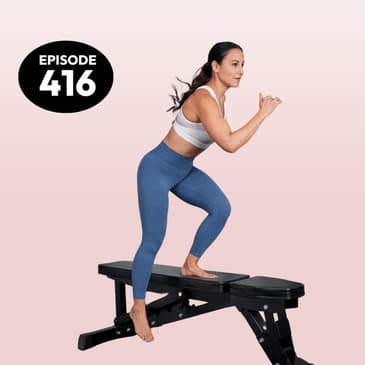
In this episode of the Optimal Body Podcast, Doc Jen PT, DPT and Dr Dom PT, DPT, physical therapy experts, compare high-intensity interval training (HIIT) and sprint interval training (SIT), answering questions from their Jen Health community. They discuss the benefits and challenges of each method, especially for women in perimenopause and post-menopause, and emphasize the importance of individualizing workouts for optimal health. The hosts offer practical advice on balancing HIIT and SIT with other exercise modalities and physical activity, highlight the significance of recovery, and encourage listeners to find an approach that supports their unique health needs and goals to best support overall health optimization.
VivoBarefoot Discount:
Support your feet and ankles with VivoBarefoot shoes—perfect for any occasion! Boost mobility and strength from the ground up. Use code OPTIMAL20 for 20% off. 100-day trial included—return if you’re not satisfied!
**Vivo offers a 100-Day trial period. If you are not completely satisfied, you can send the shoes back and get a refund.
LMNT Electrolytes: Free Gift with Purchase!
Stay hydrated and energized with LMNT electrolytes—sodium, potassium, and magnesium for brain and body. Get a free gift with every purchase and try new flavors! Get your Free Gift now!
We think you’ll love:
For full show notes and resources, visit: https://jen.health/podcast/416
What You Will Learn:
1:43 Introduction to the HIIT vs SIT topic, social media influence, and relevance for perimenopausal/postmenopausal women.
2:52 Clarifying the benefits of HIIT, addressing misconceptions, and emphasizing not demonizing any exercise form.
3:42 Explanation of Sprint Interval Training (SIT), its structure, and exercise examples.
6:58 Comparison of energy expenditure, session length, and rounds for HIIT and SIT.
08:18 How HIIT and SIT affect bone density, especially for women in perimenopause and post-menopause.
09:56 How hormonal changes...
Hosted by Simplecast, an AdsWizz company. See pcm.adswizz.com for information about our collection and use of personal data for advertising.
[00:00:05] Welcome to the Optimal Body Podcast. I'm Dr. Jen and I'm Dr. Dom and we are doctors of physical therapy bringing you the body tips and physical therapy pearls of wisdom to help you begin to understand your body, relieve your pains and restrictions and answer your questions. Along with expert guests, our goal of the Optimal Body Podcast is really to help you discover what optimal means within your own body. Let's dive in.
[00:00:28] So before we hop into this episode, I need to talk about barefoot shoes, specifically Vivo barefoot shoes. It is what Jen and I have worn almost exclusively for over five years now and the changes we have felt in our feet is absolutely incredible. Now we're going to be talking about high intensity exercises and sprint exercises and that might sound intimidating, especially in a barefoot shoe. And let me tell you, when I started wearing barefoot shoes five years ago, I could hardly go on a half mile jog without my feet and my calves and my ankles.
[00:00:59] Absolutely barking at me. But five years later now, I can jog, I can run, I can hike, I can do just about anything in them and I don't feel the same impact. That's because just by wearing the style of shoe for the majority of time, you will start to notice significant mobility and strength increases in your foot health and you will notice how it impacts your movement up the change and impacts your movement patterns downstream.
[00:01:20] Regardless of where you're at in life right now with your foot health, there is a way to progress to a more barefoot style of living safely in a way that improves and strengthens your feet. That's why we recommend everybody try out a pair of Vivo barefoot shoes. Go down to the link in the show notes and make sure you use code OPTIMAL20 at checkout to get 20% off your entire order. All right, let's get into the episode.
[00:01:42] Now I'm excited to dive into this information on sit versus hit because especially in this came as a question actually within our Gen Health membership because we do monthly webinars. And so I asked for topic recommendations and what people are interested in. And this is a hot topic right now, I think, especially because of social media. And if you're in the perimenopause, menopause, postmenopause phase, you might be getting recommended some of these.
[00:02:10] But you always watch those videos, so you're probably getting fed a lot of that stuff. I am for sure in this as well. So I understand why someone's asking this question. You know, there's a lot of talk about now you have to do sit. And like, I feel like social media demonized hit for a long time. So hit got demonized and then all of a sudden it's like, well, no, you're not supposed to do hit. You're supposed to do sit. Like, but only when you reach a certain age.
[00:02:37] And so it's like, okay, let's actually look at the research and go back, pause for a moment and see what is beneficial in the whole scheme of everything. And where, when and where should you be paying attention to these differences? And I mean, we did a previous podcast on hit training and all the benefits that you can get from hit. And I don't think you can argue that hit training is super beneficial.
[00:03:02] And it has a lot of adaptations that it can give you positively in like every system of the body. And there are reasons that hit training might be challenging for certain people. And depending on the phase of life, there's hormonal reasons or stress-based reasons that it might be a challenge on the body. But I don't think I'm going to ever live in the space of, oh, we need a demonized hit. Like, if you're able to do hit, there's still a lot of benefit that can be had from it. Right.
[00:03:30] I think you and I are both under the impression we don't demonize one exercise. Don't demonize any form of exercise. Like, it's all about intention and understanding. So that's what we want to bring you. Like, let's understand. What's sit? What is this sit training? The sprint interval training. It doesn't have to mean that you're literally doing sprints. It's an easy way to think about it.
[00:03:59] Like, all-out sprints, right? On a treadmill or running somewhere. But it could also be all-out battle rope. All-out squat jumps. Squat jumps. All-out. Assault bike. Row machine. Yes. Swimming. Like, maybe not swimming. Maybe not swimming. But whatever you can tolerate within your body. And I think this scares a lot of women who might be getting older or people who might be getting older because, oh, my knees are bad or this is bad. Okay.
[00:04:26] Well, we can think of some other high intense exercise that you're going to do for like 20 to 30 seconds max for as hard as you can, like near maximum effort. And then it's followed by a lot longer of a rest period. I guess I shouldn't say maybe not swimming because you still will get some of the benefit. We're going to talk later about where the impact type exercises might be more beneficial for certain things.
[00:04:51] Where even assault bike or row machine, they're a lot lower impact. So, you might not get like the bone density benefits that we're going to talk about later. Right. And that compares to HIIT training, which tends to have longer work periods. You're working in a lower intensity, you know, maybe 80% of your max or 85%. Which is still intense. Which you're still supposed to be going hard for longer periods. Of time, maybe one minute.
[00:05:17] Maybe it says one to four minutes on what we looked up, but four minutes at 80% is a lot of work. I know when we do HIIT workouts, it's generally like 45 seconds or something for the work period. But the difference is you have a lot shorter rest period versus sit training. Your rest period is four minutes. Yeah. Two to four minutes. It's versus 30 seconds of work where your rest period and HIIT is going to be a lot shorter than your work period. Yeah.
[00:05:45] It's like 15 second rest. 15 to 30 seconds of rest. Right. Now, as we talk about high intensity exercise, we know that this comes with a lot more sweat because we're going to be working the body. Right. And so it's normal for your body to sweat more. However, are you replacing it? Not just hydrating, but replacing the electrolytes that we're losing, especially in summer. You have to be thinking about this.
[00:06:12] If you're getting any cramping, if you're getting brain fog, if you're just feeling really fatigued throughout the day. My mother-in-law said that this is our pick-me-up. Not another cup of coffee, but element. Having just one pack a day. And we put it in about 32 ounces of water. It doesn't have to go in a lot. And if you want to just start with half a packet because you're not used to getting that much sodium in, that's where I would recommend starting. But I would recommend starting.
[00:06:36] So if you haven't checked out element yet, this is drink element, drink L-M-N-T backslash optimal. Of course, please support our podcast as we're giving you this information. Go to drink element.com backslash optimal. You're going to get a free sample pack with your purchase. And these samples are incredible because all the flavors are so amazing. And again, it is so crucial to replenish our body and hydrate fully, not just with plain water, but with electrolytes.
[00:07:05] I'd highly recommend at least adding half a pack to your day and just start to see how you feel. Again, that's drink element.com backslash optimal. And you're typically going for a lot longer. So people could do hit from anywhere from like 10 to 30 minutes where people who do sit, you know, you're thinking of these short bursts only like four to six rounds. So you're not doing as... So maybe it's 10 minutes max, eight to 10 minutes kind of thing.
[00:07:34] I was going to say if you do five rounds where you're doing 30 seconds on, two minutes off, that's about 10 minutes, 10, 12 minutes. So let's get into the benefits. And this is where when you look at both of these at face value, they both show really great benefits across the spectrum with energy expenditure. You're going to be able to expend a lot of energy in an efficient amount of time. And I think that's why people like hit or why people, you know, should start to look
[00:08:01] at hit, uh, sit more because, um, there's research that says hit sessions tend to maybe be higher in energy expenditure, um, because you have those longer work periods versus sit training that also can play into some of the negatives. We have to look at like, as we go into the different phases, right now we're looking as
[00:08:25] estrogen drops, when we get into perimenopause and postmenopause, our bone loss really accelerates. Yeah. And so that's especially in the spine and hips. And we know that resistance training is beneficial, but interval training also then plays a role here because we have emerging evidence that shows that both hit and sit can put mechanical stress on the bone. And especially when there's ground impact like sprinting or cycling or jumping that
[00:08:54] stimulates this osteogenesis to have new bone, new bone formation. Yeah. And this, this is a lot greater than if you're doing something like steady state cardio, like just jogging on a treadmill because of that high intensity. You're putting a lot more impact and stress through the bone and the tendons for that matter. Um, so you're going to be able to see a lot more growth in bone density or tendon strength, uh, than you do with steady state cardio.
[00:09:23] I mean, and just to briefly mention, we're kind of wanting to stay more on the bone density and the hormonal side of this discussion, but fat oxidation, both sit and hit yield and enhance fat oxidation during exercise with longer training duration. So if you're doing this for more than four weeks, you're going to yield pretty significant effects and aerobic capacity because you're working at such a high percentage of your max, you're going to see significant increases in your VO2 max.
[00:09:49] It has been shown that maybe hit, you have a little bit more of an increase in that VO2 max because of the longer work intervals. Now, I just want to touch a little bit more on like, you know, what is happening in the female hormonal patterns, especially as estrogen and progesterone fluctuates or starts to decline. Right. And that's where we really start to see these differences in sit versus hit and why someone like Dr. Stacey Sims, you might hear her a lot, talk more about sit training at this point
[00:10:17] in time because hit with its shorter rest periods and still working at that moderate to high intensity, it can raise cortisol and, and, and it could be harder to recover from as well. So especially when you're in midlife as a woman, it's already, you already have this like increased baseline stress with what your body is hormonally going through.
[00:10:42] So sometimes adding in those that hit training can be a lot more on your system. And that makes a lot of sense when it comes down to it. Like you said, with the longer training periods, the shorter rest periods. Yeah. And I feel like that's where people who are already working a stressful job, they have multiple young kids, they might still be in a postpartum phase or coming up on perimenopause. And then they come and hammer out this 30 minute hit workout because they're like, oh, this is
[00:11:10] what I need to do for my bone health and for, you know, calorie burn and for, you know, fat loss and metabolism, um, where they might be getting themselves in trouble on the stress side of things. Like you said, it raises your cortisol a lot more. It's going to be tougher to recover from. And if you're already in a place in life where you're not getting great sleep and you have a lot of other stress in your life, that's where we can start to get into some of that
[00:11:36] adrenal fatigue conversation and your hormones just getting out of whack. So you're not actually getting the benefit that you think you might be getting from the HIIT workout, changing to something like SIT, yeah, you might see a marginal decrease in the amount of calories you would burn in each session, but your body isn't going to be able to better recover from that. Your body's going to be able to utilize that input of that super high intensity, um, to model
[00:12:01] the bone, model the tendons and actually help better regulate the hormones rather than dumping more stress onto the, onto the fire already that might be going on in this stressful life. So it's kind of looked at as like your less stress, more gains type of protocol because it's reducing that overall stress, but while still getting improved VO2 max, uh, insulin sensitivity, fat oxidation, but it's more effective at preserving that lean mass and stimulating
[00:12:31] growth hormone, which tends to decline as we age and have these hormonal changes. So it's really interesting to, to look at SIT in that way, to have better recovery, adaptation, giving the nervous system and the muscular system enough time to recover between sprints. So we kind of avoid overtraining, reduce our risk of injury and improve performance and adaptation over time.
[00:12:56] And so, you know, and this is especially when recovery is just critical, which is why we talk about breath work so much on the podcast, which is why we talk about mobility and sprinkling in other things, especially in perimenopause and menopause, because we just have so many changes in inflammation, sleep and tissue repair. And I mean, you brought up Stacey Sims, Dr. Stacey Sims. We've had her on the podcast multiple times. She's come on for lives for our community because she really is like a pioneer in this space.
[00:13:24] And if anyone would know, she would know what the research says on what is more beneficial, especially for this midlife period for women, when hormones are going through a lot of changes. You might not know exactly where your hormones are at or what your body is doing, but to summarize why she prefers SIT over HIT, especially for women in the postpartum to menopause phases, it respects hormonal and recovery needs.
[00:13:54] It builds strength and fitness without frying the nervous system. It encourages lean mass retention and metabolic health, and it's time efficient and highly effective. Well, and let's pause for a second, because I think we also have to understand that just because SIT, you know, is short doesn't mean that it's easy, right? We're still working at 100% plus of our max. We're pushing the barriers. Is it safe for everyone? And that's where we really have to see it's a very intense protocol.
[00:14:22] So if you're just starting or you're currently dealing with a lot of joint pain, you know, that's where HIT and doing it at a modified level for your body might be a better place to begin. Or even finding that SIT protocol with something that's slightly lower impact. That's where we bring up stuff like stationary bike or a battle rope or rowing, swimming. You're still going to be able to do work that's at 100% of your VO2 max, but you might not be
[00:14:52] getting some of the impact benefits that could be something you work into. Right. And that's why whenever I do my HIT workouts on Gen Health or any of our challenges or courses, I have levels that could be modified for everyone. My 70-year-old mother can do my HIT workouts because they are modifiable for everyone. And I think that's what's so important is to understand how you can start building in that
[00:15:18] impact and getting used to it, you know, at a safer level for you before you maybe are thinking about going so hard in this SITCUN training. I think even when you say sprint interval training and you need to go at 100% of your max intensity, like the thing that pops into my mind, which is probably what pops into everyone, is like some Olympic style runner sprinting up a hill for 30 seconds straight. And that's not going to be the reality for everyone.
[00:15:46] Like think of where you're at, whether you're 40, 50, 60, or like you said, your mom who's 70, her 100% effort or when you're doing the HIT workouts, her, you know, 80% effort is going to look very different than your 80% effort. Right. And it does. And she still gets great benefit from those types of workouts. Right. I will say also, this is where, you know, people might not enjoy it as much, but you might not, you really probably wouldn't enjoy it like watching someone on a video.
[00:16:15] Like if you're thinking of SIT training, I already feel like HIT training is hard for me to shoot because it's pretty repetitive, but at least there's a variety of exercises I typically do. There's a lot of instruction that can be had, but when you're doing SIT, you're trying to think of like one exercise that you're doing four to six rounds and you're taking about a two to four minute rest. Right. So this is something you really kind of do on your own. You zone out.
[00:16:44] You don't necessarily need a video or a plan to follow, but understanding when to add it in. I think starting with one to two days a week is a really good place to start. And I don't really think you need more than two at max three times for either HIT or SIT. So if you want to do both of them, maybe you're doing a HIT one day and a SIT another day of the week.
[00:17:10] And again, we're talking about this conversation of not increasing cortisol. So let's not put it in your week too often then. Let's focus on that strength training. Let's focus on that resistance training. Let's focus on walking more and moving more throughout the day and then sprinkling these HIT and SIT sessions in as appropriate for your life. But starting at one to two times a week, I think is a good place to start. Yeah.
[00:17:37] And I know that there might be the people out there that use HIT or something as their primary exercise modality. And they're like, nope, I wake up and I do my 30 minute HIT every day or five days a week. You know, Monday through Friday, I wake up, do my HIT before I go to work. And I know that people get very, you know, attached and connected to a specific style or mode of exercise. But based on the research and what we just went through, like that might actually be hurting the goals that you're trying to get to.
[00:18:04] If it is fat loss, if it is, you know, hormonal regulation and balance, if it is feeling rested and feeling good in your body. And if you're noticing some of those symptoms of like lack of recovery that we talked about, that could be the sign where find another style of exercise that you can really enjoy, whether it is strength training, whether it's going for a walk with your dog or going on a bike
[00:18:29] ride or, you know, getting in a pool, going to a yoga class, something that's going to allow a little bit more of that recovery. Right. And scaling back to two to three days a week of HIT and maybe turning one of those into the sit style workout. You might notice that your HIT workouts become more enjoyable and you get more benefit out of them. Yeah. The benefit. Yeah. I think that's what's so important. I mean, there's no, there's not going to be like, oh, this is what you need to do. This is the golden standard.
[00:18:57] All types of movement are really good to introduce your body to. Strength training, long state cardio, steady state cardio. Mobility. Which could just be walking. Mobility or yoga, down regulation training, tai chi, you know, all of these different forms of movement are so incredibly important. And so when you're thinking of like, oh, well, everyone is saying this is so important. Yes. And again. At the right dose. Right. Dosing matters.
[00:19:26] And there's, it has its benefits, but so does other, other forms of exercise. So, you know, dose it in as appropriate for your body. Take this in for what you can. If you can start, you know, tapping into some SIT training. Great. Try that. See how you feel. See how you feel after trying it for a few weeks, a few months. You know, it takes time for your body to feel some of these benefits and changes, but
[00:19:53] also focus on some weight bearing exercises in those. Starting to get some jumping or stair climbing resistance band and maximize those bone benefits, especially as we age as women is so crucial. Thanks so much for joining us for another podcast. I really hope that you grab onto some of those benefits that you can get from either SIT training or HIIT training and maybe start to sprinkle it in if it's something you're not doing, or if you're overdoing it, find ways to modify your exercise routine.
[00:20:21] If you found this beneficial, please consider passing it along to another person or leave a rating and review on your favorite podcasting platform. And remember, we have a whole high intensity program on Gen Health. You can start a week for free and even get a discount on your first month using code optimal at checkout.