
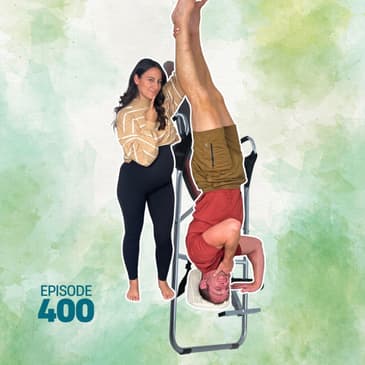
In this episode of the Optimal Body Podcast, Doc Jen and Doctor Dom, both doctors of physical therapy, focus on the use of an inversion table for back pain relief. They explore the associated risks and short-term benefits of inversion therapy using an inversion table, emphasizing the importance of addressing the root causes of pain through active rehabilitation, exercise, and lifestyle changes. The discussion encourages a holistic approach to health optimization, combining practical advice with professional insights to promote long-term well-being.
VivoBarefoot Discount:
Support your feet and ankles with VivoBarefoot shoes—perfect for any occasion! Boost mobility and strength from the ground up. Use code OPTIMAL20 for 20% off. 100-day trial included—return if you’re not satisfied!
**Vivo offers a 100-Day trial period. If you are not completely satisfied, you can send the shoes back and get a refund.
LMNT Electrolytes: Free Gift with Purchase!
Stay hydrated and energized with LMNT electrolytes—sodium, potassium, and magnesium for brain and body. Get a free gift with every purchase and try new flavors! Get your Free Gift now!
We think you’ll love:
What you will learn:
2:01 Inversion Tables: Worth the Risk?
3:13 Description of inversion table therapy as a passive treatment for back pain and its effects.
5:15 Summary of studies comparing lumbar traction's short-term benefits versus long-term effectiveness.
6:16 Advice against relying solely on passive treatments like inversion tables for back pain relief.
7:31 Emphasis on understanding and addressing the root causes of back pain for effective treatment.
9:09 Promotion of a free e-book and course on understanding and addressing low back pain.
10:34 Discussion on a study revealing limited effects of traction on back pain relief and functional improvement.
11:34 Advice on seeking active treatments and avoiding excessive...
For full show notes and resources go to: https://jen.health/podcast/400
Hosted by Simplecast, an AdsWizz company. See pcm.adswizz.com for information about our collection and use of personal data for advertising.
[00:00:05] Welcome to the Optimal Body Podcast. I'm Dr. Jen. And I'm Dr. Dom. And we are doctors of physical therapy, bringing you the body tips and physical therapy pearls of wisdom to help you begin to understand your body, relieve your pains and restrictions, and answer your questions. Along with expert guests, our goal of the Optimal Body Podcast is really to help you discover what optimal means within your own body. Let's dive in. Since I've had a lot of friends asking me about Vivo Barefoot shoes, and particularly
[00:00:33] which ones they should get where they just want to walk and go out and about, they want lifestyle shoes, not just like workout shoes. They want them to look cute. And trust me, I get compliments on mine. So I'm going to let you in on a little secret, let you in on my favorite Vivo Barefoot shoes that you need to go check out right now. And my first one is going to be the Gobi 2 Sneaker Premium Canvas Women's. Love this shoe. I wear it as much as
[00:00:58] I can when I'm out and about. It looks like a regular sneaker. It's super cute. It feels good. And it has that toe space, that flat bottom, the zero heel drop, everything we love to keep those feet healthy while looking cute. Now they also have some really cute boots. They have Gobi Chelsea boots. They have a Gobi Hyper Women's. So they have different stuff as well.
[00:01:23] But I'm telling you, check out those Gobi 2 Sneaker Premium Canvas. Those are my favorite right now. They always have really cute lifestyle shoes. I've had some of them throughout and I love wearing them. Cute, functional, but also the best for your feet. So if you haven't checked out Vivo yet, that's going to be code OPTIMAL20. Use code OPTIMAL20. You'll get 20% off your first order. Again,
[00:01:48] this code is only good for shoes that are not already discounted, like the one that I've been talking about. So use code OPTIMAL20 and check out their lifestyle shoes. Inversion tables. Are they worth the risk of death? It's true. Oh my gosh. I was reading these points that Jen read in research papers. And this one says,
[00:02:15] according to the Food and Drug Administration, Medical Device Reporting Events Database, ITT, which is inversion tables, has resulted in serious injuries, including spinal cord injury, fractures, lacerations, and death. And I don't mean to laugh. Yeah, you are laughing. That's not a laughing matter. No, it's not a laughing matter. But it's just like, it almost reads like a pharmaceutical
[00:02:42] commercial where they're listing off all of the potential risks. It is. It should be listed. And when you think about inversions tables and how you're just sticking your ankles in them and flipping upside down, I guess. There's risk. There's risk. And people could not strap themselves in and land on their head. But yeah, I'm like, death? What? There were several case studies that I saw that were, you know, serious injury came from some of these.
[00:03:08] Yeah, I get it. And again, I don't mean to be insensitive. I just, yeah. So inversion table therapy is a very popular passive treatment for back pain. And it's a form of spinal traction using gravity facilitated traction of the spine that just distracts the lumbar vertebrae because, and you can go at, you know, you can even go at barely leaning back to, you know, almost vertical.
[00:03:36] So it depends on your level of desire, essentially, of what feels best within your body and what you can tolerate to get this level of traction on the spine. And, you know, for some people, it can have that temporary relief because it is a passive treatment that results in temporary results. Taking a quick pause from the episode to talk about one of the aspects of health that's
[00:04:03] arguably most important. We have control over it, but many of us aren't paying attention to it, and that's our hydration. Not by drinking enough water, but by making sure we're replenishing the electrolytes that we're losing naturally throughout the day. Now, the weather's starting to warm up, and we don't know. Many of us don't even understand how much sodium, potassium, and magnesium we're losing through our skin just by sweating and perspiring as the weather warms up. That's why
[00:04:29] Jen and I drink Element on a daily basis. The Element electrolyte mixes make sure we're getting the sodium, potassium, and magnesium that is absolutely vital for so many of the processes in our body. It can help us with things like mental clarity, brain fog, headaches, making sure our sleep is more regulated, make sure we're having regular bowel movements, and so much more. The thing that I love most about it is that it just tastes so good, so it keeps me coming back
[00:04:55] to my water bottle throughout the day, making sure I'm getting in the water and also getting in those electrolytes. So if you go down to the link in the show notes, it's just drinkelement.com backslash optimal. That's drinkelement spelled out L-M-N-T dot com backslash optimal. You get a free sample pack with every single order, so you can try all the flavors, and then when you inevitably want to order more, you'll know what flavor you like the best. Go down to the link in the show notes and
[00:05:22] get your free gift today. All right, let's get back into the episode. That's exactly, you know, foreshadowing. The first study that you reviewed says, you know, there was 403 participants involved and compared with sham or no traction. Lumbar traction exhibited significantly more pain reduction, function and functional improvements in the short term, but not in the long term. And that's what
[00:05:48] we're alluding to. If there is any benefit or if you feel benefit, it's likely going to be a short-term physiologic thing because of the gravity-assisted traction that you get in your back helps to decompress the joints and relax the muscles around the spine. Yeah, essentially you're aiding in relaxation, right? A lot of these passive treatments that we've talked about in the past aid in relaxation so that you can hopefully then get back into the exercises that will actually result
[00:06:15] in long-term relief. And that's what we're really trying to say. But this is why I wanted to bring this topic up because so many people come to me of like, I have low back pain, should I get an inversion table? Like I've heard this is the fix, right? We're always looking for that band-aid fix that's just going to, I just need to relax in this for about five to 10 minutes and I'm not going to have to do anything else. And we just want to caution against that. Yeah. And again, that's not the case for some people. Some people want to get back to activity.
[00:06:44] Some people are very active and they're having a lot of pain. And if that's you, if you're in the boat of, I do a lot of activity, I do strength train or whatever it is, but I still have a lot of these back issues and I've done inversion, you know, table therapy or I've tried it before and it felt good. Great. You know, that could be a good part of your, you know, rehab plan essentially
[00:07:10] to reduce pain and discomfort, maybe prior to doing some of your exercises and then maybe trying to pair with a physical therapist or, you know, a program, the core plan in, you know, Gen Health, in the Gen Health membership to be able to start to establish some more stability and safety around your back. You know, what is that root cause as to why we're getting that back tension, that back pain?
[00:07:35] The distraction might offer some temporary relief. And then what exercises can we do to really help address that root cause? Because we have to understand we live in a world where we're going to have that compression all the time. So having that temporary relief from that traction, but then getting right back up and standing and now having that compression, sometimes for some people I've, I've experienced with patients that it's more aggravating. You kind of get like a rebound spasm almost. Exactly. Because now I went from that complete traction and opening to now I'm standing in and
[00:08:05] compressing again and now, oh, my back stiffened up. Right. And so for some people it's not beneficial. And this is why I don't say go run out and get an aversion table. You could try it at a clinician's office. So maybe at your chiropractic or at your physical therapy office, try it, see how it feels, but don't use that alone for treatment. And that's what I think is so incredibly important to remember. It can help and provide that short-term relief, but it's not a long-term gain here. And so what is
[00:08:32] really needed is looking at the root cause, which we've talked about with low back pain, and we're not going to hammer it all in again today. But again, root cause for low back pain can go very, very wide. That could be, you're not getting enough sleep. You're not getting enough nutrients. You're not hydrating enough. You're not moving enough throughout the day. You're mentally just so incredibly stressed out. You're not managing your stress levels. You know, you're financially just stressed out. There's so many factors that can contribute to the stressors of low back pain.
[00:09:02] Which speaking of, to help expand on that summary you just gave, we have a free low back pain ebook that we have made into a course essentially that you can get for absolutely free. It's a 27 page ebook that gets broken down into, you know, a five-day course essentially that you can go through and learn a lot of what can be the root causes that contribute to your back pain. We'll put that
[00:09:26] in the show notes or the link is just docgenfit.com backslash low back guide. Yes. Yeah, docgenfit.com backslash low back guide and you can get that absolutely free. And there was one other study that almost contradicts the first study. And this one has higher power, meaning it was a randomized controlled trial, had a lot more participants because they grouped 16. Looked at 32 randomized controlled trials.
[00:09:55] Yes. Still had a lot more participants overall because they looked at 16 different trials that they included in the review or something to that extent because they wanted to eliminate any studies that had significant amount of bias. And we talked about research bias, you know, occasionally here and there on the podcast, super prevalent. You always need to be on the lookout for if a study says this or if a study says you can lose a thousand pounds taking this or that, like there's likely,
[00:10:25] yeah, who's funding that? What did they want to see that study to have, you know, have happen? There's a good chance that they had influence on making that happen. And that's what research bias is. So they only included ones that had low level of potential research bias. And the findings indicated that traction either alone or in combination with other treatments had little to no impact on pain intensity, functional status, global improvement and return to work amongst people with low back pain.
[00:10:54] And it said there's only limited quality evidence from small sample sizes and moderate to high risk of bias that traction has significant, you know, results or symptom reduction for people. So again, that's where I would go back to. I don't think it's worth your money to purchase an inversion table for home. I really don't think so. If you want to try it out in the clinic while you're also
[00:11:20] getting other treatment and don't go from passive to passive passes. It'll go from some putting heat on your back to ultrasound in your back to massaging your back to doing some joint mobilization or adjustments and then, you know, going on the inversion table and going out the door. Those are all passive treatments that result in short-term potential short-term benefits, right? And so this is where it is so crucial to make sure that you're a bit of a clinician that's actually going to get you moving again or you're
[00:11:46] getting into gen health that's actually going to get you moving again and doing some exercises that are specific to potentially the root cause of low back pain. And just one last reminder, if you are somebody who does experience some joint pain from here and there, but you want to build strength in the body, we have a huge community going through our strong, healthy joints program within our gen health community. It's a strength building program that
[00:12:13] focuses on high top end strength training. There's some HIIT training in there. Core mobility. Core mobility kind of has a little taste of everything in a 30 day program. Like I said, we're all going through it right now together as a community, but it's never too late to come in and join. As our podcast guests, we always want you to get a little discount. So use code optimal 20 and you'll get an extra $20 discount to come in and join us today. Again, starting to build strength, starting to find some of those solutions that actually might get at the root cause of why
[00:12:42] you're having joint pains rather than searching for some of these passive treatments like inversion tables. It could be so scary to all of a sudden jump into exercise, especially if you're listening to this because you have low back pain. But it was so cool to be able to hear from so many people who went through the program before and said, oh my gosh, that's the first time I've been able to deadlift without back pain. And again, deadlift, that can mean you're using resistance bands, you're using
[00:13:06] dumbbells. It's all relative to what is hard for you, but to get that kind of feedback from people that are finally starting to find those connections within their body and feel stronger and more empowered to do movement and exercise in order to see the long-term benefits is just so exciting. Thanks so much for listening to another episode. I know that can be a little confusing in research at times, but hopefully you start to understand how to make the best decision for you. And if you've
[00:13:32] heard someone talking about this, feel free to pass this episode along to them. And of course, get into the community, move with us, get strong, feel those long-term impacts. Use code OPTIMAL20 and join our Strong Healthy Joints course. I'm so excited for everyone moving through it. And it's been so incredibly exciting. It's never too late to start and start working on your body.