
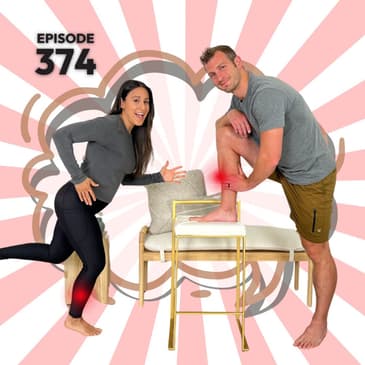
In this episode of the Optimal Body Podcast, co-hosts Doc Jen and Doctor Dom, both doctors of physical therapy, explore the common issue of shin splints, or medial tibial stress syndrome, prevalent among runners and those engaged in high-impact activities. They emphasize the importance of foot health, the benefits of barefoot shoes like Vivo Barefoot, and the necessity of maintaining strong muscles in the feet, ankles, and lower legs. Key points include understanding shin splints, load management, strengthening exercises, the importance of cross-training, seeking professional guidance, and preventive strategies. They also introduce a barefoot mini-course for improving foot and ankle health.
VivoBarefoot Discount:
We cannot talk about back issues without talking about restrictions in feet and ankles. Improve your foot and ankle health and therefore everything up the chain by wearing VivoBareoot shoes to improve the mobility and strength in your toes, feet, and ankles. There’s one for every occasion, including weddings, hiking, a grocery walk and casual wear, or shoes for your active lifestyle. Use code "OPTIMAL20" to get 20% off your VivoBarefoot Shoes!
**Code Change! The discount code is now OPTIMAL20 for 20% off.
**Vivo offers a 100-Day trial period. If you are not completely satisfied, you can send the shoes back and get a refund.
Needed Discount:
Although the journey of pregnancy is so personal and individual, Jen's number one question goes back to what she did to help her conceive and maintain the pregnancy. While there were a myriad of factors that contributed, she reliably counted on Needed supplements that supported her journey! Men need support as well via sperm support and men multivitamins. while women are supported by egg quality supplementation, CoQ10, prenatal Omega 3, iron, and choline in tablet or powder form. Used by over 4000 health professionals, Needed is available to support pregnancy, fertility, and postpartum, as well as women's and men's health in general. Check out needed if you know there's a gap in your nutrition via code OPTIMAL for 20% off.
Barefoot Mini-Course:
Tired of foot pain? Join Dr. Jen Fraboni's Barefoot Mini Course for quick 10-minute videos on foot health. Learn exercises to prevent issues like plantar fasciitis and bunions. Sign up today for happier, healthier feet!
We think you’ll love:
What will you learn from this PT Pearl:
00:29 - Importance of Foot Health
01:10 - Physical Therapy Pearl on Shin Splints
02:17 - Distinguishing Shin Splints
03:24 - Common Causes of Shin Pain
04:26 - Support During Pregnancy
07:33 - Risk Factors for Shin Splints
09:15 - Additional Risk Factors in Runners
10:25 - Footwear Considerations
11:16 - Theories Behind Shin Pain
12:23 - Symptoms and Assessment
14:04 - Gradual Loading and Exercise
15:05 - Barefoot Mini Course
16:56 - Rebuilding Strength for Shin Splints
17:01 - Calf Raises and Gait Mechanics
18:03 - Awareness of Foot Pronation
19:03 - Strengthening the Bottom of the Foot
19:14 - Hip Strengthening for Runners
21:04 - Comprehensive Lower Leg Training
21:27 - Professional Guidance for Injury Prevention
To learn more about this episode and view full show notes, please visit the full website here: https://jen.health/podcast/374
Thank you so much for checking out this episode of The Optimal Body Podcast. If you haven’t done so already, please take a minute to subscribe and leave a quick rating and review of the show!
Hosted by Simplecast, an AdsWizz company. See pcm.adswizz.com for information about our collection and use of personal data for advertising.
[00:00:05] [SPEAKER_00]: Welcome to the Optimal Body Podcast. I'm Dr. Jen. And I'm Dr. Dom. And we are doctors of physical therapy, bringing you the body tips and physical therapy pearls of wisdom to help you begin to understand your body, relieve your pains and restrictions, and answer your questions. Along with expert guests, our goal of the Optimal Body Podcast is really to help you discover what optimal means within your own body. Let's dive in.
[00:00:28] [SPEAKER_03]: Being that we're talking about shin splints today, I think it's only fitting that we talk about foot health before we dive in and how important keeping the muscles in our feet, ankles, and lower legs strong can be because some of those contribute to shin splints. And that is why Jen and I advocate for wearing barefoot shoes like Vivo barefoot shoes. We have worn them almost exclusively for the past four to five years. And I can't tell you how much it has benefited our movement, our foot health, and the way we feel when we move throughout the day.
[00:00:58] [SPEAKER_03]: Vivo's are flat, thin and flexible. And these three components go a long way to helping our feet build the natural strength and mobility that they need to do the movements that we do every day. The great thing is you can get 15% off with our special podcast code by going down to the link in the show notes and using code T-O-B at checkout. Especially since we're coming up into the winter and the late fall. I love Vivo because they even have barefoot options for boots so that you can keep your feet warm, but still get
[00:01:28] [SPEAKER_03]: the great benefits of having that barefoot shoe on. They also have options for everything else you might be looking for like movement, casual wearing and even water shoes and sandals. So check out the link down in the show notes, add a new pair of Vivo's into your closet today so you can start focusing on that foot health naturally just by wearing the shoes. Remember use code T-O-B at checkout to get that 15% discount.
[00:01:52] [SPEAKER_03]: So today's physical therapy pearl is on shin splints. And we've actually done an episode on this before, but it was way long ago. And so we just kind of want to refresh and bring it back. And shin splints is something that we find super common in runners or people who do impact type activities that just have repetitive impact movements. It's also referred to as medial tibial stress syndrome because that's what we're talking about.
[00:02:22] [SPEAKER_03]: It's where we start to feel the symptoms kind of right in the middle of that shin bone.
[00:02:27] [SPEAKER_01]: And we have to like kind of, I think, distinguishing between all the different things that can pop up along the shin, you know?
[00:02:36] [SPEAKER_01]: So sometimes it could be confused for like anterior compartment syndrome. That's going to be when we're looking at like the meaty part of this anterior tibial muscle.
[00:02:46] [SPEAKER_01]: And if that's starting to get super inflamed or there's a lot of pressure when you're kind of pushing into it and a lot of pain, that's when I would say, okay, go see a physician. Let's make sure it's not anterior compartment syndrome and then move forward a little differently than how we're going to talk today.
[00:03:03] [SPEAKER_01]: Another super common thing that it can be, and sometimes this is referred to as shin splints, is posterior tibialis tendinopathy. So you're getting that pain along the inside of that shin more.
[00:03:16] [SPEAKER_01]: And this muscle actually connects on the inside of that calf and it goes under that foot and kind of helps to control our arch.
[00:03:24] [SPEAKER_01]: And so this, because controlling of the arch is something that you're going to be doing every step that you take, especially in running, this muscle can have a lot of tendency to get overused or just cause a lot of pain around that area.
[00:03:39] [SPEAKER_01]: And then the last thing that we want to kind of look at is tibial stress fractures. So having, you know, stress fractures directly into that lower leg bone, also something that would need to kind of be looked at a little differently and diagnosed from a physician.
[00:03:56] [SPEAKER_01]: Interrupting real quick, just to remind you now, getting support through our body, especially as a woman in trying to conceive prenatal and postpartum can be really overwhelming, right? Because there's so many brands out there. It's like, what do I recommend? And what is the best option?
[00:04:14] [SPEAKER_01]: And I actually looked into needed because I saw other people that were using it that I trust. And so I went to my RD and I said, is this a good company? Would you recommend it? Because I don't mess around. I've had a miscarriage.
[00:04:28] [SPEAKER_01]: And so I just tried to really do whatever I can to support my body. We never know what the outcome might be. However, how can I right now support my body the best that I absolutely can knowing that I'm using the best supplements? And that's what I turned to needed and my RD said yes, I approved. They're great.
[00:04:47] [SPEAKER_01]: And that's why needed is recommended and used by more than 4000 women health experts from nutritionists to midwives, functional medicine doctors and OBGYNs. And I tell all my friends, I tell anyone who reaches out to me, this is what I use. This is what I recommend.
[00:05:01] [SPEAKER_01]: And here's the great thing too. If you're in a place where you're like, I cannot take many pills, and that's just too much and too overwhelming. They also have a prenatal powder so you don't have to take the pill. They have options. If you feel like smells, you know, you're really sensitive to some of the smells.
[00:05:18] [SPEAKER_01]: They have inserts that you can actually put inside the bottle that helps to mask the smell so you don't have to like be overwhelmed by it, which is really amazing. So needed really goes above and beyond because their stuff is oh my goodness, it's third party tested testing every batch to ensure the safest product.
[00:05:37] [SPEAKER_01]: They really go by what clinically needed within the body and dosed at optimal versus bare minimum levels. And this is again, why I trust it, why I use them every single day and why I'm going to continue to use it in postpartum.
[00:05:52] [SPEAKER_01]: So if you haven't, if you are in this place of trying to conceive of trying to find out what you should be taking for your body or postpartum or just feeling like you need some support nutritionally, I'd highly recommend highly recommend head over to this is needed.com use code optimal for 20% off your first order.
[00:06:11] [SPEAKER_01]: That's T H I S I S N E E D E D.com and use code optimal for 20% off your first order. And if you know anyone else who might be in this space, I'd highly recommend pass this code over to them because they're going to want it.
[00:06:26] [SPEAKER_03]: And shin splints or medial tibial stress syndrome could progress into a stress fracture of the tibia. These are all to some degree overuse injuries. Actually, all four that you just named are overuse injuries and can even appear in tandem. Anytime we're having an overuse injury again, like when we're running, we're not just using a few of these muscles like all of the muscles that Jen just talked about are being used, especially when we're running. And a lot of the findings like
[00:06:55] [SPEAKER_03]: when you see somebody who's presenting with shin splints, again, keeping in mind it's an overuse injury. It basically just means our body can't keep up our bone remodeling, our tissue remodeling, getting oxygen to the area, getting nutrients and other building blocks essentially to the area so that our muscles and our bone and everything else feels like it can keep up and can recover. And it's not doing that. So we're seeing a lot of deficiencies in these different things like oxygen
[00:07:25] [SPEAKER_03]: delivery, the bone remodeling, tissue health and integrity. And that's very indicative of overuse injuries.
[00:07:34] [SPEAKER_01]: Exactly. And some kind of like, I don't know if you want to call it risk factors or people that usually present with shin splints. We're going to look at your foot over pronating or having a lack of control of that midfoot. This is really common that can lead into shin splints.
[00:07:52] [SPEAKER_03]: Your foot over pronating in isolation isn't bad. Like if you have pronated feet, like if you can still control that arch and have good strength of that arch, that's a completely different story.
[00:08:03] [SPEAKER_01]: Right. We still need pronation.
[00:08:05] [SPEAKER_03]: Yeah. It's if we don't have the awareness and we're just uncontrolled running into an over pronated foot. That's when we'll notice that.
[00:08:13] [SPEAKER_01]: And that lower leg, sometimes if we have what is called too much tibial rotation. Now our structures are all going to be a little bit different person to person. And this doesn't always mean if you have a rotated tibia, you're going to have shin splints.
[00:08:27] [SPEAKER_01]: However, this can play a role in how our muscles are all responding together from the foot all the way up through the leg. So we want to look at, you know, tibial rotations and also hip strength.
[00:08:37] [SPEAKER_01]: This is going to be huge because how our foot response as well is responsible for how our hip is moving and working as well. So we have to look at the entire lower leg if we're going to be working with shin splints or even diagnosing how it can happen and getting to that root cause.
[00:08:55] [SPEAKER_03]: Some other, there was a study systematic review that specifically was done on runners and it shows that other risk factors for runners. And some of these might overlap with what you just said were increased external rotation of the hip, which often when we see the increased external rotation of the hip, it correlates with the foot pronation as well.
[00:09:15] [SPEAKER_01]: Because you're turning out and that, you know, feet turning out.
[00:09:18] [SPEAKER_03]: Female gender because what the number was, it's three and three and a half times.
[00:09:23] [SPEAKER_01]: One and a half to three and a half times.
[00:09:24] [SPEAKER_03]: One and a half to three and a half times more likely that a woman would get shin splints compared to a man. Orthotic use, I thought this was interesting because is it orthotic use in general or orthotic use while running?
[00:09:37] [SPEAKER_03]: Generally orthotic use means that we have some restrictions or deficiencies in the feet itself. So that kind of lines up with what you were just saying. Being a more novice runner makes sense.
[00:09:48] [SPEAKER_03]: Generally, if you're running and you're feeling good early on, you might just go gung ho and then find yourself in an overuse injury because you haven't progressed well.
[00:09:57] [SPEAKER_03]: High body mass index, which makes sense. The more weight, the more impact with each step and navicular drop, which is a specific foot measurement that it would take a physical therapist to kind of measure that or someone with that type of education.
[00:10:13] [SPEAKER_03]: I know that one that you had also said is a lower step rate.
[00:10:18] [SPEAKER_03]: Meaning if you're taking less steps per minute, you usually are having a longer stride. It's associated with having a longer stride. Longer stride means you're probably putting more impact through each step.
[00:10:30] [SPEAKER_01]: Well, you're probably landing more on your heel.
[00:10:32] [SPEAKER_03]: Yeah, a higher impact rate or impulse when you're landing on each step. So I would say that the risk would probably be just like having a higher impact rate or impulse, which is the amount of pressure put through the foot when you land.
[00:10:47] [SPEAKER_03]: So those are some risk factors. There are also footwear considerations.
[00:10:52] [SPEAKER_03]: There were studies that talked about making sure you're changing out if you're an avid runner, changing out your shoes every 250 to 500 miles because your shoes will lose 40% of its shock absorbing capabilities and overall support after 250 to 500 miles.
[00:11:08] [SPEAKER_03]: So 10 years from now, once I run 500 miles, I'll change my shoes out.
[00:11:12] [SPEAKER_01]: You've been running a lot more.
[00:11:14] [SPEAKER_03]: That's true. I have been running quite a bit lately.
[00:11:16] [SPEAKER_01]: Now, when we're looking at the research, you know, we don't really have a clear identification of the pathophysiology of what causes this pain.
[00:11:25] [SPEAKER_01]: We have essentially theories that, you know, we can kind of start to explain why you might be having pain.
[00:11:32] [SPEAKER_01]: One theory could be from fasciopathy.
[00:11:34] [SPEAKER_01]: So this kind of means like the fascial structures around this area are potentially getting disrupted over use again.
[00:11:42] [SPEAKER_01]: And so how what we're feeling around that area could disrupt what our brain signals are sending down to that area, as well as bone stress reaction to bone overload.
[00:11:52] [SPEAKER_01]: So, again, it's overload. It's overuse.
[00:11:54] [SPEAKER_01]: It's you know, we're putting too much tension and just like Dom said, so the repair is not happening fast enough for recovery.
[00:12:02] [SPEAKER_01]: So we're not taking the time to properly recover or overtraining, which is super common.
[00:12:08] [SPEAKER_01]: That could be happening or just the biomechanics through the foot.
[00:12:12] [SPEAKER_01]: What we're wearing again in our shoe and all of this stuff leading to some kind of overuse.
[00:12:17] [SPEAKER_01]: But again, the pathophysiology isn't necessarily clear, but that doesn't matter anyways.
[00:12:21] [SPEAKER_03]: We need to focus on the symptoms that we need to focus on the symptoms and, you know, those underlying causes like what happened?
[00:12:27] [SPEAKER_03]: Did any of those risk factors jump out at you?
[00:12:29] [SPEAKER_03]: Did you just start running?
[00:12:30] [SPEAKER_03]: Have you not changed your shoes out?
[00:12:33] [SPEAKER_03]: Can we look at how our feet are operating, how our hip strength and control plays a role?
[00:12:40] [SPEAKER_03]: And so this is again, we're getting with a professional, getting with a physical therapist and having them kind of assess these different components.
[00:12:47] [SPEAKER_03]: Listen with a skillful ear to say, hey, I think this could be something we might need to take a look at.
[00:12:53] [SPEAKER_03]: And that's where we then go into what we do the management of what do we do?
[00:12:59] [SPEAKER_03]: And the first thing is how do we get that pain to reduce?
[00:13:04] [SPEAKER_03]: And there's a few different things we can do.
[00:13:06] [SPEAKER_03]: Of course, like rest is great, but I know a lot of people don't just like to sit around, especially if you're somebody who likes to run or do activity consistently.
[00:13:15] [SPEAKER_03]: So how do we modify?
[00:13:17] [SPEAKER_03]: How do we modify or take into account load management?
[00:13:21] [SPEAKER_03]: So rather than running five days a week, can we do a shorter run one or two days a week and then a different aerobic type of activity like being on an elliptical, biking, swimming, something that's a significant reduction in that impact that we feel.
[00:13:38] [SPEAKER_03]: And that can make a huge difference even in just a short amount of time.
[00:13:42] [SPEAKER_01]: And then we want to gradually start to load.
[00:13:45] [SPEAKER_01]: And that's what's really important, right?
[00:13:46] [SPEAKER_01]: So after we've started to kind of like manage the pain, manage our load.
[00:13:51] [SPEAKER_01]: Now this is where patient education becomes really valuable and understanding what is a proper progression with certain exercises that I can do that will help me get back to my goal.
[00:14:04] [SPEAKER_01]: And so using that graded kind of loading program into your lower leg is going to be really helpful.
[00:14:10] [SPEAKER_01]: Now we'll go through some exercises that we think are beneficial not only in the lower leg, but also all throughout the foot and the hip.
[00:14:18] [SPEAKER_01]: And this is where I also say, you know, it's so important to understand what's happening within your foot ankle complex that could be playing a role to what you're feeling in that lower leg rather than just guessing or rather than just trying to throw a bunch of exercises that we're going to name at it.
[00:14:34] [SPEAKER_01]: And we actually do have a barefoot mini course that goes through a daily assessment exercise.
[00:14:40] [SPEAKER_01]: And people who've had shin splints use this program a lot.
[00:14:44] [SPEAKER_01]: It's lifetime access.
[00:14:45] [SPEAKER_01]: You can always come back to it to say, OK, let me reassess.
[00:14:48] [SPEAKER_01]: Let me see what exercises I need to work on.
[00:14:50] [SPEAKER_01]: It's been so beneficial for so many.
[00:14:53] [SPEAKER_01]: So this is would be what I consider a great place to start.
[00:14:56] [SPEAKER_01]: It's not going to have like your hip exercises and all of that.
[00:14:59] [SPEAKER_01]: But it's at least getting you started on that foot ankle complex and how that plays a role into what you might be feeling in that shin.
[00:15:05] [SPEAKER_03]: Yeah, barefoot mini course is great.
[00:15:07] [SPEAKER_03]: Remember, as our podcast audience, you can get a special discount if you use code optimal at checkout if you're interested in that.
[00:15:14] [SPEAKER_03]: But I can't overstress to avoid the stress injury.
[00:15:19] [SPEAKER_03]: I can't overstress the importance of like this proper progression because what a lot of people will do is this yo-yo of like, OK, I did some load management.
[00:15:27] [SPEAKER_03]: I modified about my activity.
[00:15:28] [SPEAKER_03]: I feel great now.
[00:15:29] [SPEAKER_03]: I'm going to go right back into running.
[00:15:30] [SPEAKER_03]: Right.
[00:15:31] [SPEAKER_03]: And then they go right back into the overuse side of things.
[00:15:35] [SPEAKER_03]: And then they're like, well, what the heck?
[00:15:36] [SPEAKER_03]: Like, I feel better.
[00:15:37] [SPEAKER_03]: And then I go back to my activity.
[00:15:39] [SPEAKER_03]: So having that proper progression on this site, Physio Network, which is amazing, it says a weekly running load change of 10 to 30 percent.
[00:15:50] [SPEAKER_03]: I would argue 30 percent is way too high.
[00:15:52] [SPEAKER_03]: They do say depending on your starting load.
[00:15:54] [SPEAKER_03]: So if you're starting really low and add 30 percent, it probably wouldn't be bad for the first week or two.
[00:16:01] [SPEAKER_03]: But if we're adding 30 percent every week, I personally think that's too big of a progression based on some past research I did in acute to chronic workload ratio.
[00:16:12] [SPEAKER_03]: But I think 10 percent is a good rule.
[00:16:14] [SPEAKER_03]: I've heard that a lot of different places increasing 10 percent.
[00:16:18] [SPEAKER_03]: If you find you go for a mile run for three to four times in one week.
[00:16:23] [SPEAKER_03]: OK, great. Let's just increase that by 10 percent.
[00:16:27] [SPEAKER_03]: So even adding in an extra mile is more than 10 percent.
[00:16:30] [SPEAKER_03]: You know, let's add an extra half mile.
[00:16:32] [SPEAKER_03]: So one of my runs is a mile and a half.
[00:16:35] [SPEAKER_03]: And that might sound slow and tedious and annoying, but that doesn't mean, OK, I ran my mile.
[00:16:41] [SPEAKER_03]: Now I'm going to go on a five mile bike ride.
[00:16:43] [SPEAKER_03]: You know, that is something that you could do because you're still managing that impact load and you can still incorporate load management techniques
[00:16:52] [SPEAKER_03]: while you're progressing the running, which is the goal to get back to.
[00:16:56] [SPEAKER_01]: Yeah. Now let's talk about some specific exercises you can start doing to rebuild within what you're feeling within that chin and lower leg area.
[00:17:08] [SPEAKER_01]: Now, calf raises are going to be something that a lot of people are going to do, which is great.
[00:17:13] [SPEAKER_01]: That's one exercise.
[00:17:15] [SPEAKER_01]: And what we want to really pay attention to when we're doing a heel raise is that you're keeping like your heels together
[00:17:22] [SPEAKER_01]: at the top. So it's almost like you're coming into a locked out supinated position at the top because we want the foot to be able to
[00:17:29] [SPEAKER_01]: fully supinate at the top when we're pushing off for gait.
[00:17:33] [SPEAKER_01]: So it's kind of mimicking that same pattern.
[00:17:35] [SPEAKER_01]: If when you do a heel raise, you notice that your fall out toward the pinky toes or you notice that when you lift your
[00:17:41] [SPEAKER_01]: ankles kind of come out to the side, that's when we want to say, OK, maybe we have a strength deficit kind of happening.
[00:17:47] [SPEAKER_01]: And this is where I'm getting some compensation within my muscles.
[00:17:51] [SPEAKER_01]: And maybe that's why I'm overloading in a way that's not efficient for my gait pattern, my run pattern.
[00:17:57] [SPEAKER_01]: So starting to strengthen in a good way is really going to be beneficial.
[00:18:03] [SPEAKER_03]: And then we mentioned about uncontrolled pronation.
[00:18:07] [SPEAKER_03]: So how can we start to grow the awareness, build strength in our arch?
[00:18:11] [SPEAKER_03]: You know, one thing that we do, there's a specific name to it, but it's essentially standing and pushing your knee forward
[00:18:20] [SPEAKER_03]: and inward and trying to flatten the foot into the ground and getting pronation.
[00:18:24] [SPEAKER_03]: And then you bring your knee, you kind of straighten it and bring it outward.
[00:18:28] [SPEAKER_03]: And you want to draw the ball of your foot towards your heel to create the arch.
[00:18:32] [SPEAKER_03]: And you just kind of go back and forth.
[00:18:34] [SPEAKER_03]: And this is a great way to start becoming more aware of, OK, when is my foot pronated?
[00:18:38] [SPEAKER_03]: When is my foot supinated?
[00:18:40] [SPEAKER_01]: Yeah. And then you can just try short arc holds.
[00:18:43] [SPEAKER_01]: And so that's where instead of trying to like pull a towel in to your your heel,
[00:18:49] [SPEAKER_01]: you're keeping your toes completely straight and flat.
[00:18:52] [SPEAKER_01]: And you're literally just trying to draw the ball of your foot towards your heel.
[00:18:56] [SPEAKER_01]: And you're trying to crunch essentially into that bottom of your foot.
[00:19:00] [SPEAKER_01]: Like you'll get that awareness starting with the exercise, I'm just saying.
[00:19:04] [SPEAKER_01]: But then trying to just create those holds are really going to be beneficial
[00:19:08] [SPEAKER_01]: in starting to build that strength and tolerance in the bottom of the foot,
[00:19:11] [SPEAKER_01]: particularly into your posterior to tendon as well.
[00:19:14] [SPEAKER_03]: And then we move up the chain.
[00:19:16] [SPEAKER_03]: I mean, of course, there's so many more things you can do at the feet.
[00:19:19] [SPEAKER_03]: One that a lot of people like to incorporate is kind of dorsiflexion lowers.
[00:19:24] [SPEAKER_03]: I don't know. It's like an anterior tibialis exercise
[00:19:27] [SPEAKER_03]: where you're controlling the lowering of the foot.
[00:19:30] [SPEAKER_03]: Again, that's something especially if you have a heel strike pattern
[00:19:33] [SPEAKER_03]: when you're running, that's something that's happening every step.
[00:19:35] [SPEAKER_03]: And that's where we could get some of that fasciopathy
[00:19:38] [SPEAKER_03]: or the overuse of the anterior tib resulting in fascial issues.
[00:19:43] [SPEAKER_03]: So slow lowering of that.
[00:19:44] [SPEAKER_03]: But now let's go up to the hip and cross training
[00:19:47] [SPEAKER_03]: that I think is great for all runners.
[00:19:49] [SPEAKER_03]: Running is primarily a forward and backward thing.
[00:19:52] [SPEAKER_03]: We're not doing a lot of side to side movement.
[00:19:55] [SPEAKER_03]: So making sure that we're training laterally
[00:19:57] [SPEAKER_03]: and training the outside of our hip, doing something like a step down from a stool.
[00:20:02] [SPEAKER_03]: If we have one of our feet on the stool,
[00:20:04] [SPEAKER_03]: we try and keep our pelvis stable
[00:20:07] [SPEAKER_03]: and we're going to slowly lower the opposite foot down to the ground
[00:20:11] [SPEAKER_03]: by bending through our stance leg
[00:20:14] [SPEAKER_03]: and then just barely tap that heel and stand back up.
[00:20:18] [SPEAKER_03]: Doing five to ten of these slowly and controlled,
[00:20:23] [SPEAKER_03]: you should feel a lot of activation in the outside of that hip.
[00:20:25] [SPEAKER_01]: Yeah, I mean, you can even start, you know, with
[00:20:28] [SPEAKER_01]: just laying on your side and doing some hip abduction raises,
[00:20:32] [SPEAKER_01]: you know, lifting your leg out to the side.
[00:20:34] [SPEAKER_01]: So easy to be able to just do that.
[00:20:37] [SPEAKER_01]: And then we want to make sure runners specifically,
[00:20:39] [SPEAKER_01]: you're not just training your calf, your gastrocnemius,
[00:20:42] [SPEAKER_01]: but you're training your soleus as well.
[00:20:45] [SPEAKER_01]: So we need bent leg heel raises.
[00:20:47] [SPEAKER_01]: You could do a wall squat with a heel raise.
[00:20:50] [SPEAKER_01]: You could do a bridge with your toe elevated on something.
[00:20:54] [SPEAKER_01]: So your heel is completely off the ground.
[00:20:57] [SPEAKER_01]: You could do it a single leg so you can make it more demanding
[00:21:00] [SPEAKER_01]: just by doing a single leg bridge with that toe elevated.
[00:21:04] [SPEAKER_01]: So now we're working the soleus in a bent leg position,
[00:21:07] [SPEAKER_01]: but we're also working the hips.
[00:21:09] [SPEAKER_01]: And this can be a great combination to start to add that load over time
[00:21:14] [SPEAKER_01]: and slowly progress, get stronger so that when we start to feel like
[00:21:18] [SPEAKER_01]: we're getting back to adding more mileage, we're having the support
[00:21:21] [SPEAKER_01]: through the foot, the lower leg and the hip complex,
[00:21:25] [SPEAKER_01]: all kind of working together.
[00:21:26] [SPEAKER_03]: And this might sound like a lot, right?
[00:21:30] [SPEAKER_03]: But especially if it's something that's preventing you from doing
[00:21:33] [SPEAKER_03]: the activities that you love.
[00:21:35] [SPEAKER_03]: I'm going to say this in the most loving way, but runners are crazy.
[00:21:41] [SPEAKER_03]: Like Jen said, I'm starting to run more.
[00:21:44] [SPEAKER_03]: I like the workout that I can get in a short amount of time.
[00:21:47] [SPEAKER_03]: And it's great for my dog.
[00:21:50] [SPEAKER_03]: So but if running gets taken away from people who love running,
[00:21:54] [SPEAKER_03]: it can be devastating.
[00:21:55] [SPEAKER_03]: And so going through this systematic approach,
[00:22:00] [SPEAKER_03]: getting with a professional who can help set up that plan for you,
[00:22:03] [SPEAKER_03]: you know, like a physical therapist is a great way to prevent
[00:22:07] [SPEAKER_03]: this from coming back and is a great way to train your body,
[00:22:10] [SPEAKER_03]: train your shins, train all the tissues in your lower leg
[00:22:13] [SPEAKER_03]: to be able to handle those amount of loads
[00:22:17] [SPEAKER_03]: and also do it in a way to strengthen your foot and your hip
[00:22:20] [SPEAKER_03]: so that you're not putting undue stress and strain
[00:22:24] [SPEAKER_03]: on tissues in a way that you may have been doing before.
[00:22:27] [SPEAKER_01]: Thanks so much for joining us.
[00:22:28] [SPEAKER_01]: I hope you learned a ton and start to understand different exercises
[00:22:31] [SPEAKER_01]: that you can implement for shins, glutes,
[00:22:33] [SPEAKER_01]: not just things like heel raises and toe raises
[00:22:36] [SPEAKER_01]: that can really help to benefit the overall picture
[00:22:38] [SPEAKER_01]: and get back to the root cause of preventing this injury in the future.
[00:22:42] [SPEAKER_01]: And of course, if you want more assessment for your foot ankle complex,
[00:22:46] [SPEAKER_01]: I really highly recommend the Barefoot Mini Course.
[00:22:48] [SPEAKER_01]: It's helped so many people.
[00:22:49] [SPEAKER_01]: You have lifetime access to continue to refer back to it.
[00:22:52] [SPEAKER_01]: Just use code optimal.
[00:22:53] [SPEAKER_01]: And as our podcast listener, you get a special discount.
[00:22:56] [SPEAKER_01]: And we hope to see you back on another episode from the Optimal Body Podcast.