
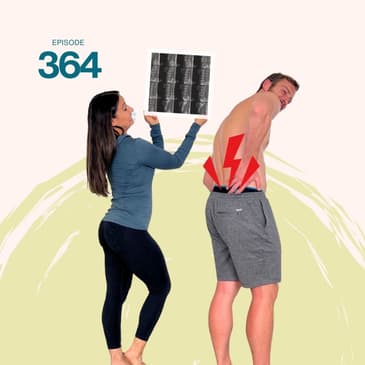
In this episode, DocJen and Dr. Dom delve into degenerative disc disease, what is happening within the body, and what the diagnosis entails. As they dive into some critical research around degenerative disc disease and back pain, they empower you with the tools and education to gain control over your back pain and spine health again! Let's dive in!
LMNT Discount Code:
Fuel every system within the body and the brain with LMNT! Keep yourself hydrated on a cellular level by replenishing the sodium, potassium, and magnesium that our body needs for basic cellular processes like nerve signalling, smooth muscle contractions, unnecessary fatigue, aches and pain, brain fog, and recovery! Get a free gift with every purchase and try some new flavours as you stay hydrated! Get Your Free Gift HERE!
Naboso Foot Health Discount Code:
Increase your foot proprioception and sense of environment with NABOSO, brought to you by a functional podiatrist, Dr. Emily Splichal. Stimulate your foot's sensory nerves and create safety within the body to ease pain and symptoms. Go check out their foot recovery socks with our 15% off coupon using code 'OPTIMAL'.
What You Will Learn in this PT Pearl:
1:56 - How do different postures affect your height?
6:41 - Is imaging for back pain necessary?
11:50 - Is DDD the reason for your pain?
17:20 - How to get to a state of no pain and the factors that influence your spine health.
20:46 - Movement strategies for DDD
To Watch the PT Pearl on YouTube, check out DocJenFit on Youtube here: https://www.youtube.com/watch
For the full show notes, visit the full website at: https://jen.health/podcast/364
Thank you so much for checking out this episode of The Optimal Body Podcast. If you haven’t done so already, please take a minute to subscribe and leave a quick rating and review of the show!
Hosted by Simplecast, an AdsWizz company. See pcm.adswizz.com for information about our collection and use of personal data for advertising.
[00:00:06] Welcome to The Optimal Body Podcast. I'm Dr. Jen. And I'm Dr. Dom and we are Doctors of Physical Therapy, bringing you the body tips and physical therapy pearls of wisdom to help you begin to understand your body, relieve your pains
[00:00:17] and restrictions, and answer your questions. Along with expert guests, our goal of The Optimal Body Podcast is really to help you discover what optimal means within your own body. Let's dive in. Before we hop into the difference between stretching and mobility,
[00:00:32] I want to talk about our feet and why we use Neboso technology to really help open up our feet and access our nervous system. One thing is that our feet have so many nerve endings and
[00:00:45] sensory nerve endings. They're one of the most innervated places in our entire body. And Neboso technology has incredible tools like their NeuroBall, their sensory socks, their sensory mat that can help access that nervous system from our feet and down regulate
[00:01:00] tension really throughout our whole body. And one thing that we know is that once we open up our feet, we're going to start to change movement throughout our entire body. Neboso has given a special 15% discount code to us for our podcast listeners. If you go down to
[00:01:14] the link in the show notes and make sure you use code optimal at checkout, you'll get 15% off your entire order. So go check out some of their tools like their NeuroBall and their sensory socks,
[00:01:24] even their toe splay, which is an amazing way to start getting that passive stretch into those toes so you can feel the ground differently and move differently throughout your entire body. Check out the link in the show notes and make sure you use code
[00:01:37] optimal at checkout. Okay, so today we're diving into DDD, which is degenerative disc disease. Super common one. I'm actually surprised we haven't done a specific episode on this yet. And I'm actually really excited about the first few points that we're going to talk about because
[00:01:55] I... So many times in the clinic, you'd have the person come in who says, oh my gosh, my doctor took an image of my back. They got an MRI. Got an MRI. They said I had the back of a 90 year old. Yeah.
[00:02:11] They said they've never seen a back that looks this bad on MRI. And just like, which first of all, I don't understand the provider that sees an image and like wants to put the fear of... Everything.
[00:02:25] ...disability, lifelong disability into a person by saying things like that. But the amount of times we would have people walk in or come into the clinic and say that their doctor told them
[00:02:37] something like that, how bad their image looked, whatever crazy words they use, it's kind of wild how many people have that put in their mind when their doctor reviews their image with them.
[00:02:49] I mean, I've had a young person come to me and say, my doctor said that my back was so bad. I should never lift weights because I don't want to add load onto my spine. And I'm like, well,
[00:03:01] then you better never get out of bed because the minute you get out of bed, you're putting some stress just on standing and putting load on your spine. And we also know, fun fact, the height
[00:03:13] of a human body varies in 24 hours. So it can be assumed on average an individual's stature is shortened by about 1% during the period of daytime standing. And an elderly age 70 to 80, the shortening is reduced by about 0.5 while standing and is 2% in young people. But like
[00:03:33] that's it, you know, we're going to put load on our body just by standing. Interrupting to ask you, are you drinking your water? Is it sitting there untouched? This used to be me. I would go from barely being able to drink 32 to 40 ounces a day
[00:03:51] to suddenly drinking, I'm telling you 80 to 100 ounces a day easily. And this is because I added element to my water. And I don't know if it's just the delicious taste or what it is about it,
[00:04:03] but I could suck down water when I have element with me. And it really helps anyone stay hydrated without the sugar and other dodgy ingredients found in popular electrolyte in sports drinks. And once you feel this difference, because electrolyte deficiency or imbalance can cause
[00:04:19] headaches, cramps, fatigue, brain fog, and weakness. And I even heard it from my mother-in-law. She was like, I could tell the difference if I'm not having element throughout my day. Like I just feel more
[00:04:29] sluggish. I don't feel like I have energy and it really makes a difference throughout your day rather than having to reach for that other cup of coffee. Now, element is your zero sugar electrolyte drink mix born from the growing body of research revealing that optimal health outcomes
[00:04:46] occur at sodium levels two to three times higher than government recommendations. And that is especially true for those who are trying to stay away from going out all the time, getting highly processed foods. If you're trying to cook in, you're trying to watch your salt intake. You need
[00:05:03] to be adding electrolytes, especially if you work out and especially as the weather is changing, right? And it's getting warmer for a lot of us. So if you haven't yet get your free sample pack with
[00:05:14] any element drink mix purchase at drink element, that's drink LMNT.com backslash optimal, and please use backslash optimal. It's just going to help to support our podcasts. And you're going to help support your body at the same time and also try the element sparkling. They also have
[00:05:33] sparkling drinks now a bold 16 ounce can of sparkling electrolyte water. So especially if you like sparkling drinks, get it with your electrolytes in it. I'm telling you it's going to make a huge difference in how you feel throughout the day. So let's drink element LMNT.com
[00:05:50] backslash optimal. All right, back into the podcast. That's pretty crazy to think about because 2% in young people. So say I'm six feet tall, six foot three, 75 inches. 1% of 75 inches is three quarters of an inch to like,
[00:06:12] I don't know why I never thought of this or realized this, but if you're going to measure yourself in the morning, do it right when you get out of bed. You might be a quarter inch to
[00:06:21] three quarters of an inch taller. Right? Yeah, I feel like that's a big difference, especially when I was younger 2% would be an inch and a half. You're trying to get on a ride and you've been like out and about all day.
[00:06:34] Yeah, like hang upside down by your ankles for a minute and you might gain a quarter of an inch. That's pretty crazy. But the main thing that we want to talk about is this point about, oh, my image looks so bad and associating that with back pain.
[00:06:48] And we're having more and more research articles because imaging has become so prevalent. You come in, you have back pain, get an image of your back. Is that actually good for us to be imaging
[00:06:59] everyone's back or is it just giving us more fuel to this fire going on in someone's mind of, oh, that's why I have pain. I have to fix that because that's why I have pain.
[00:07:11] These first three studies that we're going to talk about show that there is significant evidence that the back pain we feel doesn't specifically correlate at all with what our image looks like.
[00:07:26] Well, and that's what's so cool. I love this first systematic review that we're looking at. It goes over 33 articles. So it's reporting imaging findings for 3,110 asymptomatic individuals. No pain. No pain in these images of people. Now, disc degeneration prevalence ranged from 37%
[00:07:47] of asymptomatic individuals 20 years of age. That's more than one in every three people who are 20 years of age already have disc degeneration. To 96% of those 80 years of age. 96% of asymptomatic no pain individuals have degenerative disc disease. With a large increase in the prevalence through 50 years.
[00:08:13] So it just continues to point out, remember how we are going to age and we see these aging processes happen on the outside of the body. And whatever you get Botox, you want to fix it,
[00:08:28] but it's there. We know that we get aging on the outside of our body. And I think what we forget is that we age on the inside of the body as well. If our tissues are going to change externally,
[00:08:39] our tissues are going to change internally and it doesn't have to correlate to the pain you're experiencing. Absolutely. And of course, the same way that we can try to mediate that aging process,
[00:08:54] like there's of course things that we can probably do. But again, the same way you get wrinkles, you're getting wrinkles in the spine, is that directly correlated to your pain? These next studies are going to further demonstrate that that's not the case.
[00:09:09] The last points for this first study we were talking about was, so essentially more than 50% of asymptomatic people, people without pain between 30 and 39 years have age-related disc degeneration, height loss or bulging that suggests even in younger adults, degenerative changes may
[00:09:30] be incidental and not causally related to presenting symptoms or pain. Degenerative spine findings are incidentally seen and should be considered as normal age-related changes rather than pathologic processes. It's huge. Huge. Huge findings of this massive meta-analysis with a lot of research and statistical power
[00:09:51] behind it. So, this next study kind of further reinforces what the first one was saying. The takeaway was just the clinical relevance of MRI findings in predicting degree of disability in patients with degenerative disc disease is limited and MRI studies should be sparingly
[00:10:09] ordered in evaluation of these patients, particularly in resource constraint settings. That's another huge soapbox of mine. If you're in an area where you know people don't have a lot of income or a lot of just like disposable income to throw around on health-related costs,
[00:10:26] don't order them the MRI, especially if you already know that they're a DDD patient. The MRI is not going to tell you anything significantly more, especially if they have previous ones on the books. So, further report saying we should not be using MRI to determine level of disability
[00:10:45] with DDD patients. I mean, I think that's so huge because everyone wants that quick understanding. Why is my back hurting? Right? And I get it. Like, especially if you've been in chronic pain, if this is something you've gone to multiple therapists, you've gone and you've tried all
[00:11:01] the treatments, you've done the things. And then there's some people who get the MRI and they're like, everything's fine. Everything looks normal. So, should you have done that in the first place
[00:11:11] or you get the finding of like, oh, it's horrible. And now I'm only going to have more back pain and be afraid to move even more because I've seen... I'm broken. I'm brittle. I'm fragile. Right. No, that's not the case. And hopefully this becomes more general practice. So,
[00:11:25] if someone who's 60 and has severe back pain goes in and gets the image and they see degeneration, the doctor says, this is normal. This is normal findings. I see patients with backs that look like
[00:11:37] this all the time that have very minimal symptoms. So, let's get you on a plan to get you functioning strong and feeling more confident in your body again. This last study, I think the last point
[00:11:49] that really wraps it all together is... So, what they did is they took this big group of close to 400 people. I really like this one. They took this group of close to 400 people and put them in
[00:12:00] groups of low DD. So, low disc degeneration, appropriate DD or high DD. And this is essentially saying compared to your age, like from the first study we looked at... The aging process. Do you have disc degeneration that we would expect to be appropriate for your age?
[00:12:17] Less for the low group, less than we would expect to be appropriate for your age or higher. And then they analyzed everyone's prevalence of low back pain, low back pain intensity, RDQ and SF36 score which are essentially pain, quality of life, disability questionnaires that
[00:12:35] people would fill out. And here were the results. There were no significant differences among the groups in terms of prevalence of low back pain, low back pain intensity, RDQ or SF36 score. And there were no associations found between age appropriate DD, low or high DD groups in age
[00:12:58] appropriate DD or the appropriate group in terms of prevalence of low back pain, low back pain intensity, RDQ or SF36 scores. So, this is a study that really brings it home in saying the level of
[00:13:10] that degeneration has no correlation to the significant level of low back pain or disability that you're feeling. And again, that can be difficult for some people to hear if you have been out there and have been told, oh, you have such horrible disc degeneration and you have
[00:13:29] significant back pain. We really as humans, we connect that. Like you said, we want to have a reason. Why do I feel low back pain? Oh, my image, my image looks awful. Okay, great. That's why I
[00:13:39] have low back pain. But low back pain is not that simple. It's really not. Pain in general is not that simple. Structural issues and things structurally in our body can contribute as we're seeing in these studies, DDD specifically is showing very little, very little to no correlation
[00:14:00] to our pain in our bodies. So then what do we do? The people out there listening who are like, okay, well, if those horrible images the doctors were showing me have no bearing on how high my
[00:14:15] levels of pain are, then what do I do? I know. And I think what's hard too is that the moment that you get an MRI, it's just going to put all the findings there. And it's not going to necessarily
[00:14:24] say, oh, you have degenerative disc disease. This is okay. This is normal and you shouldn't worry about it. It's just going to note, I see degenerative disc disease in this MRI. Yeah. It'll probably be more like signal loss at T11, T12. Blah, blah, blah, osteophytes here and there.
[00:14:43] What's difficult about that is that now you're seeing more things pop up. Oh, there's more findings. There's more findings. There's more findings. But again, we want you to go back to what we're saying that this doesn't necessarily correlate to your pain level or intensity or the
[00:15:00] reason that you have pain. It can be a part of your pain story. It's a part of your body story. For sure, this is a part of you. But just like we're learning, everyone has different
[00:15:14] postures. Everyone has different ways that they walk. We cannot necessarily say you walk like this. This is why you have pain. You stand like this. This is why you have pain. Your image is
[00:15:24] like this. This is why you have pain. Now we have numerous studies that prove that one thing doesn't lead to another. There's so much more to the picture and that's what we want to really dive
[00:15:35] into. And we have on so many other podcasts. I mean, when someone comes to me on chronic pain, I think we have 20 podcast episodes that I now send people. That are related to pain or persistent
[00:15:46] pain, especially when it comes to low back. And really, we don't want this information to be frustrating to people. We want it to be empowering. Yeah, we want it to be empowering to people to put the information back in your hands to say, like Jen said,
[00:16:00] your image is a part of your story. I promise you, if I were to get images right now, I would be one of those 30 to 39 year olds that would have disc degeneration. I played football. 100%. And I looked at studies that showed football, high impact activities,
[00:16:14] heavy axial loading, weightlifting, all things I've done for decades plus will probably have affected how my joints appear. And I do have occasional back pain and I have my ways that I
[00:16:26] proactively work on it, but we want it to be empowering. That image is a part of your story. What if the story starts going down the path of, hey, I'm someone who has a pretty messed
[00:16:38] up looking spine on my image, but I feel strong, I feel capable, I feel relatively pain-free in my body, or I know what I need to do when my pain pops up.
[00:16:51] Well, and I think what's also empowering is to know, okay, if 96% of 80 year olds have no pain, but presented with DDD, then it's possible. It's possible. I mean, in other age groups as well,
[00:17:05] right? It's possible for me as well to have images saying this stuff on an image, on an MRI, yet it's possible to be in that section of group who doesn't have pain anymore. So how do I get
[00:17:20] there? That's what we want to help guide you to. How do I get there, right? And we know some of the biggest factors that play a role on disc changes or degeneration of the spine don't necessarily
[00:17:30] always have to do with movement, but environmental factors as well. So smoking, smoking has a huge impact on our tissue health and how it's going to age. And I remember saying this as we're talking
[00:17:45] about it in like our drug classes in elementary school, you see someone, the appearance of their outside of the body and kind of more wrinkles and everything, and the appearance of their lungs.
[00:17:56] Well, look at the tissues in your spine as well. Those are going to age more as well. So smoking will have such a huge factor on your tissue health. In a huge part because of blood supply,
[00:18:08] and there's not a ton of blood supply that goes to our discs. And when we smoke, it constricts our blood supply peripherally, which limits the blood supply going to those discs, which is part
[00:18:18] of the thing that helps them stay hydrated for as long as possible. And we start to see that dehydration when we start to get disc degeneration. But other points being our body weight or obesity,
[00:18:33] consistent flexed postures, or I think that it's funny because on this list it says low levels of physical activity or heavy physical labor or consistent high level and high impact activities. So meaning either end of the spectrum. If you're going too hard or if you're not going at
[00:18:53] all, it could definitely impact how our spine degenerates. But in general, then we have to include our environmental factors to help with not only our spine health, but how we're feeling and
[00:19:09] moving in our body. And this is what we come back to all the time is how are we treating our body, not just biomechanically, not just movement wise, but also am I getting adequate quality of sleep?
[00:19:22] This is so incredibly huge. We have to recharge our body in order for receptors and everything to be working together and working well. How do we expect our body to work well if we're not getting adequate recovery? And that includes getting adequate hydration, making sure that
[00:19:42] we're eating our micronutrients and the nutrients that really fulfill our body or are we only eating out and processed foods and not really nourishing our body? All of this really plays a role and
[00:19:55] specifically stress. If you're in a super stressed out state, your pain threshold is not going to be very high. It's going to be a lot lower because you don't have as much energy to really go up in
[00:20:10] that pain threshold. There's no more room because you're already taking on so much from everything else. You're going to feel things a lot more. So, stress plays a huge impact on pain.
[00:20:20] Yeah. These are all massive things that are going to play into our pain perception. If we are lacking in any of these areas, it can start to deplete that threshold or increase just our
[00:20:33] resting level of nervous stimulation which impacts how we process pain. And then when it comes to back pain in general, going back to the question of like what do we do? Focus on these things that
[00:20:45] Jen just mentioned, of course. How can we work on improving 1%, 2% in these different areas every day? And then as far as the movement side of things go, we came out with not too long ago
[00:20:58] a whole episode on low back. We have a low back episode, an upper back episode and a neck episode that if you're listening, we'll try linking up in the show notes. If you're watching on YouTube,
[00:21:09] hopefully we can tag them somewhere or also put them in the description. But on optimization of movement in these areas and those could be great episodes to go listen to to help understand,
[00:21:19] okay, what kind of mobility might I need to be looking at? What type of stability work should I be working at in certain areas? And then strengthening work which all three of those
[00:21:28] episodes kind of go in that order. Where do I need to find mobility? Where do I need to gain a little bit more stability? And then how do I strengthen it all up to grow resilience in the
[00:21:38] body? Like that's really the process of how we're going to start to biomechanically build a functional and resilient back. But what we know for sure is that you can't say, oh, I have DDD,
[00:21:51] I shouldn't do deadlifts anymore. You know, or I exactly or this one exercise is going to help my DDD. We can't, we don't unfortunately have one perfect exercise protocol. We don't have one
[00:22:04] exercise protocol you shouldn't do. In general, it's very specific to you and what your body is needing and seeking. And, you know, in general, we can say, okay, if you're having a bit more DDD,
[00:22:16] a bit more degenerate degeneration in the spine, you might not like extension of the spine quite as much right now. So we can work into slowly kind of regaining extension very slowly and
[00:22:29] appropriate for you. But also you might find a little bit more relief temporarily, or at least in the very beginning to help you start more of your movement journey by gaining more connection
[00:22:40] to that inner core stability of how that core really works together with your hips and your trunk movement and stability through movement and rotation. You know, so understanding better core coordination to help support your trunk and make you feel more confident in movement can be
[00:22:57] a really good place to start, I would say, for those who are having DDD as well as, yes, you will want to look at the mobility of the body all around. But, you know, I would say in general,
[00:23:08] and this is a very general thing, looking at that deep core coordination, which we have a core plan on GenHealth if you want to understand more, can be a really good helpful place to start just to
[00:23:18] start relieving some of those pains. The core plan on GenHealth, there's a low back plan, there's an upper back and neck plan. So regardless of where you might be feeling your symptoms, like Jen said, core plan is great and can generally be very helpful to people who have
[00:23:33] been having back issues. Also those other low back, neck and upper back plan as our podcast audience if you want to go try it out. One, you get a free week trial if you haven't used your
[00:23:43] free trial yet, but you can also use code optimal to get an extra discount on your first month. And we would love for you to go try that out and reach out to us if you have any other questions
[00:23:53] that you don't feel like we answered in this podcast, please feel free to email us at gen.health. We will try to get back to any questions or if you have future topics you want us to cover,
[00:24:04] that's the place that you should let us know. Thanks so much for joining us. Of course, don't forget to use code optimal and you get not only to try a free week on the platform, but you also get an additional discount with that for being our podcast listener,
[00:24:19] because there is so much hope if you're currently in pain and it doesn't just come to your MRI. I hope you've learned a ton. Pass this episode along if you know it could benefit other people and we'll see you back on another episode of the Optimal Body Podcast.