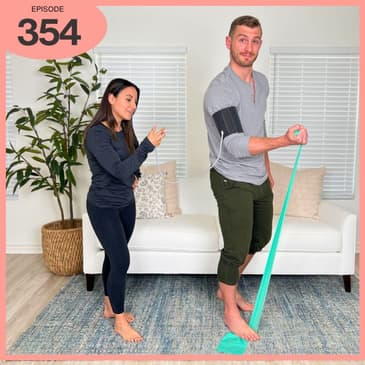
Have you heard of Blood Flow Restriction? DocJen and Dr. Dom dive into the researcher who developed the method of Blood Flow Restriction training, their story of innovation and the science behind its effects on the body. Diving into its clinical implications associated with sarcopenia, cardiovascular complications, muscle growth and pain perception, they provide you with the latest research insights into Blood Flow Restriction Training.
LMNT Discount:
Fuel every system within the body and the brain by replenishing your electrolytes with LMNT! Get a free gift with every purchase and try some new flavors as you stay hydrated!
What You Will Learn in this PT Pearl:
1:50 - How BFR training was born?
6:00 - How BFR training affects age related muscle wasting?
8:50 - How BFR supports blood pressure regulation
10:40 - Protocals to stimulate BFR for muscle growth
13:00 - BFR training and pain sensitivity
16:50 - The importance of supervision
To Watch the PT Pearl on YouTube, click here: https://www.youtube.com/watch
For the full show notes, visit the full website at: https://jen.health/podcast/354
Thank you so much for checking out this episode of The Optimal Body Podcast. If you haven’t done so already, please take a minute to subscribe and leave a quick rating and review of the show!
Hosted by Simplecast, an AdsWizz company. See pcm.adswizz.com for information about our collection and use of personal data for advertising.
[00:00:05] Welcome to The Optimal Body podcast. I'm Dr. Jen.
[00:00:08] And I'm Dr. Dom. And we are doctors of physical therapy, bringing you the body tips and physical
[00:00:13] therapy pearls of wisdom to help you begin to understand your body, relieve your pains
[00:00:17] and restrictions, and answer your questions. Along with expert guests, our goal of The
[00:00:21] Optimal Body podcast is really to help you discover what optimal means within
[00:00:26] your own body. Let's dive in.
[00:00:28] Okay. So for our PT Pearl today, we're going to be talking about a topic that
[00:00:32] I feel like it's been gaining a lot more popularity, especially in the rehab space in recent
[00:00:37] years. And that's blood flow restriction training and diving in a little bit more to
[00:00:43] what that is when you should be potentially considering using it, how it was
[00:00:48] discovered. And I know that you got a kick out of the story of how the initial guys
[00:00:53] started looking into this and researching it.
[00:00:55] Yeah, it originated in Japan by Dr. Yoshiaki Satto. And he actually came up with what
[00:01:01] is called katsu training. And so what I thought was really funny is that so his legs
[00:01:06] became numb after he was sitting at a Buddhist memorial in an kneeling position.
[00:01:10] And then he started to massage his calf and he noticed the swelling and discomfort
[00:01:14] was similar to like when he was doing calf exercises.
[00:01:16] So he decided, OK, well, what happens if I then kind of restrict the blood flow
[00:01:22] and do low level exercise? Will I get the same kind of effect?
[00:01:25] And that's how he came up with, you know, low intensity exercise.
[00:01:29] So you're looking at like about 20 to 50 percent of your one rep max and you're
[00:01:36] occluding. He had it occlude up to 200 millimeters mercury of the systolic blood
[00:01:41] pressure. And so it's kind of cool how this really originated and what his
[00:01:46] brain was kind of doing when he thought, oh, my goodness, this feels,
[00:01:50] you know, similar to strength training.
[00:01:52] I know it's interesting just like I feel like many people out there are
[00:01:56] like, oh, I sit in a certain position and then my legs get kind of numb or tingly.
[00:01:59] And then when I walk up, you know, stand up and walk around, it feels a lot
[00:02:03] different. And it's interesting that he noticed this massage.
[00:02:07] His calf is like, huh, that kind of feels like exercise.
[00:02:10] And then basically decided to cut the circulation from his legs and
[00:02:15] experiment with this a bit.
[00:02:16] And it's interesting where he started out occluding 200 millimeters
[00:02:21] mercury. So like the systolic blood pressure is the higher one.
[00:02:24] Yeah. So normal or healthy is 120 over 80 ish.
[00:02:30] So 200 millimeters mercury essentially would for most people be occluding
[00:02:35] all blood flow into the legs.
[00:02:37] And that's different than what, you know, most parameters are that are used
[00:02:42] today, especially in the rehab space.
[00:02:45] But what when he started and when other people started researching it,
[00:02:49] what they found was that essentially the body needs to work harder.
[00:02:54] You're not getting as much blood flow.
[00:02:55] You're not getting as much nutrients, oxygen, all the things that your
[00:02:59] muscles need to do exercise.
[00:03:02] So when you're doing a lot lower intensity exercise, your body's
[00:03:06] recruiting muscle fibers sooner.
[00:03:08] It's recruiting larger motor units, which essentially it's recruiting more
[00:03:12] muscle fibers to do the exercise that normally might be very low
[00:03:16] intensity. And they would also notice the body starts creating a lot
[00:03:21] more of what we would call these metabolites or essentially the products
[00:03:25] that are created when you do exercise.
[00:03:27] It's the waste of the muscle.
[00:03:29] So people start to think and realize, oh, wow, when we slightly
[00:03:35] occlude or occlude the blood flow from muscles, they need to work
[00:03:38] harder to do the same amount of work, which kind of makes sense
[00:03:41] when you think about it intuitively.
[00:03:45] Taking a quick pause from the episode to talk about something we can all
[00:03:47] focus on just a little bit more to optimize our overall health.
[00:03:51] And that is our hydration, not just by drinking water, but by making sure
[00:03:55] we're getting back in the electrolytes that we're naturally
[00:03:58] losing throughout the day.
[00:04:00] That's why Jen and I drink element on a daily basis.
[00:04:03] We love it so much one because it tastes so great and keeps us coming
[00:04:06] back to our water bottle, but two because it gets back in the vital
[00:04:10] sodium, potassium and magnesium that our body requires for so many
[00:04:15] cellular processes.
[00:04:16] Just by optimizing our electrolytes, we can help combat things like brain
[00:04:20] fog, fatigue, we can have better bowel movements and better sleep.
[00:04:25] Making sure we have these electrolytes is absolutely vital.
[00:04:28] So if you go down to the link in the show notes, you will get a free
[00:04:31] sample pack with every single order.
[00:04:33] This will help you so you can try every single flavor and know which
[00:04:37] one you like best when you inevitably come back and get more.
[00:04:40] So go down to the link in the show notes, grab yourself a box,
[00:04:43] get that free sample pack and make sure you're keeping yourself
[00:04:46] hydrated on a daily basis.
[00:04:49] Yeah, and I think that's what's cool.
[00:04:50] So we get to see that this low load, you know, blood flow restriction
[00:04:55] with resistance exercise really allows for the ability to train at a
[00:04:59] greater frequency with less mechanical stress on the joints, which allows
[00:05:03] for a broad application of post-operative injured and cardiac
[00:05:07] rehabilitation in patients, even in season athletes and in the elderly
[00:05:12] individuals.
[00:05:12] And so I think that's what's really cool is that you can get, you know,
[00:05:17] you could still train just at a very low intensity, but still get this
[00:05:21] hypertrophy and strength gains happening within the body.
[00:05:25] And the that's where it's being used.
[00:05:27] I feel like so much more in different rehab scenarios.
[00:05:30] Like you said, anywhere from elite, elite athletes to people in nursing
[00:05:34] homes or people who are in very significant cardiac situations or events
[00:05:41] because we can introduce exercise at such a lower load, do it safely in
[00:05:46] a way that their body responds as if they're doing closer to maximal or
[00:05:51] higher intensity training.
[00:05:53] And that's really cool.
[00:05:54] So I think something that we should do is just point out some of
[00:05:56] the stuff that is seen in studies.
[00:06:00] So there was a blood flow training done and with just even a single
[00:06:04] session of resistance exercise and older men, it led to and here's
[00:06:09] where some sciency words come in.
[00:06:11] But increased phosphorylation of proteins involved in skeletal
[00:06:14] muscle anabolism by 30 to 300%.
[00:06:18] So like anywhere from a, you know, mild to a massive increase in what
[00:06:25] that means, the phosphorylation of these proteins is essentially the
[00:06:28] creation of these proteins that help to build skeletal muscle.
[00:06:32] So what this could help with is people who are seeing a
[00:06:36] significant amount of sarcopenia or atrophy, muscle atrophy,
[00:06:41] and wasting as they get older, it could be a way to like go to your
[00:06:45] local blood flow restriction training center and do a couple of sessions
[00:06:49] a week that will give you the similar results to as if you're heavy
[00:06:54] resistance training or Olympic training when you were younger to
[00:06:58] combat some of that muscle wasting.
[00:07:01] Yeah.
[00:07:01] I think that's what's, you know, one of the coolest parts.
[00:07:04] One, you pointed out something very specific that I think we have to
[00:07:08] include right away is that you're going to professionals who work with this,
[00:07:13] who have their certifications that you can get in this now, you know,
[00:07:17] who understand what you're really measuring.
[00:07:20] Because sometimes you see people just like wrapping resistance bands
[00:07:23] around their arms and legs and doing it themselves.
[00:07:25] Yeah.
[00:07:26] Which I've done before.
[00:07:27] Oh my gosh.
[00:07:29] Not great.
[00:07:30] You know, especially if you're somebody who has other comorbidities,
[00:07:36] like has heart conditions, has, you know, that's why it's so important
[00:07:39] because a lot of the, we talked about Dr.
[00:07:42] Yoshiaki who basically occluded all blood flow into the legs.
[00:07:47] Most protocols these days use a pressure that's above the diastolic
[00:07:52] blood pressure, which is the lower number.
[00:07:54] Like, so if it's 120 over 80, you know, they're using a number
[00:07:57] that's more in like the 90 to a hundred range.
[00:08:00] So it's still allowing some blood to get to the muscles, but not as much
[00:08:05] return or get out of the muscles.
[00:08:06] So it still creates that hypoxic environment, but that's why it's important.
[00:08:10] Because how many people know what their blood pressure is at any given moment
[00:08:15] on any given day, you know, you're going with professionals who will
[00:08:18] measure your blood pressure, actually measuring it out, find the correct
[00:08:21] amount and then monitor to see if you're showing any sort of adverse
[00:08:24] reactions as it's going on and using different cuffs like it, you know,
[00:08:27] for the upper extremity, obviously we're going to use a cuff that's
[00:08:30] different than the lower extremity because you have a much thicker and
[00:08:34] bigger, you know, shape that you need to include.
[00:08:38] Might be different in those areas.
[00:08:40] In the lower body than the upper body.
[00:08:41] So, you know, just working with someone and getting that understood is good.
[00:08:45] And, and what I think is also cool, what they've shown with the
[00:08:48] cardiovascular health in older patients is not only is it going to help with
[00:08:52] skeletal muscle and growth, but it's also going to help to reduce blood
[00:08:55] pressure and that's what they were seeing.
[00:08:58] So, you know, combining resistance training, exercise in general, we
[00:09:03] know is going to help to reduce blood pressure, but now-
[00:09:06] I was going to say that's something you see in like resistance training in
[00:09:08] general, you see a reduction in blood pressure.
[00:09:10] So it makes sense that you might see it here as well.
[00:09:13] Well, and giving them the opportunity to be able to exercise in people
[00:09:16] that may not be doing as much.
[00:09:18] So overall, you know, you're going to see a lot of those benefits.
[00:09:22] So another area, you know, other than people who might be older
[00:09:27] dealing with muscle wasting or, you know, be somebody who's having
[00:09:31] heart issues where this could be a beneficial type of training, we're
[00:09:35] seeing it a lot in the rehab space.
[00:09:37] I had a buddy who played in the NFL for five, six, seven years.
[00:09:41] And he said, blood flow restriction is one of the primary things that
[00:09:45] their training staffs use when they have somebody who's injured.
[00:09:48] Because again, say somebody tears their ACL or, and is in their
[00:09:53] rehab protocol, so they've had surgery, but something that you
[00:09:56] don't want to do is load the knee too significantly too early after
[00:10:02] you have that surgery, because the graft, the new ACL that they put in
[00:10:05] is tender and is in a compromised position.
[00:10:09] So you don't want to start loading it heavily or else that-
[00:10:12] Yeah, you have to give it the time to heal.
[00:10:13] Give it the time to heal.
[00:10:14] But they have found doing some of this blood flow restriction training
[00:10:19] is a great way to start getting that quad muscle on the front of your
[00:10:22] thigh, working and firing well very early after surgery in a way that
[00:10:28] previously we weren't able to do safely or confidently.
[00:10:31] Yeah, there's a lot of studies now coming out on ACL rehabilitation with
[00:10:35] using blood flow restriction, which I think is cool.
[00:10:38] And when we look at, you know, just in general, if we're trying
[00:10:40] to improve our stimulate muscle growth, some of the protocols that
[00:10:46] we look at are pretty, pretty consistent with resistance training
[00:10:51] in general, right?
[00:10:52] You're not going to do it every single day.
[00:10:54] So they looked at a combination of dynamic exercise.
[00:10:57] So they looked at doing it two to three times a week for over three weeks,
[00:11:03] intensity one to two times a day, repetition, 75 reps overall.
[00:11:08] So they're looking at 30 reps, 15 reps, 15 reps, 15 reps.
[00:11:12] So four sets of that, two to four sets.
[00:11:15] Set pressure between 40 to 80% and restriction time, five to 10 minutes
[00:11:21] of exercise with rest between 30 to 60 seconds.
[00:11:25] So pretty similar to what you would see, especially with like
[00:11:29] low load resistance training.
[00:11:30] Now you're just adding that blood flow restriction to it and seeing
[00:11:34] the results that helps to stimulate the muscle growth.
[00:11:37] So it's not something that you need to be doing every single day.
[00:11:40] I mean, this obviously depends too on where you're at.
[00:11:43] So say you are really early in your rehab journey and you're not doing a lot.
[00:11:48] You could afford to do a little bit more, but if you are actually just trying
[00:11:53] to stimulate muscle growth and you're just, you know, working with this,
[00:11:57] you doing it just like you would with regular exercises, I think
[00:12:00] is a good way to look at it.
[00:12:01] Yeah.
[00:12:02] And I think that so again, the breadth and the different types of people
[00:12:07] that this can benefit or be beneficial for is pretty amazing because they've
[00:12:11] actually done studies with people in the intensive care unit or people who are
[00:12:16] even to the level of almost comatose where they are not moving at all.
[00:12:20] Yeah, I think that's cool.
[00:12:21] And one of the biggest risks in those populations is deconditioning
[00:12:25] significantly to the point where if you wake up or if you start trying
[00:12:28] to do exercise again, your body is so deconditioned that you can't
[00:12:31] do much or you're in a, you're in a pretty tough spot.
[00:12:34] And so they've done passive limb movement.
[00:12:37] So literally putting on the blood flow restriction cuffs and doing
[00:12:40] passive limb movement in patients that are in intensive care units.
[00:12:44] And it was shown as an effective way to reduce the muscle wasting.
[00:12:48] They specifically were measuring the thigh muscle because easy muscle
[00:12:51] to kind of monitor and measure the size of in people in the intensive
[00:12:56] care unit, and that's an area in medicine that is hugely important
[00:13:00] because deconditioning during stays in the intensive care unit is a huge problem.
[00:13:06] So we also looked at, you know, there's a study on blood flow
[00:13:08] restriction and pain sensitivity, and I think this is a huge one for a lot of people.
[00:13:13] So when they were kind of looking at a ton of different studies
[00:13:16] and looking at what they were really saying, higher pressure
[00:13:21] blood flow restriction results in greater exercise induced analgesia,
[00:13:26] which is helping to, you know, really relieve your pain
[00:13:31] compared to lower pressure.
[00:13:32] And this is kind of the same of like exercising to failure,
[00:13:35] which produces a reduction in pain sensitivity with or without blood flow restriction.
[00:13:39] So they're saying, you know, essentially kind of what we've been talking about
[00:13:44] blood flow restriction, including low intensity exercise, can be an effective
[00:13:49] treatment to help reduce that pain threshold and really kind of introduce you back into movement.
[00:13:55] And I think that's what's really effective.
[00:13:56] Every podcast that we talk about, there's movement involved.
[00:13:59] There has to be movement in order to move you forward and getting you out of pain.
[00:14:03] So if this is helping you get to that point of being able to exercise and move,
[00:14:08] I think it could be a really cool practice to integrate with people who have really high pain.
[00:14:13] Yeah, it's a great tool, again, in that period where we talk about manual
[00:14:18] therapies and rolling and things that are done to you.
[00:14:22] Like this is more active.
[00:14:23] I feel like it allows people to feel more involved in the therapy itself.
[00:14:27] If you're doing movement, you know, getting that same
[00:14:31] pain analgesia, like the pain reduction, as if you're exercising to failure,
[00:14:36] just by doing blood flow restriction and doing supervised exercise is great.
[00:14:39] And there are studies done on osteoarthritis.
[00:14:42] There are studies done on patellofemoral pain that show this,
[00:14:45] that you can get a significant amount of pain reduction, in some cases even higher than
[00:14:50] the groups that are doing exercise, like the control group that's just doing normal exercise.
[00:14:54] Blood flow restriction groups will often see equal or greater pain relief.
[00:14:59] So again, a massive tool to help people get start getting into movement when they otherwise
[00:15:04] might not be able to or might not be able to safely.
[00:15:07] But there are safety considerations, which we've already been kind of alluding to.
[00:15:11] Like there are definitely a lot of symptoms that you might like adverse reactions or symptoms
[00:15:17] that you might start to experience, which is why the first thing and we've said it already,
[00:15:21] this should be done supervised and in a way that's prescribed, especially since most of
[00:15:26] the studies we've been talking about have to do with people that are either injured
[00:15:29] in their early rehab recovery stages or people in the hospital, like on cardiac floors or people
[00:15:35] in intensive care units. So definitely should be something done that is under supervision.
[00:15:40] Right. Exactly. I mean, even if you're not used to it, like it might not be an adverse
[00:15:46] effect, but even you might experience a lot of delayed onset muscle soreness or some bruising.
[00:15:50] You get the same soreness as if you were exercising very heavily.
[00:15:53] And that could feel very alarming if you're not used to it. So again, working with someone who
[00:15:58] can help educate and talk you through what is happening and make sure you're not going beyond
[00:16:02] your threshold is so important. And anytime we're talking about
[00:16:06] literally occluding blood flow, like if you're somebody who has blood pressure issues,
[00:16:10] if you're somebody who has different cardiac or heart issues, like that can be a big concern.
[00:16:16] And anytime we're occluding blood flow and then taking that pressure off and letting
[00:16:20] the blood flow and return back to the heart, there can be what are called syncope events or
[00:16:25] you feel like you're going to faint. So a lot of things that lead us to say,
[00:16:31] and lead the research to give recommendations that you should be doing this under supervision.
[00:16:37] And again, to reiterate, to be able to see changes in pain populations, I think is a
[00:16:44] really great way to be able to utilize. And so maybe you are asking a physical therapy office,
[00:16:51] do you do blood flow restriction? I think it could be really beneficial. I'm having a lot
[00:16:55] of pain. I just want to get back to movement. And if that's something that you think,
[00:16:59] maybe you've been dealing with this for a long time because they see it not only with
[00:17:03] knee osteoarthritis, but also with patella femoral syndrome. So if you're having a lot
[00:17:09] of knee pain, a lot of knee discomfort, you don't feel like you can load, you could do
[00:17:12] resistance training, you could put a lot of effort into your body, getting some supervision
[00:17:17] and getting, you know, starting movement with blood flow restriction can be a great access point
[00:17:23] into starting to rebuild the muscle strength, confidence within your body and get you moving
[00:17:27] a little bit more. Thanks so much for joining us on another episode. If you heard something
[00:17:32] that you think could be beneficial to someone, you've heard someone talk about blood flow
[00:17:35] restriction or question it, or you think, oh, I think this could help someone get moving,
[00:17:40] please share the episode. We love to help educate and spread the word. And the only way
[00:17:45] we can do that is with your support. So if you haven't yet, please leave a rating and review
[00:17:49] and we'll see you back on another episode of the optimal body podcast.