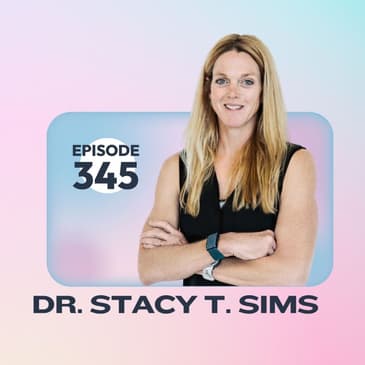
#womenarenotsmallmen Wondering how to optimize your nutrition & training as a female? Lost a period? Struggling to figure out nutrition and exercise around menopause? Dr. Stacy Sims dives deep into hormones, nutritional, and training considerations during the menstruating phase of life, perimenopause, menopause, and post-menopause. Dr. Stacy explains Amenorrhea, nutritional considerations during and post-exercise, and how eating times affect hormones and recovery. Dr. Stacy deciphers nutrition and training considerations throughout the different phases of the menstrual cycle and her top recommendations to getting your period back. Then, Dr. Stacy dives into the fad trends women should avoid, and research generalizability and transferability to women. She discusses the world of menopause and how hormonal changes affect physiological metrics like heart rate, respiratory rate, sleep, lean muscle mass, bone density, mood, and overall health. In spite of these physiological metrics, Dr. Stacy addresses optimizing recovery before, during, and after menopause. Finally, she provides a brief scope into the current research she is undergoing with WHOOP. Learn about nutrition and training from puberty to menopause.
Vital Proteins Discount:
We know that while our bodies collagen production slows as we age, our need for it only grows as our bodies become less efficient. By providing nourishing collagen and promoting our production of collagen, Vital Proteins helps people feel better and live fuller lives through HIGH-QUALITY nutrition products. Use code ‘OPTIMAL15‘ at checkout and get your very own Collagen supplement at a discounted price by clicking here!
Join Our Move 2 Improve Challenge
Combine strength and HIIT with our deep core work and mobility to understand how you can begin moving optimally for YOU! Curated for EVERYONE with modifications or progressions, especially if you're pregnant or want to build back that strength post-partum - DocJen has got you! Let's focus on that top-end Strength & Power to build strong healthy joints in less than 30 minutes a day! We've got educational webinars from different health specialists and the ability to win prizes as well! From now until the 3rd of March, you can receive a discount along with an exclusive bonus for you as our podcast listener by plugging in 'OPTIMAL10" Join Us Here!
What You Will Learn in This Interview with Dr. Stacy Sims:
3:48 - Dr. Stacy’s Passion
5:25 - Why may your menstrual period stop?
10:35 - Eating for exercise.
15:00 - Eating with your cycle.
18:00 - How to get your period back.
22:00 - Are low-carb diets bad for women?
24:45 - Menopause: can you fast?
27:00 - Repercussions of male-only data
28:32 - Trends to stay away from.
32:00 - Perimenopause, menopause and post-menopause.
34:50 - Training with menopause.
42:00 - How do you define high intensity for you?
47:00 - Learn more with Dr. Stacy
To learn more about this episode and view full show notes, please visit the full website here: https://jen.health/podcast/345
Thank you so much for checking out this episode of The Optimal Body Podcast. If you haven’t done so already, please take a minute to subscribe and leave a quick rating and review of the show!
Hosted by Simplecast, an AdsWizz company. See pcm.adswizz.com for information about our collection and use of personal data for advertising.
[00:00:00] Welcome to the Optimal Body Podcast. I'm Doc Jen.
[00:00:09] And I'm Dr. Dom. And we are doctors of physical therapy, bringing you the body tips and physical
[00:00:13] therapy pearls of wisdom to help you begin to understand your body, relieve your pains
[00:00:17] and restrictions, and answer your questions.
[00:00:19] Along with expert guests, our goal of the Optimal Body Podcast is really to help you
[00:00:24] discover what optimal means within your own body. Let's dive in. is add four tablespoons of the Vital Proteins unflavored collagen peptides to your favorite beverage, whether that's a smoothie, your water, a coffee, whatever it may be to give you that boost that you need to support healthy hair, skin, nails, bones, and joints. Now, if you haven't checked out Vital Proteins yet, I highly recommend going to the link in our show notes and use code optimal15.
[00:01:41] This is gonna get you 15% off site-wide
[00:01:44] on your first purchase.
[00:01:45] You are about to listen to our most popular episode TedX Talk. She's also published over 70 peer-reviewed papers, several books, and is a regularly featured speaker at professional and academic conferences, including those by USOC and USA Cycling. She currently resides at the beach in New Zealand with her husband and young daughter and I am always so honored to
[00:03:00] talk to her so I really hope you enjoy this episode. Hi Stacey, thank you so for me trying to figure out questions for me and my teammates, but now it expands because I have a daughter and I want her world in sport and fitness to be completely different in an empowering way than it has been for me. And then also as I'm getting older and I have friends and training competitively and trying to compete
[00:04:21] and they're like, what's going on?
[00:04:22] And there's no real information
[00:04:24] for that whole 40, 50 year old age set
[00:04:27] that is really applicable. period because they were just too fit or something. They didn't really have an explanation for why that happened, but could you dice that apart a little bit more? Why might some people who are training really heavily stop getting their menstrual period? And what's that mean? Interrupting this episode real quick, there's so much incredible information in this episode, so please stay tuned. However, if you missed out on early bird pricing of our new move to improve strong healthy
[00:05:43] joints challenge, you can still get in with code optimal10. Yeah, so there are two different scopes. Like if girls start training early and then they don't get their period, that's a primary amenorrhea. So that means like their endocrine system hasn't developed enough to really get some of the signaling to start the cycle.
[00:07:01] And that is an energy misstep where they're not eating enough for the training or they're
[00:07:06] not eating around the right times around
[00:08:21] their training to allow their body to understand that there's nutrition coming in to support
[00:08:26] that additional stress. breakdown state. If you don't eat within that 45-minute window to really stop the signaling for breakdown, you stay in this long catabolic or breakdown state. And what that happens, what happens there is it's giving signals back to the brain, the hypothalamus, that we? Yeah, so for women, we really want to focus on some protein with some carbohydrate. We end up using more free fatty acids and not as much stored carbohydrate. We use a lot of blood glucose during exercise, which comes from the liver, but not so much from the muscles compared to men.
[00:11:02] And we also break down a lot of amino acids.
[00:11:04] So we need to have protein first
[00:11:06] with a little bit of carbohydrate It's not a massive amount, but it is critical to get those macronutrients in to really signal the body to, yeah, sweet. We have nutrition coming in. We can adapt. We can stop the breakdown state. We can get into that full recovery. So then the next time you hit it, you can hit it hard. Yeah, I think that's so important to even just continue to remember like directly after
[00:12:23] working out. I got to get it in because I've got to go somewhere and other people are like, okay, well, I'll slow down and I'll have it. It also comes around satiation as well. If you're drinking something really quickly and then boom, you're out the door, your body might not have the same signaling effect on the brain that you've had food to make you feel full.
[00:13:40] Whereas if you're drinking it the cycle, does that change or just diet in general? Do you need to have different focus? I give the Clifnus version. Pull out the old college Clifnus. So if we're talking about a menstrual cycle, the way I explain it for ease is that if you open a textbook, you have a 28 day cycle and we know that women are completely different.
[00:15:04] Like no one's really set in that 28 days. regular doses across the day, carbohydrate, you don't have to worry so much about taking carbohydrate during training because your body can access pay a little bit more attention to what you're doing, specifically around approaching requirements and your training and what kind of training you're doing
[00:17:41] in order to maximize those benefits
[00:17:43] if you're doing high intensity.
[00:18:46] What is the, I know this is going to be different for everyone, but is there food recommendation that you really, or training style that you really recommend women start to focus on in
[00:18:51] order to gain that period back?
[00:18:54] There are two things that we need to consider.
[00:18:58] I need to make it really definitively clear that I am sitting on the fine line between
[00:19:03] health and performance because I'm a female athlete performance physiologist. look in the middle and what we find works is taking the focus off the fuel depleting workouts like long endurance stuff. We put it on strength training and we know that strength training in itself is not completely fuel depleting but it
[00:20:21] is still beneficial in the fact that youuteinizing hormone pulse. And that takes a lot of energy. And we have another area in the brain that's responsible for our metabolic rate and our endocrine health. We know that from different studies that when people start fasting and their nutrient intake comes down,
[00:21:45] especially when women lose their periods, then it's a around training, it's really easy to get that extra 1,000 calories in without having a negative impact on body composition, because that becomes the biggest fear for a lot of women
[00:23:00] that it's gonna interfere with performance,
[00:23:02] it's gonna interfere with body composition.
[00:23:04] But what we find is when you start fueling for performance, full red ass and had no periods three years ago to implementing this and coming out of the blue to win gold because they were all eating, they felt good, they had optimal body composition and their power went up. That's amazing. Yeah, it's just incredible the way that food has gotten such a negative stigma, but it's
[00:24:21] so critical for all the things that people are like, oh, I feel fantastic when I'm doing intermittent fasting or time restricted eating.
[00:25:42] And I do my fasted training and I go to work and then I'm like, I want to see all this
[00:25:46] stuff. So, I mean, do you think that's an issue that a lot of them just get pushed popularly in like the media or, or what have you because of these specific benefits that we can get and a woman's like they may feel benefit after a few days, but it's just not something that the female body has been built to sustain. Right. So it is partly the male data thing, but then the other thing that is endemic,
[00:27:03] just in our culture is the fact that if something works in a clinical
[00:27:06] environment, it gets picked up by the fitness world, which is probably why the fitness and supplement world
[00:28:22] is such a billion dollar industry
[00:28:23] because women are the primary buyers
[00:28:25] and women are the primary target training adaptation because if you're eating before you go training, boom, you've got some food. If we're looking at plant-based, and that's great because you're affecting the gut microbiome in a positive way, some people end up with a little bit of deficiency. So there's hit some myths there. But when you're looking at all the other fats, they're really exclusionary.
[00:29:41] They're taking food groups and they're making them the evil part, right?
[00:29:46] So if you're thinking about ketogenic, low-carb, high-fat, it's more complex than the generalization of what people should follow or not follow because we do have individual variations. But the basic premise is have a look at the health outcomes of where you want to be when you're 80. Is what you're doing now going to be beneficial along the way as you're looking at phone composition, mood, energy levels, muscle integrity,
[00:31:03] cardiovascular health, blood vessel health, all of those things.
[00:32:05] It's a massive topic that we want to touch on a little bit more and the pre-menopausal, perimenopausal, postmenopausal considerations that women may need to have in their mind.
[00:32:11] So do you have a Cliff Notes version of that?
[00:32:15] I do.
[00:32:16] I do.
[00:32:18] So I think most people are very aware of puberty and pre-menopause, the reproductive years,
[00:32:23] but a lot of people aren't really aware of what perimenopause, menopause, and postmenopause
[00:32:27] are. society at all because men age in a linear fashion. So when we're looking at perimenopause, which are the years leading up to menopause, it can start in your late 30s or 40s. A lot of women will start to feel effects when they're around 45, 46, where all of a sudden the training and nutrition they've been following up to this point is not working
[00:33:41] for them anymore.
[00:33:42] They're finding that they are not recovering well.
[00:33:45] They might be, quote, squishy are a little bit more estrogen dominant. And when we're looking at how these hormones are changing, they affect every cell in the body. So we know that we're having issues with building lean mass because we don't have the signaling between estrogen and progesterone,
[00:35:03] then we aren't going to get the signaling to build lean mass what I mean by that is we need to really, really polarize our training. So we see a lot of women that fall into, I'm gonna be a great ultra distance athlete now because the body is really, really attuned to going long and slow in burning fat. But that is not beneficial for so many of the health outcomes
[00:36:21] and the body composition changes that women want.
[00:36:24] So we need to take that moderate intensity stuff out.
[00:36:27] We need to be able to help the brain with some of the central nervous system fatigue that lingers after exercise. So when we're talking about the tightness of perimenopause, this is where all the changes happen, and this is where we need to address those
[00:37:41] changes
[00:37:42] in order to make the rest, the stronger that you get, the more that those aches and pains can go away. So I just, I love hearing this, learning it myself. And it's incredible how much information that you're able to put in like five minutes there. Well, and like you said, it's with that increased intensity,
[00:39:02] we still need that polarization.
[00:39:03] Cause you know, as we age,
[00:39:04] the recovery time might be a little bit increased.
[00:39:06] And I think sometimes that's why people
[00:39:08] want to shy like her. That's amazing. Yeah. And people are afraid of slowing down. And we know from some recent studies that it's not about the neuromuscular aspect actually slowing down. It's the fact that we lose strength. So we need to keep the strength component and put a huge emphasis on resistance training,
[00:40:24] both for just daily life, but also to maintain performance. work as well. One thing I really want to highlight too, I mean you brought up your 105 year old grandma which is amazing that she's still that active, is what high intensity means for an individual and of course you know you work with really high level athletes and so we're talking kind of from that scope of an high level of a high level athlete but high intensity can mean a lot of
[00:41:41] different things like you kind of mentioned for somebody who might not be
[00:41:44] doing as much activity right now. So you might be on the verge of sprinting for your life, but you're not going to fall down vomiting and go, ugh.
[00:43:02] So being able to get people more in tune with how they feel, resilient to stress. And it is definitely used to look at recovery metrics and people who are training consistently. It's also a mark of parasympathetic activation. So if you have a higher heart rate variability, then that lower and your recovery metrics reflect that until around day two, day three of the placebo week where then all of a sudden it looks like you're recovered again because you've had
[00:45:42] this washout. measuring our ability to recover. So knowing that what you might be using for contraceptive could impact your recovery throughout the cycle and throughout the month is so important. And I mean, I just want to thank you first off for being here with us and all of the information that you've dumped out there. I know you have so much more that people can go to to take courses and learn
[00:47:00] themselves, and I would encourage anybody more men that are open and talking about it, the more empowering it is because it normalizes the conversation. So thank you so much for being part of this conversation and embracing it, it's fantastic. Absolutely, and I was very lucky. I had a dad who was a family practice doctor
[00:48:22] who delivered babies.
[00:48:24] He specialized in OB,
[00:48:25] and I was very used to having conversations Yeah, so the website has all the stuff that's coming up in like the study we were talking about in a couple other things. And then you can always follow me on social. Dr. Stacy Sims on Instagram and Facebook. And then if you're into more of the academic scope, my Twitter account is more the academic account. But that one's completely different from Dr. Stacy Sims. It's summer stack.