
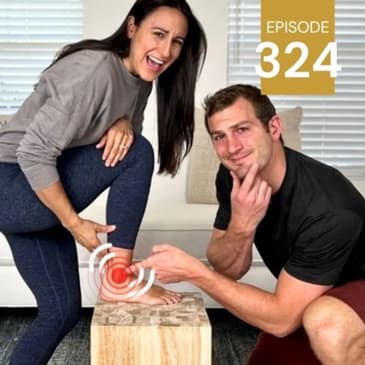
Been diagnosed with Peroneal Tendinitis? Or experiencing pain on the outside of your ankles? DocJen and Dr. Dom have got you covered in this episode explaining what the peroneals are, their function within the feet and ankle complex, who is affected most by Peroneal Tendinitis, and what is actually contributing to your symptoms. Believe it or not, it may not be what the 'itis' suffix suggests! Therefore, tune in to learn more about how it is a tendinosis injury as well as how you can begin to address your symptoms through a 5-step protocol! Let's dive in!
Barefoot Mini-Course:
Experiencing aches, pains, and niggles in your feet and ankles. Join the Barefoot Mini-Course as it contains all the tools you need to assess what could be contributing to your aches and pains and what exercises are best for you to address those limitations! With educational videos, a workbook, and lifetime access, you will begin to feel something different and work towards your movement goals faster! Use code OPTIMAL to get 20% off the course at checkout by clicking here!
What You Will Learn In This PT Pearl:
1:50 - Anatomy: What are the peroneal?
3:13 - Function: What do the peroneals do?
4:43 - Pathology: Who is affected and what is happening internally?
5:30 - Is it really tendonitis?
14:30 - Rehab: Stretch, Mobilize, Strengthen, Re-gain Proprioception
To Watch the PT Pearl on YouTube, click here: https://youtube.com/watch/
For research and full show notes, visit the full website at: https://www.docjenfit.com/podcast/episode324/
Hosted by Simplecast, an AdsWizz company. See pcm.adswizz.com for information about our collection and use of personal data for advertising.
[00:00:00] Welcome to the Optimal Body Podcast. I'm Doc Jen. And I'm Dr. Dom. And we are doctors
[00:00:10] of physical therapy, bringing you the body tips and physical therapy pearls of wisdom
[00:00:14] to help you begin to understand your body, relieve your pains and restrictions, and answer
[00:00:18] your questions. Along with expert guests, our goal of the Optimal Body Podcast is really
[00:00:23] to help you discover what optimal means within your entire order. So go check out that link and get yourself in a pair of Vivo Bare a calf muscle. Yeah, but you really start to fire up and feel the peroneal muscles.
[00:03:01] And I think that's one of the most powerful ways,
[00:03:03] especially the longest obviously,
[00:03:05] is where you really feel that.
[00:03:06] And I mean, you know, what is the mechanism of this injury? Yeah, why do we develop tendonitis?
[00:04:20] Yes, exactly.
[00:04:22] And we want to start to change the conversation
[00:04:25] from this acute And that's what, when we start to get these tendonitis disorders, and I want to touch again on like, you mentioned tendonitis. I feel like we've just called these injuries or these diagnoses tendonitis for so long that the name has stuck. Even though people like us continue to say like,
[00:05:40] I know the term itis means inflammation or acute
[00:05:45] inflammation.
[00:05:46] And really when we get to the treatment aspect, especially if you know that you spend a lot of time
[00:07:00] on your feet and you're not working actively on your foot,
[00:07:04] you're gonna want to hear these exercises For sure. And so when we are slightly overloading these tendons, our body's constantly modulating. They're taking away collagen, they're adding in new collagen. And when we're overloading, but not doing it in a great way or not giving that tendon the full range of motion, the body doesn't know exactly how to imbalance in the foot and the brain is just now having to work a little bit harder to try to send signals down to these muscles that aren't always getting the correct information. And so that's where it becomes more of like, well, shifts in hospitals too at one point and it's like where can you find that 30 seconds or minute in the day and I loved being at the standing computers in the hallway right outside someone's room, typing in a quick note, pumping my ankles, doing a few things you know with my upper body and
[00:11:00] then getting over to the next patient's room, like there's ways you can throw
[00:11:03] these things in where it can it can feel more manageable than like oh I need to consistently see this with people who roll their ankles. Because as soon as you roll the ankle, then you have some degree of acute injury in that tendon. When we have an acute injury, we also lose proprioceptive ability. If we don't rehab that well, then we're gonna develop more tendon dysregulation and predispose ourselves to developing
[00:12:20] this peroneal tendinopathy
[00:12:22] or recurring ankle sprains down the road.
[00:12:24] Yeah, exactly.
[00:12:25] That was a lot, but.
[00:12:26] No, but I think that's all important plus a workbook, there's a lot of information to continue to learn and you're gonna have access to this. We just changed it over. You have lifetime access. Lifetime access. So it's your resource to continue to come back to and feel like you can move through on your own time but really gain this awareness. It's truly like your self masterclass
[00:13:40] in your own foot and ankle.
[00:13:41] And people will ask us on different social platforms
[00:13:44] all the time like, oh, I'm experiencing this with my foot.
[00:13:46] Like what could be wrong? and calf is so incredibly important. So that's one of the main places that I would start to address first. A lot of people have a lot of restrictions there because we don't spend a lot of time. Maybe you do a little, you know, hang your heel off a curb every once in a while, especially if you are walking or running more, but are we putting intentional work into stretching both the gastrocnemius with a straight knee
[00:15:03] and dropping that heel
[00:15:05] and with a bent knee the foot and ankle plan. Again, we'll show a little glimpse of that on YouTube also. But just another way to start with that mobility aspect. And that's one place we tend to tell people to start is like find full, active, passive mobility to this. That's gonna help hopefully bring down any irritation or pain that you may have in the area
[00:16:21] and then prepare you for the next step,
[00:16:22] which is strengthening.
[00:16:24] Right, and we have to understand that a stretch
[00:16:26] is a load place to start. Also strengthening around the foot in ways that are going to further help support that muscle
[00:17:40] by strengthening our foot intrinsics.
[00:17:42] And there's multiple different ways
[00:17:43] that we can strengthen our foot intrinsics.
[00:17:45] I mean, and one of the best ways is to,
[00:17:47] can you spread your toes? area, the peroneal start to light up and fire, which is a great way to gain that strength and control, especially when you do it very slowly and controlled. Yeah. And that's a great exercise for the people who may be experiencing consistent ankle rolling or ankle sprains or have a lot of instability, because it's going to help you keep that ankle more in line with the foot and the leg rather than
[00:19:02] allowing it to fall into that inversion, which is where a lot of people get those
[00:19:05] sprains.
[00:20:02] into the brain and tell you where that, where those muscles are in space, where that foot is.
[00:20:05] So even just starting there
[00:20:07] and then going into some balance exercises,
[00:20:09] maybe you're on two feet
[00:20:11] and you're throwing a ball with someone
[00:20:13] and then you go to a single foot
[00:20:15] and you're kind of, again, throwing a ball back and forth.
[00:20:18] So different ways that you can start to develop that balance,
[00:20:22] that awareness, that proprioception,
[00:20:24] and then continuing to progress I do work a long job. Well, when you're doing your exercises, are you just doing squats, lunges, and moving in a front and back kind of plane? We wanna make sure we get a side to side because again, we're talking about the peroneals which are on the side and the outside of the ankle, right? So we need to be doing movements that move you side to side
[00:21:41] and getting that foot and ankle strong in that pattern.
[00:21:43] So even thinking of lateral lunges, rotational lunges,
[00:22:42] movement when it comes to foot and ankle. Again, this episode was more specifically
[00:22:44] on the peroneal tendons and peroneal tendonitis.
[00:22:48] We have so many other episodes talking about
[00:22:50] tendonitis in different areas of the body.
[00:22:53] And if you had any interest, check out that
[00:22:56] Barefoot Mini Course.
[00:22:58] So much information in there that's gonna be able
[00:22:59] to help you out educating yourself on where
[00:23:03] your specific restrictions are.
[00:23:06] Thanks so much for sticking around
[00:23:08] and being a part of our community.