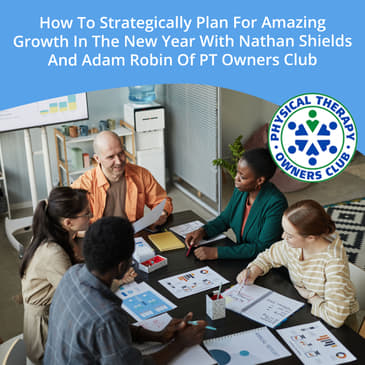
The beginning of a new year is the typical time to measure past growth and plan for future accomplishments. In this episode of the Physical Therapy Owners Club, Nathan Shields and Adam Robin discuss their recent annual strategic planning session, the benefits to any owner of going through the process, and how prioritizing long-term activities and following through will typically equate to success over time. Failing to prioritize and set goals leads to anxiety and a default to completing short-term, less-consequential tasks. Don't be the business owner who ends this year doing the same thing they're doing now. Growth is imperative.
Want to talk about how we can help you with your PT business, or have a question you want to ask? Book a call with Nathan - https://calendly.com/ptoclub/discoverycall
Love the show? Subscribe, rate, review, and share! https://ptoclub.com
[00:00:00] The first decision you have to make is to say no, no more. You've got to make that decision and that's a hard decision. You've got to say no more. I'm going to risk it. I'm going to step out of treatment. I'm going to make the hire.
[00:00:10] I'm going to spend the time. I'm going to whatever it is that's your monster on the other end of the room that you're avoiding, like you need to go for it and you need to just do it. And that's hard because it's super hard.
[00:00:22] Even if you're suffering in mediocrity and whatever you want to call it, fear, anxiety, at least you can be comfortable in that state because you know it. Welcome. You've entered the Physical Therapy Owners Club podcast where your hosts, Nathan Shields
[00:00:41] and other successful PT owners and leaders share their experience and insights on how to build successful PT businesses. They'll share the stories of their paths to success and show you how you can also obtain greater freedom and more profits from your business.
[00:00:56] That's what the PT Owners Club is all about. Greater freedom and more profits. There's plenty of room for you as well, so come on in and join the club. Hello, and welcome to the Physical Therapy Owners Club. Nathan Shields here with my good buddy and partner Adam Robin.
[00:01:15] How you doing, man? Charged up, man. That's right. Glad to be back. Yeah. It's a new year and I have to apologize for listeners. Some people are complaining that their drive time is a little boring because I've
[00:01:26] missed a few weeks on the podcast and yeah, it's my fault. I decided to take a vacation, but now we're back at it in 2024. That's right, baby. You take the greatest show away from that the people just, they revolt. Right.
[00:01:38] Well, hopefully they haven't found a different podcast than my stem. Hopefully you guys will stay with me. Today, we want to talk about how to approach 2024 to make it super successful, right? It's something that Adam and I did. We finally met each other. We haven't met each other.
[00:01:52] We've been working together for years, four plus years now and haven't met each other yet, but we finally met each other in person in Tempe, Arizona over the holidays and we're able to do some annual strategic planning for the coaching business.
[00:02:05] And thought that maybe going over some of those aspects of the annual strategic planning session would be appropriate and valuable for those listeners to the podcast. Today, we'll break that down a little bit. We'll also talk about how to prioritize appropriately, how to set goals for this
[00:02:21] 2024 to make it ultimately successful and see significant growth in your practices for this upcoming year. I'll just start with this. I'll get into a little bit into nuts and bolts of the annual strategic plan session that we went through, but what did you take away from that? Yeah.
[00:02:36] So I'm a young practice owner. Now, I haven't been in this game for very long. And so I've actually done my own annual strategic planning forever. I've never had anybody else be the host or the moderator. It was a new experience for me, which it was awesome.
[00:02:53] Well, talk about that with me a little bit going from doing it by yourself in the past for your own business to having a separate person lead out on that strategic planning session. Because that's something that I did the same thing when I was a younger owner.
[00:03:08] I would kind of do my own SWAT analysis. SWAT is SWOT Strength, Weaknesses, Opportunities and Threats to see what I wanted to do and what was upcoming in the next year.
[00:03:19] And it wasn't until Will and I were probably in our fifth or sixth year that we had a separate party come in and our mentor led us through that process.
[00:03:30] It was valuable to have an outside voice to lead it and kind of question a little bit of what we were thinking. What do you think the difference was between you just doing it by yourself versus having someone else like me take you through it?
[00:03:43] Yeah, a few things. One, over the last three or four years, my company has steadily grown pretty significantly. Yeah, you're on your third clinic here soon. Yeah, so like the annual strategic plans have become more and more intense, like harder, harder to do
[00:03:59] because there's way more moving parts and there's more people involved. The preparation for that has been a big challenge for me. I kind of felt like especially this past year, like I felt like there was a little more pressure on me to deliver.
[00:04:12] But what was cool about doing it with you was like, I felt really relaxed. I felt like I could kind of take the back seat and let the process work.
[00:04:22] And I felt like I was able to be in a more creative, passive state with you as opposed to more like a rule follower, like moderating the meeting every year that I do it at the end of the meeting or at the end of the call
[00:04:34] or the meeting with my team. I'm like, man, we've got to get somebody to do this next year. And then I'll end up doing it again. We've got to get somebody else to do this. I'm like, every single year.
[00:04:42] So like one year, I'm going to hire you to come do it for us. I can see exactly what you're talking about where if you are the owner and you're doing the moderating, then your brain's going the entire time because you're thinking about what you're doing now
[00:04:56] and what's the next step in this process of planning things out. And unfortunately, you're also you're bringing your own bias into it. So you're going to lead the team in the direction that you want to go.
[00:05:08] And maybe and that's going to be good for the clinic, but is it in the best interest of the clinic for you to be the person that's really guiding it instead of the leadership team?
[00:05:17] Being the ones who are guiding it and kind of taking it off your plate. Yeah, I can see a big difference between those two situations. Those two different scenarios where when you're involved, that brings your own bias to the table.
[00:05:30] And it also doesn't allow you to think maybe your thoughts are a little muddled. You're thinking about the present instead of the future, which is what the annual strategic planning session should be about. You're thinking about just getting through the day and hitting all the targets
[00:05:43] and or the checklist of the planning session instead of thinking about big picture things, which you should be focused on. Yeah. And another thing that I thought was really cool that I learned from you was you don't have to have a lot of goals.
[00:05:55] I think we walked away from the meeting with like five goals, maybe for the whole year. Five goals. We talked about a ton of things, but we got like five main goals down on paper. Is that different from what you experienced in the past?
[00:06:08] They usually come away with like eight or 10 goals or something. Yeah, way too many. I realized we have way too many goals. Like we were breaking them down to departments and just like I can see how getting, being willing to prioritize what's most important is really hard.
[00:06:26] And there's levels to that. Yeah, I felt like I learned a lot there about with that. Yeah. And one thing I've learned through the last couple of sessions that I've done
[00:06:34] is sometimes there can be a goal that is more of a result than it is a particular goal. Say, for example, profit margin of 20%, that is a good goal, but it could be a result of something else.
[00:06:49] And for example, the coaching call that I had this morning, this client, she's killing it in Texas and but her profit margins aren't she wants them to be and she knows that her team productivity rate slash utilization percentage isn't where it should be.
[00:07:05] You know, maybe it's in the 60s or 70s when it should be in the 80s. I asked her what are some of her priorities or goals would be for the next year and she says, well, I want to get that productivity level up
[00:07:14] and I want to get my profit margin to this level that and so I had to say, well, the profit margin is going to be a result of other things. I know that your profit margin will get where you want it to go
[00:07:27] if you get your productivity level up to an 80, 85, 90% utilization rate or productivity rate. You can keep watching the profit margins, but I think the greater work and what the way you're going to work with your team isn't going to be surrounding
[00:07:40] the profit margin, what you're going to work on your team with is production at getting that productivity rate. If we hit those productivity markers, then your profit margin will get to where you want it to go. Sometimes we can mistake some of the end results for priorities
[00:07:55] or instead of other key stats to focus on that represent a bigger picture of what needs to be worked on. I hope I was clear on that. It wasn't too muddy, but that's what I've experienced the last couple of times. Yeah, for sure. We call that input goals.
[00:08:08] I don't know if that's the right thing, but that's what we call it in our team. What we'll do is we'll get all of our stuff on the board and we'll just continue to ask the question like, what's the input? What's the input? What's the input?
[00:08:18] And so you make the goals around the input. Your inputs will dictate your outputs. Inputs will dictate the results. Make your goals less about the results and make them more about what actions can you commit to inputting into your business?
[00:08:31] Because you can control that parameter, focus on the inputs and the outputs happen. Yeah, because it's appropriate to have a profit margin goal, appropriate to have a gross revenues goal. But what's going to drive you to that? Is it production? Is it better collections?
[00:08:48] Is it that represents so many things maybe getting a little bit more specific as to what's going to drive us to that profit margin would be a more appropriate priority? We could definitely get to a certain monthly figure, you name it.
[00:09:02] But is it going to be due to more new patients? Is it going to be due to more of better compliance rate, cancellations, that kind of stuff? It's good to focus on the bigger picture things, but it's important to narrow down
[00:09:15] to what's going to really make those goals come to pass. All right, well, it gets the tire moving. Let's focus there. Yeah, you know what I found? And tell me if you had this, I know you're past this stage, I believe, in your own ownership.
[00:09:27] But what I find often in newer PT businesses, and this might be speaking to small businesses as a whole, but typically one of the top priorities ends up being building out policy procedure manuals. Was that a priority that usually came up in your first few years?
[00:09:45] Yes, not so much during the annual plan. But I say I got lucky, but everybody's got a different journey. And I believe that I got into coaching pretty early in my journey. So it was like maybe a year after ownership I got into.
[00:10:01] I was less than two years into ownership and I found myself in this place where I was like not treating patients anymore. This is crazy. Like what do I do with all my time?
[00:10:08] And I remember I asked Nathan, I said, do you think I should just like write down everything I do on paper? And Nathan was immediately head nod like, yes, you should already have that. I just literally locked myself in a room for like three months and wrote down
[00:10:24] every single thing on paper, bounded it together, put a cover on it and created a manual. All that to say, I never really got to a place where I never found myself starving for policy and procedure because I was very proactive about it, if that makes sense.
[00:10:41] Safe to say that your growth was easier because you had that. 100%. Now I will also say that every single year we go through every policy, every year. Just to review and make sure it's up to date. Every single year we go through every policy.
[00:10:58] We start at the front desk, patient walks in, we go through the whole patient life cycle and we clean it up. It's usually around Q2 when we start that. Q1s more like get started and kind of stuff. Yeah, your systems are key. So reviewing those.
[00:11:10] And you know what? We always make massive improvements. Always. We always find things, oh, we can cut this out or we can automate this or like, yeah, why are we doing that this way every single time? That's cool that you make it such a living document like that.
[00:11:24] That's huge because typically those policy and procedures collect dust. An employee handbook, if you're not telling the team to go back to it and reference it when they have questions, it's going to collect dust. It has to be a living document.
[00:11:36] And the beauty of that is also, and you haven't witnessed this yet, but you will is when someone comes to purchase your practice, you're going to be able to say, you just hand that over and there's value to that. You can you will see increases in multiple
[00:11:52] of in the multiple that's applied to your EBITDA in the offer because you have solid policy and procedures. You have a leadership team that's following it and it's not you running everything all the time,
[00:12:04] but people outside of you so they can cut you out and things keep running. And it's all because of that policy and procedure work that you put into place. Yeah, our thing is we get our systems out in and then we try to grow so fast
[00:12:15] until we run out of money or we try to grow so fast until we run out of money or break it. And then it's like, all right, well, guess we got to fix it. You know, we fix it. Did we get some money and then grow again? Right.
[00:12:29] Well, it's worked out well for you thus far. Yeah, I think so. Before we get too far, I'll just walk through a little bit about how we went through it and how I typically go through it with people. But we'll establish the rules.
[00:12:39] We do our one word open, turn off the phones, set up timers to make sure we run it like 50 minutes sprints and give ourselves 50 to 60 minutes sprints and gives ourselves time to refresh for five or 10 minutes before we hit back at it again.
[00:12:53] And then we'll typically get into talking about reviewing the past year. What goals did we have? What did we hit? What did we like about it? What we didn't like? What are our goals for this next year? Setting up the ideal scene, right?
[00:13:06] If we're having this conversation at the end of 2024 or whatever year you're in, what would the clinics, what would the company have to look like in order to say this was a huge monumental success? We achieved all our goals. And so we write all those down, right?
[00:13:20] Clear on those. We also then will go through purpose and values in our mission. If those aren't established, maybe it's time to talk about establishing if any of them are not clear or maybe not appropriate anymore and need to be edited.
[00:13:35] That's a time to do it as well. The main idea of going through the purpose and values to say, how are we doing? Where are we falling short? What can we commend ourselves for? Do we still hold these true?
[00:13:46] And if there's any place where we get where we are falling short, where do we need to address? What's appropriate to use that this annual session as a time to reflect on those? Then we get into it. It's a SWOT analysis like many people have done before.
[00:13:59] We write down all our strengths. We shared those with each other in our session. We shared the weaknesses, shared those with each other, shared the opportunity, took five minutes to write down our opportunities and then share those with each other. Another five to ten minutes talk about threats.
[00:14:14] Inevitably, we'll have some things that are very similar and some things that are completely different. And then the idea is to then start establishing priorities. And I don't know if this is this was new to you, this exercise, but where we would reword the threats and the weaknesses
[00:14:34] into strengths and opportunities. Right. I'm trying to think of, do you recall a weakness that we approached and had to reword by chance? I don't. That's fine. I'll just bring up something that's typical and that is we weaknesses. It's hard to find physical therapists.
[00:14:49] Right. We don't have enough therapists. Don't have enough providers, eight more providers. You would simply reword that into a strength and say we have plenty of providers coming through our doors asking to work at our clinics as it relates to recruiting, you name it.
[00:15:04] And then after we've reworded all of those, then it's time to break those down into the three, four, five top priorities. Some of them are duplicates. Some of them that's more of a project versus a year round goal or priority process these out.
[00:15:21] And then we'd have to like just decide what are our type. Some of them are good ideas, but maybe they're not in the top three to five. And we come up with our top five priorities for the year. And that took us a while.
[00:15:32] Probably took us about a half hour, maybe more. And if there's more people on the team, it might require some more discussion. That'll take a while. And then we do something called the priority star to determine how to organize those priorities one through five.
[00:15:46] And then after we establish the hierarchy of priorities, establish goals with them. What do we want to see? What is the completion of this priority look like in terms of a measurable goal? Put a deadline to it. Put an owner to it.
[00:16:00] Put a singular person in charge of that and then set up some milepost markers, milepost goals by quarter one. We should be here by quarter two. We should be here quarter three, et cetera. And also some 30 day baby steps.
[00:16:14] So in the next 30 days, by the end of January, by the end of February, I'm going to accomplish this after we've gotten through that. What we come away with is the top three to five priorities for the company for the year, the goals that are in place,
[00:16:28] the owner of that goal, the deadlines and next steps. And that should guide leadership team meetings for the next year. Those should be addressed every week, however often you're meeting every week to make sure. And the owner of each priority slash goal
[00:16:45] would report on their progress on a weekly basis. And so that's the benefit of it. You come away with the top priorities. You come away with owners and measurable goals and milepost markers to hit along the way. And so the owners can say, this is where we're at.
[00:17:00] This is my next step. I'm on target and move on. Yeah, it's so hard to see the value in doing that when you're busy. Just being just like doing a take an hour break from work.
[00:17:12] If you ask owners nowadays, like, hey, can you just like take a break? It's like it's hard for them to take a break much. Let's ask them to take a whole day off. Well, I was going to say it took us what five, six hours?
[00:17:23] Yeah, we have like four people on our team. Right. So like we have a small gig, but it's like you never really appreciate the value of that until after you walk away from that. And then like the proceeding 30 to 60 days following it.
[00:17:36] Because man, I could tell you what, we started this gig PTO Club. I don't remember when it was. It was like sometime in the middle of last year. We got our purpose and values dialed in and we set some goals. And then we kind of just took off.
[00:17:49] And really we used a lot of grit, determination and hustle to kind of get where we are today. And we had a ton of success. Well, we have a bunch of clients joining our program. People are crushing it.
[00:17:59] Then, course, end of the year, we got stagnant because we kind of lost focus and we were like, OK, what are we doing again? Where are we at again? And then we had our annual strategic meeting and now guess what? We're back on fire.
[00:18:13] We both got things on our plate. We're freaking knocking things out, you know, so it's fun again. Right. It just something amazing happens whenever you can get everybody aligned and moving in the same direction. I tell that to people all the time.
[00:18:25] It's like it's not the marketing strategy. It's not the Facebook ads. It's not the CEUs. It's not the location of your practice. It's getting clear and getting your team aligned around your vision. That is the key. Yeah. And we were talking before I pushed record how owners can
[00:18:45] see all the things they need to do and they all have the same level of importance. They all have the same hair on fire urgency level without having established some of that foundational work to be clear about what your
[00:18:59] annual priority is, not what your priority is for that day, but what your annual priority is. That's what should determine what you're doing that day, not your email list and not the providers coming and knocking on your door. Hey, I need this or that.
[00:19:14] Your annual priorities that you've established when you had a clear head are those things that should be driving your day to day behaviors. And they you don't have to remember them anymore. You don't have to think about it.
[00:19:26] You can just recall back to your notes, your experience and say, that's what I need to do today. So I know that I'm going to meet my metrics by the end of the year. If I just give some attention to blank today or this week, right?
[00:19:40] And make sure that gets done so you can know that you're making progress towards that thing. And that's where a lot of owners get burned out. They get a lot of anxiety is because all the things are important.
[00:19:50] I got to do all the things and sometimes what they'll default to are the simpler tasks or the technical tasks that they are that come easier to them and not as hard, which is treat patients, pay bills, do documentation.
[00:20:05] That's not going to get you where you want to go by the end of the year. Those things are important. But as a business owner, you have a greater responsibility to the business and the health and the vision and the growth of the business. That's your core responsibility.
[00:20:17] Those other things are secondary. A strategic planning session that sets clear priorities and goals help you maybe minimize your anxiety a little bit and give you a clearer head as to what needs to be done to achieve your goals.
[00:20:29] Right. It's a tool just like all these things are, but I love what you said. How you design it, you pre-design it, pre-design your year, pre-design your month, pre-design your week, pre-design your day, pre-design your work setting. You don't do it while you're doing the work.
[00:20:45] You do it before the work. It's like you think, then you plan, then you do not do, then kind of plan in the middle and thinking how you think plan do when you can get your
[00:20:53] play, when you can kind of like step out and like let the emotions settle, get eight hours of sleep, go get a massage, wake up early, go for a walk, listen to a good book, come in charged, excited about the day
[00:21:07] and really have this energy and this creative headspace to like be creative and design and like think about what you really want to do in your business. That's the perfect time to do it.
[00:21:19] Once you design that, what comes from that is like clarity on what you really want. Then what happens is we go to work, things get crazy. Phones start ringing and people start quitting and then anxiety and overwhelm and stuff starts to build up.
[00:21:32] And as soon as you feel that, you're like, I'm actually getting a little worked up right now. That's the perfect time to stop, pull out your notes and get really clear on what you want to do.
[00:21:47] Before we jump into the next episode, let's talk about something I think we'd all like a little more of and that is money. As a PT owner, I know how hard it is to increase your revenue without spending
[00:21:58] more on marketing or trying to attract a flood of new patients. And let's face it, you're already stretched then trying to run your clinics. But what if there was a proven way to increase your revenue 10% in just 30 days with minimal effort?
[00:22:11] Better yet, how could you use the additional revenue in your business? PT could start saving to open a new location or my personal favorite. Invest in yourself by hiring a business coach. Regardless of how you choose to spend it, a 10% bump in revenue can have
[00:22:26] a huge impact on your business. And that's why I created how to increase your revenue 10% within 30 days. A free guide to help you boost your clinics revenue and see big changes to your bottom line by tracking just one simple statistic in your business. And here's my big promise.
[00:22:42] When you follow the three steps I lay out in the guide, you're going to see up to a 10% increase in revenue in 30 days. This revenue boosting strategy is the same one I teach inside my one-on-one coaching program for PT owners, but it's my gift to you
[00:22:58] just for being a listener to the show. So head over to ptoclub.com to download your free copy of how to increase your revenue 10% within 30 days. And again, that's ptoclub.com. After you download it and implement it, feel free to reach out to me,
[00:23:16] schedule an appointment with me on the same website, schedule an appointment with Nathan, and let me know how it went. And we can talk about next steps. That's ptoclub.com. You decided your priority was and recommit to that. I love that part. I love what you said.
[00:23:37] I think that the brain work, the thinking work is the work that most of us tend to avoid because it's the hardest thing to do. And our default is to go into hustle mode because it's what we know. We know how to hustle.
[00:23:51] We know how to run around, treat patients and bill and get those units in and sell that plan of care and use all of our physical energy to get things done. But there's no high growth business, right? It's not going to move the business forward.
[00:24:04] We got to do the brain work. The brain work is where the money's at. There was a caption in Tim Ferriss's book, the four hour work week that absolutely smacked me across the face, figuratively. As I read it, he said in a caption, I had to underline it.
[00:24:22] I've reread it and mentioned it a number of times, maybe not on this podcast, but with people. But busyness, people like to wear busyness as like a badge of honor. I know it's a disease. Everyone's busy. Everyone's busy.
[00:24:35] And sometimes you want to show people that you're busier than they are. I've got this, this and this going on. He said busyness is a sign of just being mentally lazy because you're not clear. You haven't taken the time to be clear about how to get things done
[00:24:50] and what things are of greatest priority. If you take the time to think about it and in his situation, he's talking about particularly offloading things that you're not expert at to third parties who are expert at it. We'll save you money in the future.
[00:25:07] Yeah, but doing a little bit of work like that or spending the time like you did on a policy and procedure manual will save a lot of headaches and questions down the road because you put some effort into that.
[00:25:18] But simply being busy means that you're not looking through all of things that you have before you and prioritizing them accordingly to say, I need to spend more time here and more time here and I don't
[00:25:29] need to spend time over here or I can offload that thing over there to someone else or that thing can wait another 30 days before I handle it. I loved what Tim Ferriss said in four hour work week about that. And like we talked about before pushing record here,
[00:25:43] Alex Hormozzi said something similarly in that he knows when he's anxious that he hasn't appropriately prioritized all that's before him. Is that am I saying it right? Yeah, too many options and you don't know which one to choose yet. Yeah.
[00:25:57] You're not clear on which one you should be choosing. Yeah, you just haven't made proper decisions. Right. So you've got all of these things before you and you don't know where to go. Whereas when you feel depressed is a state in which you don't know
[00:26:09] if there are any other options. Right. Yeah, you just think whatever state you're in is the only option that you can even consider is when he finds himself in depression. And I think a lot of owners find themselves in that anxiety situation.
[00:26:22] Number one, because so much is in front of them. But it can also lead to some depression because they think this is the only way that this issue can be addressed. And I think that's where the beauty of coaching comes into play
[00:26:36] because that's where a coach says, well, there are these other options, you know, you might not like them. You're not going to like them most of the time. That's why you're not doing them. That's why you're not doing them.
[00:26:48] Yeah, and no one's holding you accountable to do the stuff that you don't want to do. Exactly. But that's the beauty of coaching is to say, well, you actually have options. We just need to make a decision.
[00:26:59] And the faster you can make a decision, the more quickly your current stable change. The first decision you have to make is to say no, no more. You got to make that decision. And that's a hard decision to say no more. I'm going to risk it.
[00:27:12] I'm going to step out of treatment. I'm going to make the hire. I'm going to spend the time. I'm going to whatever it is that's your monster on the other end of the room
[00:27:20] that you're avoiding like you need to go for it and you need to just do it. And that's hard. It's hard. Super hard. Even if you're suffering in mediocrity, whatever you want to call it, fear, anxiety,
[00:27:32] at least you can be comfortable in that state because you know it. There's a lot of fear in the unknown. Well, what if I make that hire and they suck? What if I spend the money and it doesn't work out?
[00:27:43] Well, it's easier to just paralyze yourself and just say, well, I'll just status quo, even though it sucks. At least I'm comfortable with it. I've become buddies with my anxiety and my fear. And I know how to handle those somehow. It's not going to get you your dreams.
[00:27:57] It's not going to get you what you want to accomplish. No, it's going to be hard. But on the other side is everything you've ever wanted. And it's more than just business too. It's your role in the family, like your ability to be a better father
[00:28:08] or better mother, your ability to serve your team better, your ability to be a powerful leader. And like there's a lot on the other side of that fear that you're not leaning into. Yeah, it's really interesting how much I learned in business may be a better. Oh, totally.
[00:28:24] Son, friend, you name it. Where communication skills are better. I'd like to think I'm a little bit more humble when it comes to like being the first to apologize and take responsibility for a mistake that I made
[00:28:38] and if we're going to plan things out, it's going to be planned differently now. And that really made a mark on me when my mentor, he told me that not only did he have values in his company, but he and his wife and children established family values.
[00:28:53] And they established their family values and they resided them every day. Me and my family, we have family values because I agree. It's just as important to have family values. I didn't recite him every day like he did would recite their family motto
[00:29:06] when they said hi and bye to each other and stuff. And I was like, all those business lessons translate. It's not like you walk out the door of your business and all of that's left behind. You take that with you and you can learn a lot. Yeah.
[00:29:18] And I think that this goes without saying, which I hope it does. It's like I still struggle with all of those the same problems, the same challenges. Like I find myself avoiding work all the time, all the time. Like I'm like, I'm avoiding work.
[00:29:34] I'm avoiding that thing that I'm just tired of doing, that I'm kind of doing but not fully committed to doing. I find myself there all the time. And I think the difference now is that I'm aware of it. I'm aware of it.
[00:29:46] And I've gone through the experience of becoming aware of it and overcoming that. It helps me just be a better person. You're right. Like because I'm more aware of like what who I am, you know,
[00:29:59] and what I don't like to do and what I do like to do. That really struck me in Brené Brown's Daring Greatly. She talked about procrastination or something to that regard. But when you find yourself doing like streaming a social media site
[00:30:15] or YouTube or playing a game on your phone, I find myself doing this all the time. Thinking to myself, what am I avoiding right now that needs to get? What am I avoiding that needs to be addressed? Because instead of purposely thinking about I've checked my list
[00:30:31] of things that I want to do, accomplish this day. I'm happy with what I did and I'm ready to close the book on the day and then bringing up my phone and doing something. It usually ends up being like, oh, I finished the task, grab my phone.
[00:30:45] I did a waste an hour and then come back and be like, oh, that's right. I need to get some more stuff done. Did I like what you said in that it's important for us to be aware that some of those tactics are simply distractions
[00:30:58] and they are avoidance mechanisms to what truly needs to get done. And it's important for us to be aware of those. Yes, we have an exercise in our coaching program, which I kind of robbed from another guy who taught me. But it's establishing your non-negotiables,
[00:31:13] which basically is an exercise where you define like who you really want to be and what you want to commit to and what's really important in your life and choosing to prioritize that. And part of some of that is going to be family and mental health
[00:31:26] and physical health and eating healthy and reading books, right? But like the quiet time and the quiet thinking time like annual strategic planning, that's where the health of your business is developed. And the thing about life and the thing about business is
[00:31:41] the first thing that we sacrifice is our own health or our business health. It's the first thing that we sacrifice, right? Like how many times have you started an exercise, routine or a diet or like whatever that you wanted to commit to,
[00:31:54] which I'm sure many people who are listening have said big goals that they want to commit to this year. And it's like what happens? It's like we're good for a week or two weeks, three weeks, maybe we're 80 percent in four weeks. I got busy. I'll have a cupcake.
[00:32:06] It's like the first thing we sacrifice is our health. If there's any lesson to be learned here, it's like the first sign that you're going off track is when you start to jeopardize your health and your business health specifically. It's the most important thing.
[00:32:21] Take care of yourself, take care of your business and everything else will follow. Right. Yeah, I like to say your love language for your business is quality time. You need to give it time. And when I say quality time, I'm not talking about going into the office
[00:32:33] and cleaning the toilets before everyone gets there and that kind of stuff. And it's more of working on the business like it's a real business and demanding profit from your business and pulling the proper levers to get the profit, to develop culture intentional about the culture
[00:32:50] that you want to create and creating systems and processes so these things can live in without you. You can be gone for a couple of weeks and they still run fluidly. Right. A month at least. That's the important part of working on your business.
[00:33:04] And that's to bring it back around. That's where when you get an annual strategic plan session, you take all those things that are in front of you that you could be doing, boil them down to the things that are most appropriate for this time
[00:33:15] of your business to move it forward. I think it would be super important to talk about a few other things that we can do to make sure that we maintain focus throughout the year. We reference the book Traction by Gina Wickman all the time.
[00:33:30] We probably say it every other podcast. So like if you haven't read it, read it. In fact, Chapter Three will basically outline exactly how to do an annual strategic plan like in detail. And I read Chapter Three of Traction every year, every single year.
[00:33:44] But there are many other principles in that book that what he calls the entrepreneurial operating system, the EOS. Part of it is not only writing the goals and priorities down, but we write them down on one place and everybody uses the same piece of paper, right?
[00:34:02] Either electronically or pen to paper. But like the thing is, it's like when there are notes and updates to be made, they're not made on your paper. They're made on this paper, the teens paper that everybody shares. Right? There's no hiding.
[00:34:17] There's no like things getting lost in the week. The communication channels the same. Making sure that you're using one system to update on the priorities is really, really important. Number two is like you mentioned, meeting every single week.
[00:34:31] Put it on the schedule, the meetings Tuesday at one o'clock, whatever, Monday at nine o'clock every single week. And you have to be committed to pulling out that piece of paper and saying, OK, team, everybody, we're going to go around the room
[00:34:44] and everybody's going to update us on where we're at and what we can expect on the priorities. If you just do those two things like you're just creating an environment of accountability and transparency. And it's like, you can't like how are you and your team?
[00:34:58] What more powerful tool that you can do is to actually create a team that holds each other accountable. You're like, if you have a team that you love and you trust in that, that you're really trying to like help and you know, on Monday,
[00:35:08] you're going to have to get up there and talk about how you didn't do X, Y, Z. Like you said, you were going to do like that's a hard thing. There's like an intrinsic drive that will naturally evolve
[00:35:17] and your culture will develop to help things get moving a lot quicker. Those are two tips that I would would highly recommend. Yeah, I broke down and it took me a few minutes to break down the agenda for that for our session.
[00:35:30] And yeah, plenty of people might aren't in a situation where they can write that down. You can definitely go to traction. You can reach out to me as well, Nathan at PTO Club dot com. And I can share with you my guidelines for it.
[00:35:42] There are opportunities to get these done and you don't have to figure out the agendas yourself. We would recommend is if you have a leadership team of you and at least one or two other people, maybe it's time to have someone outside of yourself to lead that conversation.
[00:35:57] And if it's just you, that's fine. I'd recommend you do it with a coach so you get some feedback and have someone to hold you accountable to those goals and deadlines down over the course of the year so that you have someone to report to.
[00:36:12] But you can do it by yourself just as easily. 100 percent. Right, man. Well, I think we covered a lot of it. Anything else you want to add? No, I think that kind of a boring topic, depending on if you're looking for something flashy.
[00:36:24] This is not flashy. Most of the time success is not flashy. It's usually boring work. It's the hard work. That's why business coaching is hard to market because it's like, we're going to show you how to do boring things.
[00:36:35] We're going to make you do a bunch of stuff you don't want to do. You don't want to do. Isn't that a story of physical therapy? We're going to make you do all kinds of exercises you never wanted to do. You hate coming here.
[00:36:47] And it's going to hurt. You will hate me. Aren't you excited? Yes, indeed. We're used to that. But I would say I remember and I tell this story a few times. I've told this to a few clients, but I remember us having a conversation.
[00:37:05] It was me, you and I think maybe Will. And I can't remember. There was a few people on a call and we talked a little bit about what is the most important thing that you can develop or create this year to most likely correlate you to success
[00:37:17] or towards these goals or towards your goals. And you said alignment of your leadership team, alignment of your leadership team. And that has stuck with me to this day, like you being able to develop alignment and basically take your vision out of your head
[00:37:36] and getting it to in a place where your team can actually see it like you see it and have an opportunity to like raise their hand and say like I see that and I want to be a part of it. And I'm committed to it
[00:37:48] and I'm open to you holding me accountable to it. And like developing that in your company is like, man, if you just take a day, you would go to the moon. You'd copy it to the moon. It's called investment, right? This isn't quote unquote productive time,
[00:38:04] but it's investing in your business and investing in the right things in your business. There's people out there who are wondering how they can improve their culture, the culture of their business. This is where that kind of stuff starts.
[00:38:16] It's when you meet together, when you have a team, when you are intentional about your growth and you're intentional about implementing values and living out your purpose and that kind of stuff. That's when you really start to see alignment and growth. It's almost impossible to measure,
[00:38:31] but you will see the growth from it. 100 percent. And I'm glad you mentioned that because I don't guarantee a lot of things, but I guarantee that if you decide to focus on your priorities this year, you will grow.
[00:38:44] I don't know why the world is the way it is, but that's what it is. Like if you just focus on it and if you need any help with that, please shoot me a DM, email me, adam at ptoclub.com.
[00:38:56] We've developed a system to where we can show you exactly what stage of business you're in, depending on the size of your business, the income that you have coming in and out of your business. And we can help you get very, very clear
[00:39:09] on exactly what your priorities are, what you need to focus on so that you can grow. Most of our clients are growing at between 40 and 60 percent annually. Don't miss out. You can do it too. Yeah. Reach out to Adam, adam at ptoclub.com, me Nathan at ptoclub.com.
[00:39:24] Check out the website ptoclub.com if you want to do a discovery call with the both of us, because you can book a call there and talk to us a little bit about business, which we love to do. Make sure if you haven't yet joined
[00:39:35] the 600 plus other PT owners on the Facebook group, physical therapy owners, Club Facebook Group, you can get on there and ask questions and share wins, etc., etc. But we'd love to see more of you. That's for sure. Absolutely. All right, well, thank you so much for joining today.
[00:39:52] It's good to get back on the horse. Yes, get out some content. Let's kick some butt. Yeah, this will be an awesome year. All right, brother. See you, man. Thanks for joining us today in the physical therapy owners Club, the resource for stability and freedom
[00:40:05] in your PT practice. Reach out and join the network today. Subscribe to our podcast, get links to social media and access all of our episodes with show notes at ptoclub.com.