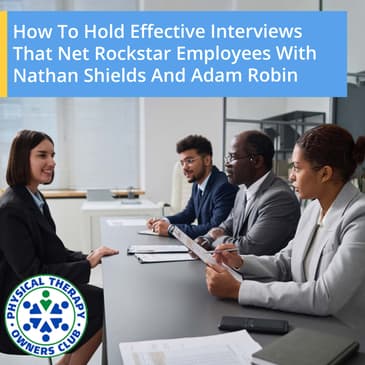
Ever wonder why some interviews feel off? Discover effective strategies to enhance your PT clinic's hiring process with our latest episode.
In this podcast episode, Nathan Shields teams up with recruitment expert Adam Robin to tackle the surprisingly tricky world of physical therapist interviews. Discover why old-school hiring just doesn't cut it anymore and how to make your clinic stand out to top talent.
Learn why treating interviews as a sales opportunity can lead to more enthusiastic hires and how job shadowing can reveal if a candidate truly fits your clinic's culture. Plus, get the lowdown on why quick hiring decisions can be your best friend in today's competitive market.
Ready to transform your hiring process and build the dream team for your clinic? Don't miss out on the insights this episode has to offer.
Want to talk about how we can help you with your PT business, or have a question you want to ask? Book a call with Nathan - https://calendly.com/ptoclub/discoverycall
Love the show? Subscribe, rate, review, and share! https://ptoclub.com/
[00:00:00] I want to see them get excited too. I want to see you get re-ignited about, like, yeah,
[00:00:06] I've been missing this. Like, this is exactly what I'm looking for. I'm looking for some
[00:00:10] out of who can help me get excited about work again and who can hold me accountable and push
[00:00:15] me and challenge me and help me be a better version of myself. And so when I can start seeing
[00:00:20] them get excited and start buying into the idea of like really going for what they really,
[00:00:25] really want. That's an indication to me that, hey, I'm having a good conversation with this person.
[00:00:30] This is a fun conversation. Welcome! You've entered the Physical Therapy Owners Club podcast.
[00:00:38] We're your host Nathan Shields and other successful PT owners and leaders share their
[00:00:43] experience and insights on how to build successful PT businesses. They'll share the stories of
[00:00:48] their paths to success and show you how you can also obtain greater freedom and more profits from
[00:00:53] your business. That's what the PT owners club is all about, greater freedom and more profits.
[00:00:59] There's plenty of room for you as well so come on in and join the club.
[00:01:06] Hello and welcome to the Physical Therapy Owners Club. I am Nathan Shields, Scott, my good buddy Adam
[00:01:12] Robin with me again. Hey partner, what's up? What's up Nathan glad to be here man. All right,
[00:01:17] I can't remember but there's been a few times over the past number of podcasts where I'm like,
[00:01:21] I don't think I ever did a topic regarding the blank, filling the blank right. I've been doing this
[00:01:26] for almost six or seven years now. It's amazing to think that there's plenty of things that I haven't
[00:01:33] actually discussed but I'm saying it again today. Today we're talking about something that I haven't
[00:01:39] really focused on I guess. That's a better way to put it and that is the interview. So much right now
[00:01:45] we're talking about recruiting for Physical Therapist because everybody needs a physical therapist
[00:01:50] and what needs to get done. And if you're still looking for a physical therapist, you need to be talking
[00:01:54] to Adam. You need to talk to Wilhelm Freeze. You need to talk to look at our previous podcasts about
[00:02:00] what it takes to recruit somebody. So figure that out but you brought this up Adam because it sounds
[00:02:06] like a number of our coaching clients. Maybe they're doing the recruiting process and now
[00:02:11] the interview is seemingly really clunky. Is that what you're seeing? You're seeing the interviews
[00:02:17] or just something's not going quite right. Well listen everybody's got their ideas about ways to
[00:02:22] do things and by the way this is Adam's ideas. I'm sure like if you listen to somebody else talk
[00:02:26] about it, they might have different perspectives but in my opinion, the hiring process has changed
[00:02:33] like you can no longer hire recruit and onboard PT's the same way anymore. What do you mean by that?
[00:02:41] So back in the day, you're too young dude. I'll tell you if it was back in the day so give me your
[00:02:46] two cents. PT's were abundant or more abundant, right? It's always been a struggle dude. How many times
[00:02:55] though have we been like it's not been like this? I will admit it's not like this. Yeah. We've got
[00:02:59] this idea that the interview is like a test. Yes. It's almost like are you good enough? Are you good
[00:03:07] enough? Like prove to me why I should grant you permission to work, right? And it's like we've got
[00:03:16] this. I don't know where that's come from but I think you can couple that up and doorway because
[00:03:23] really what we're doing is we're selling an opportunity, right? So we might have to start thinking
[00:03:28] about what do we need to create to close this client or this new hire or this candidate? How do we
[00:03:36] convince them? How do we enroll them in the idea of working with us and integrating them with our
[00:03:42] culture, helping them get what they want so that they would be happy and more excited about working
[00:03:48] with us, right? So it's more of a sales process. I really think that the recruiting piece is like how
[00:03:53] do I get the leads? And then the interview is like how do I close the deal? And so there's a disconnect
[00:03:58] there with how to show up the type of energy to show up the questions to ask, right? And the things
[00:04:04] that you're looking for. And I don't fault any of the owners for it because we've never been trained
[00:04:09] on how to do an interview. We've been part of the interview our entire lives and now you're asking
[00:04:13] us to do it. So we're just going to replicate what we think an interview should look like or what
[00:04:17] we've been through before, what we've experienced in the past. And we'll bring down some questions
[00:04:21] off of Google that tells what to ask, right? Part of it is I think a majority of it is the sales
[00:04:28] process. If you've figured out during the interview process, that person is a valid, that person
[00:04:34] is a value fit. So once they've shown that there are value fit. So we always talked about value-based
[00:04:41] hiring and value based firings. We would talk about our values during the interview process
[00:04:46] and while doing so, observing their body language, right? Some people talk about values and maybe
[00:04:52] they get a little bit more relaxed or they look at the walls and aren't engaged as much or
[00:04:57] we asked them about times in which they might have. So one of our values was growth.
[00:05:04] What have you done in the past year or two years to better yourself? What are some of the goals
[00:05:09] that you have for the next five years and what books have you read recently? Those would be things
[00:05:14] that I think would exemplify growth if they answered those in the affirmative. And then we do that
[00:05:18] with each of the values. And by this time, you've probably communicated with them once or twice. Are we
[00:05:24] talking specifically about the in-person interview or the phone interview? But in person.
[00:05:28] The in-person, yeah. So you probably talked to them a little bit. It may be it's virtual because
[00:05:32] they're on the other side of the country or whatever but it's that interview, right? We're talking
[00:05:35] about so you talk about some of those things and you want to hear about them. Ideally,
[00:05:41] they're doing most of the talking, right? Ideally, they're telling you all about them. You've done
[00:05:47] some insight. You've provided some insightful questions that require more than one word answers.
[00:05:52] I thought I was so cool because I'd ask, what do you think some of your weaknesses are?
[00:05:55] You know, I'm just you know, I expect in that one. Are you good enough? Here comes the left hook.
[00:06:01] Why should I choose you? What do you think some of your weaknesses are? Because everyone's
[00:06:04] going to say, what are your strengths? And I can't tell you how many times disappointedly people would
[00:06:08] say, I care too much. Come on. That's not an honest answer. But I agree with you. I think once
[00:06:17] you've determined this is a value fit and you've also laid out, I think part of it is, hey,
[00:06:23] these are some of our expectations in terms of productivity. Do you see a problem with that? Do
[00:06:29] you have any concerns questions about that because we don't need to go any further if you do.
[00:06:32] That's the price drop. Yeah, exactly. And so it's like, I got an amazing culture. I've got amazing
[00:06:39] people who wouldn't want to work for me. I mean, that's really the type of attitude you're talking
[00:06:44] about, isn't it? So the way that I look at things is like, I'm the owner and along this journey,
[00:06:52] I started to realize, and this is just for me in my company that I no longer had a physical
[00:06:58] therapy business. I had a coaching company and I coached physical therapists on how to
[00:07:06] get the most out of their career. I coached them on leadership. I coached them on setting goals
[00:07:13] and taking action, making an impact. I coached them on marketing, coached them on sales,
[00:07:18] coached them on performance. And you didn't say anything in there about treating patients. None!
[00:07:23] Nothing. Let the con ed do that. Right? So like, I have a coaching company and I coach others
[00:07:30] on how to run a physical therapy business. And whenever that shifted for me, I realized
[00:07:38] I have a product that I'm selling. I am selling like a greater possibility for the people who are
[00:07:44] looking for my opportunity, who are looking for the ability to like get re-engaging re-excited about
[00:07:49] their career. I have a company that can help them bridge that gap between where they are and where
[00:07:54] they really want to go in their career. And that's what I'm selling. Right? Give me an example of some
[00:08:00] of the things that you're saying when you're selling your clinic. So I'm going to give a shout out
[00:08:04] to Chris Smith. Chris Smith is a mentor of mine. You can check him out. He has a program called,
[00:08:10] Blitz called the campfire effect in that he has a sales process where that he calls the enrollment
[00:08:16] narrative. And so the first question I have is going to be like, hey Nathan, super grateful for
[00:08:23] you to be here today. Really interested in learning more about what's most important to you. Tell me
[00:08:29] what are your career goals? What do you really want out of your career? And what I'm doing there is
[00:08:35] I'm helping them to dream a little bigger about what's possible for them.
[00:08:40] What can I do with my career? Maybe I've had these career goals that I've let die, but I got stuck in
[00:08:45] the PT mill that I'm working at and I'm giving them the place to really like dream about what's
[00:08:50] possible for them. Right? And then once I can help them realize what they really really want
[00:08:55] and I can envision myself helping them get that. Now we're kicking glasses like I've heard
[00:09:00] everything that you're saying. And sometimes it's like, I've always wanted to get into pediatrics.
[00:09:05] I've always wanted to learn how to work with neurological patients and start a pelvic floor program
[00:09:11] like it's been a dream of that's why I've gotten that's why I became a physical therapist. And it's
[00:09:15] like really we don't have pelvic floor and our clinic. I would love to do that. Tell me more about
[00:09:21] what type of possibilities would that open up for you? Why would that make you happy?
[00:09:25] Right? I'm selling them on the idea of going after that. Yeah, you're not telling them what
[00:09:29] you can do for them. They're like, what would that do for your life if you had that opportunity?
[00:09:34] Just like you're selling a plan of care to your patient. You're selling, right? Along that journey
[00:09:41] you're going to listen to what they really, really want. You're going to listen to what's stopping
[00:09:45] them from getting there. You're going to ask some value-based questions to make sure there's some
[00:09:48] alignment there. But you can do the enrollment narrative and you can help people get where they
[00:09:53] really want to go. And you can also weed them out with some good value-based questions as well.
[00:09:58] I don't think Chris does this, but I think he does a version of it where some people have said,
[00:10:03] you know what? If at any point during this interview you feel like it's not going to be a fit.
[00:10:08] Just feel free to let me know and I'll give you the same courtesy. That way you don't have to
[00:10:12] feel like you're stuck for an hour. Isn't that kind of thing? But Chris's version is kind of like,
[00:10:18] hey, if at any point during this conversation I think that we can be a value to each other,
[00:10:25] I'm going to let you know that. Hey man, that's how I like to start it. When we frame up the
[00:10:29] interview and it's like, hey Nathan, I want to let you know today, I'm here to learn more about
[00:10:35] you. We don't even have to make any decisions today. Let's just get to know each other. And if it's
[00:10:39] a good fit, great. We'll talk about what it's like to work together and if it's not, that's okay
[00:10:44] too. We're going to have a follow-up appointment. At the end of this conversation we're going to
[00:10:47] decide if we're going to meet again. That's right. We're going to decide, hey do we want to have
[00:10:52] another conversation? We're decompressing the room like, hey there's no expectations here. You can
[00:10:57] let your guard down. I want to learn a little bit more about who you are. I want to be authentic
[00:11:01] with you. I want to be real with you. Next question. What's the most important thing in your career?
[00:11:06] How can I help you get it? Right. And you bleed them down that enrollment narrative and much more
[00:11:11] fun way to do an interview. I love the decompressing of it. Like, I'm not deciding right now if I'm
[00:11:16] hiring you or not. You and I are going to decide if we're going to have a second date. If we're
[00:11:22] going to have another conversation. And if you're not feeling it, great. That's fine. If I'm not
[00:11:27] feeling it, that's fine too. Let's just decompress and get to know each other. Have you found as you've
[00:11:34] done this that there's a point during the conversation where either it clicks and you're like,
[00:11:39] yeah I want this person. And have you had the other side of it where it's like, oh, I don't want
[00:11:45] this person. Have you had both experiences as you've gone through this? Yeah, of course. So
[00:11:50] everybody's going to have a little bit of a different culture. For me, I'm a culture of passion.
[00:11:55] I'm a culture of emotion. I'm a culture of excitement. Right. And so like when I'm asking these
[00:11:59] questions, I want to see them get excited too. Right. I want to see you get re-ignited about like,
[00:12:07] yeah, I've been missing this. Like this is exactly what I'm looking for. I'm looking for some
[00:12:11] amount of who can help me get excited about work again and who can hold me accountable and push me
[00:12:16] and challenge me and help me be a better version of myself. Right. And so when I can start seeing
[00:12:21] them get excited and start buying into the idea of like really going for what they really, really
[00:12:26] want. That's the indication to me that hey, I'm having a good conversation with this person.
[00:12:31] This is a fun conversation. Instead on the opposite end of what I hear for people who aren't a good fit
[00:12:37] for me are, I just want a job. I'm just looking. I just need to pay my student loans. Yeah. You know,
[00:12:44] I just want to like come in. Listen, I got about three or four more years to work and then I'm
[00:12:48] going to retire. And I just want to like, I don't want to get into all that stuff. Those are no
[00:12:52] goes for you. Those are no goes. You're going to have a hard time fitting in in my company.
[00:12:58] Because we're a team of go getters and we're looking to grow. That's going to be a hard fit.
[00:13:04] You're going to really bog us down and we're going to bog you down. We're going to overwhelm you with
[00:13:08] all of our energy and our excitement. Before we jump into the next episode, let's talk about something
[00:13:17] I think we'd all like a little more of and that is money. As a PT owner, I know how hard it is
[00:13:24] to increase your revenue without spending more on marketing or trying to attract a flood of new
[00:13:29] patients. And let's face it, you're already stretched then trying to run your clinics.
[00:13:33] But what if there was a proven way to increase your revenue 10% in just 30 days with minimal effort?
[00:13:39] Better yet, how could you use the additional revenue in your business? Maybe you could hire another
[00:13:43] PT. You could start saving to open a new location or my personal favorite invest in yourself by hiring
[00:13:50] a business coach. Regardless of how you choose to spend it, a 10% bump in revenue can have a huge
[00:13:55] impact on your business. And that's why I created how to increase your revenue 10% within 30 days.
[00:14:02] A free guide to help you boost your clinics revenue and see big changes to your bottom line by
[00:14:06] tracking just one simple statistic in your business. And here's my big promise. When you follow
[00:14:12] the three steps I lay out in the guide, you're going to see up to a 10% increase in revenue
[00:14:18] in 30 days. This revenue boosting strategy is the same one I teach inside my one-on-one coaching
[00:14:24] program for PT owners. But it's my gift to you just for being a listener to the show. So head over
[00:14:30] to ptoclub.com to download your free copy of how to increase your revenue 10% within 30 days. And
[00:14:38] again, that's ptoclub.com. After you download it and implement it, feel free to reach out to me,
[00:14:45] schedule an appointment with me on the same website, schedule an appointment with Nathan,
[00:14:49] and let me know how it went. And we can talk about next steps. That's ptoclub.com.
[00:15:02] I know this isn't what we're talking about specifically today, but how do you make the transition
[00:15:07] between the recruiting efforts that you're doing to that call? I know you work a lot on LinkedIn.
[00:15:12] Is it just like, hey, let's jump on a call sometime and it ends up being this call? Or what does
[00:15:15] that look like? Yeah, so like what I'll typically do is I'll first do a quick phone screen.
[00:15:21] Oh, okay. So you are doing a little bit, you're doing something now.
[00:15:24] Yeah, it'll be a quick phone screen. 5, 10, 15 minutes. 15 minutes tops. Hey, I've got 15 minutes.
[00:15:31] And I just want to ask you a few questions to see if you want to come in in person. Right? And so
[00:15:34] we're basically just scraping the surface of that. What are some of those questions like? Hey,
[00:15:39] what do you live? You have any career goals? Why what's the transition for? What's your background
[00:15:44] like? Where'd you go to school? What's your background? Yeah. Hey, listen, you know, I don't know if
[00:15:48] this is a good fit or not, but I'd love to meet with you. You have time next week to sit
[00:15:52] for a couple hours. Okay. So you're massaging the recruiting cycles and working that strategy
[00:15:58] and plan. And then you're doing a 15 minute max phone interview. That leads to this interview
[00:16:05] right here, right? Correct. And at this time, I'm either interested or curious if I don't have
[00:16:12] a good feeling on that phone call, but I don't feel excited about the idea of meeting with them,
[00:16:17] then they probably wouldn't make it to the interview process. Right. So you're screening along the way.
[00:16:23] Correct. Yeah. I see. Interesting. I'm sure people are like, what are you doing on the recruiting
[00:16:28] side? Yeah, we've done the podcast episodes on that. You're just going to have to go back and find
[00:16:32] those. Yeah, we're talking about listen, look in your phone book or look in your cell phone all
[00:16:38] of those things. We have a phone book anyway. Yeah. Contacts. Yeah, exactly. Look at
[00:16:45] about 35 to 40 pts in there that you've been working with over your career. Oh, calm up. There
[00:16:51] you go. That's how you get leads. You're going to be in the call call. Is your network?
[00:16:54] Leverage. Yeah, I have lunch with them. Sit them down and ask them what their goals are.
[00:16:58] There you go. You got 20 leads right there. Find your PT school alumni that you can reach out
[00:17:04] to people in your class, right? I like it. Leverage. So getting back to that interview specifically
[00:17:10] that we're talking about, we decide okay, we're going to have another conversation. What is the general
[00:17:15] format for that conversation? Are we talking about numbers and terms at that point? What is that
[00:17:20] looking like? Yeah. So typically, what will happen is it's been transforming over the last couple
[00:17:26] years. But what will happen is I invite them in for a two hour working interview slash in person
[00:17:32] interview. And it's like, hey, welcome to the clinic. Let's get to work. I'm talking about right after
[00:17:38] you say, are we going to have a second date or are we going to have another call? So that second
[00:17:42] call is setting up this working interview. I'm assuming like if people are out of state and they're
[00:17:47] calling you about your job. Yeah, yeah. So this is after the phone screen? Yeah. So you did the 15
[00:17:51] minute call. You did the call about telling about your life and dreams. We're going to decide if we
[00:17:55] have another call is the next call the in person two hour block? No, no, no, that's going to be
[00:18:02] the in person piece. So we'll do a 15 minute screen from there. They're coming in for a two hour
[00:18:08] interview with me. But we don't necessarily have to make a decision when if we're going to work
[00:18:13] together or not during that time. Oh, so you're wrapping that initial in person interview into your
[00:18:18] two hour screen like job shadow that kind of stuff. So part of the interview in your situation
[00:18:24] because we would do two separate things and I don't know if it matters either way. But we would
[00:18:29] have an in person interview. And if we liked them then we didn't bite them back for the two to four
[00:18:35] hour or shout job shadow kind of thing. But you just wrap it all up in one. I do. And the reason why I
[00:18:40] do that is I do think that it's important to take your time. I also think that the more practice
[00:18:48] that you have with hiring the better you get at it. And I also think that in today's climate
[00:18:53] you can get time to wait. If you want to close a deal, the speed to closure is an important factor
[00:18:59] because there's so many hooks on the water and if you let that candidate this could be your next
[00:19:05] clinical director that helps you open up the next three locations. Right? So like
[00:19:09] the sense of urgency behind getting to the offer should be there. Like we need to get there as
[00:19:14] quickly as possible. That's a good mindset to have. I mean, you can't do all this recruiting effort
[00:19:20] knowing that it's hard to find physical therapist and then take your time and then like pump the
[00:19:24] brakes once you get to that point. That's not a good idea. Yeah. So I think it's really,
[00:19:29] really important to get to that is a little bit quicker. I like what you're doing as well because
[00:19:33] we got to recognize we got to respect people's time then to like come in for an in person
[00:19:37] interview and then separately come another time for a job shadow and highly recommend the job
[00:19:43] shadow, by the way. I wouldn't hire somebody without it no matter what the position. This just
[00:19:47] takes more time. It's kind of hard. So to do it all at once, I like that idea. Knowing your clinic,
[00:19:52] you're not the person that they're shadowing. No, no, no, we got to get the team involved. Right? Because
[00:19:58] here's the thing, the beautiful thing about getting... You're going to hire some knuckleheads.
[00:20:04] If you've been in business and any length of time, you're going to hire some knuckleheads who you
[00:20:07] shouldn't have hired. But those are also good because you get to learn. You and your team get to
[00:20:13] learn. It's like you remember that list of people that we fired, remember what they were like?
[00:20:18] Remember the old, all those indicators that we learned? We don't want that anymore, right? So now your
[00:20:23] team is becoming more aware and they're starting to be like, ah, red flag here. So I think the key is
[00:20:31] hire a little bit quicker, but make your onboarding process a little bit more rigid and less risky.
[00:20:38] After the hire? Correct. Right? So instead of like spending 90 days of like a bunch of rigorous
[00:20:46] onboarding, let's get to work pretty quick and let's see if this is a good fit. So even the initial
[00:20:51] 90 days of employment is still like a probationary period. Like if you don't make it through the 90 days,
[00:20:57] it's like on to the next, right? Let's leverage that 90 days to make sure this is a fit. Let's not
[00:21:02] drag our feet there either. Correct. Yeah, I get it. I love the job shadow and I'm surprised how
[00:21:08] many people don't do it, but it is not a very common practice. And so I wish more people would do
[00:21:12] it, especially after listening to it because it whether it's following you, if you're the only provider,
[00:21:17] that's fine. Ideally, they're following another provider if you have one in the clinic because it's
[00:21:22] at that point when they're appear to appear that they can let their guard down a little bit and you
[00:21:26] can get a true or sensitive who that person is. They're going to say things and do things in front
[00:21:30] of someone else that they wouldn't do in front of their due or say in front of their interviewer,
[00:21:34] right? And we miss some bullets. I mean, a couple of hires because I thought after the interview,
[00:21:40] this was great. And then found out afterwards from the team like no she did this and that and she
[00:21:47] said that and or they were on their phone and didn't even engage with us or the patients. And so
[00:21:53] yeah, I'm glad we missed some of those people. It was a good filter. It's a great filtering process.
[00:21:58] I wouldn't say it's good. It's a great filtering process. You have to go through those
[00:22:04] to become more aware of what they look like during your interview process, right? And you also
[00:22:11] have to understand like I think that as you do more and more interviews, you start to
[00:22:17] get really, really clear on the type of avatar you're looking for. And you also start to get clear on
[00:22:25] who's your avatar in disguise? Right? Who's the person that kind of looks like your avatar but
[00:22:31] also has this other evil villain behind the curtain? You know what I mean? Like maybe they're a
[00:22:36] little passionate. They're high energy, but they're also like super anxious and get really,
[00:22:39] really overwhelmed all the time. Right? So like you can mistake those two. Right? So really
[00:22:44] understanding who your avatar is and also the chameleon in the group, if you will.
[00:22:48] There's a beauty behind as you've lived, as you've expressed and hired and fired according to
[00:22:54] your values that you start naturally developing a culture. And during that shadow is also a time
[00:23:01] for them to experience that culture. And if they are not a fit, then they will self-select.
[00:23:07] I love the job shadow because of that. And hopefully more people do it. Now, I'm assuming you're going
[00:23:13] from interview to job shadow. Are you then like sending them off and getting the teams input
[00:23:19] and coming back to them a day later? Is that kind of how it goes after that? Yeah, so we typically will do
[00:23:26] job shadow interview. Oh, they're job shadowing first and then the interview. Okay.
[00:23:31] Correct. Then the interview, right? Because there's a great opportunity for you to be like, so what
[00:23:35] do you think? Oh yeah. What do you think about that? Right? And so what I'll do is like, I don't necessarily
[00:23:42] do all the interviews. But if it's a great fit, if it's just a knockout home run, then we will
[00:23:48] present an offer most of the time we don't because during that interview and during that shadowing
[00:23:54] process after I have an opportunity to talk to them about what's most important to them and I get
[00:23:59] them excited about that. Then I get to ask them like, what do you think about working here? And if
[00:24:04] you've served them well, if they're a good fit, if they're aligned with your values, and you've
[00:24:10] helped them realize what's most important to them, like they should naturally be more connected to
[00:24:15] you and the idea of working for you. Right? If they're a good fit. And what you want to hear is like
[00:24:21] this place is amazing. Like I've like learned more about the dreams that I've let go and like I've
[00:24:26] really learned about what's most important to me here. Like I can see myself really growing and
[00:24:30] I can see how this you can get the best out of me. I would love to consider working here. You
[00:24:35] want to get that because guess what you get to do now? Well, we have to think about it. Let me
[00:24:42] think about that for a little bit. Right? You get to put up the little exactly you get to pull back.
[00:24:49] Now you've served them right. Now you get to pull back and be like well, we do have some expectations
[00:24:56] that are going to be required to work here. So like is it okay if we go through those
[00:25:01] productivity, right? All the things that you don't want to go right now. Like you start with what they
[00:25:07] want and then you end with what you want. Nice transition, bro. Nice transition. At that point
[00:25:13] it's like yeah, what do you think about that? Like I want to help you get this but these are some
[00:25:17] of the things that we would need for that to be an even exchange. What do you think about that?
[00:25:20] Yeah, that sounds fantastic. I can totally get on board with that. Right? Okay, fantastic.
[00:25:26] Let's talk about what an offer would look like. So what your dream offer look like and you can
[00:25:32] kind of get that picture then it's like okay, great. I'm going to talk with my team and we're
[00:25:36] going to put together an offer. I want you to really think about if you have any more questions.
[00:25:39] I'll give you a call tomorrow and we'll talk about what we can offer you. Cool. All right, great.
[00:25:45] That's kind of my process. Speed. I love it. And to speak to your process a little bit like how many
[00:25:51] people have you hired in the past? Let's say, I don't know. We're in March right now. How many
[00:25:56] PTs have you hired this year? PTs none haven't had to several PTAs have hired four speech therapists
[00:26:07] in two OTs. So over a four or five six in the past two plus months. Yeah, so like just two weeks
[00:26:14] ago we hired three therapists. Wow, it's impressive. But you don't have an issue with finding physical
[00:26:20] therapists either, which is crazy. No, I have four candidates who are in our pipeline and we're
[00:26:24] going to make an offer. We've got several interviews lined up. So yeah, we're doing well with it.
[00:26:28] All right. Cool. Impressive, dude. Well, more do you want to say about the interview process?
[00:26:33] I think we covered like soup to nuts almost after the marketing. Like is there a way you have
[00:26:38] bumbled things after that interview and the offer? Yeah, I think that the biggest mistake that
[00:26:43] you can make is get really, really like get too excited about a hire. Right? So like if you get
[00:26:49] really excited and you really want to send out an offer right there, that could come back to
[00:26:55] bite you. Right. In my opinion, I think it's a good idea to kind of sit back and wait and digest
[00:26:59] and talk with your team about it. Have a little bit more reflection about the experience.
[00:27:04] I have made mistakes sent out an offer a little bit too quickly. The other thing is like main takeaway is
[00:27:12] it's a sales process. It's not an interrogation. It's not a test. All you're trying to do is help
[00:27:22] you and the candidate get really, really clear on what is most important to them and what would their
[00:27:28] dream outcome look like? Because if you know what they want, then you know what they value.
[00:27:33] You know their intentions. If you can do that and you can help them realize what they really,
[00:27:38] really want. If they're value aligned and you can help them get there through mentorship or whatever
[00:27:42] it is, then try to find ways to make that work and don't find ways not to make it work. I think
[00:27:50] there's opportunities there, especially for some of the younger PT graduates where they have
[00:27:54] student loans or an issue. And if they might ask do you have a student loan repayment program?
[00:28:00] Nope. Well, let me look into it. Don't say that. Just say let me look into it. Tap into our
[00:28:05] network and we can help you figure out what our appropriate student loan repayment program might
[00:28:10] look like. Don't just off the cuff say no, I can't help you there. Well, if you what you can do,
[00:28:15] just say, oh, I'm going to look into that. So Nathan, let me ask you a question. Let's pretend
[00:28:19] like you own a practice and this candidate walked in rock star. The next will Humphries. Right?
[00:28:29] The next will Humphries. And they said, I would take this job and just help you blow this company up.
[00:28:38] If you could help me with student loans, would you be willing to do that? I'm going to find a way.
[00:28:41] Oh, you're going to find a way dang it. You know what I mean? Like of course. So the response is like
[00:28:48] will we don't have a student loan program but for the right people, I would love to support you
[00:28:54] with that. I will write it in the contract but I will have something for you within the next three
[00:28:58] months. There you go. Right? Like let's create a possibility here. I love it. Yeah, there's opportunities
[00:29:06] and I think that we just need to be open to them. I love your conversation about how to structure
[00:29:10] that conversation. And I think we could all do a little bit better on the interview process to just
[00:29:16] like let's let our guard down and get to know these people. And let's make sure that we like
[00:29:21] them. Let's work with people that we like. That's something that I've learned over time is
[00:29:26] I want to work with the people that I like being with outside of business because these are
[00:29:32] people you're going to be around for a long time see them more often than your family, especially
[00:29:37] as a small clinic. So you better like them a lot. And almost never not works out if you like them
[00:29:44] and if they like you. Right? At least you respect each other. Yeah. Like I'm willing to give a
[00:29:50] little you're willing to give a little we've got some common goals. We see things similarly. I
[00:29:55] want to support you. You want to support me like how do you not? That's a hard thing to beat. Right.
[00:30:00] Yeah. Everyone wants to work with people that they like. They consider family and enjoy being around.
[00:30:06] So cool man. Anything else you want to add? Come in, not at all. I think it's really wise for
[00:30:12] you to just sit and think about what you're saying on the interview, what your intention is.
[00:30:16] Just be mindful that you're selling an opportunity. Right.
[00:30:19] Gotcha. Well, if they have questions, they can reach out to you at them at ptoclub.com or
[00:30:24] mean Nathan at ptoclub.com or check out the website and book a business call with us. We can
[00:30:29] talk you through it. Absolutely. Don't forget to check out the Facebook group.
[00:30:33] Tons of content in there free resources for those who will join the group. Yeah, we'd love
[00:30:37] to have you hang out with us there too. All right. Thanks man. All right, buddy. Peace out.