
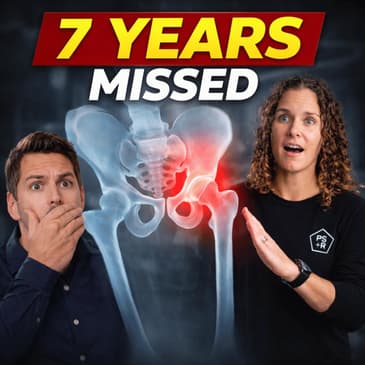
Why do patients with hip dysplasia go years without a diagnosis?
In this episode, physical therapist and researcher Dr. Libby Bergman explains why hip dysplasia in young adults is frequently overlooked—and what clinicians can do to catch it earlier.
Her research explores whether simple clinical tests physical therapists already use—range of motion, strength testing, and hypermobility measures—might help identify hidden hip instability.
The findings could help clinicians recognize hip dysplasia sooner and potentially prevent years of unexplained pain and delayed treatment.
In this conversation we discuss:
• Why hip dysplasia is commonly missed
• Early clinical signs physical therapists should watch for
• Why athletes like dancers and swimmers may be at higher risk
• New research linking range of motion and adductor strength to dysplasia
• Why patients often wait 5–7 years for the correct diagnosis
00:00:00 --> 00:00:02 All right, hip pain in young adults,
00:00:03 --> 00:00:04 it's one of those problems that can linger
00:00:04 --> 00:00:05 for years.
00:00:05 --> 00:00:07 Patients balance between providers.
00:00:07 --> 00:00:08 Imaging looks confusing.
00:00:09 --> 00:00:11 Symptoms don't quite match what the
00:00:11 --> 00:00:12 textbooks actually say.
00:00:13 --> 00:00:14 And sometimes what looks like a simple
00:00:14 --> 00:00:16 orthopedic issue turns out to be something
00:00:16 --> 00:00:18 much more complex,
00:00:18 --> 00:00:20 a structural problem in the hip that was
00:00:20 --> 00:00:21 never recognized in the first place.
00:00:22 --> 00:00:24 Our guest today has been studying exactly
00:00:24 --> 00:00:24 that.
00:00:24 --> 00:00:26 She's a physical therapist, researcher,
00:00:26 --> 00:00:28 and educator who's been digging into
00:00:28 --> 00:00:29 whether the things we measure every day,
00:00:30 --> 00:00:31 strength, range of motion,
00:00:31 --> 00:00:33 even hypermobility scores,
00:00:34 --> 00:00:37 might help clinicians spot hidden hip
00:00:37 --> 00:00:38 instability earlier.
00:00:40 --> 00:00:41 Because when hip dysplasia goes
00:00:41 --> 00:00:42 undetected,
00:00:42 --> 00:00:45 patients can spend years in pain before
00:00:45 --> 00:00:47 they finally get the right diagnosis and
00:00:47 --> 00:00:48 then treatment.
00:00:49 --> 00:00:51 She presented this research at CSM.
00:00:51 --> 00:00:52 Her goal was simple,
00:00:52 --> 00:00:54 give clinicians better clues to recognize
00:00:54 --> 00:00:55 the problem sooner.
00:00:56 --> 00:00:57 Our guest today, Libby Burton.
00:00:58 --> 00:01:00 Libby, welcome to the show.
00:01:00 --> 00:01:00 Thanks, Jimmy.
00:01:00 --> 00:01:02 I really appreciate that introduction.
00:01:02 --> 00:01:02 That was awesome.
00:01:03 --> 00:01:04 Big fancy intro.
00:01:04 --> 00:01:06 That's the peak.
00:01:06 --> 00:01:07 I do nothing well for the rest of
00:01:07 --> 00:01:07 the show.
00:01:07 --> 00:01:08 It's all on me, so no pressure.
00:01:09 --> 00:01:11 So you're spreading hip dysplasia and
00:01:11 --> 00:01:12 instability in young adults.
00:01:12 --> 00:01:15 A diagnosis that I said in the intro
00:01:15 --> 00:01:17 often gets missed.
00:01:18 --> 00:01:19 So we'll just go with it.
00:01:19 --> 00:01:20 Let's do the value for a million-dollar
00:01:20 --> 00:01:21 question first.
00:01:21 --> 00:01:23 Why does this happen so frequently?
00:01:23 --> 00:01:25 Why are we bad at this?
00:01:25 --> 00:01:25 What happens?
00:01:25 --> 00:01:26 Gosh.
00:01:27 --> 00:01:28 That's such a complex question.
00:01:28 --> 00:01:30 And I think your summary in the first
00:01:30 --> 00:01:32 minute of introducing this topic, I mean,
00:01:33 --> 00:01:34 if everyone just knew what you said in
00:01:34 --> 00:01:35 the minute, I'd be stoked, right?
00:01:36 --> 00:01:37 That's a starting point.
00:01:37 --> 00:01:37 I mean,
00:01:38 --> 00:01:40 I think our knowledge about what hip
00:01:40 --> 00:01:43 dysplasia is, is so far behind the times.
00:01:43 --> 00:01:45 You know, when I went to PT school,
00:01:45 --> 00:01:46 I'm going to do one of those that
00:01:46 --> 00:01:46 dates me.
00:01:47 --> 00:01:48 When I went to PT school over twenty
00:01:48 --> 00:01:49 years ago now,
00:01:50 --> 00:01:51 I was told that the hip can't be
00:01:51 --> 00:01:52 unstable.
00:01:52 --> 00:01:53 It's just impossible.
00:01:53 --> 00:01:55 It cannot have a hypermobility there.
00:01:55 --> 00:01:57 And that just didn't make sense to me.
00:01:57 --> 00:01:59 And so I think a few things.
00:01:59 --> 00:02:00 One,
00:02:00 --> 00:02:02 there's a misunderstanding about hip
00:02:02 --> 00:02:03 dysplasia and instability,
00:02:03 --> 00:02:07 and that's that dysplasia only occurs
00:02:07 --> 00:02:08 between birth and age two.
00:02:09 --> 00:02:10 And so we think about this as something
00:02:10 --> 00:02:12 we learned in pediatrics.
00:02:12 --> 00:02:13 We think about a screen for the hip,
00:02:14 --> 00:02:15 but that's just not true.
00:02:15 --> 00:02:17 As we're starting to really learn about
00:02:17 --> 00:02:19 growth and development and growth plates,
00:02:19 --> 00:02:21 it turns out that dysplasia,
00:02:21 --> 00:02:24 when it occurs in adolescents and adults,
00:02:24 --> 00:02:25 particularly athletes,
00:02:27 --> 00:02:28 It does not mean that it was necessarily
00:02:28 --> 00:02:30 missed at birth.
00:02:30 --> 00:02:31 It actually is something that can develop
00:02:32 --> 00:02:33 as a result of loading in the way
00:02:33 --> 00:02:35 the growth plates are loaded during growth
00:02:35 --> 00:02:35 and development.
00:02:36 --> 00:02:37 And that's kind of why we've changed the
00:02:37 --> 00:02:39 terminology in hip dysplasia to
00:02:39 --> 00:02:41 developmental dysplasia of the hips.
00:02:41 --> 00:02:42 So this is not just a condition that
00:02:42 --> 00:02:43 occurs between zero and two,
00:02:44 --> 00:02:46 but it can develop at any time in
00:02:46 --> 00:02:48 the growth span of human development.
00:02:48 --> 00:02:50 So as long as that skeleton is open,
00:02:50 --> 00:02:51 someone can develop hip dysplasia.
00:02:52 --> 00:02:53 Understood.
00:02:53 --> 00:02:53 Okay.
00:02:54 --> 00:02:55 So we've gotten the million dollar
00:02:55 --> 00:02:55 question out of the way.
00:02:56 --> 00:02:56 Let's get some other ones.
00:02:57 --> 00:02:59 Your specific research looks at whether
00:02:59 --> 00:03:01 standardized clinical tests,
00:03:01 --> 00:03:02 I mentioned this in the intro too,
00:03:02 --> 00:03:03 range of motion, strength,
00:03:03 --> 00:03:05 hypermobility scores might actually help
00:03:05 --> 00:03:07 predict hip dysplasia.
00:03:08 --> 00:03:10 So what early signs should clinicians
00:03:10 --> 00:03:12 start paying closer attention to?
00:03:12 --> 00:03:14 Where should they be looking?
00:03:14 --> 00:03:15 What is the canary in the coal mine?
00:03:16 --> 00:03:18 Yeah, I think, first of all, history.
00:03:18 --> 00:03:18 You know,
00:03:18 --> 00:03:20 if you've got someone with unexplained hip
00:03:20 --> 00:03:21 pain and they come from a sporting
00:03:21 --> 00:03:23 background with kind of more of a
00:03:23 --> 00:03:24 hypermobile bias.
00:03:24 --> 00:03:26 So our ballet dancers,
00:03:26 --> 00:03:27 we know in performing arts,
00:03:28 --> 00:03:28 particularly ballet,
00:03:28 --> 00:03:30 the incidence of hip dysplasia is
00:03:30 --> 00:03:31 somewhere between eighty and ninety
00:03:31 --> 00:03:31 percent.
00:03:32 --> 00:03:34 And so if you have an athlete that's
00:03:34 --> 00:03:35 kind of living on that hypermobile
00:03:35 --> 00:03:37 spectrum with unexplained hip dysfunction,
00:03:38 --> 00:03:39 you can probably bet there's some hip
00:03:39 --> 00:03:41 instability and possibly dysplasia there.
00:03:42 --> 00:03:44 That'd be similar even with running,
00:03:44 --> 00:03:45 breaststroke and swimming.
00:03:45 --> 00:03:47 And so sports that were done at a
00:03:47 --> 00:03:47 high level.
00:03:48 --> 00:03:49 So I'm not talking about occasional
00:03:49 --> 00:03:50 performance,
00:03:50 --> 00:03:51 but these high level athletes that are
00:03:51 --> 00:03:53 exposed to many,
00:03:53 --> 00:03:55 many hours of loading in these end range
00:03:55 --> 00:03:57 positions during adolescence are
00:03:57 --> 00:03:58 definitely more at risk.
00:03:59 --> 00:04:01 We know women as predominantly females
00:04:01 --> 00:04:02 more than males.
00:04:02 --> 00:04:03 And then, you know,
00:04:03 --> 00:04:04 generally as a clinician,
00:04:04 --> 00:04:06 what I see so often is just there's
00:04:06 --> 00:04:07 increased motion.
00:04:07 --> 00:04:09 So I think our target and what I
00:04:09 --> 00:04:10 hope to see eventually,
00:04:10 --> 00:04:11 and we're starting to see in the research
00:04:11 --> 00:04:12 that I'm working on,
00:04:13 --> 00:04:15 is that when we look at the arc
00:04:15 --> 00:04:17 of rotation, particularly in hip flexion,
00:04:17 --> 00:04:18 so in hip flexion,
00:04:18 --> 00:04:20 when we look from external to internal
00:04:20 --> 00:04:23 rotation, seeing just a global increase,
00:04:23 --> 00:04:23 you know,
00:04:23 --> 00:04:25 greater than what you would expect.
00:04:26 --> 00:04:26 Yeah,
00:04:26 --> 00:04:27 I've got someone in the clinic right now,
00:04:27 --> 00:04:28 and he's in his seventies,
00:04:28 --> 00:04:30 has had multiple back surgeries.
00:04:31 --> 00:04:32 And the guy's got somewhere between eighty
00:04:32 --> 00:04:33 and ninety degrees of external rotation of
00:04:34 --> 00:04:35 his hip.
00:04:35 --> 00:04:36 And you got to look at that in
00:04:36 --> 00:04:37 an otherwise kind of stiff,
00:04:37 --> 00:04:39 not super mobile guy and say, you know,
00:04:39 --> 00:04:39 that doesn't add up.
00:04:39 --> 00:04:41 That's more than I would expect.
00:04:42 --> 00:04:42 So, you know,
00:04:42 --> 00:04:44 hopefully someday we're going to be able
00:04:44 --> 00:04:44 to say, well,
00:04:44 --> 00:04:46 beyond this range of motion cutoff,
00:04:46 --> 00:04:48 if we look at an extreme of external
00:04:48 --> 00:04:50 to internal range of motion in the hip,
00:04:50 --> 00:04:52 that maybe there's something along this
00:04:52 --> 00:04:54 instability or dysplasia spectrum
00:04:54 --> 00:04:54 occurring.
00:04:55 --> 00:04:56 Great, as a former breaststroker,
00:04:56 --> 00:04:57 I am very in tuned with this.
00:04:57 --> 00:04:58 And yes, I understand a lot of this.
00:04:58 --> 00:04:59 Me too.
00:04:59 --> 00:05:01 Yeah, that's how I got into this research,
00:05:01 --> 00:05:02 likewise.
00:05:02 --> 00:05:02 I bet, right?
00:05:02 --> 00:05:02 I mean,
00:05:02 --> 00:05:04 that's how we get our research interest a
00:05:04 --> 00:05:07 lot of times, is personal experience.
00:05:07 --> 00:05:08 It was the only stroke I could do
00:05:08 --> 00:05:11 where my mediocrity was an advantage.
00:05:11 --> 00:05:13 Nobody wanted to do breaststroke.
00:05:13 --> 00:05:16 Yeah, and actually, for me,
00:05:16 --> 00:05:17 I couldn't do breaststroke.
00:05:17 --> 00:05:19 And so my parents doubled down and said,
00:05:19 --> 00:05:20 well, if you can't do it,
00:05:20 --> 00:05:21 we're going to get you extra lessons.
00:05:21 --> 00:05:23 So I went through special lessons to be
00:05:23 --> 00:05:24 able to do that motion.
00:05:24 --> 00:05:26 that guess what my hip couldn't do and
00:05:26 --> 00:05:28 then i wound up being almost a collegiate
00:05:28 --> 00:05:30 breaststroker doing a breaststroke was my
00:05:30 --> 00:05:32 specialty so you can imagine what that
00:05:32 --> 00:05:33 caused in a hip that couldn't do that
00:05:33 --> 00:05:36 motion over the years so yeah yeah so
00:05:36 --> 00:05:39 you've trained pts across an entire health
00:05:39 --> 00:05:41 system to use a standardized measurement
00:05:41 --> 00:05:43 protocol what would that look like talk us
00:05:43 --> 00:05:45 through that and why was that important
00:05:46 --> 00:05:47 for your your research
00:05:48 --> 00:05:49 Yeah, yeah.
00:05:49 --> 00:05:51 So I'm very fortunate to work with a
00:05:51 --> 00:05:53 phenomenal hip preservation specialist.
00:05:54 --> 00:05:56 These surgeons can be difficult to find
00:05:56 --> 00:05:57 and there's a small network of them.
00:05:57 --> 00:05:58 I work with Dr.
00:05:58 --> 00:06:00 Joel Wells in the Dallas metro area.
00:06:01 --> 00:06:03 He is a phenomenal human being and an
00:06:03 --> 00:06:04 exceptional surgeon.
00:06:05 --> 00:06:08 So when you look at trying to find
00:06:08 --> 00:06:09 clinical measures,
00:06:09 --> 00:06:10 so if we're going to look at,
00:06:10 --> 00:06:10 you know,
00:06:10 --> 00:06:11 what do PTs look at and how do
00:06:11 --> 00:06:13 we start to develop a screen or any
00:06:14 --> 00:06:15 sort of clinical utility of tests that we
00:06:15 --> 00:06:16 do?
00:06:16 --> 00:06:18 What we really wanted to do was create
00:06:18 --> 00:06:20 a pragmatic trial where we're able to kind
00:06:20 --> 00:06:22 of look at tests that PTs do every
00:06:22 --> 00:06:22 day.
00:06:23 --> 00:06:24 And thankfully,
00:06:24 --> 00:06:25 like a lot of hip preservation
00:06:25 --> 00:06:26 specialists,
00:06:26 --> 00:06:27 he'd already kind of had a system of
00:06:27 --> 00:06:29 data collection and he had PTs that he
00:06:29 --> 00:06:30 referred to.
00:06:30 --> 00:06:31 And so we just had to ask the
00:06:31 --> 00:06:34 question of how can we standardize how
00:06:34 --> 00:06:35 these measurements are done,
00:06:36 --> 00:06:38 get some decent reliability data,
00:06:38 --> 00:06:40 and so that we can use this information
00:06:40 --> 00:06:42 that's basically passing by every day and
00:06:42 --> 00:06:42 start to capture it.
00:06:43 --> 00:06:45 so that was kind of the overall goal
00:06:45 --> 00:06:46 is you know initially we trained over
00:06:46 --> 00:06:48 fifty clinicians across a hundred clinics
00:06:49 --> 00:06:50 and then for the study we had to
00:06:50 --> 00:06:51 kind of pare it down with the ones
00:06:51 --> 00:06:53 that were really interested in continuing
00:06:53 --> 00:06:55 on in this work and so um it
00:06:55 --> 00:06:57 took a few trials um in looking at
00:06:57 --> 00:06:59 reliability we have some of our
00:06:59 --> 00:07:00 measurements were a little more
00:07:00 --> 00:07:02 problematic than others but you know we
00:07:02 --> 00:07:04 came up with a good mix between something
00:07:04 --> 00:07:06 that's more research based and something
00:07:06 --> 00:07:08 that's more pragmatic that clinicians do
00:07:08 --> 00:07:10 every day so we can get good information
00:07:10 --> 00:07:11 and data
00:07:11 --> 00:07:13 again on things that pts would measure
00:07:13 --> 00:07:15 every day anyways right and that's the
00:07:15 --> 00:07:16 sweet spot right you don't want to make
00:07:16 --> 00:07:18 it so specific that someone couldn't do it
00:07:18 --> 00:07:22 quickly consistently clearly and you don't
00:07:22 --> 00:07:23 want to make it so loose and so
00:07:23 --> 00:07:25 easy it doesn't give you any good data
00:07:25 --> 00:07:26 you sort of have to have that that
00:07:26 --> 00:07:28 sweet spot between clinician and
00:07:28 --> 00:07:30 researcher that understands what the
00:07:30 --> 00:07:33 constraints are for both absolutely yeah
00:07:34 --> 00:07:35 now do i have this right you just
00:07:35 --> 00:07:37 presented at csm right as we record in
00:07:37 --> 00:07:39 march correct i did i did i just
00:07:39 --> 00:07:39 had a poster
00:07:40 --> 00:07:40 Perfect.
00:07:40 --> 00:07:42 So your poster presentation at CSM,
00:07:44 --> 00:07:45 what trends are starting to show up in
00:07:45 --> 00:07:45 the data?
00:07:45 --> 00:07:47 Like give us the movie trailer version of
00:07:47 --> 00:07:48 the poster,
00:07:48 --> 00:07:49 which I think is how we should look
00:07:49 --> 00:07:52 at posters in terms of movie trailers,
00:07:52 --> 00:07:54 because who doesn't love a movie trailer?
00:07:55 --> 00:07:57 Yeah, I love that.
00:07:57 --> 00:07:59 It's a good synopsis of what we're
00:07:59 --> 00:08:00 starting to see.
00:08:01 --> 00:08:02 We've screened over a hundred and fifty
00:08:02 --> 00:08:03 people.
00:08:03 --> 00:08:05 We have about sixty that we included.
00:08:05 --> 00:08:07 At the time that I published the poster,
00:08:07 --> 00:08:09 we only had about twenty five that had
00:08:09 --> 00:08:09 dysplasia.
00:08:10 --> 00:08:11 We only had nine with FAI.
00:08:11 --> 00:08:13 And so with this study,
00:08:13 --> 00:08:14 we're really looking at those hips that
00:08:14 --> 00:08:15 are not arthritic.
00:08:16 --> 00:08:18 And we're seeing that when we catch FAI,
00:08:19 --> 00:08:20 they tend to be people that are already
00:08:20 --> 00:08:21 arthritic.
00:08:21 --> 00:08:22 And so we're having a harder time
00:08:22 --> 00:08:23 capturing those FAI hips.
00:08:24 --> 00:08:26 But with that early data where we had
00:08:26 --> 00:08:29 about twenty to thirty dysplasia cases and
00:08:29 --> 00:08:31 about nine FAI cases,
00:08:31 --> 00:08:33 we actually did find some cool things.
00:08:33 --> 00:08:36 And the take home is that there's two
00:08:36 --> 00:08:38 things that are starting to show up as
00:08:38 --> 00:08:38 predictors.
00:08:39 --> 00:08:39 One,
00:08:40 --> 00:08:42 generally range of motion being greater in
00:08:43 --> 00:08:44 acetabular dysplasia group.
00:08:44 --> 00:08:46 Because of the type of prediction modeling
00:08:46 --> 00:08:47 that we were doing,
00:08:47 --> 00:08:49 we weren't able to really come down to
00:08:49 --> 00:08:50 which one just yet,
00:08:50 --> 00:08:52 but it's already starting to pop up that
00:08:52 --> 00:08:53 we think that there's going to be one
00:08:53 --> 00:08:54 or more of these range of motion
00:08:54 --> 00:08:56 measurements that is showing some
00:08:56 --> 00:08:58 relationship to what we see on imaging
00:08:58 --> 00:08:59 studies.
00:08:59 --> 00:09:00 And again,
00:09:00 --> 00:09:01 it is kind of probably that flexion
00:09:01 --> 00:09:03 rotation arc of motion.
00:09:03 --> 00:09:04 And as we get more numbers,
00:09:04 --> 00:09:06 we'll be able to now really kind of
00:09:06 --> 00:09:08 dive in and figure out which motion
00:09:08 --> 00:09:10 measurement is the one that's triggering
00:09:10 --> 00:09:11 the significance.
00:09:12 --> 00:09:13 The second thing that we noticed is that
00:09:13 --> 00:09:15 adduction strength.
00:09:15 --> 00:09:17 And so patients with hip dysplasia had
00:09:17 --> 00:09:19 significantly weaker hip adduction,
00:09:20 --> 00:09:22 and that was actually able to predict what
00:09:22 --> 00:09:25 we see on imaging studies.
00:09:25 --> 00:09:26 So the two of those things together.
00:09:27 --> 00:09:27 So a little surprising,
00:09:27 --> 00:09:29 not the Baten hypermobility score did not
00:09:29 --> 00:09:30 pop up,
00:09:30 --> 00:09:32 but increased range of motion and
00:09:32 --> 00:09:35 decreased adductor strength.
00:09:35 --> 00:09:35 And it makes sense, right?
00:09:35 --> 00:09:36 Go ahead.
00:09:36 --> 00:09:38 Yeah, keep going.
00:09:39 --> 00:09:40 It makes sense, right?
00:09:40 --> 00:09:41 Because the adductors and the rotators are
00:09:41 --> 00:09:43 really what's helping to create
00:09:43 --> 00:09:44 compression of the femoral head into the
00:09:44 --> 00:09:45 socket, right?
00:09:45 --> 00:09:47 So those patients who have dysplasia,
00:09:47 --> 00:09:48 and remember,
00:09:48 --> 00:09:49 these patients are symptomatic,
00:09:49 --> 00:09:50 they went to see a surgeon.
00:09:51 --> 00:09:53 And so we think that maybe once the
00:09:53 --> 00:09:55 adductors get weak enough with dysplasia,
00:09:55 --> 00:09:56 so say you have an athlete,
00:09:56 --> 00:09:58 they're performing at a high level,
00:09:58 --> 00:09:59 they go to college or they become an
00:09:59 --> 00:10:01 adult, they become less active.
00:10:01 --> 00:10:02 And now all of a sudden we have
00:10:02 --> 00:10:05 this situation where the adductors get
00:10:05 --> 00:10:06 weaker and we have more sloppiness and
00:10:06 --> 00:10:08 instability and they have symptoms.
00:10:09 --> 00:10:10 That makes sense.
00:10:12 --> 00:10:14 For there to be a good story or
00:10:14 --> 00:10:16 reason for people to change,
00:10:16 --> 00:10:18 there needs to be tension in the story
00:10:18 --> 00:10:20 to go along with our movie trailer and
00:10:20 --> 00:10:20 movie analogy.
00:10:21 --> 00:10:24 If PTs can identify possible hip dysplasia
00:10:24 --> 00:10:27 earlier, what changes for the patient?
00:10:27 --> 00:10:29 Why are we doing all this?
00:10:29 --> 00:10:30 Tell me the outcome.
00:10:30 --> 00:10:31 If we can do this, what happens?
00:10:33 --> 00:10:34 This is the key point.
00:10:35 --> 00:10:36 As someone and anyone who's listening to
00:10:36 --> 00:10:37 this,
00:10:37 --> 00:10:38 who treats patients that have this can
00:10:38 --> 00:10:41 testify, these patients suffer for many,
00:10:41 --> 00:10:43 many years with chronic unexplained pain.
00:10:43 --> 00:10:44 Their pain isn't always in the hip.
00:10:44 --> 00:10:45 It can be back pain.
00:10:46 --> 00:10:48 They oftentimes have a history of multiple
00:10:48 --> 00:10:48 surgeries.
00:10:49 --> 00:10:51 The average time right now for a patient
00:10:51 --> 00:10:53 with hip dysplasia from symptom onset or
00:10:54 --> 00:10:56 entering into the medical system to
00:10:56 --> 00:10:58 diagnosis is over seven years.
00:10:58 --> 00:11:00 They see an average of three to five
00:11:00 --> 00:11:00 years.
00:11:00 --> 00:11:01 Seven years.
00:11:01 --> 00:11:02 I was not expecting that.
00:11:03 --> 00:11:03 Yep.
00:11:03 --> 00:11:03 Yep.
00:11:03 --> 00:11:04 Yep.
00:11:04 --> 00:11:05 Now that study is older.
00:11:05 --> 00:11:06 That's a twenty eleven study.
00:11:06 --> 00:11:08 But we're actually looking at those things
00:11:08 --> 00:11:09 in the current study and we're seeing
00:11:09 --> 00:11:10 something similar.
00:11:10 --> 00:11:13 It's about five to seven years before
00:11:13 --> 00:11:16 someone gets an accurate diagnosis.
00:11:16 --> 00:11:17 Wow.
00:11:17 --> 00:11:18 That like took the wind out of my
00:11:18 --> 00:11:19 sails there.
00:11:20 --> 00:11:21 Imagine the suffering, not understanding.
00:11:21 --> 00:11:21 Yeah.
00:11:21 --> 00:11:22 Yeah.
00:11:22 --> 00:11:22 Unnecessary.
00:11:22 --> 00:11:24 Yeah.
00:11:24 --> 00:11:25 And there's surgical implications for
00:11:25 --> 00:11:26 that.
00:11:26 --> 00:11:27 So when you're younger and you have a
00:11:27 --> 00:11:28 lower BMI,
00:11:28 --> 00:11:30 there's surgeries that can help.
00:11:31 --> 00:11:31 You know,
00:11:31 --> 00:11:33 when we're older and we gain more weight
00:11:33 --> 00:11:34 and we have more arthritis on board,
00:11:35 --> 00:11:37 you really don't have as many options.
00:11:37 --> 00:11:39 And so there's surgical options that
00:11:39 --> 00:11:41 change when you know earlier.
00:11:41 --> 00:11:42 And to be honest,
00:11:42 --> 00:11:43 a lot of people will not opt because
00:11:43 --> 00:11:44 those surgeries are they're pretty
00:11:44 --> 00:11:45 invasive.
00:11:45 --> 00:11:47 So even if you opt not to have
00:11:47 --> 00:11:47 surgery,
00:11:48 --> 00:11:51 the power of understanding what is wrong
00:11:51 --> 00:11:53 with you is life changing, you know,
00:11:53 --> 00:11:55 and then you have the power to decide
00:11:55 --> 00:11:56 what you want to do about it.
00:11:56 --> 00:11:57 Wow.
00:11:57 --> 00:11:59 Was not expecting that answer.
00:11:59 --> 00:11:59 Wow.
00:12:00 --> 00:12:00 Yeah.
00:12:00 --> 00:12:02 That's very clear now.
00:12:02 --> 00:12:02 Wow.
00:12:03 --> 00:12:04 So your work really sits at the
00:12:04 --> 00:12:06 intersection of research, performance,
00:12:06 --> 00:12:07 science, clinical care.
00:12:08 --> 00:12:10 How do we make sure research like this
00:12:10 --> 00:12:13 actually reaches everyday clinicians
00:12:13 --> 00:12:15 besides being on a podcast like this?
00:12:15 --> 00:12:15 Yeah.
00:12:17 --> 00:12:18 That's a million dollar question.
00:12:18 --> 00:12:18 As we know,
00:12:18 --> 00:12:20 the publishing environment is challenging.
00:12:20 --> 00:12:23 And as a newly minted PhD and researcher,
00:12:23 --> 00:12:24 obviously,
00:12:24 --> 00:12:26 I have to work to get this to
00:12:26 --> 00:12:27 the quality level that it needs to to
00:12:27 --> 00:12:29 get out in publications.
00:12:29 --> 00:12:30 But yeah,
00:12:30 --> 00:12:32 I hope in the common or current media
00:12:32 --> 00:12:34 environment, things like podcasts,
00:12:34 --> 00:12:36 social media, understanding, you know,
00:12:37 --> 00:12:39 really helps to grow the understanding
00:12:39 --> 00:12:41 about what's happening in hip dysplasia.
00:12:42 --> 00:12:44 I think the people that treat hips,
00:12:44 --> 00:12:45 there tends to be kind of a small
00:12:45 --> 00:12:47 circle of us that are really passionate
00:12:47 --> 00:12:48 about this stuff.
00:12:48 --> 00:12:49 And yeah, it's a good question.
00:12:49 --> 00:12:51 How do we start to disseminate this
00:12:51 --> 00:12:51 information?
00:12:52 --> 00:12:53 You know, it starts with good data, right?
00:12:53 --> 00:12:55 Some of this stuff is at the very
00:12:55 --> 00:12:57 beginnings of understanding.
00:12:57 --> 00:12:58 And so when we don't have great data
00:12:58 --> 00:12:59 just yet, like my posters,
00:12:59 --> 00:13:01 only twenty or thirty people, right?
00:13:02 --> 00:13:03 It's important and it's a start,
00:13:03 --> 00:13:05 but we need to keep going with this
00:13:05 --> 00:13:05 study.
00:13:05 --> 00:13:06 So for us,
00:13:06 --> 00:13:08 we're trying to get almost a thousand
00:13:08 --> 00:13:09 people through this study.
00:13:10 --> 00:13:12 And that hopefully in that a thousand
00:13:12 --> 00:13:13 people, we'll have about four hundred.
00:13:13 --> 00:13:15 And then we can have at least maybe
00:13:15 --> 00:13:17 it's looking like we'll get lucky if we
00:13:17 --> 00:13:19 get two or three hundred with dysplasia
00:13:19 --> 00:13:21 and a hundred with FAI.
00:13:21 --> 00:13:22 And that'll give us enough power to really
00:13:22 --> 00:13:26 understand with better numbers and better
00:13:26 --> 00:13:30 data and better confidence that we have
00:13:30 --> 00:13:31 these clinical measures that can predict
00:13:31 --> 00:13:32 this hip dysplasia.
00:13:33 --> 00:13:34 And then you have to go on a
00:13:34 --> 00:13:34 roadshow.
00:13:34 --> 00:13:35 You got to go on tour.
00:13:36 --> 00:13:38 I'll do it.
00:13:39 --> 00:13:39 I'll do it.
00:13:39 --> 00:13:39 I would love to.
00:13:39 --> 00:13:41 They call it the poster child for a
00:13:41 --> 00:13:43 reason because we've got a problem.
00:13:43 --> 00:13:44 We didn't put a face with it.
00:13:44 --> 00:13:46 Now that face needs to sort of be
00:13:46 --> 00:13:47 everywhere.
00:13:48 --> 00:13:49 We have a segment on the show at
00:13:49 --> 00:13:51 the end called Words of Wisdom.
00:13:51 --> 00:13:53 I'll ask you this for our last question.
00:13:53 --> 00:13:55 If a physical therapist is evaluating a
00:13:55 --> 00:13:56 young adult with chronic hip pain,
00:13:57 --> 00:13:58 just hammer it into them.
00:13:58 --> 00:14:00 What are the one or two signs that
00:14:00 --> 00:14:02 should make them pause and think this
00:14:02 --> 00:14:05 might be dysplasia instead of something
00:14:05 --> 00:14:06 else?
00:14:07 --> 00:14:09 Hmm.
00:14:09 --> 00:14:10 Signs or symptoms.
00:14:10 --> 00:14:11 My mind is going crazy.
00:14:11 --> 00:14:15 So young female athlete stopped sport has
00:14:16 --> 00:14:19 chronic unexplained pain in and around the
00:14:19 --> 00:14:20 hip, low back, down the leg,
00:14:20 --> 00:14:22 mechanical symptoms.
00:14:23 --> 00:14:25 And they've probably seen multiple
00:14:25 --> 00:14:28 providers and they're struggling and
00:14:28 --> 00:14:29 they're upset about their pain because
00:14:29 --> 00:14:30 it's very limiting.
00:14:31 --> 00:14:31 Yeah.
00:14:31 --> 00:14:32 Well said.
00:14:32 --> 00:14:33 If someone wants to reach out and find
00:14:33 --> 00:14:35 out more and connect with you, Libby,
00:14:35 --> 00:14:37 what's the one spot you want to send
00:14:37 --> 00:14:37 them?
00:14:38 --> 00:14:38 Sure.
00:14:39 --> 00:14:40 Our private practice is Performance
00:14:40 --> 00:14:41 Science and Rehab.
00:14:41 --> 00:14:42 So if you go to
00:14:42 --> 00:14:44 performancesciencerehab.com,
00:14:44 --> 00:14:46 you can find our clinical practice here in
00:14:46 --> 00:14:46 St.
00:14:46 --> 00:14:47 Augustine, Florida.
00:14:47 --> 00:14:48 It's a very well done website.
00:14:48 --> 00:14:49 I went there earlier.
00:14:49 --> 00:14:50 So I want to give you kudos for
00:14:50 --> 00:14:53 that because I think your science is
00:14:53 --> 00:14:53 great,
00:14:53 --> 00:14:55 but people have to want to engage with
00:14:55 --> 00:14:55 it.
00:14:55 --> 00:14:56 And you have a very engaging website.
00:14:56 --> 00:14:59 Well done for whoever did that.
00:14:59 --> 00:14:59 Thank you.
00:14:59 --> 00:15:00 It was not me.
00:15:02 --> 00:15:02 Well, Libby,
00:15:02 --> 00:15:04 thanks for doing this work and thanks for
00:15:04 --> 00:15:05 sharing it with us here on AMT.
00:15:06 --> 00:15:07 Thank you so much,
00:15:07 --> 00:15:08 I really appreciate your time Jimmy.