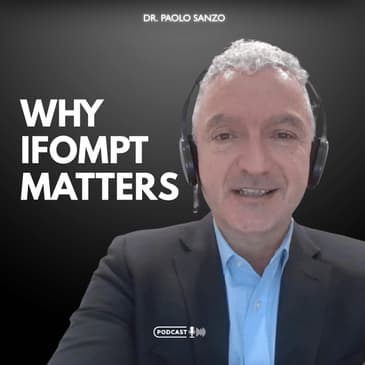
What role does IFOMPT play in global manual and musculoskeletal physiotherapy?
In this episode of the Hands-On, Hands-Off Podcast, leaders from AAOMPT sit down with IFOMPT President Dr. Paolo Sanzo to discuss international education standards, evidence-informed practice, and global collaboration. The conversation explores how IFOMPT supports clinicians, educators, and researchers worldwide—and why global consistency ultimately improves patient care.
00:00 – Introduction to the AAOMPT–IFOMPT collaborative series
01:29 – Introducing Dr. Paolo Sanzo and IFOMT leadership
03:19 – What IFOMPT is and its role within World Physiotherapy
04:12 – Paolo’s journey through IFOMPT leadership roles
05:21 – IFOMPT’s growth since 1974
07:11 – IFOMPT’s vision and mission explained
09:47 – Education standards and member organization requirements
12:10 – International monitoring and maintaining consistency
17:49 – Evidence-based practice and global context
20:16 – IFOMPT as a research and collaboration conduit
23:14 – Challenges and opportunities of global collaboration
26:18 – Working with international organizations and regions
30:35 – Strategic priorities and future direction
32:46 – Advice for clinicians pursuing excellence
34:02 – Final reflections and closing remarks
00:00:02 --> 00:00:03 Okay, we're recording.
00:00:05 --> 00:00:06 Welcome to the Hands-On,
00:00:06 --> 00:00:09 Hands-Off podcast brought to you by AONT,
00:00:09 --> 00:00:11 the American Academy of Orthopedic Manual
00:00:11 --> 00:00:11 Physical Therapists.
00:00:12 --> 00:00:14 And today we're really excited to launch
00:00:15 --> 00:00:18 the first of four podcasts,
00:00:18 --> 00:00:19 including iFOMT.
00:00:19 --> 00:00:21 So this is an AONT-iFOMT collaborative.
00:00:22 --> 00:00:23 And so over this series,
00:00:23 --> 00:00:24 we're going to bring you various
00:00:24 --> 00:00:26 conversations with internationally
00:00:26 --> 00:00:29 recognized speakers in orthopedic manual
00:00:29 --> 00:00:29 physical therapy.
00:00:30 --> 00:00:32 So we're really excited to launch this new
00:00:32 --> 00:00:32 series.
00:00:34 --> 00:00:35 And I'm Megan Donaldson.
00:00:35 --> 00:00:37 I'm the president of AOMT.
00:00:37 --> 00:00:39 And of course, I have Amy McDevitt,
00:00:39 --> 00:00:41 who's joining us as a member at large
00:00:41 --> 00:00:43 for our AOMT organization.
00:00:44 --> 00:00:45 And together today,
00:00:45 --> 00:00:47 we are thrilled to join a colleague and
00:00:47 --> 00:00:49 friend, Dr. Paolo Sanas,
00:00:49 --> 00:00:51 who is the president of IVOMT.
00:00:53 --> 00:00:55 So Paolo is an associate professor at
00:00:56 --> 00:00:59 Lakehead University and the Northern
00:00:59 --> 00:01:02 Ontario School of Medicine University,
00:01:02 --> 00:01:04 director of active potential
00:01:04 --> 00:01:06 rehabilitation services and a clinical
00:01:06 --> 00:01:08 specialist in musculoskeletal
00:01:08 --> 00:01:10 physiotherapy in Canada.
00:01:10 --> 00:01:13 He's also a lead instructor and examiner
00:01:13 --> 00:01:15 for the IFOMT accredited Advanced
00:01:16 --> 00:01:18 Integrated Musculoskeletal or AIM program
00:01:18 --> 00:01:20 of the Canadian Physiotherapy Association.
00:01:21 --> 00:01:24 Paolo is also currently the president of
00:01:24 --> 00:01:28 the iFOMT organization.
00:01:28 --> 00:01:29 And in this episode,
00:01:29 --> 00:01:31 we want to explore the iFOMT vision a
00:01:31 --> 00:01:33 bit more and Paolo has had such a
00:01:33 --> 00:01:36 rich contribution to this over the last
00:01:36 --> 00:01:39 many years and its role in shaping global
00:01:39 --> 00:01:41 standards for manual and musculoskeletal
00:01:41 --> 00:01:43 physical therapy with an international
00:01:43 --> 00:01:45 collaboration and what that means for
00:01:45 --> 00:01:47 patients and clinicians worldwide.
00:01:48 --> 00:01:50 So let's go ahead and get started.
00:01:51 --> 00:01:53 Paulo, first, again,
00:01:53 --> 00:01:54 we want to welcome you.
00:01:54 --> 00:01:57 Can you give us just a little bit
00:01:57 --> 00:01:58 of a background on yourself,
00:01:58 --> 00:02:00 if there's anything that wasn't covered in
00:02:00 --> 00:02:03 your introduction?
00:02:03 --> 00:02:05 Thank you very much, Amy and Megan,
00:02:05 --> 00:02:06 for the opportunity to be here today.
00:02:06 --> 00:02:08 And thank you for the very,
00:02:08 --> 00:02:09 very kind words and introduction.
00:02:10 --> 00:02:11 I guess the other thing is,
00:02:12 --> 00:02:14 other than physiotherapy and being a
00:02:14 --> 00:02:15 professor at a university,
00:02:16 --> 00:02:16 I am also
00:02:17 --> 00:02:17 you know,
00:02:17 --> 00:02:18 the husband of a wife that's an
00:02:18 --> 00:02:19 occupational therapist.
00:02:19 --> 00:02:22 And I have two wonderful daughters as well
00:02:22 --> 00:02:23 that are young adults,
00:02:23 --> 00:02:24 one in university still,
00:02:24 --> 00:02:27 and one that is starting her career as
00:02:27 --> 00:02:29 a nurse and going on to grad school
00:02:29 --> 00:02:31 and more education in the future.
00:02:32 --> 00:02:35 And I'm here in Northwestern Ontario,
00:02:35 --> 00:02:37 just north of the Minnesota border as
00:02:37 --> 00:02:39 well, and had some snow overnight.
00:02:40 --> 00:02:41 Yeah, and it's probably very cold.
00:02:43 --> 00:02:43 Well, you know what?
00:02:43 --> 00:02:45 It's been unseasonably warm,
00:02:45 --> 00:02:46 believe it or not,
00:02:46 --> 00:02:48 but we've had the last week or two
00:02:48 --> 00:02:49 things are changing and you can definitely
00:02:49 --> 00:02:52 get a flavor that winter is coming.
00:02:52 --> 00:02:53 That is great.
00:02:54 --> 00:02:54 Well,
00:02:54 --> 00:02:56 thank you for being here despite the cold
00:02:56 --> 00:02:57 and the need to shovel outside,
00:02:57 --> 00:02:59 as you mentioned previously.
00:02:59 --> 00:03:01 So I'm going to dive in.
00:03:01 --> 00:03:03 And what I wanted to start talking about
00:03:03 --> 00:03:05 first, Paolo, is really IFOMS.
00:03:05 --> 00:03:07 So for listeners who may not be familiar,
00:03:08 --> 00:03:09 can you tell us a little bit about
00:03:09 --> 00:03:13 what IFOMS is and what makes it unique
00:03:13 --> 00:03:16 in the global physiotherapy landscape?
00:03:16 --> 00:03:18 That's a great question and a great place
00:03:18 --> 00:03:19 to start.
00:03:19 --> 00:03:21 For people that aren't familiar with what
00:03:21 --> 00:03:23 iFONT is exactly as an organization,
00:03:24 --> 00:03:25 I think we start first with World
00:03:25 --> 00:03:26 Physiotherapy.
00:03:26 --> 00:03:29 World Physiotherapy is the representative
00:03:29 --> 00:03:31 organization globally for all
00:03:31 --> 00:03:33 physiotherapists that work in different
00:03:33 --> 00:03:35 areas of practice.
00:03:36 --> 00:03:38 And they have specialty groups that
00:03:38 --> 00:03:39 represent different,
00:03:40 --> 00:03:42 very specific or very unique
00:03:42 --> 00:03:45 niche-oriented special interest groups.
00:03:46 --> 00:03:47 And iFONT represents the
00:03:48 --> 00:03:50 physiotherapists that work in manual and
00:03:50 --> 00:03:52 musculoskeletal physiotherapy.
00:03:53 --> 00:03:55 And essentially, it is the oldest,
00:03:55 --> 00:03:58 it is the largest representative group for
00:03:59 --> 00:04:00 physiotherapists around the world.
00:04:00 --> 00:04:04 And it is a global representative.
00:04:05 --> 00:04:06 And so tell us a little bit about
00:04:06 --> 00:04:08 the history of some of what your
00:04:08 --> 00:04:10 involvement has been in IFOMT over time.
00:04:12 --> 00:04:12 Yes,
00:04:12 --> 00:04:15 so I was originally part of IFOMT as
00:04:15 --> 00:04:19 the junior delegate representing Canada
00:04:19 --> 00:04:21 and worked with our sort of delegate at
00:04:21 --> 00:04:24 the time to kind of learn and see
00:04:24 --> 00:04:26 what the role was exactly of delegate
00:04:26 --> 00:04:27 representing Canada.
00:04:28 --> 00:04:31 I then was appointed as a treasurer for
00:04:31 --> 00:04:33 the IFOMT executive committee,
00:04:33 --> 00:04:35 so had the capacity to kind of learn
00:04:35 --> 00:04:38 a little bit about the finances and the
00:04:38 --> 00:04:41 finance side of a global organization
00:04:42 --> 00:04:44 I then sat in the vice president's role
00:04:44 --> 00:04:46 for four years and had the opportunity to
00:04:46 --> 00:04:48 work with an amazing executive at that
00:04:48 --> 00:04:49 time,
00:04:49 --> 00:04:52 trying to implement strategy and change
00:04:52 --> 00:04:53 and listen to the delegates and what was
00:04:53 --> 00:04:54 happening around the world.
00:04:55 --> 00:04:57 And in twenty twenty four at the Basel
00:04:57 --> 00:04:58 Conference,
00:04:58 --> 00:05:00 I had the opportunity to now be elected
00:05:01 --> 00:05:02 into the president's role,
00:05:02 --> 00:05:04 which I currently sit in at this time.
00:05:05 --> 00:05:05 Yeah.
00:05:05 --> 00:05:06 And congratulations.
00:05:06 --> 00:05:08 Megan and I were both there for that.
00:05:08 --> 00:05:09 That was really exciting.
00:05:09 --> 00:05:10 It was a wonderful conference.
00:05:10 --> 00:05:12 It was so neat to have all these
00:05:12 --> 00:05:14 different people from different parts of
00:05:14 --> 00:05:15 the world come together and talk about
00:05:16 --> 00:05:17 topics that they're passionate about.
00:05:18 --> 00:05:19 And so, you know,
00:05:19 --> 00:05:20 iFont has been around since nineteen
00:05:20 --> 00:05:21 seventy four.
00:05:21 --> 00:05:23 How do you believe the organization has
00:05:23 --> 00:05:26 really grown over time?
00:05:26 --> 00:05:26 Wow.
00:05:26 --> 00:05:27 That's you know,
00:05:27 --> 00:05:29 it's been fifty one years now for this
00:05:29 --> 00:05:31 organization and it's really evolved,
00:05:32 --> 00:05:32 you know,
00:05:32 --> 00:05:34 originally from the grassroots of a
00:05:34 --> 00:05:36 passionate group of individuals that
00:05:36 --> 00:05:39 really had an interest in manual and
00:05:39 --> 00:05:42 manipulative physiotherapy to the
00:05:42 --> 00:05:45 development of educational standards that
00:05:46 --> 00:05:48 should be part of this organization and
00:05:48 --> 00:05:52 guiding education around the world to now
00:05:52 --> 00:05:54 where it has evolved and integrated
00:05:54 --> 00:05:57 evidence and research into everything that
00:05:57 --> 00:06:00 we do and really try to upskill and
00:06:00 --> 00:06:01 upscale
00:06:01 --> 00:06:03 the organization from a governance
00:06:03 --> 00:06:04 perspective,
00:06:05 --> 00:06:07 from the integration and connection of
00:06:08 --> 00:06:09 clinicians and researchers
00:06:10 --> 00:06:12 and trying to transform and transport that
00:06:12 --> 00:06:14 into our educational system,
00:06:14 --> 00:06:17 whether it is community-based programs,
00:06:17 --> 00:06:19 university-based programs that teach a
00:06:19 --> 00:06:22 variety of topics related to this,
00:06:22 --> 00:06:25 but also the growth of just the profession
00:06:26 --> 00:06:28 and trying to keep up with all of
00:06:28 --> 00:06:29 those changes.
00:06:29 --> 00:06:29 You know,
00:06:29 --> 00:06:32 I've really tried to integrate the history
00:06:32 --> 00:06:34 into sort of the modern contemporary
00:06:34 --> 00:06:36 physiotherapists and the roles
00:06:36 --> 00:06:38 that we have at an organizational level
00:06:38 --> 00:06:41 and also be globally representative and
00:06:41 --> 00:06:43 mindful of where everybody's at around the
00:06:43 --> 00:06:43 world.
00:06:43 --> 00:06:44 Yeah,
00:06:44 --> 00:06:45 and I think that's a really important
00:06:47 --> 00:06:47 you know,
00:06:47 --> 00:06:49 comment and I don't know that I really
00:06:49 --> 00:06:51 appreciated it until I came to some of
00:06:51 --> 00:06:52 the I found conferences.
00:06:52 --> 00:06:53 So I was at Glasgow and then I
00:06:53 --> 00:06:56 was in Basel and it's really interesting,
00:06:56 --> 00:06:57 you know, to your point,
00:06:57 --> 00:06:59 to just see what's happening globally.
00:06:59 --> 00:07:01 A lot of times I think we're myopic
00:07:01 --> 00:07:03 in our own country or region.
00:07:03 --> 00:07:05 And so it's it's interesting to get
00:07:05 --> 00:07:07 together with this group and really see
00:07:07 --> 00:07:09 how things are moving, you know,
00:07:09 --> 00:07:10 not just locally, but worldwide.
00:07:11 --> 00:07:13 What are some of the, like,
00:07:13 --> 00:07:15 what's the vision for iFOMT?
00:07:15 --> 00:07:16 Can you share a little bit of the,
00:07:16 --> 00:07:18 maybe the mission and vision and why it
00:07:18 --> 00:07:20 matters for musculoskeletal health
00:07:20 --> 00:07:21 worldwide?
00:07:22 --> 00:07:22 Yes.
00:07:22 --> 00:07:25 So I think if you think about iFOMT's
00:07:25 --> 00:07:27 vision and we're in the process right now
00:07:27 --> 00:07:30 of rolling out a new strategic plan and
00:07:30 --> 00:07:32 we've just announced a new vision and our
00:07:32 --> 00:07:34 vision is really a world where
00:07:34 --> 00:07:37 musculoskeletal physiotherapy transforms
00:07:37 --> 00:07:38 the lives of our patients
00:07:39 --> 00:07:41 and strengthens global health.
00:07:41 --> 00:07:43 We really want to try to take on
00:07:43 --> 00:07:45 a bigger role as physiotherapists.
00:07:45 --> 00:07:47 The opportunities there,
00:07:47 --> 00:07:50 we have sort of the skill set,
00:07:50 --> 00:07:51 the educational background,
00:07:51 --> 00:07:54 the will to be able to do this.
00:07:55 --> 00:07:56 From a mission perspective,
00:07:56 --> 00:07:58 in terms of our organization,
00:07:59 --> 00:08:01 there's a call for us to take on
00:08:01 --> 00:08:03 different roles and responsibilities.
00:08:03 --> 00:08:06 And we really want to promote and advance
00:08:06 --> 00:08:08 manual and musculoskeletal physiotherapy
00:08:08 --> 00:08:09 worldwide.
00:08:09 --> 00:08:10 And how can we do that?
00:08:10 --> 00:08:11 Well,
00:08:11 --> 00:08:13 we can do that by exchanging scientific
00:08:13 --> 00:08:14 knowledge.
00:08:14 --> 00:08:16 We want to try to encourage research and
00:08:16 --> 00:08:18 innovation and connect clinicians and
00:08:18 --> 00:08:21 researchers and really try to support and
00:08:21 --> 00:08:24 foster higher educational and clinical
00:08:24 --> 00:08:26 standards and really try to represent
00:08:27 --> 00:08:28 physiotherapists around the world
00:08:28 --> 00:08:29 internationally.
00:08:29 --> 00:08:30 And how can we do that?
00:08:30 --> 00:08:31 I think we can do that through
00:08:31 --> 00:08:34 collaboration and continuing to use
00:08:34 --> 00:08:37 evidence-informed practices and answer
00:08:37 --> 00:08:38 some of the difficult discussions and
00:08:38 --> 00:08:40 questions that people are having,
00:08:40 --> 00:08:41 but at the same time,
00:08:42 --> 00:08:43 to also not be afraid to say,
00:08:44 --> 00:08:44 we don't know,
00:08:45 --> 00:08:46 and we need to continue to build on
00:08:46 --> 00:08:49 that knowledge and motivate people to
00:08:49 --> 00:08:50 continue to learn.
00:08:51 --> 00:08:52 Yeah, I think that's great.
00:08:53 --> 00:08:55 And some of my own observations are that
00:08:56 --> 00:08:58 know the collaborations that are happening
00:08:59 --> 00:09:01 across this organization with people in
00:09:01 --> 00:09:03 different regions of the world is really
00:09:04 --> 00:09:06 incredible and i i love that the the
00:09:06 --> 00:09:09 vision is is i see it playing out
00:09:09 --> 00:09:11 in real time and i i think it's
00:09:11 --> 00:09:14 fantastic um i'm gonna turn it over to
00:09:14 --> 00:09:16 megan to ask you know just a couple
00:09:16 --> 00:09:18 questions that um she's interested about
00:09:19 --> 00:09:21 So Paolo, I mean, again, IFOMT has been,
00:09:22 --> 00:09:23 I love the word evolving.
00:09:23 --> 00:09:25 I mean, you have been highlighting that,
00:09:25 --> 00:09:26 the growth,
00:09:27 --> 00:09:29 hearing the needs and responding, right?
00:09:29 --> 00:09:29 I mean,
00:09:29 --> 00:09:32 I think that's a job of any organization.
00:09:32 --> 00:09:34 And I share that understanding is
00:09:34 --> 00:09:35 obviously present of AOMT.
00:09:36 --> 00:09:37 You're learning, you're receiving,
00:09:37 --> 00:09:37 you're growing,
00:09:38 --> 00:09:40 and we're trying to constantly integrate
00:09:40 --> 00:09:41 what we're learning from an evidence
00:09:41 --> 00:09:43 standpoint into practice.
00:09:43 --> 00:09:44 And so let's dive a little bit more
00:09:45 --> 00:09:47 into maybe some standards in education,
00:09:47 --> 00:09:47 because
00:09:47 --> 00:09:49 Obviously, IFOMT has a huge role there,
00:09:50 --> 00:09:52 especially as the group that's, you know,
00:09:52 --> 00:09:53 we have these standards and these
00:09:53 --> 00:09:55 standards are used across the world,
00:09:55 --> 00:09:56 which is pretty important.
00:09:57 --> 00:09:59 And so IFOMT established rigorous
00:09:59 --> 00:10:01 standards for education and practice,
00:10:01 --> 00:10:03 especially for advanced musculoskeletal
00:10:03 --> 00:10:04 manual therapy.
00:10:04 --> 00:10:06 And so what does that process look like
00:10:06 --> 00:10:08 for a member organization?
00:10:08 --> 00:10:09 So maybe talk a little bit about that
00:10:10 --> 00:10:12 so they can understand how do we get
00:10:12 --> 00:10:14 to be an MO and why is that
00:10:14 --> 00:10:14 so important?
00:10:15 --> 00:10:16 Yeah, thanks, Megan.
00:10:16 --> 00:10:18 And that's the foundation really for our
00:10:18 --> 00:10:19 organization.
00:10:19 --> 00:10:21 And it also makes us unique from other
00:10:21 --> 00:10:23 special interest groups within World
00:10:23 --> 00:10:24 Physiotherapy.
00:10:24 --> 00:10:26 We are the only one that actually has
00:10:26 --> 00:10:29 a standard by which countries need to meet
00:10:29 --> 00:10:31 that standard in order to be a full
00:10:32 --> 00:10:33 member organization.
00:10:33 --> 00:10:35 So what might this look like?
00:10:35 --> 00:10:35 You know,
00:10:35 --> 00:10:37 this might be a country that is not
00:10:37 --> 00:10:39 part of our organization that has an
00:10:39 --> 00:10:43 interest in A, being part of this group.
00:10:43 --> 00:10:45 also looking at the programs within,
00:10:46 --> 00:10:47 program or programs,
00:10:47 --> 00:10:48 it could be multiple programs within that
00:10:48 --> 00:10:49 country,
00:10:49 --> 00:10:51 and looking at the curriculum that they
00:10:51 --> 00:10:52 have set,
00:10:52 --> 00:10:54 and making sure that it meets the
00:10:54 --> 00:10:57 different competencies, pillars,
00:10:57 --> 00:10:59 dimensions that are identified in the
00:11:00 --> 00:11:02 IFLMP Educational Standards document.
00:11:03 --> 00:11:03 Now,
00:11:03 --> 00:11:05 what they do is they essentially compile
00:11:05 --> 00:11:06 all of this information,
00:11:07 --> 00:11:10 and with the work and assistance of some
00:11:10 --> 00:11:10 of the
00:11:11 --> 00:11:13 advisory groups that we have,
00:11:13 --> 00:11:14 and it's the advisory group on membership
00:11:14 --> 00:11:15 development.
00:11:15 --> 00:11:16 They would work really closely with that
00:11:16 --> 00:11:18 group essentially to make sure that
00:11:18 --> 00:11:20 they've got everything that's required
00:11:20 --> 00:11:20 there.
00:11:20 --> 00:11:22 At that stage of the game,
00:11:22 --> 00:11:24 it then is submitted to IFONT,
00:11:24 --> 00:11:27 who has the standards committee and the
00:11:27 --> 00:11:29 executive committee essentially looking at
00:11:29 --> 00:11:30 that material,
00:11:31 --> 00:11:32 and the standards committee would
00:11:32 --> 00:11:33 independently,
00:11:33 --> 00:11:36 very closely and objectively compare it to
00:11:36 --> 00:11:38 the current standards document that we
00:11:38 --> 00:11:38 have.
00:11:39 --> 00:11:40 And essentially what they do is they
00:11:41 --> 00:11:44 provide some feedback on things that have
00:11:44 --> 00:11:46 met the standard versus things that that
00:11:46 --> 00:11:48 country maybe needs to work on.
00:11:49 --> 00:11:49 Now,
00:11:49 --> 00:11:52 if the application and those standards
00:11:53 --> 00:11:55 meet this fairly high level,
00:11:55 --> 00:11:58 rigorous educational standard that has
00:11:58 --> 00:11:59 been set,
00:12:00 --> 00:12:03 then what happens is the delegate assembly
00:12:03 --> 00:12:07 would vote on this country being part of
00:12:07 --> 00:12:09 the standards, being part of IFUNCT.
00:12:10 --> 00:12:11 And at that stage,
00:12:11 --> 00:12:12 they would then enter into this
00:12:12 --> 00:12:14 international monitoring process,
00:12:14 --> 00:12:16 which is one of the benefits of making
00:12:16 --> 00:12:18 sure that those countries continue to have
00:12:19 --> 00:12:21 these high educational standards threaded
00:12:21 --> 00:12:23 through their curriculum from that point
00:12:23 --> 00:12:23 forward.
00:12:24 --> 00:12:25 Yeah,
00:12:25 --> 00:12:27 there's so much to unpack in that because
00:12:27 --> 00:12:29 I remember when we got to vote on
00:12:29 --> 00:12:32 some of these countries and there's such
00:12:32 --> 00:12:34 pride in that.
00:12:35 --> 00:12:37 Watching them go from a rig to an
00:12:37 --> 00:12:39 MO and knowing that they've invested
00:12:39 --> 00:12:39 energy, time,
00:12:39 --> 00:12:41 and resources in some countries that just
00:12:41 --> 00:12:43 don't have as much time, energy,
00:12:43 --> 00:12:44 and resource.
00:12:45 --> 00:12:47 Seeing the passion of some individuals
00:12:47 --> 00:12:48 bringing that forward and carrying that
00:12:48 --> 00:12:49 along the way.
00:12:49 --> 00:12:50 I met with some of the groups and
00:12:50 --> 00:12:51 that was really,
00:12:51 --> 00:12:51 really a
00:12:51 --> 00:12:53 a unique experience to watch them,
00:12:54 --> 00:12:54 you know,
00:12:54 --> 00:12:55 be announced as an MO and the pride
00:12:55 --> 00:12:57 that you can see that that brought.
00:12:57 --> 00:12:57 So,
00:12:58 --> 00:12:59 and then you talked a little bit about,
00:12:59 --> 00:12:59 you know,
00:12:59 --> 00:13:01 the packaging where you go and you're
00:13:01 --> 00:13:03 supporting them and the groups that are
00:13:03 --> 00:13:04 doing that, you know,
00:13:04 --> 00:13:06 and I think this is where maybe you
00:13:06 --> 00:13:08 can talk about maybe the IAM monitoring
00:13:08 --> 00:13:10 process a little bit more because my
00:13:10 --> 00:13:10 question,
00:13:10 --> 00:13:12 and I think this is more from a
00:13:12 --> 00:13:13 worldwide,
00:13:13 --> 00:13:14 understand that maybe in the US we're
00:13:14 --> 00:13:16 thinking about competency-based education.
00:13:17 --> 00:13:19 You all have talked about criterion-based
00:13:19 --> 00:13:20 education, different aspects of it.
00:13:21 --> 00:13:23 But how does IFOMP ensure consistency,
00:13:23 --> 00:13:25 maybe in these clinical competencies
00:13:25 --> 00:13:27 across all these countries and cultures
00:13:28 --> 00:13:30 that might have varying resources and
00:13:30 --> 00:13:30 supports?
00:13:30 --> 00:13:32 And so maybe you can talk a little
00:13:32 --> 00:13:33 bit about that and unpack that.
00:13:33 --> 00:13:35 What I am monitoring is after they become
00:13:35 --> 00:13:36 an MO.
00:13:36 --> 00:13:37 Yeah, that's great.
00:13:38 --> 00:13:41 So so essentially and let me maybe preface
00:13:41 --> 00:13:43 it first by saying, you know,
00:13:43 --> 00:13:45 the intent is to try to review the
00:13:45 --> 00:13:48 standards document in periodic segments.
00:13:48 --> 00:13:50 And we're currently doing that right now.
00:13:51 --> 00:13:52 and we're updating the standards document
00:13:52 --> 00:13:53 to, again,
00:13:53 --> 00:13:54 try to make it more contemporary,
00:13:54 --> 00:13:55 try to update it with the evidence.
00:13:56 --> 00:13:58 Much of the content that's in there
00:13:58 --> 00:13:59 already is still very, very good,
00:14:00 --> 00:14:02 but it's really to add more to it.
00:14:02 --> 00:14:02 Now,
00:14:02 --> 00:14:04 from an international monitoring
00:14:05 --> 00:14:05 perspective,
00:14:07 --> 00:14:09 as with the development of the new
00:14:09 --> 00:14:10 standards document,
00:14:10 --> 00:14:13 the processes are also under kind of
00:14:13 --> 00:14:16 review and development and being modified.
00:14:16 --> 00:14:16 Now,
00:14:17 --> 00:14:19 if we look at how does this normally
00:14:19 --> 00:14:19 happen?
00:14:20 --> 00:14:20 A country,
00:14:20 --> 00:14:22 once they become a member of IFOM,
00:14:23 --> 00:14:25 they then undergo international monitoring
00:14:25 --> 00:14:27 approximately once every six years.
00:14:28 --> 00:14:29 And this is a pretty big deal.
00:14:29 --> 00:14:29 You know,
00:14:29 --> 00:14:32 this is a really big job for the
00:14:32 --> 00:14:32 countries.
00:14:32 --> 00:14:33 It's fairly labor intensive.
00:14:34 --> 00:14:34 There's a cost,
00:14:35 --> 00:14:38 whether it's time or cost for the process
00:14:38 --> 00:14:39 undertaking itself.
00:14:39 --> 00:14:41 So I think as an organization,
00:14:41 --> 00:14:44 we need to rely on the national
00:14:44 --> 00:14:46 accreditation bodies that programs have
00:14:46 --> 00:14:47 you know, independently,
00:14:47 --> 00:14:49 some on a yearly basis.
00:14:49 --> 00:14:50 But every six years,
00:14:51 --> 00:14:53 what will happen is an external assessor
00:14:53 --> 00:14:56 essentially reviews and provides some
00:14:56 --> 00:14:59 feedback and input with regards to what
00:14:59 --> 00:15:02 their thoughts are on changes or
00:15:02 --> 00:15:04 modifications that have been done to those
00:15:04 --> 00:15:07 programs and across all aspects of the
00:15:07 --> 00:15:09 program, not just curriculum.
00:15:10 --> 00:15:10 It could be,
00:15:10 --> 00:15:12 what did they do from the practical
00:15:13 --> 00:15:14 application sense?
00:15:14 --> 00:15:16 How do they deliver some of that
00:15:16 --> 00:15:19 content that feedback from an external
00:15:20 --> 00:15:22 assessor then comes back to the standards
00:15:23 --> 00:15:25 committee who obviously will compare it to
00:15:25 --> 00:15:27 you know where were they in the past
00:15:27 --> 00:15:29 when they were either monitored previously
00:15:30 --> 00:15:31 or if they were some a country that
00:15:31 --> 00:15:34 was relatively new they'll kind of monitor
00:15:34 --> 00:15:38 and again provide some suggestions on how
00:15:39 --> 00:15:41 and what they can maybe focus on for
00:15:41 --> 00:15:45 the next monitoring also if there are some
00:15:45 --> 00:15:45 deficiencies
00:15:46 --> 00:15:47 that would be flagged or that would be
00:15:47 --> 00:15:48 highlighted.
00:15:48 --> 00:15:50 And moving forward in the future,
00:15:51 --> 00:15:53 the hope is we've got some really seasoned
00:15:53 --> 00:15:55 countries that they've been doing this for
00:15:55 --> 00:15:56 a long time.
00:15:56 --> 00:15:57 They're really,
00:15:57 --> 00:15:58 really well established that have been
00:15:58 --> 00:16:00 monitored four or five times.
00:16:00 --> 00:16:02 So I think what we'll sort of see
00:16:02 --> 00:16:04 in the future is that some countries,
00:16:04 --> 00:16:06 it will be a little more of a
00:16:06 --> 00:16:07 streamlined approach,
00:16:07 --> 00:16:07 others
00:16:08 --> 00:16:10 might have more of a directed type of
00:16:10 --> 00:16:12 approach where it was really this
00:16:12 --> 00:16:14 particular aspect that we needed to look
00:16:14 --> 00:16:14 at.
00:16:14 --> 00:16:16 Tell us about how that might be changed
00:16:16 --> 00:16:18 versus others that might have,
00:16:18 --> 00:16:20 we've got a new program within this
00:16:20 --> 00:16:22 respective country that might be a bit
00:16:22 --> 00:16:25 more of a comprehensive type of a review.
00:16:25 --> 00:16:26 Essentially, by using that,
00:16:27 --> 00:16:29 that's how we ensure that all of these
00:16:29 --> 00:16:32 countries with external assessors,
00:16:32 --> 00:16:34 with the standards committee,
00:16:34 --> 00:16:36 with the self-reflection process of those
00:16:36 --> 00:16:37 individual countries,
00:16:38 --> 00:16:40 That allows us to ensure that clinical
00:16:40 --> 00:16:42 competency is met and those high standards
00:16:42 --> 00:16:44 are maintained throughout.
00:16:44 --> 00:16:45 Yeah.
00:16:45 --> 00:16:47 And that's, I mean, again,
00:16:47 --> 00:16:49 that's such a job for an organization to
00:16:49 --> 00:16:51 keep that high level standard.
00:16:51 --> 00:16:53 And again, when I say standard,
00:16:53 --> 00:16:54 it's that commonality across all these
00:16:54 --> 00:16:57 countries that we can have trust and know
00:16:57 --> 00:16:57 that
00:16:58 --> 00:16:59 what you're doing in your country is
00:16:59 --> 00:17:00 similar to our country.
00:17:00 --> 00:17:02 And that's what I think the beauty is
00:17:02 --> 00:17:04 and really appreciating IFOM's heavy work
00:17:04 --> 00:17:06 in that space because I know it has
00:17:07 --> 00:17:08 to evolve too, right?
00:17:08 --> 00:17:08 Like again,
00:17:08 --> 00:17:11 I appreciate kind of the pragmatic nature
00:17:11 --> 00:17:14 that I hear the responsiveness rather than
00:17:14 --> 00:17:15 this is the prescriptive approach.
00:17:15 --> 00:17:16 I might be wearing a little bit of
00:17:16 --> 00:17:18 an accreditation lens at times and I'm
00:17:18 --> 00:17:19 like, man,
00:17:19 --> 00:17:21 sometimes this just could be a little
00:17:21 --> 00:17:21 easier.
00:17:21 --> 00:17:22 And so it sounds like you guys are
00:17:23 --> 00:17:24 making some thoughtful transitions
00:17:25 --> 00:17:26 in ways to kind of be responsive to
00:17:26 --> 00:17:28 needs, which I really can appreciate.
00:17:29 --> 00:17:31 I'd love to take it another direction and
00:17:31 --> 00:17:33 maybe look a little bit more at a
00:17:33 --> 00:17:33 scholarship,
00:17:34 --> 00:17:35 but really evidence-based practice as we
00:17:35 --> 00:17:36 think about scholarship,
00:17:37 --> 00:17:38 maybe a little bit more education.
00:17:38 --> 00:17:39 And we've talked a little bit about that,
00:17:39 --> 00:17:41 so we can dive into that.
00:17:41 --> 00:17:43 But education also then means
00:17:43 --> 00:17:44 evidence-based practice,
00:17:44 --> 00:17:45 how we're training people,
00:17:45 --> 00:17:46 how we're seeing things happening in the
00:17:46 --> 00:17:47 clinic.
00:17:48 --> 00:17:49 As you've mentioned,
00:17:49 --> 00:17:52 iFOMD really emphasizes evidence-based
00:17:52 --> 00:17:54 practice and looking at that integration
00:17:54 --> 00:17:56 into your standards and how we make
00:17:56 --> 00:17:59 clinical practice across the world to meet
00:17:59 --> 00:18:00 the vision.
00:18:00 --> 00:18:02 So how do you see research shaping
00:18:03 --> 00:18:05 education and practice of musculoskeletal
00:18:05 --> 00:18:07 manual therapy in the next decade?
00:18:07 --> 00:18:09 If you maybe can give us some thoughts
00:18:09 --> 00:18:10 there.
00:18:10 --> 00:18:11 Yeah,
00:18:11 --> 00:18:13 so I think everything that we do is...
00:18:14 --> 00:18:15 is centered with evidence.
00:18:16 --> 00:18:18 We have to be clinically informed by what
00:18:18 --> 00:18:20 the best available evidence is at that
00:18:20 --> 00:18:21 time.
00:18:21 --> 00:18:22 But at the same time,
00:18:23 --> 00:18:24 I think we also need to realize as
00:18:24 --> 00:18:26 clinicians, as researchers,
00:18:26 --> 00:18:27 as an organization,
00:18:27 --> 00:18:29 the limitations of the evidence,
00:18:29 --> 00:18:30 whether it's the designs,
00:18:30 --> 00:18:32 whether it's the interpretation of the
00:18:32 --> 00:18:34 information, whether it's the context.
00:18:35 --> 00:18:37 And the context could be so very different
00:18:37 --> 00:18:39 if I'm in North America,
00:18:39 --> 00:18:40 if I am in Europe,
00:18:40 --> 00:18:43 if I'm in South America, Africa, Asia,
00:18:43 --> 00:18:44 Wherever I am in the world,
00:18:44 --> 00:18:46 the context and the person in front of
00:18:46 --> 00:18:48 me is so very different.
00:18:49 --> 00:18:50 And the makeup,
00:18:50 --> 00:18:52 we just don't have a one size fits
00:18:52 --> 00:18:53 all.
00:18:53 --> 00:18:55 And I think that sometimes we try to
00:18:55 --> 00:18:57 oversimplify the evidence and we try to do
00:18:57 --> 00:18:58 that purposefully, I think,
00:18:58 --> 00:19:01 to try to get the message across to
00:19:01 --> 00:19:02 clinicians,
00:19:03 --> 00:19:04 to other health care providers,
00:19:04 --> 00:19:05 to our patients as well.
00:19:06 --> 00:19:07 But I think the evidence is really what
00:19:07 --> 00:19:09 guides everything that we do.
00:19:09 --> 00:19:11 And as an organization in developing the
00:19:11 --> 00:19:13 standards many, many years ago,
00:19:13 --> 00:19:15 they were driven by the evidence and the
00:19:15 --> 00:19:18 research that was being performed in this,
00:19:18 --> 00:19:20 not even just in this space,
00:19:20 --> 00:19:23 but in other spaces and just evolving the
00:19:23 --> 00:19:27 role of physiotherapy in all different
00:19:27 --> 00:19:29 conditions.
00:19:30 --> 00:19:30 Yeah.
00:19:30 --> 00:19:31 And, you know,
00:19:31 --> 00:19:33 when you identify like person-centered
00:19:33 --> 00:19:35 care and we're seeing the growth,
00:19:35 --> 00:19:35 you know,
00:19:35 --> 00:19:38 you think about in person-centered care,
00:19:38 --> 00:19:38 where they came from,
00:19:38 --> 00:19:40 their environment and their cultures.
00:19:41 --> 00:19:42 have such a huge impact because, I mean,
00:19:42 --> 00:19:44 it even goes to external validity of any
00:19:44 --> 00:19:45 study, right?
00:19:45 --> 00:19:47 Can you relate it back to that population
00:19:47 --> 00:19:48 in which the sample came from?
00:19:49 --> 00:19:50 And if your cultures are vastly different,
00:19:50 --> 00:19:52 it makes it really hard to generalize some
00:19:52 --> 00:19:53 of those things.
00:19:53 --> 00:19:54 So that may be part of the reason
00:19:54 --> 00:19:58 we see a variety of results in different
00:19:58 --> 00:19:59 studies, again,
00:19:59 --> 00:20:01 based on the populations in which they're
00:20:01 --> 00:20:01 sampled.
00:20:02 --> 00:20:03 which might be different countries for
00:20:03 --> 00:20:04 iFont, right?
00:20:04 --> 00:20:06 So that leads me to my next one,
00:20:06 --> 00:20:09 which is really how does iFont play a
00:20:09 --> 00:20:11 role in really promoting kind of research
00:20:11 --> 00:20:14 in this collaboration model that we need
00:20:14 --> 00:20:15 to do internationally?
00:20:16 --> 00:20:16 Well, you know,
00:20:17 --> 00:20:19 I really think that the iFont is the
00:20:19 --> 00:20:20 conduit.
00:20:20 --> 00:20:23 It's the organizer that will sort of bring
00:20:23 --> 00:20:26 the different clinicians and researchers
00:20:26 --> 00:20:28 around the world together with a common
00:20:28 --> 00:20:29 passion or interest.
00:20:29 --> 00:20:30 you know,
00:20:30 --> 00:20:32 I've developed several position statements
00:20:32 --> 00:20:35 that, you know, relate back to, you know,
00:20:35 --> 00:20:38 the cervical artery dissections or,
00:20:39 --> 00:20:39 you know,
00:20:39 --> 00:20:41 challenges with the vertebral artery and
00:20:41 --> 00:20:42 vertebral basilar system.
00:20:42 --> 00:20:44 That was maybe one of our first and
00:20:44 --> 00:20:46 sort of outputs that occurred.
00:20:47 --> 00:20:49 I think recognizing that we then need to
00:20:49 --> 00:20:51 be more that knowledge broker,
00:20:51 --> 00:20:52 that knowledge translator and
00:20:52 --> 00:20:54 disseminator, you know,
00:20:54 --> 00:20:56 developing position statements around
00:20:56 --> 00:20:57 you know,
00:20:57 --> 00:20:58 recognizing red flags or serious
00:20:58 --> 00:21:01 pathology, recognizing, you know,
00:21:01 --> 00:21:03 the use of pediatric manipulation and
00:21:03 --> 00:21:05 continuing to sort of develop these
00:21:05 --> 00:21:08 special interests that really continue to
00:21:08 --> 00:21:11 inform different aspects of manual and
00:21:11 --> 00:21:14 musculoskeletal physiotherapy is sort of
00:21:14 --> 00:21:17 the role where iFOMT sort of helps to
00:21:17 --> 00:21:18 develop that.
00:21:18 --> 00:21:21 We also are a conduit where people can
00:21:21 --> 00:21:23 have a wider group to get different
00:21:23 --> 00:21:26 perspectives as opposed to it just being
00:21:27 --> 00:21:27 I'm from Canada,
00:21:27 --> 00:21:29 just Canadian-driven perspective.
00:21:30 --> 00:21:31 By integrating IFOMP,
00:21:31 --> 00:21:33 now we're able to have this global
00:21:33 --> 00:21:35 community of either researchers and
00:21:35 --> 00:21:37 collaborators that are directly involved
00:21:37 --> 00:21:40 in the projects or having the input from
00:21:40 --> 00:21:42 different perspectives around the world.
00:21:42 --> 00:21:43 And I really think
00:21:44 --> 00:21:46 that that will continue to be a big
00:21:46 --> 00:21:49 role that iPhone plays in different topic
00:21:49 --> 00:21:49 areas.
00:21:49 --> 00:21:51 And it could be topical depending upon
00:21:52 --> 00:21:54 what's going on at that time in the
00:21:54 --> 00:21:54 world.
00:21:54 --> 00:21:56 It could be something that we build on
00:21:56 --> 00:21:57 as the research develops.
00:21:58 --> 00:22:00 This also drives some of our speakers at
00:22:00 --> 00:22:02 different conferences that we have or
00:22:02 --> 00:22:04 courses and workshops that people have.
00:22:04 --> 00:22:04 And again,
00:22:05 --> 00:22:07 it's iPhone's ability to be able to
00:22:08 --> 00:22:09 connect some of those people, I think.
00:22:10 --> 00:22:11 It's wonderful.
00:22:11 --> 00:22:12 Hey, thanks so much.
00:22:12 --> 00:22:12 Cause I know this is like,
00:22:13 --> 00:22:14 this would be a passion topic.
00:22:14 --> 00:22:15 We could just have one podcast just on
00:22:16 --> 00:22:16 this alone.
00:22:16 --> 00:22:16 Right.
00:22:16 --> 00:22:18 So thanks for going to give an issue
00:22:18 --> 00:22:19 of vision there.
00:22:19 --> 00:22:20 Yeah.
00:22:20 --> 00:22:21 And I think I, you know,
00:22:21 --> 00:22:25 I think it's really important to hear
00:22:25 --> 00:22:27 about some of these collaborations that
00:22:27 --> 00:22:30 have occurred really as a result of IFONT
00:22:30 --> 00:22:33 organizing researchers and clinicians from
00:22:33 --> 00:22:34 different parts of the world to come up
00:22:34 --> 00:22:35 with some of these standards,
00:22:35 --> 00:22:36 because again,
00:22:36 --> 00:22:38 I think it's important that IFOMT is the
00:22:38 --> 00:22:41 body that kind of initiates some of these
00:22:41 --> 00:22:42 collaboratives.
00:22:42 --> 00:22:44 And you spoke about, you know,
00:22:44 --> 00:22:47 some of the VBI work and then the
00:22:47 --> 00:22:48 Pediatric Manipulation Task Force.
00:22:49 --> 00:22:52 And a lot of those products, you know,
00:22:52 --> 00:22:54 are the currency of this organization.
00:22:54 --> 00:22:56 And I think it's fantastic.
00:22:56 --> 00:22:58 And they're used and I think and adopted
00:22:58 --> 00:23:00 broadly because you're able to bring in
00:23:00 --> 00:23:02 people from different parts of the world.
00:23:02 --> 00:23:03 I think that's really important work.
00:23:04 --> 00:23:06 But I know with that also comes,
00:23:06 --> 00:23:06 you know,
00:23:07 --> 00:23:09 challenges in terms of collaborating
00:23:09 --> 00:23:10 globally.
00:23:10 --> 00:23:12 And what do you think some of those
00:23:12 --> 00:23:14 challenges but also opportunities are?
00:23:14 --> 00:23:16 Because this is really the organization
00:23:16 --> 00:23:18 that's trying to unite manual therapy
00:23:18 --> 00:23:20 standards and work globally.
00:23:20 --> 00:23:20 So again,
00:23:21 --> 00:23:22 what are some of the challenges that you
00:23:22 --> 00:23:23 see, Paulo,
00:23:23 --> 00:23:24 and what are some of the opportunities?
00:23:25 --> 00:23:27 I think the biggest challenge is even at
00:23:28 --> 00:23:29 a professional level,
00:23:29 --> 00:23:31 meaning that the role and abilities of
00:23:31 --> 00:23:32 physiotherapists
00:23:33 --> 00:23:35 are different depending upon different
00:23:35 --> 00:23:37 parts of the world and the education that
00:23:37 --> 00:23:39 they have to get to that stage.
00:23:39 --> 00:23:41 Some countries are still at a bachelor's
00:23:41 --> 00:23:43 level, other are at a postgraduate level,
00:23:43 --> 00:23:45 whether it's a master's or a doctoral
00:23:45 --> 00:23:45 level.
00:23:46 --> 00:23:47 So that creates a
00:23:47 --> 00:23:50 quite a broad spectrum of entry-level
00:23:50 --> 00:23:52 physiotherapy that they have.
00:23:52 --> 00:23:53 Now, post-professionally as well,
00:23:54 --> 00:23:56 there's quite a variety of community-based
00:23:56 --> 00:23:59 versus university-based educational
00:23:59 --> 00:24:00 programs post-professionally.
00:24:01 --> 00:24:01 Now,
00:24:01 --> 00:24:02 we know that the curriculum within those
00:24:02 --> 00:24:05 programs meets the standards,
00:24:05 --> 00:24:07 so they should be at that consistent
00:24:07 --> 00:24:07 level.
00:24:07 --> 00:24:09 But the different responsibilities and
00:24:10 --> 00:24:12 educational levels also align with
00:24:12 --> 00:24:13 national standards
00:24:13 --> 00:24:16 alliances with your regulatory bodies.
00:24:16 --> 00:24:18 So because you know what you can do
00:24:18 --> 00:24:19 in one part of the world,
00:24:19 --> 00:24:20 you may not be able to do in
00:24:20 --> 00:24:21 another part of the world.
00:24:21 --> 00:24:23 kind of creates some challenges,
00:24:23 --> 00:24:25 especially when you're trying to either
00:24:25 --> 00:24:28 develop research that's trying to elevate,
00:24:28 --> 00:24:29 continually elevate what we do.
00:24:30 --> 00:24:31 Well, in some countries,
00:24:31 --> 00:24:32 they're not there yet.
00:24:33 --> 00:24:34 They may not be there for five or
00:24:34 --> 00:24:34 ten years.
00:24:35 --> 00:24:37 So that creates both a challenge but also
00:24:37 --> 00:24:39 an opportunity within those through
00:24:39 --> 00:24:40 advocacy,
00:24:40 --> 00:24:42 through demonstrating what they are able
00:24:42 --> 00:24:45 to do in some countries and the success
00:24:45 --> 00:24:47 as well as the cost benefits that come
00:24:47 --> 00:24:48 with that.
00:24:48 --> 00:24:48 You know,
00:24:48 --> 00:24:50 some of the other challenges are obviously
00:24:50 --> 00:24:51 fiscal,
00:24:51 --> 00:24:53 meaning that there are some individuals
00:24:53 --> 00:24:56 that have infrastructure or funding that
00:24:56 --> 00:24:57 is available.
00:24:57 --> 00:24:58 And of course,
00:24:58 --> 00:24:59 we all know that with research,
00:25:00 --> 00:25:01 if you have some funds,
00:25:01 --> 00:25:03 it sometimes makes it a little bit easier.
00:25:03 --> 00:25:05 So those are definitely some of the
00:25:05 --> 00:25:06 challenges, but as well,
00:25:07 --> 00:25:07 the opportunities.
00:25:07 --> 00:25:08 And I think with that,
00:25:09 --> 00:25:10 it builds other opportunities,
00:25:10 --> 00:25:13 other opportunities to educate and upskill
00:25:14 --> 00:25:16 some of the programs and physios around
00:25:16 --> 00:25:16 the world,
00:25:16 --> 00:25:16 or
00:25:17 --> 00:25:18 some of the countries that are not even
00:25:19 --> 00:25:22 part of world physiotherapy yet wow what
00:25:22 --> 00:25:25 an opportunity we have as physiotherapists
00:25:25 --> 00:25:28 and wouldn't you want us to be the
00:25:28 --> 00:25:30 people that are teaching them about manual
00:25:30 --> 00:25:32 and musculoskeletal physiotherapy as
00:25:32 --> 00:25:35 opposed to trying to do this independently
00:25:35 --> 00:25:37 because they're not going to get there
00:25:37 --> 00:25:39 it's going to be really challenging for
00:25:39 --> 00:25:40 them at the best of times
00:25:41 --> 00:25:41 Yeah,
00:25:42 --> 00:25:44 and I think what's my observation is that
00:25:45 --> 00:25:47 countries can't elevate their standards of
00:25:47 --> 00:25:50 practice without having access to people
00:25:50 --> 00:25:51 to help them get there.
00:25:51 --> 00:25:53 And so we did host on this podcast
00:25:54 --> 00:25:57 a couple of months ago an individual from
00:25:57 --> 00:26:00 Kenya and then also from Uganda.
00:26:00 --> 00:26:01 And it was really interesting to hear
00:26:01 --> 00:26:03 about some of the challenges.
00:26:03 --> 00:26:05 But what I was pleased to hear is
00:26:05 --> 00:26:06 how they're leveraging people within the
00:26:06 --> 00:26:07 organization
00:26:08 --> 00:26:10 to help start moving the needle in some
00:26:10 --> 00:26:11 of these countries, you know,
00:26:11 --> 00:26:13 to kind of elevate standards of practice
00:26:13 --> 00:26:15 and get them closer, you know,
00:26:15 --> 00:26:17 both clinically and from an educational
00:26:17 --> 00:26:17 standpoint.
00:26:18 --> 00:26:21 So how does iFOMT currently operate with
00:26:22 --> 00:26:24 international organizations and other
00:26:24 --> 00:26:25 international groups?
00:26:25 --> 00:26:26 And then how do you think organizations
00:26:26 --> 00:26:28 like our organization,
00:26:28 --> 00:26:30 AOMT and iFOMT can really continue to work
00:26:30 --> 00:26:32 together to advance the profession?
00:26:33 --> 00:26:33 Well,
00:26:33 --> 00:26:35 I think one of the big things is
00:26:35 --> 00:26:37 many of our working groups, task forces,
00:26:37 --> 00:26:41 committees are made up of international
00:26:41 --> 00:26:42 individuals.
00:26:42 --> 00:26:44 We really try to be cognizant of trying
00:26:44 --> 00:26:46 to include, you know, English,
00:26:46 --> 00:26:49 non-English, male, female, Western,
00:26:50 --> 00:26:51 Eastern, Northern,
00:26:51 --> 00:26:53 Southern individuals within the committee.
00:26:53 --> 00:26:54 So that allows, you know,
00:26:54 --> 00:26:56 individuals that maybe would never have
00:26:56 --> 00:26:58 had an opportunity to be part of some
00:26:58 --> 00:27:00 of these discussions and initiatives.
00:27:00 --> 00:27:02 They now have that capability.
00:27:02 --> 00:27:04 The other thing is we also try to
00:27:04 --> 00:27:07 have sort of an idea of what's occurring
00:27:07 --> 00:27:08 regionally in the different areas.
00:27:09 --> 00:27:10 And this kind of goes back to our
00:27:10 --> 00:27:10 delegates.
00:27:10 --> 00:27:12 Our delegates that represent those
00:27:12 --> 00:27:14 countries will bring different concerns,
00:27:14 --> 00:27:16 challenges, opportunities forward to us.
00:27:17 --> 00:27:18 It doesn't mean that we have the answers,
00:27:18 --> 00:27:20 but we can sometimes disseminate them or
00:27:20 --> 00:27:22 connect them to other individuals in other
00:27:23 --> 00:27:25 countries that may have had similar
00:27:25 --> 00:27:26 challenges or experiences,
00:27:26 --> 00:27:28 and they can explain how they've handled
00:27:28 --> 00:27:28 it.
00:27:28 --> 00:27:30 With our fifty one year history,
00:27:30 --> 00:27:32 we've probably seen it at some point in
00:27:32 --> 00:27:33 time.
00:27:33 --> 00:27:35 And as such, we also have, you know,
00:27:35 --> 00:27:38 files or notes that sometimes point to
00:27:38 --> 00:27:39 similar things.
00:27:39 --> 00:27:40 So we try to utilize that.
00:27:40 --> 00:27:42 The other thing is by working with other
00:27:42 --> 00:27:44 special interest groups that we have some
00:27:44 --> 00:27:46 collaborations that we've done in the past
00:27:46 --> 00:27:48 and we'll be doing more of in the
00:27:48 --> 00:27:48 future.
00:27:49 --> 00:27:50 And they're approaching us,
00:27:50 --> 00:27:52 whether it's in, you know, sports,
00:27:52 --> 00:27:53 oncology,
00:27:54 --> 00:27:56 looking at the older age group and
00:27:56 --> 00:27:58 fractures, again,
00:27:58 --> 00:28:00 developing those position statements from
00:28:00 --> 00:28:01 different perspectives,
00:28:01 --> 00:28:05 but also having these different groups or
00:28:05 --> 00:28:06 different parts of the world where we
00:28:06 --> 00:28:09 might have sort of regionally dedicated
00:28:09 --> 00:28:11 events in countries that maybe they
00:28:11 --> 00:28:13 wouldn't normally be able to attend an
00:28:13 --> 00:28:16 IFOMP conference in some big location
00:28:16 --> 00:28:17 because of the costs or
00:28:18 --> 00:28:20 prohibitive nature of travel and things
00:28:20 --> 00:28:20 like that.
00:28:21 --> 00:28:22 We've got an IFOMP Africa event,
00:28:22 --> 00:28:24 speaking of some of the African countries,
00:28:24 --> 00:28:25 in April of twenty twenty six.
00:28:26 --> 00:28:27 And our hope is to continue to try
00:28:27 --> 00:28:31 to do that and utilize the valuable input
00:28:31 --> 00:28:33 from AOMPT,
00:28:33 --> 00:28:35 from all of the different organizations
00:28:35 --> 00:28:37 that really have done this for a long
00:28:37 --> 00:28:39 time and continue to evolve.
00:28:39 --> 00:28:40 But they're evolving at a different pace
00:28:41 --> 00:28:43 than maybe some of our newer member
00:28:43 --> 00:28:44 organizations.
00:28:45 --> 00:28:45 Yeah, yeah.
00:28:46 --> 00:28:49 And then how do you think our organization
00:28:49 --> 00:28:51 AOMT and IFOMT can come together and work
00:28:51 --> 00:28:54 together even to kind of leverage what's
00:28:54 --> 00:28:55 happening globally?
00:28:55 --> 00:28:57 Well, I think the big thing is,
00:28:57 --> 00:28:58 you know,
00:28:58 --> 00:28:59 physiotherapists continuing to get
00:28:59 --> 00:29:00 involved,
00:29:00 --> 00:29:02 put their names forward for different,
00:29:02 --> 00:29:04 whether it's national or whether it's
00:29:04 --> 00:29:05 international committees.
00:29:05 --> 00:29:06 And, you know,
00:29:07 --> 00:29:09 we have lots of individuals that are quite
00:29:09 --> 00:29:11 interested in, you know, getting involved,
00:29:11 --> 00:29:12 but we also have some that are nervous,
00:29:13 --> 00:29:13 that are new to this,
00:29:14 --> 00:29:15 some that don't want to be involved,
00:29:15 --> 00:29:17 and that's okay because of capacity or
00:29:18 --> 00:29:18 other issues.
00:29:18 --> 00:29:19 And I think when we look at,
00:29:20 --> 00:29:22 you know, AOMT and IFOMS partnership,
00:29:22 --> 00:29:25 Over the many, many, many decades,
00:29:25 --> 00:29:28 it's been a real strong and important
00:29:28 --> 00:29:28 partnership.
00:29:29 --> 00:29:31 I think it's very important for us to
00:29:32 --> 00:29:34 always sort of be quite honest and
00:29:34 --> 00:29:34 upfront.
00:29:34 --> 00:29:36 We don't always, you know,
00:29:36 --> 00:29:37 not just the organization and all
00:29:37 --> 00:29:39 countries come at it from a different
00:29:39 --> 00:29:40 perspective.
00:29:40 --> 00:29:41 And as has been the case,
00:29:41 --> 00:29:43 even with AOMT and IFOMT,
00:29:43 --> 00:29:44 you're going to look at it from a
00:29:44 --> 00:29:45 unique perspective.
00:29:46 --> 00:29:47 And I thought we'll try to look at
00:29:47 --> 00:29:48 it from a global perspective,
00:29:49 --> 00:29:50 but I think that's the beauty.
00:29:50 --> 00:29:52 I think that's the perspective we need to
00:29:52 --> 00:29:54 bring because it is very important for,
00:29:54 --> 00:29:54 you know,
00:29:54 --> 00:29:57 me as a physiotherapist in Canada might be
00:29:57 --> 00:29:58 very different than the perspective that's
00:29:58 --> 00:30:00 happening somewhere else globally.
00:30:00 --> 00:30:02 And we have to understand that,
00:30:03 --> 00:30:06 try to find that common sort of language
00:30:06 --> 00:30:08 interest initiative, but at the same time,
00:30:09 --> 00:30:10 recognize the differences and that's
00:30:10 --> 00:30:11 totally okay as well.
00:30:12 --> 00:30:12 Yeah.
00:30:13 --> 00:30:13 Yeah.
00:30:13 --> 00:30:14 I think that's really important.
00:30:14 --> 00:30:15 And, and,
00:30:15 --> 00:30:15 You know,
00:30:15 --> 00:30:17 jumping off from those statements,
00:30:17 --> 00:30:19 what do you see as some of the
00:30:19 --> 00:30:21 priorities then over the next couple of
00:30:21 --> 00:30:22 years?
00:30:22 --> 00:30:22 I mean,
00:30:22 --> 00:30:24 we've really gotten to see a number of,
00:30:25 --> 00:30:26 as you mentioned,
00:30:26 --> 00:30:27 task forces take shape that have some
00:30:27 --> 00:30:29 international representation,
00:30:29 --> 00:30:30 which are really moving some of the work
00:30:30 --> 00:30:30 forward.
00:30:31 --> 00:30:32 But what else is what else is coming
00:30:32 --> 00:30:34 down the pipeline, Paulo,
00:30:34 --> 00:30:35 in the next couple of years?
00:30:35 --> 00:30:37 Well, I think, you know, the big thing,
00:30:37 --> 00:30:38 if we think about our strategic plan,
00:30:39 --> 00:30:39 excellence,
00:30:40 --> 00:30:41 continuing to promote excellence,
00:30:41 --> 00:30:43 continuing to use
00:30:43 --> 00:30:45 you know, the standards that we have,
00:30:45 --> 00:30:46 you know, modernizing,
00:30:47 --> 00:30:49 making them evidence informed with the
00:30:49 --> 00:30:50 contemporary literature,
00:30:51 --> 00:30:51 but at the same time,
00:30:51 --> 00:30:52 balancing that with
00:30:53 --> 00:30:54 equity and inclusivity.
00:30:54 --> 00:30:56 And what I mean by that is just
00:30:56 --> 00:30:58 making sure that we don't continue to
00:30:58 --> 00:31:00 evolve at such a pace that we forget
00:31:00 --> 00:31:02 about countries and programs that are a
00:31:02 --> 00:31:04 different level and giving them the
00:31:04 --> 00:31:07 opportunity to be part of this and try
00:31:07 --> 00:31:09 to come up with an idea to make
00:31:09 --> 00:31:11 it not prohibitive for whatever that might
00:31:11 --> 00:31:13 be, whether it is costs,
00:31:13 --> 00:31:15 whether it is a location.
00:31:16 --> 00:31:16 I think we can do it.
00:31:16 --> 00:31:18 We've definitely learned ways of doing
00:31:18 --> 00:31:18 things.
00:31:18 --> 00:31:21 Empowerment, giving the clinicians
00:31:21 --> 00:31:23 giving the the teachers the researchers
00:31:23 --> 00:31:25 the ability to do this and to do
00:31:25 --> 00:31:28 this in this larger community and
00:31:28 --> 00:31:31 collaborating at a global level but also
00:31:31 --> 00:31:34 doing it professionally compassionately in
00:31:34 --> 00:31:37 a culturally sensitive manner and always
00:31:37 --> 00:31:40 above all maintaining integrity and
00:31:40 --> 00:31:43 representing our profession as a
00:31:43 --> 00:31:44 physiotherapist
00:31:45 --> 00:31:46 in the most positive sense,
00:31:47 --> 00:31:48 and maybe leaving some of the agendas at
00:31:48 --> 00:31:49 the door.
00:31:49 --> 00:31:50 And again,
00:31:51 --> 00:31:52 really maintaining that professional
00:31:52 --> 00:31:53 integrity.
00:31:53 --> 00:31:54 I think those are some of the things
00:31:54 --> 00:31:55 that I hope to see.
00:31:55 --> 00:31:56 And continued growth,
00:31:57 --> 00:31:59 growth in all aspects, research,
00:31:59 --> 00:32:02 growth in the representation around the
00:32:02 --> 00:32:02 world,
00:32:03 --> 00:32:06 and just in our role as an organization
00:32:06 --> 00:32:07 at a global level.
00:32:07 --> 00:32:09 And we're already seeing it.
00:32:09 --> 00:32:11 and being asked for more and more
00:32:11 --> 00:32:11 involvement.
00:32:11 --> 00:32:12 And it's a really,
00:32:12 --> 00:32:14 really exciting time and a real
00:32:14 --> 00:32:14 opportunity,
00:32:14 --> 00:32:16 but it's gonna come with challenges as
00:32:16 --> 00:32:16 well.
00:32:17 --> 00:32:17 Sure,
00:32:17 --> 00:32:20 and I really like and appreciate how you
00:32:20 --> 00:32:22 really boiled this all down to the
00:32:22 --> 00:32:22 patient.
00:32:23 --> 00:32:23 You know,
00:32:23 --> 00:32:24 there's a lot that happens at the level
00:32:24 --> 00:32:25 of an organization,
00:32:25 --> 00:32:27 but what you just said is really critical,
00:32:27 --> 00:32:29 which is, you know,
00:32:29 --> 00:32:30 it's about all of us coming together to
00:32:31 --> 00:32:32 try to really optimize
00:32:32 --> 00:32:35 outcomes in terms of the human that's in
00:32:35 --> 00:32:37 front of us that we're treating and
00:32:37 --> 00:32:37 managing.
00:32:37 --> 00:32:39 And it really does come back to the
00:32:39 --> 00:32:39 patient.
00:32:39 --> 00:32:41 And so I like that you kind of
00:32:41 --> 00:32:42 grounded us back in that.
00:32:43 --> 00:32:45 Speaking of the patient and the clinical
00:32:46 --> 00:32:48 interface that we have with patients,
00:32:48 --> 00:32:51 what's one piece of advice that you might
00:32:51 --> 00:32:53 give to clinicians that are striving for
00:32:53 --> 00:32:55 excellence in manual therapy?
00:32:56 --> 00:32:56 Well,
00:32:56 --> 00:32:58 I think the big thing is you're going
00:32:58 --> 00:32:58 to keep learning.
00:32:59 --> 00:33:00 I think the
00:33:00 --> 00:33:02 what I'm sort of seeing sometimes in the
00:33:02 --> 00:33:05 new learners or new physiotherapists,
00:33:05 --> 00:33:07 and it's not just physiotherapy driven.
00:33:07 --> 00:33:08 I think we're in an age now where
00:33:09 --> 00:33:10 we can kind of look up things very
00:33:10 --> 00:33:11 quickly on our devices,
00:33:12 --> 00:33:13 but it's a world that is evolving at
00:33:14 --> 00:33:15 such a quick pace that you need to
00:33:15 --> 00:33:17 continue to keep learning,
00:33:17 --> 00:33:19 keep an open mind.
00:33:19 --> 00:33:22 There is so many things that we can
00:33:22 --> 00:33:25 kind of take advantage of and try to
00:33:25 --> 00:33:27 continue to learn from the research,
00:33:27 --> 00:33:29 continue to learn from the different
00:33:29 --> 00:33:30 program and opportunities.
00:33:30 --> 00:33:33 that we have and try not to just
00:33:33 --> 00:33:34 get,
00:33:35 --> 00:33:37 don't let some of the paradigms that are
00:33:37 --> 00:33:40 shifting sometimes only in one direction,
00:33:40 --> 00:33:43 modify the variety of things that you can
00:33:43 --> 00:33:45 offer to those individuals and use them
00:33:46 --> 00:33:48 within the context of your setting,
00:33:48 --> 00:33:49 wherever you are geographically with the
00:33:49 --> 00:33:50 person that's in front of you.
00:33:51 --> 00:33:52 Yeah, thank you for that.
00:33:54 --> 00:33:54 That's great.
00:33:54 --> 00:33:57 It's a great kind of close to this
00:33:57 --> 00:33:58 conversation.
00:33:58 --> 00:33:58 Megan,
00:33:58 --> 00:33:59 what would you like to add as we
00:34:00 --> 00:34:01 kind of wrap up our conversation with
00:34:01 --> 00:34:02 Paolo Sanzo?
00:34:03 --> 00:34:04 Yeah, Paolo, so first of all,
00:34:04 --> 00:34:06 thank you so much for all you do
00:34:07 --> 00:34:07 and, you know,
00:34:07 --> 00:34:10 just the leadership that you have given
00:34:10 --> 00:34:11 for so many years.
00:34:11 --> 00:34:12 And I think, you know,
00:34:13 --> 00:34:15 you leave this kind of a conversation,
00:34:15 --> 00:34:16 hopefully our listeners will too,
00:34:16 --> 00:34:18 by feeling inspired by it, right?
00:34:18 --> 00:34:20 There's a lot of questions around what's
00:34:20 --> 00:34:22 the role of nanotherapy and what does
00:34:22 --> 00:34:23 excellence look like?
00:34:23 --> 00:34:25 And how do we advance our professions?
00:34:26 --> 00:34:27 And what does collaboration look like?
00:34:27 --> 00:34:29 And why is AOMT a part of iFOMT?
00:34:29 --> 00:34:30 And like all the questions.
00:34:30 --> 00:34:32 And I hope that this conversation actually
00:34:32 --> 00:34:32 helps
00:34:33 --> 00:34:36 We see ourselves as leaders in the
00:34:36 --> 00:34:37 profession and the opportunity to
00:34:37 --> 00:34:40 collaborate with other really incredible
00:34:40 --> 00:34:42 leaders to advance this as practice is
00:34:43 --> 00:34:46 such a unique way for us to really
00:34:46 --> 00:34:48 show our organizational alignment that
00:34:48 --> 00:34:50 helps you meet your vision,
00:34:50 --> 00:34:51 helps us meet our vision.
00:34:52 --> 00:34:53 And again, collaboration,
00:34:53 --> 00:34:54 I love that word.
00:34:55 --> 00:34:57 I think this is just the start of
00:34:57 --> 00:34:58 a lot of excitement.
00:34:58 --> 00:34:58 However,
00:34:58 --> 00:35:01 I will always say growth is hard and
00:35:01 --> 00:35:03 everything worthwhile is uphill.
00:35:03 --> 00:35:04 And I know you have experienced that.
00:35:04 --> 00:35:06 We've been experiencing this for years.
00:35:06 --> 00:35:08 We're just grateful for your leadership as
00:35:08 --> 00:35:12 you're doing that work.
00:35:13 --> 00:35:14 Thank you both for the opportunity.
00:35:14 --> 00:35:15 Yeah,
00:35:15 --> 00:35:16 and I was just going to say for
00:35:16 --> 00:35:18 listeners who are clinicians or
00:35:18 --> 00:35:19 researchers or educators,
00:35:19 --> 00:35:22 I think if you haven't poked around or
00:35:22 --> 00:35:24 looked at the iFOMT website,
00:35:24 --> 00:35:25 there's so many incredible resources.
00:35:25 --> 00:35:28 And I think to Megan's point and Paolo's
00:35:28 --> 00:35:28 point,
00:35:29 --> 00:35:30 we're only going to get better and
00:35:30 --> 00:35:32 stronger if we have more context
00:35:33 --> 00:35:35 about what's going on internationally and
00:35:35 --> 00:35:37 not just in our own countries,
00:35:37 --> 00:35:37 in our own regions.
00:35:37 --> 00:35:39 And so looking at the website,
00:35:40 --> 00:35:41 looking at some of the resources,
00:35:41 --> 00:35:43 I think it's a it's a great way
00:35:43 --> 00:35:45 to continue to grow, you know,
00:35:45 --> 00:35:49 as a professional in in all capacities.
00:35:49 --> 00:35:51 Well, thank you for you know,
00:35:51 --> 00:35:53 we've got two brilliant minds here on
00:35:53 --> 00:35:54 screen here,
00:35:54 --> 00:35:55 and thank you for all of the work
00:35:55 --> 00:35:55 that you guys have done in your
00:35:56 --> 00:35:56 leadership,
00:35:56 --> 00:35:58 in your research and teaching and all
00:35:58 --> 00:35:59 aspects.
00:35:59 --> 00:36:00 And again,
00:36:00 --> 00:36:02 I look forward to working again with you
00:36:02 --> 00:36:04 guys more in the future and just all
00:36:04 --> 00:36:06 of the physiotherapists around the world
00:36:06 --> 00:36:09 and those collaborations and friendships
00:36:09 --> 00:36:09 and the networking.
00:36:09 --> 00:36:11 That is probably the best part of
00:36:11 --> 00:36:12 everything that we do as well.
00:36:13 --> 00:36:13 Agreed.
00:36:14 --> 00:36:14 Agreed.
00:36:14 --> 00:36:17 Thank you, Paolo, for being with us today.
00:36:17 --> 00:36:18 Thank you.