
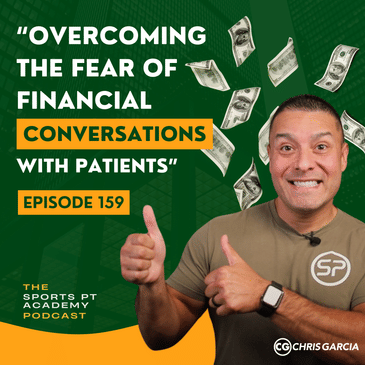
Do you have a hard time discussing money with patients? Have you ever recommended a less-than-ideal plan of care or recommendation due to fear of patients judging you? If so, you're not alone.
In this video, Dr. Chris Garcia shares his secrets to success with overcoming the fear of financial conversations with cash-pay patients. If you're a cash-based PT and want to improve outcomes while making more profit, this episode is perfect for you. Enjoy episode 159 on the Sports PT Academy podcast on YouTube, Spotify, and Apple Podcasts!
_____________________________________
Are you a physical therapist or physiotherapist looking for tips, tools, and strategies to work with more athletes, become a sports specialist or get a job in a sports setting...so you can finally enjoy the career that you've always dreamed of? If so, you're in the right place...this podcast is for you. Your host is Dr. Chris Garcia, a physical therapist, business owner, entrepreneur, nationally recognized public speaker, and residency-trained sports specialist.
Dr. Chris Garcia, PT, DPT, SCS, CSCS, USAW has worked in professional sports and traveled around the world working with elite athletes throughout his career, and he's learned a lot of lessons along the way. He created this podcast to share his experiences and give you everything you need to know to help YOU become a successful clinician. Dr. Chris Garcia talks about everything from sports rehab and injury prevention to developing athletic performance and the path to getting your dream job...even if it is in professional sports.
If you want to become a successful clinician so you can finally enjoy the career you've always dreamed of, visit www.DrChrisGarcia.com.
LINKS:
www.Instagram.com/ChrisGarciaDPT
www.Facebook.com/ChrisGarciaDPT
***DISCLAIMER: This content is for educational & informational use only and & does not constitute medical advice. The content is not intended to be a substitute for professional advice or medical recommendations, diagnosis, or treatment. Please consult with a qualified medical professional for proper evaluation & treatment, or beginning any exercises or activity in this content. Chris Garcia Academy, Inc. and The Sports PT Academy Podcast are not responsible for any harm caused by the use of this content.***
[00:00:00] Are you a motivated healthcare fitness professional? Are you looking to work with more athletes, become a sports specialist, or even get a job in a sports setting so you can finally enjoy the career that you've always dreamed of? If so, you're in the right place. My name is
[00:00:18] Chris Garcia, physical therapist, business owner, entrepreneur and residency trained sports specialist. I've been fortunate to work in professional sports and travel around the world working with elite athletes throughout my career and I've learned
[00:00:29] a lot of lessons along the way. I created this podcast to share my experiences and give you everything you need to know to help you become a sports expert. Welcome to the Sports PT Academy. If you want to know how to overcome the fear of having a
[00:00:54] financial conversation with a cash-pay patient, you need to tune into this episode. Hi everyone, welcome back to the podcast. Welcome all new listeners and welcome back to those who have heard my content in the past. Before I
[00:01:06] go on to this podcast, you know how I like to start, what is new, what is bigger and what is better in life. I'll share some fun things that are happening right
[00:01:15] now. You know I like to work with my kids and see how they grow up in this new age. One of the things that we're struggling with right now both my wife and I is making deals with our kids. We've set them up to understand
[00:01:32] that you can have options in life and you can say yes to certain sports and no certain sports but you have to complete everything that we agreed upon. So right now they are making deals with us to try and reduce how much jujitsu
[00:01:46] they're doing right now. When asked what do you not like about it, they just can't give me an answer. It's been a full year of jujitsu so I think they're wanting to calm down for a while which I totally get.
[00:01:59] Yeah so our deal currently in our household is if you give up physical activity with one sport, you got to make it up with another. So we're looking for another sport maybe basketball or baseball. Yeah so they're making deals.
[00:02:11] What's happening with my wife and I? We just did an amazing date night on Saturday and it was incredible, incredible customer service. Just good overall experience and I'll bring some of that up in today's podcast. From a fitness
[00:02:25] standpoint I still am very hesitant to, you know when I do CrossFit I am hesitant to pull from the ground like any weight even like 95 pounds. That fear of avoidance is real absolutely real. I don't want to go backwards. The back
[00:02:43] is about 72% but I'm just not forcing anything. In terms of updates on the CG Academy those who are interested the Cache PT clinical elevation course is now live. Go ahead and go to that at DrChristCarcia.com forward slash
[00:02:58] elevation. Alright let's get on to this podcast. Why am I doing this podcast? Alright so I had, I love talking to highly motivated physical therapists, Cache PT owners, business owners and I like to know like what are you
[00:03:19] struggling with because I'm struggling with things all the time and I was trying to find solutions and I was talking to a business owner who is in network, out of network and they run a hybrid practice and I said what are you
[00:03:30] struggling with with physical therapists and they said you know I can't get my PT's. My PT's struggle with having a financial conversation like creating a plan of care or a plan for a person and they give them a plan of
[00:03:47] care or number of sessions or weeks or prescription for Cache P.A. patients or direct access and the quotes were they just won't sell the damn thing. Now for some people the word sell or sales is a tough word to understand in
[00:04:03] healthcare but ultimately you're in business and I'm gonna solve that challenge right now. I want to share with you whether you're a brand new Cache PT business owner, you're an established business owner and you're struggling with your staff who has a hard time delivering this message to
[00:04:21] the patient who is asking for it but it's an internal battle on the staff, on the staff PT and for those of you listening out there you've done this, you've struggled with this right? Maybe you've done clinical rotations or
[00:04:31] you worked insurance based care and it was so much easier just do your work and now when you have that same patient coming Cache Pay now you feel bad. For some reason it was so much easier when somebody else was paying
[00:04:41] for it but not that they're paying for it you feel bad so you either recommend a lower plan of care because you're concerned about their finances or they've mentioned that and now you become their financial
[00:04:52] advisor and you're like well I don't want them to feel bad so I'm gonna go ahead and recommend a lower one just so they don't have to spend enough and so if you've ever felt bad and you wanna know there's gotta
[00:05:03] be some solutions to overcome this or to tackle this or to make this easier for me the PT or the patient that's what I'm gonna cover inside this podcast and it came from a very simple conversation that I
[00:05:14] think can be easily solved. Now for those who don't know I'm a Cache PT clinic owner I have three locations I'm a staff of over 15 staff and I've trained a lot of PTs in Cache and in this type of a
[00:05:27] setting over the last 10 years and what I'm gonna give you today is consolidated from my 10 years of experience and what I mentor my own staff is with Erebus on but also what I help other PT business owners who are startups or they're established
[00:05:43] and they're looking for a way to make this a little easier because you're really good at your craft. You're good at you know doing the clinical work. You have no problem with that but at the end of that session or every session you gotta tell
[00:05:56] them you should come back or you need to come back or here's a recommended number of sessions that conversation is like people will go through anything else they rather have go through torture than go through that last statement again
[00:06:09] and what they'll often do is you'll find is they'll briefly go over it they avoid it or they have a lower recommendation so I'm gonna solve that for you guys today. So at the principle level let me tell you what the problem is
[00:06:24] at the top of it is that patients want a certain outcome right? That's why they hire you that's ultimately why they come see a physical therapist and you have to decide okay why did they not go to an in network physical therapists
[00:06:37] you know why did they choose to go out of network cash there's a reason for that right? Let's start there that's that's one of the main things you have to solve. Why did they choose you versus going in network or if they in
[00:06:49] were in network in your same clinic why do they choose to go cash that that's a big question and why didn't they solve this with YouTube? Why didn't they solve this with another insurance style setting? They're clearly looking for something different. That's the first thing you
[00:07:03] have to solve if you don't solve that you cannot continue with your care because it has to be a different approach. So at the top level the patient wants a certain outcome now the business owner if you're the business owner having this
[00:07:18] conversation you actually want them you have to be able to do this because you're trying to maximize their outcomes but then at the same time maximize your income and your profit now there's a there's two things that need to happen. The patient saying I want this perfect
[00:07:31] we can deliver that and the PT is saying I can deliver that at this cost so that's that's the challenge at the top but now the communication inside that conveying that message is the challenge. So you know the the problem becomes is that they physical therapists like yourself
[00:07:49] will have a challenge summarizing this and delivering it in a confident method without ascending salesy without feeling bad about it yourself and that's a real struggle and so I'm going to help you tackle this I'll give you some phrasing on how to be clear
[00:08:04] and concise and confident and not feel bad whatsoever and ultimately that's why I built this this podcast episode and I'm excited to share it so here we go. So now knowing where cash patients are coming from and where the PT is struggling let's talk about
[00:08:23] this all right so you're the you're the cash PT whether you work for somebody you're employed or you're self-employed or you work in insurance based clinic or you're the business owner and you're trying to teach your staff are there's several scenarios it really
[00:08:38] doesn't matter it's all the same things here. What it comes down to is the PT has an internal challenge they they got into health care because they're very empathetic the very analytical this is by and large most pts right people enter a profession
[00:08:55] because of who they are what they want to do and the number one thing they want to do is help people I get it everyone wants to help people here's the problem if you're going to help people what you've
[00:09:07] typically grown up in is a PT school mindset or insurance based mindset where your jobs to treat as many customers as possible going through insurance based now. People can disagree on this but the reason why patients go through insurance because it's a low
[00:09:23] and low as paying costs it's the path of least resistance so you were taught to perform a mill like style treatment because that's what the boards are that's what PT school treat to here's a goniometer proved to this insurance based company that you have to justify their
[00:09:38] care so your you were given a mill like production style of education. And no one had to make decisions because the insurance based the insurance model and the physician made that decision so all you had to do was deliver
[00:09:52] on the treatment and made it easy and that patient because it's a low barrier to entry to low cost low low copay that's what they're willing to they're willing to take a lower performing treatment because it's cheaper cost that's just what happens right that's why
[00:10:06] you go to a grocery store that's cheaper you're willing to have lower quality ingredients because it's cheaper that's okay for your stage of life but as you start to age and maybe you're like well I want better things for myself on better things
[00:10:17] my kids so you start to go to a higher end grocery store that has better ingredients less processed stuff you know a higher caliber of produce higher caliber of meats that's just how people go through life well that's how patients go through life patients
[00:10:31] start at a low copay with insurance based maybe they realize I don't like this fruit it doesn't I don't like this care I don't like this fruit I don't like this me I want to go up one more level that's
[00:10:40] fantastic but you as a PT have to understand that now what they're doing is they've gone through the lower copay the lower expectations now they're raising their expectations so now as a clinician what you have to do it's not about more clinical skills
[00:10:53] that get you there it's about okay understanding the customer so the customer has looked they've gone from Walmart to now go into Target I want a higher level of service I want something different and I'm willing to pay more but they got to
[00:11:06] deliver on them okay that is what the patient has come in with now the PT is having a little problem here because they haven't understood that what their understanding is well this person's now paying after deliver more skills because they couldn't get those skills inside insurance
[00:11:24] based model so now my skills have to be so much better which is absolutely false then becomes okay well now now I have to at the end of the session have to convey okay if I've grown my skills I got them better and out there at the
[00:11:37] end of the session I'm like oh my gosh I've never had to do this I was insurance based now whatever the physician or insurance approved I said you have two more visits I'm used to 12 more visits three more visits that's what
[00:11:46] I'm used to this is where the fumbling happens they say well Mrs. Jones you and this is where you start to stutter and you start to talk and you're not confident in your voice waivers all over the place yeah you have tight
[00:12:02] hamstrings and your hips are stiff and your postures poor so we're gonna work on your posture to make you feel better okay so here's your seven exercises next time you come in we'll reassess and see how you're doing that's a traditional insurance based approach
[00:12:18] now when you apply that to cash base that won't work anymore because that person just went through that with insurance so the question becomes what's so different how do you approach that so at the top level patients make decisions and you make decisions not on
[00:12:35] aspirations people don't want to lose 50 pounds people don't want to be pain free those are aspirations right they those are goals I want to lose five pounds I want to improve my hip mobility but nobody thinks that I want to increase my speed five by two
[00:12:53] minutes okay people don't make decisions those are aspirations right I want to be rich one day I want to do this like those are all great but nothing creates action until people are concerned fearful or frustrated so one is aspiration I call it pleasure and the
[00:13:11] other one is concerns fears and frustrations so one is aspirational and the little one is concerns people make decisions off of concerns right so for instance I said hey you're you're gonna if you hit these marks you're gonna make $40,000 more next year like oh my gosh
[00:13:29] that sounds amazing to me now if I said okay great if you don't you're gonna lose your job one of those creates action more than the other now more money sounds amazing but you're safe so that's not concerning but when
[00:13:42] you're gonna lose your job next year whoa now I'm gonna pick it up so even yourself as a consumer will make your decisions based off fear frustrations or concerns so when you know that when you deliver a planet care and you're gonna have this conversation with
[00:13:57] somebody who is considering paying out of pocket a lot of times you're like well maybe they don't have the money maybe they don't maybe I'm not worth it the reality is the patients looking for a solution and they sought you out because of who you are and
[00:14:14] what you could potentially do for them they're willing to pay they came in with that mindset you're like why don't want them to pay a lot yet you want to make money here's the the irony this whole situation you're like I deserve more money great now the patients
[00:14:27] willing to pay you're like oh but they're gonna pay I don't know about that let me let me offer them less so there's a paradox in this whole situation if you want to make more money whether you're employed or you're self-employed you have to be willing to
[00:14:40] pay for a party and at some point this has nothing to do with the patient has everything to do with you your internal concerns your internal fears and I understand it I've been through that and I suffered with this for years and I eventually conquered
[00:14:52] it with the things I'm gonna share today but I can tell you here's the scenario that PT struggle with they want to make more money and help more people yet but the problem is they don't want to do it at a cost and they don't want
[00:15:03] that patient to come in twice a week or four times a week because they feel bad there's an irony I want to make more I don't want to offer more and have somebody pay for it because you grew up in insurance
[00:15:13] based models that's why I say you're trained in insurance based model to produce meal like production at a lower cost and those patients were okay with that but now you're moving from Walmart to Target how do you know how are you going to
[00:15:25] change your approach so when we look at this by and large now we have the understanding of what the consumer wants they were concerned and fearful of something happening that's why they came in they weren't aspirational they weren't thinking oh finally this is my chance to
[00:15:42] lose five pounds and feel better about myself no what it was was I'm frustrated with who I am concerns not aspiration I'm concerned about cool how I look how I feel or maybe have a wedding in three months and that is what got them there
[00:15:56] it's not that the wedding's coming up as they don't feel good about themselves and that's why they're doing it now they made a decision to go to the gym and be more active well they weren't more active so they started going to the stairmaster running and doing more
[00:16:07] squats and all these other things to make themselves look tone and good if that were the case now they've added more stress in a short amount of time cute to chronic work workload ratio is the term that they made a short a large
[00:16:18] change in a small time now that changes the biomechanics and stress to their legs or whatever it is now their back hurts and he hurts so they went to insurance based care they couldn't solve their problem why because they want impairment based and it's not that the hamstrings
[00:16:30] were tight or anything else just they made a large change in a short period of time it's all about adjusting their programming plus addressing their impairments so they seek out of network care okay was it out of network care physical therapists do the 100% look at
[00:16:43] oh well great you actually made a large change in a fitness this is what we need to adjust I mean we do leg days twice a week instead of three times a week we back off of this to address some impairments get some new shoes
[00:16:53] watch about mechanics the whole package is great but then at the end of the session that cash PT is concerned about that person and they're saving for their wedding so they don't want to you know burden them so they're like oh well let me just see
[00:17:06] you once a week or like four weeks right I don't feel I feel bad when in reality you know that it's going to take you twice a week for six weeks minimum to get this person better and possibly a second plan of care but because of
[00:17:19] that you feel bad so when you start to look at why this person needs your care rather than focus on the impairments I'm gonna I'm gonna give you some easy options here to be able to feel good and confident about doing this because if you don't feel good
[00:17:39] there's no way you feel confident and you have to see it differently in order to know that what you're doing is for the right reason so this person has a wedding and they want to feel good about themselves you're delivering on improving their confidence so they can
[00:17:53] enjoy their wedding what you're not delivering on is I'm improving their hamstring length so they can you know do whatever in the gym I'm not fixing their programming so I can reduce the knee pain and they can be happy that's not what you're doing you're all about
[00:18:07] what they're concerned or frustrated or fearful of you focus on that you do not focus on the impairment get away from the insurance based model this how PT school taught you this on the insurance based model taught you get away from that you have to
[00:18:19] understand the customer what are they concerned about what's the thing that brought them into your clinic to see you it's probably the concern the fear so you got a fear you got to figure that out and if you can't that's where the problem lies it's not
[00:18:32] in the phrasing in the financial conversation it's understanding what their concerns fears or frustrations are once you understand that that is what you focus on in your plan of care design and this is genuine because you have to understand the customer so for instance when you provide a
[00:18:51] plan of care of you know talk about finances when you're like hey I need you to come in four times a week or whatever your thing is instead of saying I need to see one time a week for eight weeks and that's what you say
[00:19:02] the first step you're going to do is provide two to three options for them to come see you hi mrs. Jones I understand that you are preparing for your wedding in three months and you have knee pain and back pain from all the exercise you've been
[00:19:15] doing as we've discussed in this session and what up from what I've seen in your impairments I'm recommending that you come in two times a week for six weeks just to start you off now that would be a better situation if you're saying hey I want
[00:19:34] to have the best chance possible to be in that wedding without any pain whatsoever and you help you lose weight throughout the entire process we're gonna have to be a little more aggressive so I'd recommend three times a week during those six weeks
[00:19:47] now if you're saying Chris I can do a lot of it on my own and I'm willing to do this on the gym and I only need you one time a week perfect at the bare minimum I won't let you go any
[00:19:58] shorter if you were then one time a week for the next six weeks so now really depends on how you want to attack this wedding do you need more support for me and I can help you attack this at a faster rate with three times a week
[00:20:11] two times a week would be just in that sweet spot if you are not overly concerned and if you're saying hey I'm very independent I can do one time a week that would be fantastic that's perfect now you have three different options good better and best which one
[00:20:25] out of all those Miss Jones would you prefer which one are you considering that allows that person to make a judgment and a choice and be a participant in their care now a lot of times physical therapists don't think about providing options so they provide one
[00:20:41] and that's why they're fearful they're like you provide the lowest one possible because you're fearful of them judging you or you're fearful that they won't be able to afford you so step number one is instead of providing one thing you provide three option
[00:20:55] this simplifies the process and it feels good now you take some pressure off of your shoulders and you have to think wow I didn't give the lowest I gave them an option to do the lowest but I also gave them the option to the highest
[00:21:07] and they can choose now even if they didn't have all the money in the world if they were willing to do it in this short term because it's their wedding it's a once-in-a-lifetime thing you never know what the motivation of that client is but you have to be
[00:21:21] able to do that so step number one to overcome this fear is remove the fear by placing the choice and judgment on them by giving them options versus one thing it's the number one thing that you can do the second point
[00:21:38] of this whole thing is it to do it concisely I see physical therapists when they offer these plans of care and you're recommending hey what should I do it gets very complicated they make it super complicated they'll say well Mrs. Jones let's see you two
[00:21:54] to three times a week for the next six to eight weeks and after that we're going to do one time a week for the next four weeks and after that we'll go to every other week that person is so lost because you went
[00:22:03] from phase one to phase two to phase three and that person's like wait what are we doing it wasn't clear and concise focus on this first phase that's rule number one and you have to say it's so clear that there's not another option if you
[00:22:19] want to do this at a steady rate and you feel that you can do this on your own let's do two times a week for six weeks that's it that's it do not do two to three six to ten twelve to fourteen eighty twenty this then this
[00:22:35] then it's too much the first phase is two times a week for six weeks then here's where the fear concern and frustrations come about if the fear and frustration is that they won't be ready for the wedding right that maybe that's what they held on
[00:22:53] to the aspiration was look good in the way no no no people make decisions off their frustrations and fears and concerns so you're going to finish out your statement with reminding them that you know what they're concerned about and this is why they're here
[00:23:11] Ms. Jones to help you with this and you feel like you can do this at a steady rate we're going to do this for twice a week for the next six weeks so that you are feeling good in your wedding dress and not
[00:23:25] concerned about not fitting in it or looking as good as you wanted to that's why you came in here they made a choice to come see you because they were concerned they weren't going to fit in their wedding dress and lose the weight
[00:23:39] that they wanted you're here to help guide them through the process not so they can fit good in their wedding dress so that they're not concerned that they won't fit in their wedding dress it's one small thing but people make decisions remember this
[00:23:52] I'm going to give you $40,000 raise or you're going to lose your job which when you concern more about losing my job you make decisions based off of your concerns and frustrations and fears so does a consumer but you don't realize this because you you think everyone
[00:24:07] is aspirational so the first one is to provide options number two was to provide a concise statement ending with their concerns fears frustrations because that's why they make decisions and you're reminding them of that and the great part is you're doing this after every session to remind
[00:24:26] people why they want to come back to you this is how people make decisions the third one is once you've provided options you've provided a clear concise statement followed by their fears frustrations you have to allow silence silence allows people to process information and if you continue rambling
[00:24:51] they can't understand what you just said and process what they want to do so this is the common thing that I see a lot of cash based pts do or insurance based pts who see a cash patient is that they say we're going to
[00:25:06] provide one option miss Jones I'll see you one time week every other week for 12 weeks right so because they don't want to they don't want to have them pay a lot and then they don't make it concise yeah we're going to start with one time
[00:25:17] week for every other week for 12 weeks and then we're going to move you to once a month for 12 weeks and then you're going to do these seven exercises three times a day every other day that's what we're going to do and we're going to
[00:25:30] see you next week and we'll reassess everything and for instance like so confused and they just keep talking why because they feel bad about offering a service for a fee now what you need to do is pause after you make your statements or your recommendations to allow
[00:25:47] the consumer that patient to process information this is how we all process formation so you're going to provide options good better best then you're going to provide it with a concise statement ending with their fear frustrations great we're going to see you twice
[00:26:01] a week for the next six weeks so that way you're not concerned about fitting in your wet wedding dress in three months which option are you considering silence allow them to marinate on that and you think that silence is awkward but silence is golden to be
[00:26:25] able to help this person make that decision clearly silence is what allows them to process everything you just said just shut up so the crazy part about this whole thing is that for some of you this is wow I never thought or consider
[00:26:45] this and some of you think well I don't know if I really need to do this if you work insurance and you see cash patients you need to do this if you work solely in cash you need to do this why because the consumer has
[00:26:59] then made a choice to come see you the other one hasn't because they're not paying directly for every single session it's a difference in expectation and the skill set involved and if you don't understand that you continue to fail with an empty schedule and people leaving you
[00:27:12] on average two to three visits into their planet care that's how I can tell a clinician is not very good at cash pt is because they have a normal visit average rate of two to three visits and we would like walk out of pain
[00:27:26] you didn't solve the problem because our wedding is in three weeks and three months really you got them pain free in three weeks and they're not going to fall off and they don't need more help with their programming they don't need help in the gym with Obama canx
[00:27:36] and everything else you think it's magically not going to come back a person didn't go to school at the same length of you to understand fitness to understand health and biomechanics and how to progress over the next three months so it doesn't come back they don't understand
[00:27:48] that so you can't tell me they're pain free into the revisits you didn't solve their main problem and you did them to disservice so the difference becomes here is in insurance based model a lot of times you are maybe work for a hospital may work for another
[00:28:02] tip by setting and that's a non for profit setting now when you work in a for profit setting you have to understand that whether you like it or not if your staff is with therapist at you will work for a profit you need to
[00:28:13] in order to have sustainability in your position you have to work for a profit if you are a business owner 100% you're going to close the doors if you don't make a profit so you have this patient who wants to come see you and you need to make a
[00:28:24] profit but you're scared to make a profit because that's where your barrier is I don't want to recommend it to them so remove the remove that emotion and that feeling of stress from yourself by providing the options to the three options provided in a clear concise statement
[00:28:40] followed by their concerns and fears and then allow silence those three tips will put you in a good position to feel good about it because you no longer have to stress it's not your burden it's their burden to make that decision and you need
[00:28:55] to allow them to do that now once you get this all down and you are you know absolutely crushing it you will come into people who process differently they are different personalities will get into those into other podcasts but ultimately this is the starting point for you
[00:29:12] if you're a cash-based PT this is going to help you tremendously if you're an in-network out of network staff PT this is going to help you if you're a business owner with multiple pts underneath you you need to teach them this because if you don't your numbers will
[00:29:24] never change your profit won't change your salary won't change nothing will change and that you have to understand this is a different person with different expectations and it requires a different skill set not just clinical skills that worked in insurance but will never work in cash
[00:29:37] I've been doing this 10 years for those you know I have 10 years experience working in cash-based clinic I'm only cash I've grown up in this I've taught this I've done this mentored for over 10 years and I'm telling you right now if you don't forget this out you'll always be
[00:29:50] in this hamster wheel of two to three visits to the visits you're always looking for more patients does something I'm looking for more patients more patients more patients no there's people who want to stay and see you how about you get better at delivering better service
[00:30:04] how you fix this so there you have it for those of you who are wanting to learn more and you're thinking well there's got to be more than this to cash PT and I really want to have a startup I really want to thrive in my business
[00:30:19] and grow my business for those of you who are interested I am hosting a cash PT clinical elevation course where I help business owners aspiring business owners new business owners established with with PTs within it too basically to help you understand the customer get you to a point
[00:30:36] where your cash PT your cash P patients it's a no-brainer to come see you you feel confident about your skill set learning the skill set of cash PT but then also understanding how this consumer is a little different than your insurance based care so I'm here
[00:30:51] to help your business grow to help treat cash P patients grow your your practice and ultimately become the go-to expert inside your town which is what you want and feel good about it so there you have it if you guys are interested as a eight week
[00:31:02] online mentorship course you can go to the website at drpriscarcia.com forward slash elevation and I'm excited to see you in the course if not I will see you guys on the next episode take care professionals just like you with great information to become sports experts
[00:31:38] if you have any questions reach out to my team at drpriscarcia.com and tell us exactly what you're looking for do you want more head over to my website drpriscarcia.com and sign up for my VIP email list to stay in touch with my latest updates on courses
[00:31:53] and mentorship programs if you know someone who would benefit from my content please share this episode with them until next time have an incredible day