
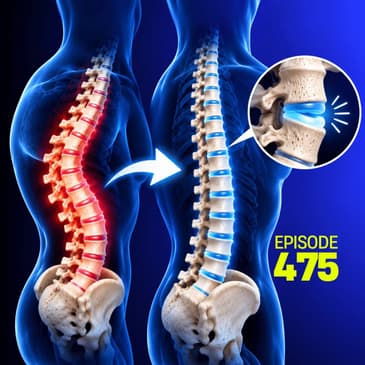
In this episode of the Optimal Body Podcast, doctors of physical therapy, Doc Jen and Doctor Dom address controversy sparked by a social media post where Doc Jen stated she doesn't seek chiropractic adjustments. They clarify that adjustments don't "realign the spine" or "put bones back into place," explaining that benefits come from reduced tension and nervous system responses. Citing research, they highlight that spinal palpation is unreliable and that similar results can be achieved through mobilization or movement. They emphasize adjustments are useful tools but shouldn't create patient dependency, advocating instead for evidence-based care and long-term self-empowerment through exercise and movement.
Needed Discount:
Jen trusted Needed Supplements for fertility, pregnancy, and beyond! Support men and women’s health with vitamins, Omega-3, and more. Used by 6,000+ pros. Use code OPTIMAL for 20% off at checkout!
We Think You'll Love:
For full show notes and resources visit https://jen.health/podcast/475
What You'll Learn:
1:16 The hosts address common misconceptions, like adjustments putting bones back into place, and the overlap between PT and chiropractic techniques.
3:42 Research shows it's unreliable for clinicians to pinpoint specific spinal segments, questioning the precision claims of some practitioners.
6:32 An adjustment doesn't just target one segment; research shows it affects multiple joints above and below the intended area.
7:26 The hosts explain that the cracking sound is a cavitation, a release of gas, not a bone moving back into place.
8:23 Discussion on the term "subluxation" and how the language used by providers can create patient dependency on treatments.
12:29 Good physical therapists and chiropractors have significant overlap in their methods, often incorporating movement and hands-on treatment beyond adjustments.
13:55 The hosts critique articles sent to them, noting many are old, small case studies, or don't actually support realignment claims.
19:15 A study showed adjustments, mobilizations, and even therapeutic touch all improved pain and brain connectivity with no significant difference.
21:51 Adjustments cause muscle relaxation and release endorphins, leading to temporary pain relief and reduced tension, lasting about 48-72 hours.
23:47 PTs use manipulations to address true mobility deficits, helping to improve range of motion before prescribing strengthening exercises.
25:15 The hosts debunk "Over Manipulation Syndrome," explaining it's not a recognized diagnosis and originated from a pro-therapy clinic.
29:06 Discussion on how degeneration is a normal part of aging and is often used as a marketing tactic to scare patients.
Hosted by Simplecast, an AdsWizz company. See pcm.adswizz.com for information about our collection and use of personal data for advertising.
[00:00:05] [SPEAKER_03] Welcome to the Optimal Body Podcast. I'm Dr. Jen and I'm Dr. Dom and we are doctors of physical therapy bringing you the body tips and physical therapy pearls of wisdom to help you begin to understand your body, relieve your pains and restrictions and answer your questions. Along with expert guests, our goal of the Optimal Body Podcast is really to help you discover what optimal means within your own body. Let's dive in. Okay, this is not like our typical podcast, I feel like, but it kind of is. I mean, we're just talking about one topic, but there was a lot of people who were in the world.
[00:00:35] [SPEAKER_01] And there was a little bit of drama that got started on my account from a post that I put up.
[00:00:41] [SPEAKER_03] You made some people a little angry.
[00:00:43] [SPEAKER_01] I did. And I get it.
[00:00:45] [SPEAKER_03] Yeah. So what the post was about, you were talking about, you talked about a couple things in the post, didn't you?
[00:00:51] [SPEAKER_01] Well, it was five things. So I said five things that I'm not doing right now as a physical therapist and a mom of two littles. Like my whole point was like, I don't have time for extra fluff. So like, I have to be really honed in on what I'm focusing on.
[00:01:05] [SPEAKER_03] But number one was, I'm not going to run out and get an adjustment.
[00:01:08] Yeah.
[00:01:09] [SPEAKER_03] And you elaborated a little bit more on why.
[00:01:13] [SPEAKER_01] A thousand percent.
[00:01:14] [SPEAKER_03] In the post.
[00:01:16] [SPEAKER_01] Just explaining like what an adjustment actually does and what it doesn't do and why I can get the same effect doing something else.
[00:01:24] [SPEAKER_03] Yeah. And there's, I feel like there was a few points of contention because you said one that it doesn't put your bones back into place. And in the post, I don't know if you said this in the post, but in the conversations after the fact, you said, listen, physical therapists, osteopaths, they do adjustments too. They just call it something different. And that's a big point of contention to that.
[00:01:51] [SPEAKER_03] Oh, what you guys do is so different. Your setup's different. You know, it's not the same thing. So really, we just wanted to go into some of the research, some of the conversations you had. Why people get so angry when you're not actually attacking adjustments or chiropractors itself.
[00:02:10] [SPEAKER_01] Yeah, that was not my intention. And I say adjustment in the post, which I know is then going to be, I'm calling out just chiropractic, right? Because it's, you understand what I'm saying. If I say manipulation, not everyone understands. Or if I say what we call it as physical therapists, high velocity, low amplitude, thrust manipulation. Like, yeah, it's not going to be known what the heck that really is. Physical therapists use like the technical terminology of what we're doing within the joint.
[00:02:40] [SPEAKER_03] And some of that is because lobbyists in certain states don't, initially, they wouldn't allow physical therapists to call them adjustments.
[00:02:48] [SPEAKER_01] Because chiropractors didn't want.
[00:02:50] [SPEAKER_03] They didn't want them to be claiming.
[00:02:52] [SPEAKER_01] Us to impede on what they do.
[00:02:53] [SPEAKER_03] Claiming that they're doing the same thing. And again, let's address the first thing where people say it's so different. Like what we do is so different from what physical therapists or osteopaths do. What are your thoughts there?
[00:03:07] [SPEAKER_01] I've literally been in courses where a chiropractor has come to help with the teaching and the education on how to properly set up an adjustment or a manipulation. So I think that they have better practice. We do obviously do them in school. We learn them. We learn how to do them. I was the easiest person to adjust because gas forms very easily in my joints when you move me around. And it is very easy to get that crack and manipulation.
[00:03:36] [SPEAKER_01] So I was one of the number one people in my class that was always being adjusted.
[00:03:40] [SPEAKER_03] You make everyone feel good about their skills. And I think this is where it boils down to some research because a lot of chiros who get upset about this, they like to say, Oh, what's your setup like? A C4 manipulation or a C4 adjustment. What's your setup like? And when we look into the research, we see very clearly in palpation studies in which a palpation study is like essentially finding C4.
[00:04:11] [SPEAKER_03] If you asked a hundred clinicians to palpate and find C4 specifically, and then we check them with imaging, like, are you on C4? It's very unreliable that you're even on the right segment. So first off saying like, Oh, what's your C4 setup like? The fact that we know through research that it's very unreliable that you're actually finding C4 says a lot about that claim in itself.
[00:04:38] [SPEAKER_01] And like one of the biggest, you know, one of the best articles that we can kind of cite from this is from 2021. And it was from chiropractic and manual therapies. That's literally the journal that it's coming out of. And it is showing that the reliability of soft tissue palpation is inconsistent and reliability of bony structures and joint mobility palpation is poor.
[00:05:02] [SPEAKER_03] Taking a quick pause to the episode to talk about and give a shout out to something that was absolutely vital in Jen and my journey to become pregnant, as well as optimizing Jen's nutrition during her pregnancy and postpartum periods. And I'm talking about needed. It isn't super well known, but 95% of women in the perinatal stages have nutrient deficiencies. And most prenatal vitamins include bare minimum nutrition based on outdated guidance and stale research.
[00:05:29] [SPEAKER_03] And we trust needed because they really offer radically better nutrition products, education and advocacy that is rooted in clinical research and practitioner validation. The thing that I especially loved is it's not just supplements for women. Of course, that is absolutely vital, but they had stuff for men, too. They have male prenatal vitamins as well as sperm support that can make sure you're getting the nutrition so that your swimmers are as strong as they possibly can be. And their products don't just stop at pregnancy and postpartum products.
[00:05:59] [SPEAKER_03] They have multivitamins and different supplements for everybody. So if I were you, I would head over to thisisneeded.com and use code optimal for 20% off your first order. That's T-H-I-S-I-S-N-E-E-D-E-D.com and use code optimal for 20% off your first order because everybody deserves the nutrition that is needed for their body. Let's get back into the episode.
[00:06:25] [SPEAKER_01] So it's chiropractors acknowledging our limitation.
[00:06:31] [SPEAKER_03] Their own journal. Right.
[00:06:32] [SPEAKER_01] Especially when we go therapist to therapist, like there's a lot of inconsistencies there. And it's so hard to know that we're pinpointing one place, which is okay because we also know from research that when we're doing an adjustment, we're not just targeting that segment, even though that's what our intention is. And that's what we're saying that we're targeting.
[00:06:53] [SPEAKER_03] We feel like we think that area is more restricted. So we're trying to target around that area.
[00:06:58] [SPEAKER_01] But studies show that we don't just hit that one vertebrae. We are affecting two to six joints above and two to six segments below.
[00:07:09] [SPEAKER_03] So two to six, meaning possibly 12 segments. So if you're at C6, you could be affecting all the way up to the occiput, all the way up to the skull and all the way down into the upper thoracic spine. Like that's a good chunk of the good chunk of the back.
[00:07:26] [SPEAKER_01] Which is sometimes when you hear like pop, pop, pop, pop. We're not just always hearing one, which is okay. And again, when we're creating, we've done a deeper podcast on what an adjustment actually is. But it's no different than any joint within the body that creating this cavitation. So we create a stretch of the joint. It creates gas within that cavity. And then when we move it a certain direction at a fast velocity, we change the pressure.
[00:07:56] [SPEAKER_01] And so all of a sudden we hear that cavitation, right? And it's like, if I crack my knuckle, I can't just go back and crack it again because it needs time for gas to kind of come into that cavity again. That's why we can't just, you know, keep doing it over and over and over again. But if you give it time, days, time between it, you can go back and continue to get that same adjustment or manipulation.
[00:08:23] [SPEAKER_03] And this is kind of addressing the other claim of, oh, it puts, it puts spine, the spine back into place. It's, it helps relocate subluxed joints. That's another term that I feel like I hear people use a lot. Oh, C4 or OT2 is subluxed. Meaning and subluxation is like on the spectrum to dislocation. A dislocated joint is something that's completely out.
[00:08:50] [SPEAKER_03] Like if someone dislocates their shoulder, which people may have seen in like sporting injuries and stuff, someone dislocates their shoulder. That means the shoulder is out of joint. A subluxed joint means the joint kind of stretches or comes out of the joint contact surface. If I'm thinking about the shoulder, it'll slightly stretch and come out. And then in some cases, like with the shoulder or hip, it'll, it'll just slide right back into place.
[00:09:17] [SPEAKER_01] Or you do a certain technique.
[00:09:18] [SPEAKER_03] Or you do a certain technique to like help get it back into place. Right. And I think we hear providers use this subluxed term when it comes to the back to say, oh, this spinal vertebrate is subluxed a little bit. And so I need to do this adjustment or manipulation to put it back into place. And what you would just address was like the cavitation and the gas. And that's where we get the pop.
[00:09:43] [SPEAKER_03] I feel like when a provider says I need to put you back into place, when the patient hears the pop, they are thinking, phew, my joint is now back into place.
[00:09:55] [SPEAKER_01] A thousand percent.
[00:09:55] [SPEAKER_03] I'm okay now.
[00:09:56] [SPEAKER_01] Yeah. And you guys, like I worked, one of my first physical therapy mentors that I had in a clinic, he would do this all the time for the SI. Like almost every patient that came in, he needed to adjust their SI and they always felt better. And they always like, they wanted to continue to go back for that treatment. Right. Like, again, this is not.
[00:10:15] [SPEAKER_03] Because what was he telling them?
[00:10:16] [SPEAKER_01] He was telling them that they were off. Right. I'm going to check your, your, I'm going to check your hip bones. And oh, see, when you're laying on the table, one is higher than the other. So I'm going to put your knees together and do either, either do the one where I kind of pull you, your knees apart quickly. And you get that, you, you feel right between your, yeah, your pubic symptoms. So like right where your pelvis kind of connects, or I'm going to twist you laying on your side. And you're going to feel that really low back SI kind of region adjustment.
[00:10:45] [SPEAKER_01] And so, because he continued to do that over and over again, like it's, it's such an easy, quick win to be able to get buy-in from a patient that I heard something. I felt something. That's what's real. And that's what we're going to talk about in the research of what is actually happening. Right. Like what you feeling is real. Like we don't want to discount that from anyone. Because that was also in my comments was like, well, I finally went to a chiropractor and I felt all these incredible change. They are the only ones that had been able to help me.
[00:11:14] [SPEAKER_01] And I'm like, I'm so glad. I'm so glad that you found a provider. The thing that I want you to realize is that you're not out of place. And so they helped you to feel better for a reason. We want to talk about what that reason really is. Yeah. Right. And get into the specificity of it. So this isn't just like an attack on chiros. This is also happening in physical therapy locations.
[00:11:33] [SPEAKER_03] You know, we're getting into the podcast and like we continue to want to say this isn't an attack on chiros. This isn't an attack on adjustments. This is attack on language. This is an attack on the words we use to promote our techniques. Yes. And why they're helping people. And how one method and how one way that we use our language, you're out of place. You're twisted. This is rotated. Once I do this technique, you will be back in alignment.
[00:12:02] [SPEAKER_03] This type of language promotes dependence, promotes. I need them to do that technique to fix me because I'm rotated again. I'm out of place again. I'm broken again. I threw out my back and clearly I need to go in so they can fix me rather than talking about what these techniques actually do. Yeah. Which can help give people space in order to have more independence, have more empowerment, understand that they're not broken.
[00:12:29] [SPEAKER_01] And I can't even believe that the term subluxation is still getting tossed around in the chiropractic space because I thought that was. You know, I've talked to new chirograds who are like, that's not what we're taught anymore. And we're taught so much more about, you know, using these tools, their tools in conjunction with movement. Like at the end of the day, when you have a good physical therapist and a good chiro, and this is what mild detox, I will applaud them for because this is what they've done.
[00:12:54] [SPEAKER_01] You don't know necessarily who you're going to because a good physical therapist and a good chiropractor have so much overlap and that's okay. And that was one of the things that inspired me to even be doing what I'm doing and how I did it. It was a chiropractor when I was in my last year of PT school and I saw her at my boyfriend at the time, his home, and she was working on him and doing what looked like a physical therapy session.
[00:13:19] [SPEAKER_01] Like she barely did any adjustment and manipulation and she did a lot more movement and, and, and just hands-on treatment and then getting him to do certain exercises and stuff. And I was like, wait, how are you doing that? You're not in an office. You're not going through insurance. You're at his house. You're doing what you want to be doing. And she inspired me to get a table and be able to explore what I could do when I graduated. Like this is never an attack on its own, like profession. And I just want to make that note. Okay.
[00:13:48] [SPEAKER_01] Now here's what I want to say. So when Cairo then sent me articles from, this is, this is funny to me. What another chiropractor had posted.
[00:14:00] [SPEAKER_03] Well, first off, I just love this specific conversation. It went something like, oh no, we have evidence. We have evidence that it realigns the spine. And, and then one of the next things they said is, but don't go to a research database. So when you say we have evidence, we have evidence, but don't go to a research database to find that evidence. Again, I know research is not perfect. No, we've acknowledged that a lot. And there's tons of bias in research. No, we've acknowledged that a lot.
[00:14:30] [SPEAKER_03] But research is what allows us to see things on scale. You know, there are anecdotes where one person felt this way. There are small case studies where, oh, we did this with five people and they saw improvement. And then there are massive randomized control trials and reviews that study and pull together thousands and thousands of people. And that's where we start to see actual trends on what research is telling us. And that's why we say, like when, when you say, oh, we have evidence, but don't go to a database.
[00:14:59] [SPEAKER_03] Go look at this person on Instagram.
[00:15:02] [SPEAKER_01] Yeah. That's what they pointed me to.
[00:15:03] [SPEAKER_03] And then they sent you a post that had this person from Instagram listing 10 articles or something that supported, supposedly supported that they are realigning the spine. Or what did they say? You looked at that.
[00:15:19] [SPEAKER_01] I mean, I think that's like essentially what they were trying to say. But like my message also in the post, like, yes, I said, we're not readjusting the spine. We're not putting things back into place. We are creating change. We are helping with pain. We are improving range of motion. Like I'm acknowledging the tools, right? And so what they sent me also acknowledged the tools.
[00:15:45] [SPEAKER_01] However, a lot of them, again, so some of them were like really old from early 2000s, not really old, but from early 2000s, small case studies. Like you were talking about something that could never be replicated in a randomized control trial.
[00:16:00] [SPEAKER_02] Yeah.
[00:16:01] [SPEAKER_01] And they even acknowledge it. So like some of the studies were just poor, like things that either had massive bias, small case studies or things that just weren't able to be reproduced.
[00:16:15] [SPEAKER_03] And even in those ones, did you see any of them that specifically talked about or confirmed that there was realignment of the spine, that there was a movement of these specific segments?
[00:16:26] [SPEAKER_01] No. A lot of it was like about treating addiction, about heart rate variability, trying to understand the immune response when we do manipulations and adjustments. You know, sleep quality, you know, sleep quality, mood.
[00:16:44] [SPEAKER_01] So it's like because and I think we've all seen there are some chiropractic locations that have huge claims on what you could do with an adjustment. Yeah.
[00:16:58] [SPEAKER_03] Right. And a lot of them come from a random, small case study like this that showed, oh, five people and four of them completely healed their addiction. And it's, again, a very weak form of evidence to be able to support such a massive claim like we can cure your addiction with adjustments.
[00:17:17] [SPEAKER_01] And the whole point is like because when I realign the spine, then I'm getting the connection from my brainstem and through through my spinal cord and the nerves that come out to communicate to every system of the body so much better.
[00:17:32] [SPEAKER_03] So much better.
[00:17:33] [SPEAKER_01] And so for that reason, then all of these other cascade of of things can improve all my chronic illnesses that have nothing to do with musculoskeletal issues and like all this stuff can start to improve, which are huge claims. Because, again, it's not that we've changed the segment alignment, the vertebrae alignment. We've just helped to create less tension on the area. Can that then result?
[00:18:00] [SPEAKER_03] I was going to say, if I'm going to rant on the physiology, if we talk through the actual route of what happens, if we reduce somebody's tension and then use that tool to help reduce their overall pain, maybe they will feel less need to rely on alcohol or whatever that addictive tendency is. If they if we reduce their theory, if they if we reduce their pain significantly, could they potentially have better sleep?
[00:18:25] [SPEAKER_01] It's a theory.
[00:18:25] [SPEAKER_03] If we reduce their pain and with the manipulation, release endorphins into the body, will they walk out with a better mood? And if we're doing that consistent consistently, will they maybe have a better mood? You know, so I think so many. So many things can be deeply rooted in someone's pain and their physical pain. Totally. That if we start addressing that underlying physical pain, other things can get better in our body.
[00:18:49] [SPEAKER_01] Rather than relying on someone to do it for you. That is.
[00:18:53] [SPEAKER_03] Yeah, that's the overall. And rather than believing that because you align this segment in my spine, that's how my addiction was healed. That's why I'm specifically why I'm sleeping better. You know, there's more to the picture.
[00:19:06] [SPEAKER_01] And what can you do on your own to help create that on your own without that dependency? Like that is that is the point. OK, so one of the one of the best. Oh, the studies. We're still on the studies. Yeah, I just want to talk through like one of the ones that was a randomized control trial and kind of stood up above any of the other ones. It was from Gay et al in 2014. And what they did is they looked at three different groups. So one group did a chiropractic spinal adjustment. One group just did a spinal mobilization.
[00:19:35] [SPEAKER_01] So we're still kind of moving the spine in different ways, but we're not creating that cavitation.
[00:19:41] [SPEAKER_03] Similar, at least for physical therapy, similar setup to what you do for a manipulation. And then you just work on a much slower pace and even lower amplitude than you do for, you know, the adjustment or manipulation.
[00:19:54] [SPEAKER_01] And then one was just a therapeutic touch resting a clinician hand resting on a person. What all three groups showed was brain connectivity changed in all three pain improved in all three. And there was no significant difference between the groups, which is incredible, which proves my point.
[00:20:19] [SPEAKER_03] That exactly supports the point that you were talking about in your initial Instagram.
[00:20:25] [SPEAKER_01] If I don't have to go out and get the adjustment to have the same effect of what I could do at home, I'm going to do that.
[00:20:34] [SPEAKER_03] And this is this when you actually look through these studies and saw what they actually said. This is indicative of why somebody like the person you were talking with. Just believes this person because they're putting out these posts, making these claims and then tagging research. Almost kind of relying that people won't go into the research and look at what they actually say.
[00:20:57] [SPEAKER_01] That's social media.
[00:20:57] [SPEAKER_03] Like so many people do this where they make massive claims, flash a research study and then but they don't. You know, the research study, when you look at it, doesn't actually support what they're saying. And we see this time and time again. And I don't know if that conversation with that person continued, but you're essentially like, yes, a lot of these research studies kind of support what I'm saying. So we agree. Great.
[00:21:26] [SPEAKER_01] Right. Exactly. And I think, you know, the other thing that we have to realize, if we are going to release tension around the area, get something moving better, we're going to feel more aligned. So I don't want to also discount that you feel like you can stand up straighter. You feel like your posture has changed. What we're saying is what the research also shows, these are temporary changes in that brain connectivity to the muscle.
[00:21:51] [SPEAKER_03] We should actually talk about what adjustments do physiologically. We haven't really fully touched on that. We've been like sprinkling it in there.
[00:21:58] [SPEAKER_01] Yeah. I mean, there was a real time MRI that actually showed that when you create that traction in the joint and then we get to see that, you know, that gas cavity and then that pressure change creating that cavitation.
[00:22:12] [SPEAKER_03] I know. But what it does for people is relaxation, general muscle relaxation releases of endorphins. It has a general and global effect on the body because when we release these endorphins, these happy feel good hormones, it gives us kind of a general feeling of relaxation and euphoria around the whole body. And then there is a more local relaxation of the muscles that were surrounding where that technique was applied.
[00:22:41] [SPEAKER_03] So, again, this is what we're saying. Like, we're not discounting at all that you go have an adjustment and feel better. That's that is supported by the research. It's supported by the research that it brings down pain, that it brings down tension, that it can help desensitize pain, but is not doing some of these other things that people are claiming. And so what we say, like, once we use that technique to reduce pain, reduce tension, maybe make you feel a bit more loose or, quote unquote, aligned in your body, then let's move.
[00:23:10] [SPEAKER_03] Then let's exercise and do things that will have more of a lasting effect or have been shown in the research to have a more lasting effect rather than relying on, OK, see you in 48 to 72 hours, because that is what we see in research. A lot of these techniques have a lasting effect of about 48, maybe 72 hours. It's going to depend on the person, sometimes 24. Or if you have a system that is really hypersensitive, you know, the effects might wear off sooner.
[00:23:41] [SPEAKER_03] So let's do things that are going to have a last more long term and lasting effect.
[00:23:47] [SPEAKER_01] And I also want to just point out because someone else had said, well, it's in your own physical therapy guidelines to like when an adjustment or manipulation is beneficial for low back pain. And I said, yes, but not because you're realigning the spine. Physical therapists use them when there is a true mobility deficit. And we feel like there's a range of motion this person is not quite tapping into.
[00:24:11] [SPEAKER_01] And I could use this quick tool to help create relaxation, improved mobility, and then get them doing exercises to hold that improved mobility. Then there's an indication that this would be positive. But it's because of a mobility deficit. It's not because I'm thinking they're out of place. Their hips are rotated. Something is wrong and I need to put it back into place. That is the whole message that I hope that you hear.
[00:24:38] [SPEAKER_03] And again, that's coming from them believing that you think adjustments and manipulations flat out bad never should do them.
[00:24:44] [SPEAKER_01] Right.
[00:24:45] [SPEAKER_03] No, they are a very useful tool. That is that we are not saying again, this isn't attacking adjustments, attacking manipulations or attacking chiropractors. I don't know how much we can say that before it gets old, but we want people to start better understand what these techniques are actually doing and how they can be a useful tool in long term change. Yeah. In empowered change where you feel like you can go forward and not need those techniques anymore and be able to manage your symptoms on your own.
[00:25:14] [SPEAKER_01] And there's one more comment that I have to address because when I did the post, I did a cheeky little thing where, again, I said that I'm like the easiest person to adjust. Right. So I cracked my back when I. Yeah. Which I know is going to stir some people up again because I did a self manipulation, which you're not supposed to do, according to people. And the reason is one person pointed out that it is called OMS. OMS.
[00:25:45] [SPEAKER_01] I learned I had to look it up because it is not something that we refer to as physical therapy. It is over manipulation syndrome.
[00:25:53] [SPEAKER_03] So from people self cracking their neck, this person.
[00:25:57] [SPEAKER_01] Yes.
[00:25:58] [SPEAKER_03] Neck or back or whatever.
[00:25:59] [SPEAKER_01] Here is the thing. It is not recognized as an actual diagnosis. Like there's no there's no ICD code that we can document for insurance purposes when we're, you know, oh, this person has OMS that came in because they're doing it on themselves. Like that's not an actual diagnosis. It's just a term that they've used. And here's where it comes from. This is what I think is so interesting. Right.
[00:26:22] [SPEAKER_01] So the main source is from a prolotherapy clinic and prolotherapy is injections that are sold specifically for ligament laxity. Now, here's the thing. It was it's described as patients that are signing up for long term chiropractic packages, including repeated thrust manipulations and ending up more unstable. That's what this was originally intended.
[00:26:50] [SPEAKER_03] Yeah, this is where OMS, the over manipulation syndrome diagnoses, quote unquote, originally came from was this prolotherapy clinic.
[00:26:58] [SPEAKER_01] Not people doing it to themselves, but actually being unstable because they got too many thrust manipulations from from a chiropractic clinic.
[00:27:07] [SPEAKER_01] So then it got borrowed, repointed, repointed at patients cracking their own necks with a conclusion that every time that you see that you come to see a professional that actually is doing the correct technique in the correct segment because you don't have the targeted place that you're actually supposed to target. You're creating more instability. This is just not true. I mean, they just kind of try to take a claim and make it their own.
[00:27:37] [SPEAKER_01] And that's like saying, OK, I just cracked my knuckle. Right. And now I'm going to be more unstable in my joint. My fingers should probably be floppy at this point because I've done so much. Right. Or the claim that people have also been told is that you're going to cause arthritis in the joint, which is also not true.
[00:27:55] [SPEAKER_01] And I've also heard claims that, you know, some orthos really hate chiropractic adjustments in the neck specifically because they have literally seen patients that have had strokes from it because there's a proper screening that you should be doing before you ever manipulate a neck. This is true across professions, no matter where you go. So and that's not necessary when you're doing a.
[00:28:25] [SPEAKER_01] Sometimes just a standardized neck adjustment, you're not even going to end range, so you shouldn't be occluding any arteries technically.
[00:28:33] [SPEAKER_02] Yeah.
[00:28:34] [SPEAKER_01] So I want to say that when someone is actually properly trained, that's not something that you should be worried about, but you should be going to someone that is actually screening you and not just on my table and out the door.
[00:28:48] [SPEAKER_02] Yeah.
[00:28:49] [SPEAKER_01] And then in that same breath. Sorry. So this is like because this was one of the comments. So in the same breath of OMS and like I'm going to, you know, over adjust myself, just right and wait until you have degeneration of the spine was what I was told. Which is hilarious.
[00:29:06] [SPEAKER_03] Because of all the episodes we've done that have shown 20, 30, 40 year olds actually are starting to show spine asymptomatic. You know, we talk about this all the time on our podcast, but if you're not familiar, there's so much research out there now that looks at every decade of life. And how there is an increasing percentage of asymptomatic people who are already showing disc degeneration or degeneration of the spine or disc bulges.
[00:29:31] [SPEAKER_03] So again, trying to use someone's image, trying to use disc degeneration or fear disc bulges to put fear in somebody that then you need this more specific technique. Again, a lot of it's a marketing thing. A lot of it's a marketing thing. And when you attack at somebody's marketing angle, when you're attacking the language they use for their marketing angle, they feel like you're attacking them, their profession, their technique specifically. And I think that's where a lot of this comes from.
[00:29:59] [SPEAKER_03] It boils down to people who have found success. Hopefully, you know, hopefully they have found success in what they're doing, but have done it through a language or a marketing angle that we don't agree with. Because it's not supported by evidence. And that's why we think this conversation is important because we think that that talking angle, which is not exclusive to chiropractors, that is a talking angle that permeates all areas of marketing and health.
[00:30:25] [SPEAKER_03] And everything is marketing to someone's fear with a solution that probably isn't supported by evidence. So common. And that is what we're attacking.
[00:30:36] [SPEAKER_01] Yeah, exactly. I mean, the research shows 37% of 20-year-olds will show disc degeneration on an MRI and have no pain. And by the time you're 80, it's 97%. Because guess what? Degeneration of the joints is going to happen as we age. The privilege of aging is that things are going to change not only on the outside, but on the inside as well. So using that to try to scare me is a little bit laughable.
[00:30:59] [SPEAKER_03] Also proves the point.
[00:31:01] [SPEAKER_01] Exactly proves the point. And if you want to go see what else I talked about, again, none of these things are bad. If I could lay on therapy balls all day, I would probably be so much better because I would feel relaxed in my body. I wouldn't feel stressed.
[00:31:16] [SPEAKER_03] And that's a whole other podcast that we could do is just talking about other techniques and the claims that people make about foam rolling, myofascial release, therapy balls.
[00:31:26] [SPEAKER_01] And you have to understand, we just did a collaboration course, Movement Rx, with a chiropractor.
[00:31:59] [SPEAKER_01] Right? We're going to give you our major discount. That's almost 50% off of Jen Health so that you can come and explore a week free. And you can actually have plans that will get you to the baseline of understanding your mobility restrictions, your strength deficits, get you progressing in a way that's effective for your body and understanding your body in a whole new way. So if your low back has been really achy, it helps mine. I used it myself.
[00:32:27] [SPEAKER_01] Your shoulder, your knee, or you just want a full body plan that gives you the workouts, the mobility and the core all in one. So you don't have to ever think like it is all there on Gen Health plus our community and our webinars. I love this community. So go on the post and only you guys know for listening. Use code or just comment TOB and I'm going to send you a private code so that you can get into Gen Health and get started at our huge discount.
[00:32:57] [SPEAKER_01] Thanks for sticking around and listening. Of course, we've also been called out on our own stuff and can had to continue to learn like that's the whole point. It's it's a never ending learning process, understanding the research. And if you want to pass this episode along, hopefully you do to other people who need to hear this as well. Please do. This is an attack. This is a opportunity for us to up level and continue learning how we can empower ourselves within our body and feel better overall.
[00:33:24] [SPEAKER_01] So hopefully we'll see you back on another episode of the optimal body podcast.