
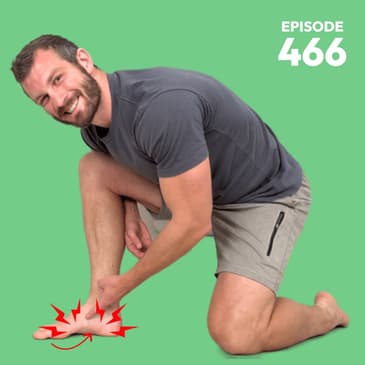
In this episode of the Optimal Body Podcast, Doc Jen and Doctor Dom explore foot pain and injury through Dom's personal experience with a Lisfranc ligament tear and two surgeries. Dom shares how a recent pickleball injury during a session triggered sharp midfoot pain, prompting him to self-assess and begin conservative treatment. They discuss potential diagnoses, footwear adjustments, and rehabilitation strategies including mobility work, strengthening exercises, and balance training. The episode highlights the value of physical therapy, direct access care, and structured programs like Gen Health's foot and ankle roadmap for achieving safe, effective long-term recovery after a pickleball injury.
Jen Health Annual Membership Discount:
Huge discount on Jen Health Annual Membership! Podcast listeners get over 50% off with code OPTIMAL10. Access 12 Therapy Plans and start your free trial now—move with us!
We Think You'll Love:
For full show notes and resources visit https://jen.health/podcast/466
What You'll Learn:
3:23 Doctor Dom begins to share his personal experience with his pickleball injury, a recurring foot injury, starting with his history of surgeries.
4:15 Dom details his high school Lisfranc ligament tear, the two surgeries he had, and the hardware placed in his foot.
5:59 Dom describes how a long session of pickleball likely triggered his recent foot pain, causing a sharp mid-arch pain.
7:23 Dom discusses ruling out plantar fasciitis and considering other potential diagnoses like a Lisfranc injury or arthritic flare-up.
9:46 Dom explains his reasoning for not immediately seeking a formal diagnosis, anticipating the likely conservative recommendations he would receive.
11:16 The speakers discuss how switching to more cushioned shoes for high-impact activities might have contributed to their recent foot issues.
13:34 Dom shares the first steps he took for relief, including toe spreading, manual mobilizations, and big toe mobility exercises.
16:06 Dom describes progressing his exercises to include short foot activations, isometric toe flexion, and single-leg stance work to normalize gait.
18:51 Dom explains why his rigid foot needs both mobility work and strengthening through its new ranges to prevent future injury.
20:45 A week after the injury, Dom details his current exercises, including heel raises, single-leg reaches, and what still causes pain.
24:52 The hosts advocate for seeing a physical therapist first for conservative treatment to potentially avoid costly and unnecessary medical procedures.
26:49 Dom outlines his plan to...
Hosted by Simplecast, an AdsWizz company. See pcm.adswizz.com for information about our collection and use of personal data for advertising.
[00:00:05] Welcome to the Optimal Body Podcast. I'm Dr. Jen and I'm Dr. Dom and we are doctors of physical therapy bringing you the body tips and physical therapy pearls of wisdom to help you begin to understand your body, relieve your pains and restrictions and answer your questions. Along with expert guests, our goal of the Optimal Body Podcast is really to help you discover what optimal means within your own body. Let's dive in.
[00:00:28] You know what I love? I love when people underestimate what we do on GenHealth. People assume it's just stretching, it's just mobility. No, we are getting you out of pain. If we're going to actually help you see long-term results, we need to challenge you. We don't get change without challenge. That is what I'm helping to provide Q, give you full video demonstrations so you are led literally by a physical therapist in GenHealth.
[00:00:55] And right now, we have almost 50% off the year. Because for people who just went through their Barefoot Mini Course, I want them to know that there is a community available where you can continue to follow a daily plan, not have to think, just press play, show up. Whether you're dealing with a specific body area, like the foot and ankle, like we just finished our Barefoot Mini Course, or you're dealing with your shoulder, your back, your neck, or you just want a full body plan
[00:01:24] that takes you through workouts, core exercises, and muscle activations, and gets your body finally feeling back to where you want to be. Lindsay said, Just so you know, I've been strength training for years, and I just started one of your plans. I thought the workouts were going to be so easy, I was concerned I would be bored. I had an injury that kept me down for four weeks. That's how I found your program.
[00:01:47] Anyways, I've completed one upper body and one lower body workout. Your Qing is awesome. And I realized that I've been doing every exercise I have even thought about doing incorrectly. Listening to and applying your Qing, I was sweating out of breath and sore, which honestly is how I like it.
[00:02:05] I've had major breakthroughs with you this week, and I'm so excited to keep learning. And that is a week into the course. There's so much to learn here. And we are not just focusing on one thing, but we're focusing on how your body moves as a whole and how you can reconnect so that you feel better long term.
[00:02:23] And not only that, but I host a monthly educational webinar based on a topic that you choose in the community so that we get to learn and continue to figure out our body together. Do not miss out on this opportunity. Not only are you going to get nearly 50% off just for signing up for the year, but you get a free week to just explore and come move.
[00:02:42] So if you have not yet take this as your opportunity, sign up on Gen Health. The link is located in the description, but just go to gen.health backslash free trial and come join us. So our last PT Pearl, we went into my story on back pain after doing deadlifts. Today, it's Dom's turn. It's going to sound like your physical therapists here are falling apart, but I promise we're not. We're just human. And we're talking about our own human experiences. I am kind of falling apart.
[00:03:12] No, don't say that. I'm in the orthopedic nightmare. Oh my goodness. This is exactly what I don't want you guys to say about yourselves. Please don't. I just say that about myself jokingly. Of course. So anyways, we're talking about his foot and there's a lot that's happened with this foot in the past. Please back off. So we want to talk about, you know, what happened, what he's feeling, what he's dealing with, potential diagnoses that he might have. These are all potentials.
[00:03:40] And then what he's doing. Is he doing things to do to help his foot or what should he be doing? We're going to talk about it. It's feeling better, but is it getting better just because of time or because I'm doing good things on it? And yes, it's only fair that we talk about an injury of mine after diving into yours a bit. I have had these high rigid arches and rigid feet developing my whole life.
[00:04:08] And I think that's a big product of, I was a sprint athlete, football, basketball, baseball, where I'm always on my toes. I'm always using that rigid rigidity of the foot. And I really didn't pay attention to it at all until I was in, you know, physical therapy school. And then meeting you, I probably focused it on a bit more. But in high school, I tore what's called my Liz Frank ligament in my foot.
[00:04:35] And that is essentially, to put it, you know, short, it's like one of the main ligaments that stabilizes the midfoot. Between your first and second toes. So when that tears, you lose a ton of stability in that mid arch, really right in the middle of the foot. So I had one surgery where they put screws in. That was non-weight bearing for 12 weeks or so.
[00:05:01] First time I tried to get back into doing any sort of football drills after I was cleared to do so. I felt screws pop out, essentially re-injuring the area. And then saw a different surgeon who put what's called a tightrope, a wire in my foot. To essentially act like a replacement for the ligament. To give my foot stability there. Which is so crazy because you have that high arch.
[00:05:28] I mean, just, and yes, you have your background with sports and everything, but just your structure as well. Like you, I think your structure, your genetics, you know, obviously plays a role. Yeah, I mean, if you look at my dad's feet, my mom's feet. Yeah, yeah. So, you know, it all plays a role in what your feet perform and function like today.
[00:05:50] Now, what happened recently that you think kind of was the initiator of feeling this pain? And I'm kind of blaming this on pickleball, but there wasn't really one instance where it was all of a sudden like, ooh, my foot, you know. But I play pickleball with my good friend. So, thanks a lot, dude. It hurt my foot. And we tend to like, we play singles. So, there's tons of lateral cutting.
[00:06:19] Tons of reliance on your foot to need to bend and shock absorb. And my feet don't do that super well. And we played seven games in a row, which is the longest kind of set of games we've played in a while. And then it was kind of the next day after that, waking up, getting out of bed. I just, I could not even roll through my foot in my normal gait without getting this kind of sharp pain right in the mid arch of the foot.
[00:06:47] More so on the bottom, but it just felt deep. And people who have had joint injuries before, they're, you know, that's kind of what they say. It just felt deep in the middle of the foot where one of the first things that comes to mind is plantar fasciitis. And I do some plantar fasciitis kind of tests on my foot and that really didn't elicit it. It was when I was really putting pressure through my foot that would require my arch to be rigid and propel myself.
[00:07:14] Or pronate and try and flatten my foot that would cause some strain on what is a more rigid arch for me. Also, plantar fasciitis is like very classical, like first step in the morning. That is the most aggravating, not necessarily what you're doing, stabilizing and how you're moving through the day. So that's also a good indicator that though it's at the bottom of the foot, like yours isn't just that fascia. Because you said it's deeper than that.
[00:07:41] So that's where, like what are some of the other injuries that potentially or diagnoses that potentially come to mind? Yeah. And I'm, again, my own mind trying to think through, of course, this is my foot. I had my surgery on. The injury was so long ago. You kind of asked like, does it feel similar to what you were feeling during your injury? And I'm like, it was so long ago. It's like hard. It's hard to even say. And since I had that wire put in my foot, I haven't had a ton of issues with this foot.
[00:08:09] But it is right in the same area where ruling out things like Morton's neuroma, plantar fasciitis, tissue-based injuries. I didn't feel like it. Could it be something like a peroneal tendinopathy where those two muscles are attaching right in the arch, your anterior and posterior peroneal muscles? Like maybe that could be something because those muscles control our arch.
[00:08:39] And did I overwork those? And those are muscles that kind of come from like the outside of your calf and then wrap underneath the foot. Yeah, there's one that wraps underneath the foot. There's one that attaches kind of into the top of the foot right in that midfoot area. So those are on the differential list for me, but a little bit lower. The thing that really stuck out for me is some sort of list rank injury or midfoot instability. Or even just like a midfoot arthritic type flare-up.
[00:09:10] Which again, I'm quote-unquote not old where like, oh, I shouldn't have arthritis. But traumatic foot injury and multiple surgeries. If you take an image of my foot, you're definitely going to see some bone and joint changes in there that the average person of my age might not have. So those are probably the two top things on my list. Anything else that I thought of or looked at, I was like, no, that's not showing classical symptoms of that.
[00:09:38] So it really narrowed down to, yep, my previous injury is probably related here in some regards. Now, something I'm sure people will wonder too is why not go and see a podiatrist or a doctor and get a formal diagnosis? I just have foot pain. Like, and again, doctors are the worst patients or physical therapists are the worst patients.
[00:10:05] And so I'd like to, if I ever am thinking about going in for an appointment, I like to try to think through what might happen. Oh, they'll do some tests on my foot. Oh, here's the... Also, I might not get an appointment for two or three weeks. And by the time I get to appointment time, symptoms could be significantly better. But they would look at the foot. They would do some tests. They'd be like, okay, great. Let's take an x-ray of it because x-ray is always first. They would maybe see some of the changes due to surgery.
[00:10:35] They'd see the hardware in my foot and be like, okay, here's what I'm thinking. Here are some exercises you should do. That is in my mind what that appointment might go like. They might recommend some changes to footwear. Especially, I mean, pickleball, I just recently started using different shoes that are a lot more supportive because I used to try and play in vivos, which my feet did okay with, honestly.
[00:11:00] But especially once we got to playing six, seven, eight, nine games, it would be a bit aggressive on my feet. And honestly, the new shoes feel significantly better. But are my feet still adjusting to those? I've only worn them three times maybe when we've played pickleball. So it's interesting the foot pain arises after we've gotten in more cushioned shoes for different experiences. Yeah, you too. Yeah, I had a little foot thing too.
[00:11:25] I mean, it felt a little bit more like instability, like you're saying. I had a little clicking and popping that would happen and that would be associated with pain. Which is interesting. But it did happen after. And we started getting more cushioned shoes when I wanted to start running and doing sprints again. And then when you just wanted to like have better comfort during pickleball. Yeah, running and sprints. So it's still not like our everyday lifting shoe, like our everyday lifting shoe and walking around is still vivos. We still wear vivos for all of that.
[00:11:55] But the sprints, the things that are super aggressive on how hard we're pounding through the feet, we're like, okay, maybe we'll try using something different. And yeah, I don't know, because there's a little more cushion. Is my foot needing to do a lot more work with that cushion? Which it's weird saying, is it doing more work? Because on the flip side, I'm pounding right into the hard pavement. Right, right. But maybe my foot is just more used to that and expecting that. I don't know. But yeah, so now I have this foot pain.
[00:12:24] And what do I do? I mean, you know, I would like get up off the couch or get up from working and I couldn't really walk through my normal gait without limping. And that is weird. And when you experience something like that, it really gives you compassion for a lot of other people. I mean, obviously we're on these social platforms and we get people commenting all the time on like, oh, I could never wear barefoot shoes. The foot pain that I have is so intense.
[00:12:51] And yeah, like when I'm in a situation where I can hardly walk through my gait without limping, there are things that enter my mind like, man, do I need to get an orthotic for a minute to give my arch a little more support to be able to walk normally? Which we've talked about orthotics for symptom relief. It's not a bad thing. Yeah. And so we went on a walk that day. I put on one of the pairs of slightly more cushioned shoes, felt a lot better getting through this walk.
[00:13:17] And towards the end of the day, my symptoms were definitely improving, you know, just outside of everything else. But some of the initial things that I started doing, again, knowing my foot, knowing where my restrictions are, I just wanted to give the foot more space. So I always wear toe socks and I kind of consider that a toe splay. Along with that, I was like, if I would sit down, I would just try and actively spread my toes, see what I felt.
[00:13:44] Even activating those intrinsic muscles to do toe spreads, I could feel where the isolated place was that I was getting pain. Yeah. I mean, that's deeper. I mean, think about like spreading your fingers apart. You have muscles deep into the hand that help to spread those fingers. And so same with our feet. We're not talking about like the external plantar fascia here. We're talking about those deeper foot muscles that are going to connect into the places that you're probably feeling that instability.
[00:14:11] Yeah, I started doing some manual just like foot mobilizations where I would grab kind of on the back of the foot and the forefoot where all of your metatarsal bones are and try to do just like some manual cross mobilization exercises. And again, with hardware in my foot, with a really rigid foot, it doesn't seem like I'm moving it a ton, but I could definitely feel it. And I could feel like I'm getting some motion there. Same with the big toe.
[00:14:39] I know I've got a lot of stiffness through the entire foot, so I would just do big toe mobilizations. And then just starting to do things like that. Toe yoga, like trying to lift just my big toe. Lifting my big toe definitely put pressure through the area, which was initially where I'm like, okay, is the plantar fascia involved? But then, again, the plantar fascia runs right over that area. So if I'm putting tension through the plantar fascia. Or the perineal.
[00:15:06] Or the perineals, you know, and just, yeah, the muscle involvement is probably putting more stress through that area. But things that were really, really uncomfortable in that first day, like I could not do a heel raise without pretty significant pain. Walking, like I said, if I were to try and step back to like lunge down to the ground, which I was doing so much because, you know, we've got two little kids.
[00:15:29] So I would lunge back to try and go down and I would have to go and put my other foot back to lunge down or just get into a squat. I had a great ankle mobility, so I always kind of come up on my toes to get into a squat. And that was not comfortable at all. I would kind of have to keep that foot flat and just squat down on my right leg. So, yeah, that was really day one what I was trying to do to get some relief, to help the area relax because something was for sure flared up in there.
[00:15:58] So what's the next progression? Like what have you progressed in the exercises? Are you doing the same things? Like what are you kind of focused on? And this is where I shamefully need to admit a little bit that I'm not the greatest patient because day two things are starting to feel a little bit better. Some of those aggravating movements were definitely still there. You know, getting down in the squat, doing a heel raise was still a bit tough. And again, being a PT, it's like, oh, I know what I need to do.
[00:16:27] I'm just going to kind of do them throughout the day when I'm sitting. So short foot exercises, which is the exercise where you essentially try to create the arch and you pull the ball of your foot towards your heel to activate the muscles through the arch and then relax it. And I would kind of do that and then relax it and try and push a little bit into that pronation.
[00:16:51] And both of those, you know, I'm feeling a little bit of discomfort, but it's feeling more comfortable kind of day two and day three going into that. Just pressing and squeezing down into my toes. Kind of like I mentioned, like lifting my big toe up was uncomfortable. Pressing down into toe flexion was also uncomfortable.
[00:17:09] So I started trying to do isometric, just toe flexion activation into the ground, doing more on like a single leg stance or getting more comfortable with the adjustments, the reactive balance that my foot needs to do to balance on a single leg. That was starting to feel relatively comfortable and getting a little bit more normalized in my gait pattern. Like some of the early adjustments I made was I'm just walking slower. I'm trying to take slightly slower steps.
[00:17:38] So I'm not needing to push off as hard each step. And so kind of progressing a little bit more into that, trying to take a little bit faster of a pace, normalizing the gait, avoiding limping as much as I can. I also just want to point out for you all, we do have a foot and ankle plan on Gen Health that he could have been following as well. That would give him a daily plan with all of these exercises included. Oh boy. Okay.
[00:18:06] But moving along, if you're going to think about progressing in your strength and being consistent, what are some of the things that you really are thinking? Okay. Because it sounds like strength and stability actually elicit symptoms. Yes. So how has that been going since the injury? Because it's been a week. We're about a week out. Yeah. So how have those been? Is it feeling any better? Is it feeling stronger, stable?
[00:18:36] And then do you feel like continuing to work into stability and strengthening work is going to be what's going to be helpful here, especially if that's what's eliciting your pain? Or do you feel like you need more relaxation and mobility around the area? What are you kind of feeling? I mean, I think it's a yes and answer because because of the nature of my foot, again, high arch rigid foot. You'd think, oh, that's strong. Not necessarily. It was super interesting.
[00:19:04] I did this event at the American Physical Therapy Association's CSM. It's their biggest conference. And I went and some friends of ours had a booth right next to us that you would test toe flexion. And I'm like, oh, I've probably got some pretty strong toe flexion. And it was not. It was not. I wasn't even hitting kind of like the normalized marks for my age and weight and that type of normalized statistics. So, again, it was a little bit humbling.
[00:19:34] But again, with my foot structure, my toes are so extension dominant. That means that my flexion is probably suffering a bit or not able to balance how extension dominant my toes are. And again, the rigid foot, yes, it's probably a very rigid lever. But that's probably part of the reason I tore my Liz Frank in the first place because it didn't have the mobility.
[00:19:57] So, when it was in a basketball game, when I put it under that extreme stress and the need to go into more pronation or the need to be a little more mobile, that's when my foot gave. So, because I have such a lack of mobility, that means I'm also not strong through those ranges. So, I think long term, I think coming back around to your question, long term, yes, I need to work still on the mobility of my foot, the mobility of my toes and my arch.
[00:20:26] And also then strengthening and supporting through that range. Because if I just work on the mobility, that means, okay, I've gained mobility, but my muscles still aren't used to supporting if I'm jumping and cutting during a pickleball game. Totally. So, what are the exercises? Like, what are you doing now? Do you feel like you can do heel raises again? Yes. So, just yesterday, especially since I knew we were going to do this podcast, I did a few more of the exercises that I should be doing. I should be doing consistently. So, what were those?
[00:20:55] Doing heel raises. And it was very interesting because we coach people to do heel raises, squeezing a ball in between their ankles. And when I would do heel raises without the ball, I could kind of cheat. Like, I still feel like I'm keeping my ankle in line, but I'm not really squeezing. You're not locking out that stability at the top. Yeah, I'm not locking out into the full stability at the top. And when I would do the ball squeeze and get all the way to the top, I would still, that's where I would feel the area in my foot. Like, oh, yep, it's still there.
[00:21:25] And doing the exercise correctly is putting the proper stress through my foot. So, getting into heel raises felt good. Starting doing heel raises with my toes elevated. So, rolling a little towel and putting a towel under the toes. Progressing that single leg balance stuff to where I'm now doing reaches. So, now I'm, again, forcing more reactive balance through the foot. And how does that feel? That felt okay. I really didn't feel a ton of stress.
[00:21:52] Again, it was really when, if I tried to reach too far to the point where I was going to lose my balance or something, and my foot really needed to work hard, that's where it was like, oh, it's still there. It's still talking to me. But, again, significantly calmed down from where it initially was. Progressing more into that active short foot and pronation.
[00:22:14] So, doing that in more of a standing loaded position where I'm really pressing into the pronation and then getting into the short foot. Duck walks, which are, those were really aggressive and I probably wasn't ready for those yet. That's when you're like down in a crouch and you're just trying to, I don't know how to explain it. Do you know how to explain duck walks? You're kind of walking each leg forward. So, you're really... In like a squatted position.
[00:22:38] So, you're like really low to the ground and then you're walking your feet through that like ankle range of motion, toe range of motion until you step forward. So, it's like, it's really aggressive mobility. Yeah, those were really aggressive. Before I did those, I was out doing, I was doing lunges because that was tough for me the first couple days where I would step back and I would be in that full, you know, toe extension position, putting a lot of pressure through the foot, the back foot.
[00:23:07] And those felt okay, which is why I tried duck walks and that probably wasn't great. We went out for a stroll with our kiddos and they were either in their truck or on their bike. And so, I grabbed my longboard. It was interesting because when I was longboarding, it's my stance foot that's on the longboard and it needs to do a lot of like reactive balance. So, it was almost like doing single leg balance on a somewhat unstable surface.
[00:23:31] And I could feel it in there, but I could feel my foot being more, you know, confident with that movement, which was great. And yeah, just last night, I was trying to think about what are the things that are still really eliciting symptoms. And the main thing, the most, the thing that still causes the most pain is if I step back and I stepped on a pillow. I think I was in one of our kids' rooms and I just like stepped the foot back and stepped onto a pillow. So, it's unstable. I'm putting my foot into a lot of toe extension.
[00:24:02] The, you know, foot itself is in more of a rigid lever position and putting a lot of pressure through the midfoot. That was really uncomfortable still. Our kids like to lay down all these pillows. Well, and we lay them down because... We lay them down so they don't kill themselves. We lay them down because they jump off the couch and land in the pillows. And so, getting up from the couch and just stepping on those pillows, some of those steps, my foot needs to do a lot more work to stabilize itself. And that was eliciting symptoms.
[00:24:31] So, yeah, I definitely still have some work to go. I would normally play pickleball either today or tomorrow with my friend. And I think I'm going to say I might need a few more days because next week I'm supposed to start up basketball. Here's where it comes back to PTs being awful patients because I'm just going to be like, great, I'm ready for a full pickup basketball game. But that's where doing the exercises, you're already starting to feel that progression. You're starting to feel that stability and that strength without as much pain.
[00:25:01] So, this is also where it's like, okay, we're not jumping as physical therapists because we know what to do, right? We're not jumping right to going to see the doctor. Okay, what conservative treatment can I do first on my own? And this is where I want to remind people as well, most states have direct access to physical therapy. So, if you want to avoid more cost potentially, even if your insurance is pretty good and it's coveted,
[00:25:29] there's a copay just to see your doctor and then a copay just to get your x-ray. And then, oh, do they recommend an MRI? And then you're going further down the road without getting the work that you need. Get referred to physical therapy. Right, months later. Where you may have just been able to go to them first. If there's an opportunity to at least see. And this is where insurance gets tough too because some people will still say,
[00:25:54] there's direct access in my state, but my insurance still requires me to go get that script for PT, which is so annoying. Which sometimes you'll be able to see the PT. They can do the assessment and they can write the recommendation. And if you've seen them, there are certain ways to work the system where you can get the assessment by the PT. Your insurance might allow that. And then they can communicate with your doctor and say, here's what I'm seeing. I think it would be great for me to see them.
[00:26:22] And then the doctor will forego and say, great, we don't need to do all the unnecessary imaging. Just go see PT. Exactly. Because if you can do conservative treatment prior, like that is, and you're starting to see the progression and it's starting to get better. Now, if Dom wasn't getting better, that's what I would recommend. I would recommend him go to see and get checked. Let's see if there's other imaging. Let's see if there's other diagnosis we need to be aware of, right? But he is getting better and it's only been a week.
[00:26:48] So I was even starting to explore just with like hops, like just doing little rebounding hops. Because again, that's like the process where your foot needs to do all the work it's meant to. It needs to land and get soft and supple and, you know, be that spring to when you hit the ground and then turn into its rigid lever and jump back off the ground. And those felt pretty okay.
[00:27:14] Okay. So over the next few days and weekend before basketball next week, my goal is to try a lot more progressive plyometric type stuff. Again, to just prepare that foot and say like, let's get back into this. We're going to do it progressively so that by the time we get to a full 40 minute basketball game. If you can. And this is where, you know, he's probably not going to listen to me.
[00:27:40] But if you can take breaks, maybe not play the whole game. We'll see. But this is again where it comes down to doing the work. And even for a physical therapist, we could see sometimes he's a little resistant to actually doing the proper exercises. So following a plan, you guys, is always going to be the easiest way. Now, of course, we recommend any new injury. Go get assessed. Go see PT. Go see what's going on.
[00:28:10] Right. Great to get an actual assessment and evaluation. And if you need a plan to follow, especially in the meantime, while you're waiting just to go see the physical therapist, we have so many plans on Gen Health. We have that foot ankle plan with all the things that you recommended. Multiple phases. Multiple phases. By phase three, we'll be getting into more. If only there were multiple phases and progression that I could follow.
[00:28:32] So this is again where I'm going to always shamelessly plug Gen Health because we have all of the things you need. I instruct you through it fully and it takes three to 15 minutes a day. It's not going to take much time. And we have roadmaps now where I could follow the foot and ankle roadmap, which again eventually gets into strength training so that you can translate all of that foot stuff into the strength training you need.
[00:28:57] And the high intensity work where you can then progress your foot into doing the jumping, which is kind of exactly what I outlined. And it would progress me over the course of almost a year to be doing that very effectively. So he gets to do that. Thanks so much for joining us. I hope you've learned a lot and you're going to take those tools and start to implement them into your life as well.
[00:29:22] And if you want to follow the foot and ankle plan or any of the 11 other plans that we have on Gen Health from body specific areas like that one or full body plans with workouts, be sure to use code optimal at checkout. You can start your first month for just $20. You get to explore any of the 12 plans that we have on the platform and start your first week for free. So don't forget to use code optimal at checkout.