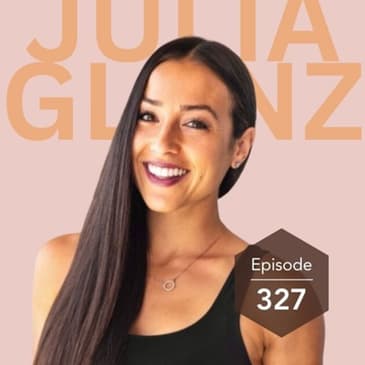
Feel like you’ve tried everything, from working out to eating healthy, and still have little to no results? Listen to the interview with Julia Glanz – registered dietician, strength and conditioning coach, speed and agility coach, and former D1 athlete for soccer – as she enlightens us on what might be the true cause and what it means to balance hormones. Tune in as Julia explains how stress levels can affect your weight loss progress as well as the power of dialling back. Lastly, Julia goes over how FAD diets affect hormonal balance, the importance of carbohydrate availability, protein recommendations, and how hormonal profiles fluctuate through premenopause and menopause. This podcast is full of juicy education. Get your pens and paper out because you will WANT to take notes!
EARLY BIRD: Mobility Foundations Challenge is out!
We’re using the month of November to dial back into our movement foundations with the Mobility Foundations Challenge. We’ll progressively advance you through all 4 stages of mobility to help you gain long-term results and kick-start a healthy movement journey. With a new intention every week, you will also gain access to weekly webinars with DocJen and the opportunity to win prizes! Use code “OPTIMAL” at check out to get an extra discount on top of the early bird! It’s only 3-8 mins a day, so join us here!
LMNT Discount Code:
Fuel every system within the body and the brain with LMNT! Keep yourself hydrated on a cellular level by replenishing the sodium, potassium, and magnesium that our body needs for basic cellular processes like nerve signalling, smooth muscle contractions, unnecessary fatigue, aches and pain, brain fog, and recovery! Get a free gift with every purchase and try some new flavours as you stay hydrated! Get Your Free Gift!
Waitlist for Julia’s New Course
The Hormone Balance Blueprint course is a research-backed plan that's already helped thousands of women lose the bloat, release stubborn fat, & feel more energized without going on a strict diet, calorie counting, or giving up their favourite foods! It's an easy-to-implement plan designed specifically for busy and stressed women. Join the waitlist here!
What You Will Learn In This Interview with Julia Glanz:
0:52 - What does hormonal health mean?
10:41 - What is the ideal goal when it comes to hormonal health?
14:48 - Hormone testing.
21:14 - FAD Diets, Fasting, and women’s health.
27:37 How do we know how much protein we need?
33:35 - The carbohydrate conversations.
40:30 - Is there a way to best support your health during your menstrual cycle?
47:10 - Following a strength program for females.
49:50 Key components of ageing health in females.
55:55 - Join the waitlist for Julia’s new course!
To learn more about Julia Glanz and view full show notes, please visit the full website here: here: https://www.docjenfit.com/podcast/episode327
Thank you so much for checking out this episode of The Optimal Body Podcast. If you haven’t done so already, please take a minute to subscribe and leave a quick rating and review of the show!
Hosted by Simplecast, an AdsWizz company. See pcm.adswizz.com for information about our collection and use of personal data for advertising.
[00:00:00] Welcome to the Optimal Body Podcast.
[00:00:08] I'm Doc Jen.
[00:00:09] And I'm Dr. Dom.
[00:00:10] And we are doctors of physical therapy, bringing you the body tips and physical therapy pearls
[00:00:13] of wisdom to help you begin to understand your body, relieve your pains and restrictions,
[00:00:18] and answer your questions.
[00:00:19] Along with expert guests, our goal of the Optimal Body Podcast is really to help you
[00:00:24] discover what optimal means within your own body.
[00:00:27] Let's needed in our body and be able to properly progress
[00:01:42] so that we have long-term results.
[00:01:45] So this is it.
[00:01:46] And if you get in this week, like a community moving and motivated to actually do our daily mobility together. I want to make this as attainable as possible. So this is the time in November where we're starting to think about what we're grateful for, especially in the States. It's when we have Thanksgiving and really give back to our body, nourish our body,
[00:03:01] especially as we step into a really stressful season of life.
[00:03:04] So please come join us in the mobility foundations course.
[00:04:05] her proven blueprint of nutrition and lifestyle strategies that has helped already change the lives of thousands of others to have more energy, get rid of the bloat, excess
[00:04:11] belly fat, improve muscle composition and really do it all while eating in a way that
[00:04:16] feels nourishing, supportive and sustainable.
[00:04:20] Her mission is to help you uncover any I love Love love talking all things hormone health. So I'm excited to be here Yeah, and I mean I think that's where we want to start in general just cuz I mean You know how the social media and online space is and everyone talks about hormone health and hormone
[00:05:43] dysregulation and I just don't even know if the average person out there grasps like
[00:06:46] who are experiencing hormone imbalances that are affecting their energy, their weight, their mood, their metabolism, and menstrual cycle.
[00:06:51] There are seven key hormones that greatly influence these things.
[00:06:56] So it's cortisol, your stress hormone, you said, they all interact differently and they all have like dozens of different actions and purposes in the body.
[00:09:27] spelt L M N T drink element.com backslash optimal with every purchase. You will get their sample pack that gives you all the different flavors. So you can try them out. And also, element
[00:09:32] now has a grapefruit as a flavor for forever. It has always just been a seasonal flavor
[00:09:39] that people just absolutely love. Grapefruit is one of my favorite personally. So if you
[00:09:43] want to try that out, check out that link of this and balance? Like does that look a certain way? Does that feel a certain way? Like what is the ideal goal? Because we're also going to change, especially as women as we go through life, whether we bunch of symptoms or presentations that your body, you know, will present with that are all overlapping with different hormones. could be perfectly fine. So I think discovering what it is for you in terms of what makes you feel the best.
[00:13:46] Like Jen, what makes you feel your best? testing with, right? Yes. But in some of the group programs or challenges that you've done, are there people that you don't necessarily do testing with? And you laid out a lot of options right there on how do I start doing this exploration process, maybe without going and doing formal testing to find some of those things that help me
[00:15:03] feel like you just threw me a lob exactly for my course and I don't even think you know what my course is. That was amazing. You're welcome. No, because that's exactly it. People always want to figure out what is wrong with me, what hormone is in valence. I know something's off, but hormone testing can be expensive.
[00:16:21] First of all, if you're doing the comprehensive hormone testing and not getting it covered
[00:16:26] by insurance and all of that. these are the people that I am working with. So we test, we assess, okay, what hormone is it? And then from there, that just gives us a little bit of insight to then peel back the layers even more of what caused that hormone imbalance. And what causes the hormone imbalances are usually very specific, nutrition and lifestyle factors.
[00:18:44] but very empowering things about that is that it takes time. And it's like, sometimes people think like,
[00:18:47] okay, I just wanna change one thing and start to feel better,
[00:18:51] but the process of taking a journal to maybe even identify
[00:18:55] one or two of those things that you wanna start changing,
[00:18:58] and then implement a change,
[00:19:00] and then take a couple of weeks of seeing how that impacts
[00:19:03] how you feel.
[00:19:04] It can be a multiple months process by the time you find and then I go back to sleep again. So I just don't have good qualities. Like you mentioned, and that's something that as much as I can control, I'm choosing to, you know, pump one last time or stay up a little later or do what I need to, for me mentally to feel like I'm supporting my child right now. So I know I'm not getting the best quality sleep.
[00:20:23] So it's like, where in those other areas can of the ones that I've changed my mind on the most. Because I think for me personally, as someone who was a high level athlete, I always wanted
[00:21:44] to do everything.
[00:21:47] If one thing was good, I wanted to do more of it. emotional or our job stressful or maybe we're in a place where we're not getting enough sleep or you know whatever it is adding on an additional stressor of fasting can't get enough sleep right now because I have a baby? And can I, you know, move my body in a way that feels good and energizing instead of depleting? Can I eat enough to make me feel energized and not constantly depleted?
[00:24:23] And again, like you said, even if it's not all of them. Have, you know, lunch is a big problem for like, or a big challenge, I should say, for a lot of my clients. And I like, how can you reduce the friction, you know, reduce the barrier between you and just eating lunch consistently? Because
[00:25:44] when you skip meals, your blood sugars and balance, people see me cooking and stuff often and they think like, oh, we're doing that for every meal. Like it's become, I wouldn't say fairly rare, but that I like spend a long time cooking for one meal. It's like, I prep most of our lunches and dinners
[00:27:02] most weeks and we have stuff that we just take out
[00:27:05] of the fridge, reheat, and there's our meal
[00:27:07] in five or 10 minutes. to find that by either looking at it or what I'm intaking that I know that I'm kind of getting enough protein. Because I remember you did a post where you were like, well, let's look at if you're having eggs in the morning, if you're just having two eggs, that's only six grams of peas, which is only 12 grams of protein. And I was like, oh no, Dom, I'm not going to eat my protein.
[00:28:23] So now Jen eats a chicken breast, a steak, three eggs. palm and thickness of your palm about one one and a half palm sizes. And for that every meal. And that's just a simple thing that you can do to support your muscle, to support your digestive enzymes, because we need amino acids to make enzymes, you can support your energy
[00:29:43] levels, having stable energy, stable blood sugar, maybe like five to 10 max protein sources, that's even probably more than you're actually eating.
[00:31:03] But if you do that for a week,
[00:31:04] you'll really start to be able to just eyeball like, let's learn how we can do that for ourselves. And that's why getting coaching can be helpful if it feels overwhelming. And if it doesn't feel overwhelming, just embracing the journey of staying curious on how you can best support your body. I think that's one of the more beneficial practices that people could do that really doesn't cost anything
[00:32:21] extra other than that little bit of time
[00:32:23] that it might take to measure things out,
[00:32:27] write it down or track it of this type of food. I might not be getting enough of X or Y. I might not be getting enough protein. I might not be getting enough vitamin D, vitamin C, whatever it is, you start to become a little more aware of that.
[00:33:42] And I think that's super valuable.
[00:33:44] So we covered protein, let me assess your diet. Like, what are the lowest. And I think whenever you're taking in any type of content
[00:36:23] information from, you know but also it's supportive for your gut, supportive for the nutrients, the micronutrients it has in them, which ultimately support your metabolism actually, and they support your energy, right? And so, and of course, support your workouts as well.
[00:37:40] Yeah.
[00:37:41] And I think that's my take on carbs.
[00:37:45] How much you need depends How are you feeling? Like all the things that are a lot more important than the size of, you know, how you're supposed to look according to offer. And moving away from can you have like aesthetic goals, body composition goals, 100 percent, right? But don't do it at the expense of your mental health, your energy, your libido, your anxiousness, your sleep.
[00:40:24] It's just not worth it. right but If you're not doing those things you're not drinking water. You're not strength training You know consistently you're not going on walks like moving throughout the body throughout the day and your body I guess but if you're not doing the foundational things
[00:41:40] First you don't need to worry about cycle sinking your exercise and nutrition right? It's like that comes after
[00:42:47] that's recommended in the first half of your cycle, right? And so honoring what your body needs
[00:42:55] is the most important. And so during the first half of the cycle when estrogen rises, yeah, it can
[00:44:23] decrease your appetite because it increases serotonin as well, which is like a natural appetite cycle in the second half of your cycle, that's when you get the, if you ovulate, you get the peak in progesterone. And maybe that affects your energy. Maybe that affects like your exercise capacity. And maybe that, you know, affects your motivation to, and scale it to how you're feeling on that given day. I love everything cycle-based that you just went through, but I think one of the most important things that you mentioned is you need to be doing the basics first.
[00:46:45] afford to eat slightly more plant-based, earth-based foods like that. I really appreciate that you said.
[00:46:48] Before we start focusing on sinking our workouts with our cycle, we need to focus on getting
[00:46:53] regular movement in throughout the course of the month, and then we can start to optimize
[00:46:57] based on what might best support or what workouts are best supported by where we're at in our
[00:47:04] cycle. I should say, but so is like, for example, if you train really hard consistently, how's your digestion? Are you constantly bloated? Are you constantly feeling inflamed? Are you having trouble sleeping? Do you constantly have cravings? Like, what would it look like if you scale that
[00:48:20] back, just focus on building strength and maybe low intensity cardio like zone two,
[00:49:24] it's going to work anymore. It's going to increase your stress hormone, increase your cravings, increase your hunger, decrease your sleep quality, increase your bloating. When
[00:49:29] you don't train appropriately with the right dose, frequency, duration, recovery, etc.,
[00:49:39] and when you're not fueled appropriately.
[00:49:41] I think that's so huge to continue to remember and you mentioned it as we age. So as we do bone health, and I think I said muscle, when we lose our estrogen, we need external factors to elicit the stimulus that estrogen supports our body with. For example, let's talk about bone and muscle health, right?
[00:51:01] As we age, that can naturally decline.
[00:51:04] It doesn't have to, but it can if we don't do anything. we're under eating, we're overdoing the hit, and we're just doing all these like quote-unquote biohacks all together that are actually just depleting us. We're gonna increase our stress hormone, which ultimately will redistribute any fat that we do have around our belly, and that's kind of what happens when you're stressed whether whatever age you're at. It we have high estrogen, sometimes we have low estrogen. And ultimately it's kind of like this up and down type of hormonal response. But what you can really focus on, again, going back to the foundations is building strength. Don't worry about sinking it with your cycle because your cycle is probably going to become
[00:53:41] irregular. the recovery needed to actually get stronger and to actually build muscle. So hopefully that wasn't too confusing because I feel like that was a lot. Well, I feel like the way that you packaged it in a concise amount of time made it fairly accessible to the average person. And Julie, there's so many things that still I would love to ask, but we don't like to
[00:55:03] have these podcasts run too long for people who are just listening in a car ride. and once enrollment opens, you will be notified as long as you're on the wait list. Other than that, I'm hanging out on Instagram and I am always open to answer any other questions you all have. I'm here to support as many women as possible, just feel their best. That starts with supporting our hormones, but like I said, a million times in this
[00:56:22] episode here, it also starts with the foundation. So if anyone has any questions,