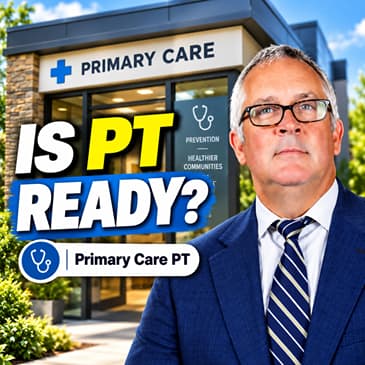
Hello, everybody. I am Nick Rainey. I am on the research team for AAM's podcast, Hands On Hands Off. I'm here with Chris Bise today. He is a researcher at the University of Pittsburgh, and I quite enjoy working with him on basically how do you think about our profession and where do they think we can go with?
And so for this- We're gonna be talking about primary care and what can, what are the, all the roles that physical therapists have with primary care in physical therapy based on a, a recent article that he wrote. It's called A Profession Knocking at the Front Door: Primary Care Physical Therapy and the Hard Part that Comes Next.
So we're gonna be hitting a little bit of primary care physical therapy, but then really what are the hard part that comes next, and what are roles that we can have with that? Welcome, Chris. Is there anything you'd like to add to how I started us off? No, I'd just like to thank you for having me. Uh, I appreciate the, the time spent on this.
It's clearly something that I'm really passionate about, um, especially trying to push the profession forward, um, and continue to evolve. Um, it's something that's near and dear to my heart, um, and I just appreciate the time Well, thank you. I know in our other conversations I've appreciated your insight, so I'm, I'm definitely looking forward to this, to learning some of your answers on these Uh, let's start off talking a little bit, so it isn't a long article, the one that you had in PTJ a few months back.
Uh, so I encourage people to read that. We're not just trying to give a summary of that article. We wanna dive deeper into some of the, some of the topics that I thought would be interesting to do so with. Uh, the first area that I wanted to look at was how do we compare to what other countries are doing?
That gives us some context. So for instance, in other healthcare delivery systems in the world, some physical therapists are just basically, are triage or first contact physical therapists, and some, uh, focus on treating. Uh, and we don't... We can do both of those things here in the United States, but we don't have that, that, that discrepancy or that divide.
How do you see primary care physical therapy relate to what we currently do as physical therapists in the United States?
Um, uh, right now it's sort of an evolution, um, that's going on, and we can use whatever sort of trite euphemism that we want. Um, we're at an inflection point, we're at a crossroads, but really that article was a very short, somewhat call to action in an editorial, um, that came after, um, a group had done a whole lot of heavy lifting around what primary care physical therapy really was Um, and Katie O'Bray, um, and her colleagues, um, have spent years, um, certainly the last three to five years trying to create a definition of primary care physical therapy.
Um, most, most of the colleagues that, or most of the support for that has been from the federal section. Um, and many of those who have, uh, contributed to that article practiced in the military, um, which has somewhat of a different practice pattern, um, but is truly the ultimate point of contact when we talk about musculoskeletal injuries.
Um, and we think about primary care physical therapy, who is best suited to be at that first point of contact? Um, and that's where some of my research has gone as well. But we were lacking a definition of what it really was, and Katie and colleagues, um, actually came up with that definition, um, using a Delphi process and surveys and qualitative research, and even some quantitative research as well to support it, um, and gave us a starting point, um, for what we would potentially need, um, for practice.
Um, I think you mentioned a little bit about what other countries potentially do as well. Yes. Um, there are other countries, and there are examples where primary care or first contact physiotherapy or, um, uh, specialty care, um, uh, as some would call it, um, occurs in both, um, the UK and the NHS, um, and in Australia and New Zealand as well, where they have first contact rights, um, especially some of the care that's come out of, or some of the research that's come out of the emergency department.
And when it comes to musculoskeletal injuries, there are few, if any, adverse events, um, that occur when a physical therapist sees a patient first and then, um, either begins to treat that patient or moves them onto the appropriate resource. And that, I think, is sort of the crux of first contact physiotherapy or primary care physical therapy.
It's recognizing what we can treat and intervene on, recognizing what we need to co-manage, um, and then recognizing what shouldn't be in our clinic and needs to be referred out
Can you expand a little bit on... So I know of other discussions I've heard of this, is that primary care physical therapy is not just first contact physical therapy, although I think there's a primary role with that. Is there-- What is the role for primary care physical therapists in treating as well here in the United States?
Uh, I think what you're getting at is it's more of a management role, and it's more of a who is best suited to manage a musculoskeletal disorder. And if you think about OA, uh, OA is a multifactorial, um, disorder. There are things that we can treat, there are interventions that we can apply, but there are some things that we can't do.
There are times that a patient's going to potentially need, um, medication for that, and they'll need a primary care physician to potentially, um, prescribe that medication. There are times that a surgical referral might actually end up being appropriate, so a referral to an orthopedic surgeon is gonna be appropriate.
And then there's going to be times where there's other disorders that are co-occurring with that osteoarthritis, and they'll need to be managed in concert with the physical therapist or the interventions that we're applying. And I think when we think about primary care or first contact physical therapy, primary care is more of the management of a condition over time, and we are still best suited in that situation to manage the condition.
But we need to be part of the primary care team. So it may be the physical therapist managing that condition, but we're working as part of a primary care team, which honestly should probably involve a primary care physician, um, and behavioral health as well So let, let's build on that a little bit more 'cause I- we talk about primary care phys- primary care physical therapists, we have primary care physicians and behavioral health.
What do you see as an ideal model for us to be able to work with them? And there may be multiple ideal models, so any thoughts you have, well, let's unpack. Um, a- an ideal model's gonna be a team-based model, and it can't just be a physical therapist just co-located in a place. Um, in fact, behavioral health, um, had a model, um, and has integrated itself into, um, essentially primary care.
Um, so it's, it's collabora- it's something called the collaborative care model. Um, and we would be well-served to take a look at that model as a profession and how, um, behavioral health be- uh, began to get recognized for their time. Um, they actually got, um, new codes, um, approved by, um, CMS, um, that were then, um, temporary codes that have become full-time codes at this point, um, and are now recognized as managers of behavioral health in the primary care setting and providing primary behavioral care, behavioral health care.
I think physical therapy could do the same thing because right now physical therapy has no way potentially of billing for the cognitive burden of what we're doing in the assessment and the management of patients on an ongoing basis. Right now we have an evaluation code, but there's no ongoing assessment code, there's no ongoing management code, and I think that's one of the things, um, from a strategy standpoint, we're gonna need to consider as we begin to move forward, um, both with the current definition of primary care and actually being integrated into that position.
And that's the work that I was referring to, um, with the article itself. We've done a great job of coming up with a consensus definition, but what do we do with it now? How do we begin to move forward at this point? Sounds like you're saying that insurance, you know, we're talking about codes, we're talking about third-party payers.
They treat us as, as what we do is we treat, not as managing conditions. And without codes that reflect that, it's gonna be hard to get our profession to, to get there. I com- You got it. You hit the nail right on the head. And I think some of this is because Medicare, um, and CMS considers physical therapy a benefit rather than a service.
Um, there is a service that we are providing with the cognitive load, um, and the decision-making and the critical thinking that we use as physical therapists that is not necessarily a benefit, but it's actually something that we're providing to the patient at that point Uh, let's talk about setting a little bit.
Okay. Does, to be able to utilize... So if we're able to expand our codes to reflect the management process, similar to how behavioral health, uh, professionals did, could we stay in our private practices? Do we have to be embedded with phys- with primary care physicians? What are, what are your thoughts there?
What did behavioral health do? I think a good bit of that remains to be seen. Um, behavioral health, um, actually became, um, integrated into, um, the primary care, um, arena. Um, I think that would be a way for us to really potentially move forward as well. But again, it's where is the team in what we're doing?
And I think some of this goes back to point of contact physical therapy as well, right? So there are different practice environments, the emergency department for one. Um, post-acute care situations, um, are another, because there's a whole host of places that patients can go from a post-acute standpoint.
Um, but who better to be the post-acute manager for musculoskeletal disorders than a physical therapist? And it's ironic that w- we're having this conversation today. Yesterday, um, the, uh, results from the, uh, first CJR, um, came out, um, looking at, um, joint replacements in the post-acute space. Um, and they found that there were some gaps in care, um, with the post-acute space and patients, um, wanting additional, not care, but additional management of their case.
Well, who better to manage that than the physical therapist? And the reductions in, um, spending, uh, that they actually found in the analysis, um, didn't redu- uh, didn't result in any inferior outcomes. In fact, in some cases, the outcomes were better, um, than they were befo- with the group that they were comparing it to That's great.
I'm gonna expound a little bit. CJR is a CMMI model. Correct. And for those of you who don't know, it's a Center for Medicaid and Medic- Medicare and Medicaid Innovation Center. Sometimes people just call it CMS Innovation Center. And they look at alternative payment models, how do we do this differently to get better results?
I know in conversations I've had with them, they're bullish on what physical therapists can do, but they haven't figured out how to make it so we can work better together with the primary care physicians. Um, specifically how do we play as a team? And partly we haven't figured out very well as a profession how do we play as a team.
And if we can do that better, then hopefully we can be involved in the management of this more. Do you have anything you'd like to add on that? Yeah, no, I, I think you're, you're spot on with that one. Um- I think one of the things that, that we really need to consider as we begin to move forward is how we're going to move forward in that.
Um, we talked about the behavioral health journey, um, but what can we do? Um, we can push for new codes, um, which is sort of the behavioral m- health model, and this is an area that we're already participating, right? Um, I talked earlier about providing, finding a path to code revision. The APTA is already engaged in the ROC and the CPT editorial panel, and the precedent is set by behavioral health for us.
But we also need to consider one of the things that behavioral health have that was helping it as well is a test model. Um, they had, um, a, an article that had come out that had shown and proven, um, their model, um, for collaborative care management or CoCM. Yeah, that's how you'll probably see it, um, abbreviated.
Uh, what we need as physical therapy is we need to begin to, uh, develop that research as well. Um, we need to begin to create a space where, okay, we're gonna manage this, um, uh, acute care, um, uh, population or post-acute care population, but we need to measure our outcomes as well. We need to show that there's value in that, um, because if we can show the same thing that behavioral health showed, that not only do outcomes, uh, get better, um, and our patients, patients are treating better, treated better, but there's a cost savings as well.
And that's really where the rubber kinda hits the road, um, especially when we're talking about, um, different models, uh, that we could potentially participate in. Let's, I, I think outcomes are crucial here, as you noted. Let's, uh, let's go over a little bit more, what do outcomes look like? Everybody in school learned about, you know, patient-reported outcomes, Oswestry, QuickDASH, those types of things.
A lot of people are using, um, registries where they can submit to MIPS. Is that the type of outcomes you're looking at? Or you l- think that we should be measuring different types of outcomes instead of or as well? Uh, I'd, I'd like us all to pick an outcome and stick with it, to be completely honest with you, because we can't truly compare things if we're measure- if we're not measuring the same things.
You can't evaluate what you're not measuring, and you can't evaluate things that you're not measuring consistently either. So it's creating an environment where, or a profession that begins to value outcomes. Um, and I think we see the administrative burden that's associated with collecting those outcomes.
So picking those outcomes that are easy, um, that can give us the type of information that we need to prove our case is gonna be critical. Um, I also th- think we probably need to come together at some point with a, a task force, um, and pick a couple of outcomes. Um, this has been stopped in the past. Um, there was the whole registry project.
Um, I'm not sure if you remember that. Um, it was burdensome- Yeah ... it was hard, it was tiring. Um, but the information that was potentially coming out of it would have allowed us to show some of the value in physical therapy. Um, I think we stopped that early, but I think some of that was technol- technology.
Um, now I think technology has taken leaps and bounds forward, um, and setting up a system where we can collect sequential data on patients could be much easier. And we talk about databases or different databases or different measurement systems. Um, if we can pick an outcome, I think AI can probably help us merge and manage the databases a whole lot better.
In addition to that, AI is gonna help us analyze, um, the data a whole lot better and a whole lot quicker. Um, I, I don't think the analysis project or process is fast by any stretch of the imagination, but AI could make it less slow, I guess, the best way to talk about that.
Let's, uh, let's go back to setting a little bit. You know, it's... We c- we have private practices, we have federally qualified health centers, we have hospital systems, we have large, uh, physical therapy practices that are private equity owned. Uh, what, how do you see the challenges of all the different types of settings that we're in relating to measuring outcomes and being able to show our value in integrating, uh, as primary care physical therapists?
I think it has to become part of your culture. I think that's, that's the biggest thing. Um, it's certainly gonna be a top-down, um, but there has to be a value to senior leadership to collecting these, and that value has to come from the senior leadership down to, um, the individual staff members. If senior leadership isn't gonna value it, um, and they come at it from a t- a, a case of, "Oh, we have to do this," or that's where we're really gonna struggle.
But I'll tell you, insurers wanna see, um, that type of information, um, to show your value as well. I think that's one of the things that's converging, um, as well, is insurers want predictability. Um, they want predictability on spend, they want predictability on episode length, they want predictability on, uh, management costs.
And again, we have some of that data, but we don't have all of it. And this is again, that whole, how do we create a CMMI test case to get the actuarial certification that we would potentially need to allow, um, or allow HHS to expand a model that we could champion or we could lead at that point?
I absolutely agree with that. We can get... That, if I've spoken to CMMI, we've discussed, you know, they're bullish on physical therapists. How do they incorporate us? How do we get a test case to be able to show, um, to show the, our value here? Yeah, and I think actually we have some of that information, and I just talked about CJR that came out.
Um, but think about, uh, CJRX and the team models which are coming live as well. These are musculoskeletal models that are outcomes-based as well. CMS is doing the work for us. Um, now we just need to test and evaluate our... We need to take that information because they're testing and evaluating models that PT already manages The quick analogy would be essentially the Medicare diabetes program, um, because CNMI used that mechanism to move essentially a non-physician service forward at that point.
Using the data that they have and then m- running a pilot on our own, similar to behavioral health, we could get that actuarial certification, um, and move forward with cost, uh, the cost, um, to kind of close the deal. Yeah. I... There's absolutely gonna be physical therapists listening to this podcast that are treating patients in one of these models and don't even realize it.
Yeah. You know, they just got sent to them, and they're in a big system, and they don't realize that they're part of the model, they're part of the data that's coming out that you've talked about. Well, I think the other part too is, um, I think private practitioners go, see there's this huge Medicare model out there, how do I get involved?
And I think some of it is finding people who are running those types of models or participating those, those types of models, a hospital, and then going and showing your value and how you could potentially participate in that model. Because they're on the hook from a risk standpoint. Um, they could potentially lose money, um, with poor post-acute management.
And again, we're part of that post-acute space where we can aggressively management a musculoskeletal, manage, aggressively manage a musculoskeletal disorder after a patient is discharged from care. Absolutely. I actually emailed our, I texted our hospital, local hospital's provider liaison and said, "Hey, CGRx is coming January 1st, 2028.
You know, could we talk about how we could help the hospital on savings and ha- sharing some of those savings?" Yeah. So that's- And that's how you sell it ... yeah. Um, the other thing is to approach ACOs as well. Um, I think there's some funding issues with the access model, but um, I think people see access as a threat instead of an opportunity.
Um, and it is the first digitally based, outcomes based musculoskeletal management strategy. And we've been approved not only for payment in that model, but for management in that model as well. And that's the key. I think if we can show, um, value in the management of that model, um, there's a way for us to move forward, but that is not a fee for service payment anymore, and I think that scares people a lot.
Um- Uh, you hear all the analogies, um, about what we've been doing with fee-for-service for the year, for over the years, um, that we've been at the trough for too long, um, that there needs to be a change. But there is going to be a change. Fee-for-service isn't going to last forever, and I think we need to be a little bit more nimble as physical therapists, um, and be ready to change our practices or our practice environments, um, to, from the linear fee-for-service model that we have to something more asymmetric that allows us to manage both patients individually and potentially an entire population of patients that could be inside of an ACO.
Yeah. For those listeners who don't know, access model is another CMMI model, and it's, there, it's got similarities to RTM. There's a technology component to it, whereas RTM is a fee-for-service model. Access is looking at value-based, how do we manage it and keep costs down, and then reward those who are doing it.
And physical therapists have a role. We can manage... We can't be the director of a model for an ACO in it, but we, we do have a management role there. Right. And again, that's being part of the team. It's being one of the team members, and there are demonstration experiments out there. There are a couple of, um, larger providers who are working with ACOs who have shown the ACO, "This is the value that we bring to this," and they've entered into not only upside risk, but also the downside risk that's associated with it.
And that came from a relationship where the ACO said, "We need this service." They provided this service and said, "We'll take some of the upside risk." And the ACO came back after seeing the, their performance and said, "How would you like to take some of this downside risk as well?" And their performance got even better.
Yeah. I absolutely... If we can be involved in upside and downside risk as a profession, uh, I think that relates back to where you were saying the senior leadership needs to value it so it comes down, and I can't help but think behavior. You know, what do we value? We value where the incentives are. Mm-hmm.
That's where behavior changes, and if we have incentive to have upside and downside risk, it's where we can make that, that jump that you're talking about. Right. And that's, that's the access model too. There's both upside and downside risk for us. We're, we're assuming some of that as well because if a patient is, a patient leaves the access model and ends up in the fee for ser- ends up billing fee for service again, you get dinged.
And it's managing that patient effectively through the model or over time that's going to show, um, a profit for physical therapists
Let's talk a little bit about skills for physical therapists here. Mm-hmm. Um, we talk about that we're good at it. There's data out there showing that, but there's limitations to the data, um, at least some of it. And how experienced does a physical therapist need to be to be a primary care physical therapist, uh, compared to a new grad?
Well, I, I think, um, Dr. Albright and colleagues laid that out pretty well, um, in the, the consensus definition. And I think a new grad coming out right now, um- I think they're close, um, if I'm being honest, and again, I'm an educator as well. Um, I think they're close. Um, but I think they probably need, um, some sort of residency model, um, to potentially get up to speed to practice in that environment.
Um, and at the risk of, um, offending some of my primary care colleagues, I'm not sure we have the infrastructure for that right now, and I touched on that, um, in the article as well, and I think that's part of the call to action, is as a profession, um, we need to begin to build that workforce. Um, I was just recently out-- Oh, you were there, too.
I forgot about that. Um, at the Payment and Policy Forum, um, and there, someone from the stage, um, asked a question, "How many people in the crowd think that, um, the graduates that are coming out of school right now, um, are ready to practice in a primary care environment?" And I saw a good number of hands go up, but it wasn't unanimous.
Um, and I think they're right. Um, I, I think there are things that need to change on the educational front to educate our students to potentially practice in those types of environments. It's different than just, "Okay, I'm gonna do a red flag screen here," or, "I'm gonna do a yellow flag screen here and make sure this patient is appropriate for my clinic."
It's recognizing, um, what actually comes from a systems screen, um, and what we can treat and what we can't I think the risk and the higher risk in primary care physical therapy, especially as a first contact physical therapist, is that there may be too much referring out that, you know, could be managed, and then there's also missing what should be referred out.
And that's some of that experience and some of more specific training, particularly mentor training. They can get it in school, but if they don't see it in a clinical situation, it's hard to apply. Yeah, and I think you see some of that, um, with the, um, advanced provider certification that the NHS is using.
So that's the National Health System in the UK. Mm-hmm. Um, and they get advanced training in that as well. But I think also what you've seen with that advanced provider training is there's... They don't miss much. Um, and it's not that there's an over-referral, um, and they're certainly not under-referral, um, because there's tens of thousands of events that are recorded with no adverse events.
Um, now, there may be a little bit of over-referral at that point, but think about your Ottawa knee or your Ottawa ankle rules. The last thing we wanna do is miss something, so I'd rather over-refer a little bit, um- Right ... and continue to manage at that point. I think one of the things, that was a perfect point that you made as well.
One of the things is, again, mentored practice and, uh, an AAOMP fellowship, 'cause I know I'm playing to that crowd right now. Um, but an AAOMP fellowship is a perfect place to begin to learn those type of skills
Any insight from your perspective, I know you're in a big health system up in, you know, at Pittsburgh. How ready are new grad physical therapists to step into that role immediately compared to, um, to managing musculoskeletal conditions as a primary care clinician compared to primary care physicians, PAs or NPs that step out of that right after...
Well, for physicians it's residency and for NPs and PAs it's schooling
I think there's a little- If you have an insight there ... yeah, I think there's a little bit of a safety net there for NPs and PAs a little bit more, um, because you're talking about independent practice. Um, and though they're, um, NPs and PAs and maybe functioning on their own, they're not practicing independently.
They're practicing under the purview of, of a physician. I think the difference between that practice and our practice is we have the musculoskeletal training that m- they may not have to manage a musculoskeletal disorder and the, instead of
Letting the physician manage it somewhat afar through an extender. Does that make sense? Yeah. That may go back to some of the setup of the practice, how much is the physician looking, you know, at, at those decisions. You know, do they... Are they waiting for questions? Are they actively examining? And probably also state practice acts.
I know locally we have some primary care NPs that have no physician oversight. They're standalone practices. Right. So it- And, uh, how much musculoskeletal experience do they have or training do they have? Not much, right? I mean, I've h- I... We have family medicine residents that come through our clinic, and one of them, his wife was an NP student at the same time, so he was comparing their, each of their training.
So I know our musculoskeletal knowledge compared to primary care physicians that are coming out, you know, through their residency, and then he could also compare it to nurse prac, uh- Right ... students. And the difference is we're talking about hundreds of hours for a physical therapist, as opposed to- Right
tens of hours for NPs, and even physicians at that point. Right. And with musculoskeletal conditions being essentially the most com- one of the most common reasons patients seek care, um, and in some cases, so one of the most costly areas that Medicare is paying for, um, I think, uh, I'm gonna... I hope I cite this correctly.
Um, it, it's somewhere north of 245 billion a year for musculoskeletal disorders. I think that's the last figure I saw. Yeah. Well, and the problem is that we can't see pain, so we treat it like other things we can see. And so it just keeps going and going. Right. But the bulk of those patients end up in primary care, who, again, we just talked about some of the limitations there, but they're, they have other visits.
They've got shrinking visit times, declining reimbursement, declining workforce. Like, the structural incentives right now still reward low-cost imaging and low-value healthcare inter- healthcare interventions This is one of the things or one of the ways that we can bend the needle as physical therapists.
And I think what's going to end up needing to happen is we're gonna have to have some sort of primary care trial, um, that's out there. Um, does it need to be a multi-site trial? That's gonna have more power to it, but again, like I said before with CJR and CJRX coming through, and TEAM, and AHEAD, um, and even some of the equip models, so even some of the state total cost of care models that are coming through, we need to be involved in those and engage with those providers because we can help bend the needle on total cost of care.
And when you say involved, I think understanding our involvement as well. I mean, there's physical therapists in those states. Maryland I know is the one that's been doing the most of it, my, my memory serves correctly. How much do they understand their role in those equip models versus are they just billing fee for service and not understanding the, the broader ecosystem around them?
Right. And we keep talking about these models that come from CMS, but they'll be pertinent to commercial providers as well because as CMS goes, commercial providers usually kind of follow suit. Yeah. Let's, uh, in the, in your article you talk about now is an important time, and, and I agree. One of the lines you put says, "Physical therapy has a long history of claiming a vision that outpaces our infrastructure," which we've hit on infrastructure a little bit.
And then you also put, "Primary care physical therapy is not an exception. Are we prepared to deliver what we are proposing?" Expand on why now and the infrastructure that needs to, needs to change, that we need to act- actively do something about so we can achieve the vision that we think we can provide for the United States.
Yeah. I, I think the now is, um, the existing physician shortage, and we're, we're gonna have a wor- a workforce problem, um, from a primary care standpoint. I think I saw something just the other day in one of the medical things that comes across my desk every day. A, a third of primary care physicians are heading towards retirement, um, in the short term.
Uh, how are we going to provide care for an aging population at that point? There's gonna have to be some sort of change in the way that we manage those patients as well. And think about the patients that are medically stable but are experiencing painful conditions like back pain or osteoarthritis.
We're best suited to manage those patients. Are they gonna be in our clinic three days a week for four to six weeks? Probably not, but do they need to check in with us and, um, potentially get a tune-up every once in a while? Um, I need a couple of visits here. Um, can we monitor that patient over time? And again, it's that management of that patient, and I think now is the time because I think the current reimbursement structure as well, people are pushing back against that.
We continue to be undervalued, um, a- as physical therapists, or our value continues... We talk about reimbursement. It's not reimbursement, it's payment. We need to get paid as a physical therapist. We don't need to be reimbursed. We're providing something. We're providing a service to this patient. It's not a benefit.
It's a service to this patient, and the billing structure as it is now isn't representative of what we actually do as physical therapists. And I think there's so much talk around healthcare and healthcare reform. If we can provide a solution, and an easy solution, and a cost-effective solution, which I know we already are, we're doing two or, two of the three of those, I think we can be that solution.
Um, otherwise, we will continue to just be a benefit that people receive instead of a service that they end up seeking
Some of that goes back to the infrastructure we were talking about earlier, right? We have to have the codes to incentivize us to do that. Mm-hmm. We have to have the structure's ability to do that so we don't have to jump through three hoops to be able to have that one management visit, you know, every six months or whatever.
And we have to have the workforce trained to get into that sp- uh, i- into that space as well. So you touched on it earlier. Uh, are our physical therapists coming out of school prepared to do this? Not sure they are right now. Um, but they, the universities are restrained by CAPTE requirements and what CAPTE wants us to teach and what CAPTE's view of contemporary practice is.
I'm not sure CAPTE's nimble enough right now, um, to kind of catch this, and the schools, um, that see these practice changes coming are gonna wanna be the ones that are ahead of the curve. And again, their grads are gonna be the ones that are sought after, um, from a supply and demand standpoint. Yeah. CAPTE makes sure that people are...
That students come out able to do the job, or the goal is to do the job that is currently being done, and we're trying to get jobs that aren't currently being done- Right ... to get us, us there. Right. So if, if I'm listening to this... No, go on. No, I was just gonna say, what if we could get CAPTE to have a little bit of vision five or 10 years down the road and see, oh, this is the healthcare landscape, this is what the healthcare landscape is going to potentially need to be.
How do we begin to get our educational system aligned with what the healthcare workforce is going to need? So if I'm a physical therapist and I'm listening to this podcast, and I think this is awesome, I wanna help take us there, what would you say that the physical therapists listening to this need to do this week or this month to start taking us to where we can so we're opening that door that we're knocking on?
Um, go read the definition. Uh, I'd say go read the full, um, article, um, that, uh, Oberte and colleagues have put out there. Um, uh, there's a pretty... There's an excellent, excellent framework, um, for us to begin to practice. Um, engage with that group. Um, there needs to be another iteration of that. It's going to evolve just like any other, um, consensus definition or even a clinical practice guideline.
Um, I think we're probably going to need some sort of guideline on what primary care practice is going to look like. Um, the other thing that I think that, that you can do next week, continue to advocate, and I think one of the strategies as well, um, from a, a workforce and a physical therapy standpoint, um, for a path forward, is also somewhat, uh, amending the definition of a physical therapist.
And if you look at, uh, the State of Utah right now, Utah's already started this revolution, and they're getting evidence as to what physical therapists look like in primary care practice. They've been recognized as a primary care provider for musculoskeletal physician, or musculoskeletal physician, musculoskeletal, um, disorders.
Um, this state-by-state strategy actually mirrors what optometry did when they became recognized as primary care providers of eye care. So again, they have that scope of practice for eye care. Why shouldn't we have it for musculoskeletal care? But they did it on a state-by-state basis and then created a federal strategy behind it as they proved it out on that state-by-state basis.
Um, states with that shortage of physicians, um- Begin to become that rural health provider. Um, there's evidence from, from models that are out there, again, that a physical therapist practicing in that condition, they may come to you as someone with a musculoskeletal disorder, but they're actually suffering from something else.
Find that primary care physician that you can begin to collaborate with and become part of that primary care team. You don't have to be embedded to be part of that team, but you should be collaborating with someone as well. And finally, look at what your state's doing. Maryland, Connecticut, Hawaii, Rhode Island, New York, those are the ahead states.
Those are, those are the total cost of care models. Um, find out what's going on at the, the Medicare/Medicaid level from a state standpoint and begin to engage there. I think there's, there's something you can do. Um, and finally, find your advocacy. Um, support the APTA, uh, from a standpoint of they're looking at payment reform.
They're trying to lobby and get some sort of legislative change moving forward. Um, and they can't do that without your support, either financial or as a volunteer. Um, I volunteer for that committee, um, and it's probably one of the more rewarding things that I actually do Chris, I very much appreciate your historical perspective and your perspective relative to other nations and also other providers here in the United States to give us a start of a playbook where we need to go from here.
Thank you for coming on today. Hey, thanks for having me, Nick. I appreciate it
Thanks for listening to Hands On, Hands Off, the official podcast of AAOMT. Subscribe now so you never miss an episode and connect with us at aaomt.org or at AAOMT on social. Opinions are those of the guests and not official AAOMT policy. See you next time